Материал: Snote
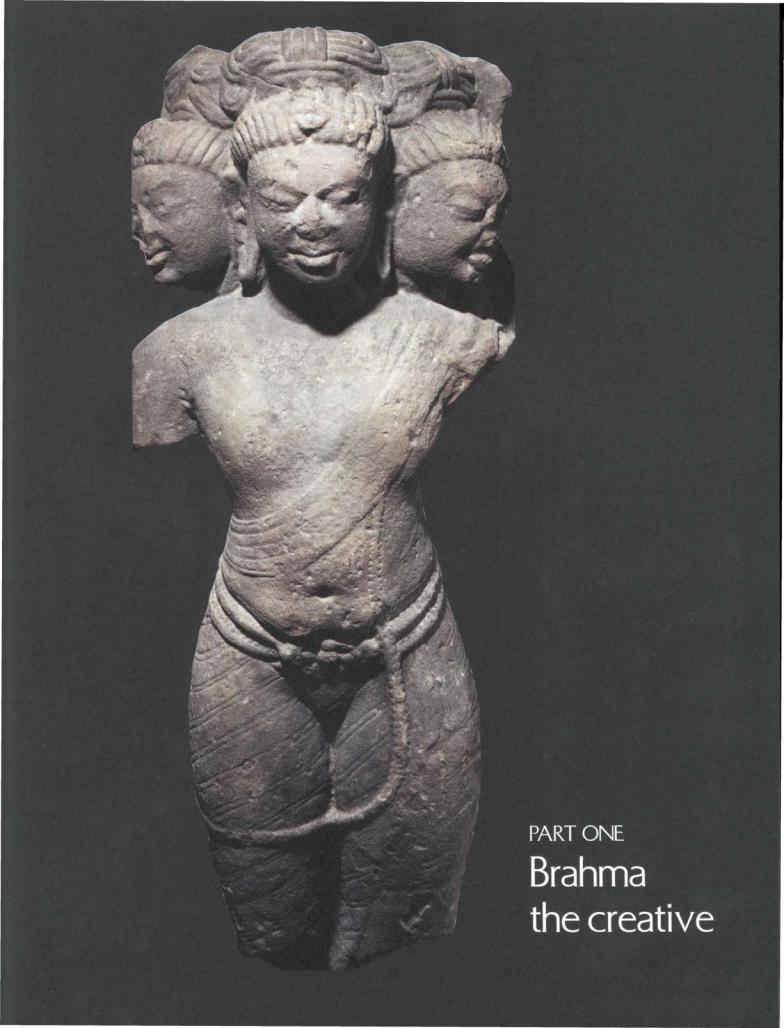
Overleaf: A gray sandstone carving of Brahma, the Hindu Creator deity, depicted with three heads and standing in a frontal pose. Sculpted in a sensuous manner, the deity has a benign expression, wears the sacred thread of a Brahmin, and has a dhoti cloth about his waist. From Uttar Pradesh, north India, post-Gupta era, circa eighth century. Private European collection.
Brahma, the Creator, desired that it should be so and he willed forth the Principle of the
Universe; from this came the Primal Energy and from that the Mind. Then there
evolved the subtle elements and from these the many worlds. From the acts performed by
beings in those worlds the chain of cause and effect was established.
MUNDAKA UPANISHAD
Saraswati, the consort of Brahma, has a bodily luster more powerful than the light of ten
million moons. Her garments are purified by celestial fire. She is the Mother of the Vedas,
the very embodiment of Nature and the Patroness of the Arts and Sciences. She is always
smiling and is exceedingly beautiful; her body is decorated with jewels and pearls.
SARASWATI STOTRA
the creative attitude
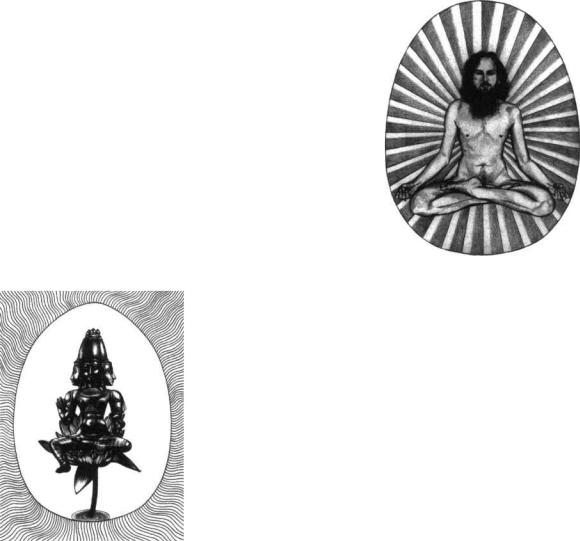
A form of Brahma, embodiment of the creative force of evolution, seated on a lotus within an effulgent ovoid emanating rays. The lotus is an ancient symbol of spirituality; rising from the muddy depths, it blooms upward majestically. From a seventeenth-century south Indian sculpture.
8 Brahma the Creative
Each person should cultivate a creative attitude in order to successfully advance along the path of love. This is a positive mental attitude, a dynamically charged state of mind, which derives its potency from the recognition that there is meaning and purpose to life. This attitude might best be called cosmic optimism. It consists in recognizing and identifying with the primal energy that has created all things. The creative attitude puts us in touch with the source of our being and endows us with a limitless capacity for evolution.
The creative attitude should remain with us always and be the touchstone by which we gauge our actions in the world. It is a feeling of self-confidence, a recognition of the Divine within each of us, a conviction that we are projections of higher principles that we can come to know. It is part of the process of evolution.
One lesson this book will endeavor to teach is that worldly or physical limitations can be overcome by invoking the creative
attitude and making it work for us. Such mental attitudes have been utilized to achieve success in the world of commerce. Salesmen and top company executives are trained to imagine themselves as filled with positive energy, which creates an impenetrable barrier to any doubts or negativity.
In the area of Tantric sexuality there are many barriers to be overcome. A creative attitude works wonders in eliminating doubts or uncertainty, while at the same time acting as a potent virilific. Impotency and sexual frustration are direct effects of a lack of selfconfidence, which in turn stems from a feeling of emptiness, that life has no purpose. By looking to high spiritual ideals for inspiration, we strengthen the creative attitude. An exquisite joyfulness accompanies this state of mind, so remember to evoke it at all times. Open yourself to the marvelous possibilities that will manifest. When the creative attitude is brought to bear during love-making, a wealth of variety unfolds.
Brahma and
Saraswati
Brahma is the name of the creative aspect of the Divine. The symbol of Brahma is a golden egg or aura, the substance of which is infinite positive energy. In Tantric cosmology, Brahma is the embodiment of all creativity. Since Brahma rules over destiny and the things of the world, it is considered imperative to "become Brahma" or "have Brahma on your side." The Eastern teachings state that one can become a thing by identifying with it. Through identification, the power of creativity can work in the individual at all times.
Recognizing the reality of the creative as co-essential with one's own being, a new awareness emerges like radiance from the central "seed" of the Golden Egg. A useful and very effective technique for identifying with Brahma and the creative universal energy is to visualize yourself surrounded by a golden egg or aura of positively charged energy. See yourself radiating golden sunbeams, warming and invigorating, illuminating life itself.
The senses are the instruments of the Cre-
ative. Originating in the subtle inner realm of Brahma, they manifest on the surface of reality and are expressed in the sense organs, the eyes, ears, nose, mouth, and skin. These instruments must be finely tuned to serve as sensitive conduits to the Divine Principle within. Esoteric traditions consider mind the instrument of the sixth sense. When the mind assumes the creative attitude, it functions as the organ of the sixth sense.
Saraswati is the Indian name given to the feminine Energy counterpart of Brahma, the Creative. She is always referred to as "Patroness of the Sixty-four Arts," of which the Art of Love is considered foremost. The feminine Energy or "Shakti" is the power of the Creative, without which no act of creation can proceed. So it is that Brahma and Saraswati are the creative Cosmic Couple, inseparable as the Creative Aspect and the Creative Energy. This dualism is found in all worldly relationships. The unity of these two principles is of particular significance to the path of Tantric love. When couples identify themselves with these high ideals, all relative aspects of their intimate relationship take on an inner and absolute significance. This is of great importance in the Art of Love.
The symbol of Saraswati is an Indian seven-stringed musical instrument known as the Vina. The Vina has gourds as sounding boxes at each end of a fretted fingerboard. Its sensual shape is evocative of the body of a
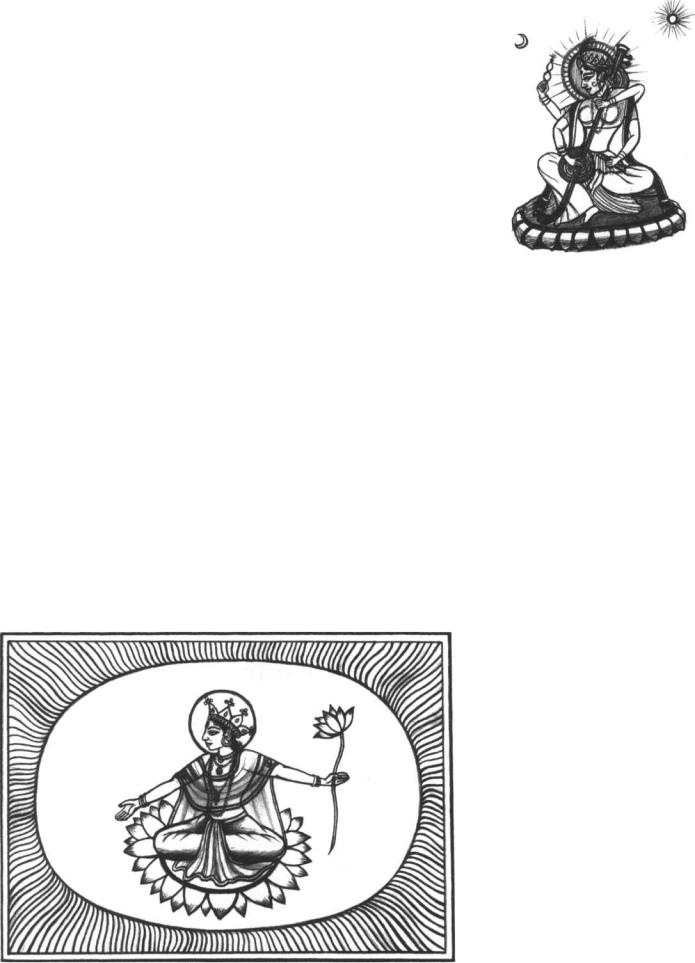
Mystic form of Saraswati, depicted playing the Vina. Her four arms symbolize that she is the embodiment of the four Vedas, the branches of all knowledge. From a nineteenth-century Nepalese painting.
Brahma began the process of creation. Dividing into man and woman, they made love. Together Brahma and Saraswati begat the whole race of mortals.
SHIVA PURANA
When one becomes Saraswati all the Sixty-four Arts are immediately knowable. She is the Mother of the Vedas, the Auspicious One.
SARASWATI STOTRA
Brahma is depicted in human form, seated on lotus petals and holding a lotus flower. Golden rays of light emanate outward from the cosmic egg of Brahma. The lotus is a universal symbol of spirituality. From an Indian painting of the eighteenth century.
Brahma the Creative 9
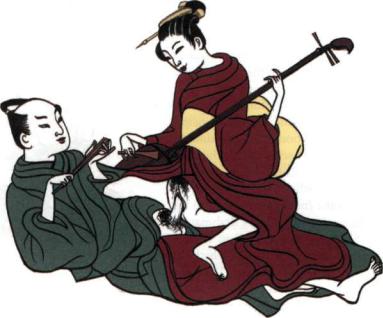
The Patroness of the Arts. From a Japanese painting of the seventeenth century.
woman; the sound it makes is like a beautiful voice. It is the "instrument of the senses," the pleasure of Brahma. By playing on the Vina the goddess Saraswati expresses her joy in creation.
The seven strings of Saraswati's Vina symbolize the sevenfold nature of evolution, the seven rays of creation, the natural order of change found in all worldly phenomena. In science we find this sevenfold division of elements in the Periodic Table, based on relative atomic weights. In music it occurs in the scale; a ray of light is naturally divided into seven colors and in the Subtle Body of Tantra there are also seven stages. This sevenfold principle occurs throughout all esoteric literature.
Both Brahma and Saraswati should be visualized as golden and radiant. Like the sun, they emit creative, invigorating light, producing growth and evolution. Through identification with these higher Cosmic Truths, the couple can derive tremendous benefits. It is an abstract and at the same time a specific meditation, a support, and an inner strength of vast potential. By "becoming Brahma and Saraswati" the couple can evoke the creative archetype of their existence.
Out of Brahma, which is the Higher Self, came space; out of space, air; out of air, fire; out of fire, water; out of water, earth; out of earth, vegetation; out of vegetation, food; out of food, the body of all humanity.
TAITTRIYA UPANISHAD
At the navel region of the body there is a subtle center of transformation. It can be considered like a lotus with sixty four petals, or a vital sun with sixty four fames.
The color of it is golden and it is turned upward.
SECRET TEACHING
OF NAROPA
the sixty-four arts
The Kama Sutra, the classical Indian treatise on the Art of Love, enumerates the Sixtyfour Arts. The text advises that these should be studied along with the Kama Sutra, preferably under the guidance of a teacher. These arts and sciences (for no distinction between them was then made) include singing, mu - sic, dancing, writing, drawing, painting, sewing, reading, recitation, poetry, sculpture, gymnastics, games, flower arranging, cooking, decoration, perfumery, gardening, mimicry, mental exercises, languages, etiquette, carpentry, magic, chemistry, mineralogy,
gambling, architecture, logic, charm-making, religious rites, household management, disguise, physical sports, and martial arts plus many specialized activities related to the culture and time. The accomplishments expected of young women in Victorian times echoed this idea. To update this, the arts related to more recent technical innovations, such as photography, could be added.
The Indian treatises on love suggest that both men and women should be well versed in as many of the Sixty-four Arts as possible. Three arguments as to why these arts should be studied are presented in the texts. First, a person who is accomplished in them is automatically given an honorable place in society. Second, through the application of these arts one can more easily win over the object of desire, be it husband, wife, or lover, and
10 Brahma the Creative
provide more fulfillment. Third, a single person can easily be self-supporting by the application of these skills. E v e n a bare knowledge of these arts adds to the charm and interest of a person.
In the West today, over-specialization is a problem, which tends to inhibit the mind's capacity to intuitively express the many facets of knowledge. Yet the Art of Love relies on the other arts for its support. Without these modes of expression our existence would be boring and restrictive. Humanity depends upon these arts as a means of communication and self-expression.
There is no Western equivalent of the
Kama Sutra, and perhaps for this reason, sex as an art form has yet to mature in the West. Social repression and internalized guilt have prevented Westerners from a frank and joyous exploration of sexuality, today's "liberated attitudes" notwithstanding. Practically all that the Occident offers in this area is pornography, or clinical sex manuals, so filled with anatomical details and "techniques" that they would be sufficient to put a person off sex for life. One result of this repression is inhuman sexual perversion, a subject we will treat in more detail later. The sexual act is rarely tastefully portrayed in Western art or literature. We either reject sex altogether as a subject proper to art or, in lieu of better,
accept mediocre treatment of it.
The Orient did not consider sex apart from, or opposed to, spirituality or religion. The sex act was given a place of honor and was intimately connected with the other arts. Men and women alike studied the Kama Sutra and similar texts. In the temples, all variations of sexual postures were openly portrayed and venerated as ideals. In the privacy of the home, the entire range of erotic art and literature was considered a normal and respectable subject of study.
The parameters of sexual behavior in the East extend way beyond the West's narrow spectrum of normalcy, without the least debasement of the sexual function. Celibacy, monogamy, polygamy, and polyandry all had a place in Oriental culture.
The Sixty-four Arts should be conceived as the Paths of creative Energy. They are the emanations of the goddess Saraswati, the "anima" of Jungian psychology. They can be likened to the flames of an inner
sun, blazing from the solar plexus. Burning up all negativity, these flames of the creative attitude purify the psyche and bring about an inner transformation. As practical skills
of the outer world, they delight others and fulfill the talented practitioner.
A person should study the Sixtyfour Arts and sciences, as also the sixty-four aspects of sexual union.
KAMA SUTRA
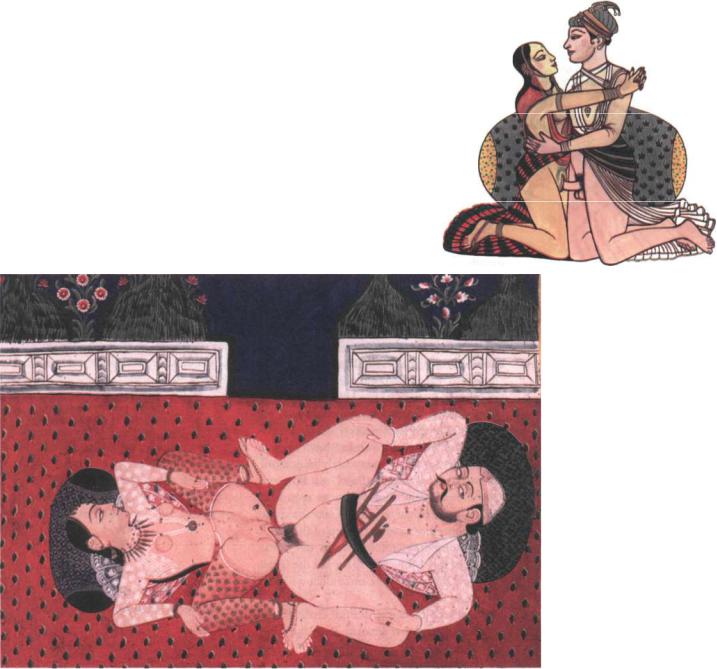
A royal couple kneeling in mutual adoration. From a miniature painting in the collection of the King of Nepal, circa 1830.
A Hindu maharaja in Tantric union with his consort. This unusual posture is particularly suitable for circulating energy during prolonged love-making. A large painting on paper, formerly in the collection of the King of Nepal, circa 1830.
Brahma the Creative 11