Материал: Snote
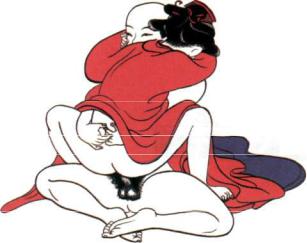
Cranes with joined Necks. From a Japanese print attributed to Tsukioka Settei, circa 1760.
believing it valid as a touchstone by which to evaluate both the practical and theoretical truth of the teaching. We have translated texts directly from the Sanskrit, Tibetan, and Chinese, and wherever possible have scrupulously sought out authentic sources. The alchemy of ecstasy is extremely simple and, at the same time, intricately complex. This paradox should not dissuade the earnest seeker, since the sexual secrets are here presented in a sequence helpful to practical use.
The sexual secrets for consciously inducing and maximizing the experience of ecstasy are most eloquently presented in the Taoist tradition of China. The Tantric teachings of India evolved synchronously and there was a two-way exchange of techniques and ideas. Tibet received the teachings from both India and China, perfecting the mysteries over a millennium. We consider the Taoist and Tantric traditions as representing the most clear and directly relevant sexual secrets for
the present-day needs of the West.
The decision to compile and synthesize the sexual secrets into a concise contemporary context was inspired by our observation of the changing attitudes toward sexuality in our society. The growing interest in the expansion of consciousness and self-awareness has led many to search for liberation through sexuality. Sexual taboos and inhibitions have been broken through in an effort to free sensual enjoyment from feelings of guilt. While this is a step in the right direction, it is dangerous unless accompanied by emotional maturation.
Liberation, especially sexual liberation, must be oriented in a positive spiritual direction. If not, when the novelty of new sexual experiences has worn off, emptiness
and meaninglessness inevitably result. Western psychiatrists and psychologists have remarked on the increasing in-
cidence of this feeling of emptiness as the root of neurosis in our allpermissive society and are aware of the need to help reestablish meaning and creative direction in
the life of the individual. |
Partly |
|||
in response to the feeling of |
||||
spiritual |
emptiness, the |
|||
West |
has |
b e c o m e |
||
conscious |
of |
the |
||
validity |
and |
p r o - |
||
found insight of East- |
||||
ern mystical |
practices. |
|||
Yoga and meditation have
become household words. The proliferation of encounter groups, sensitivity training, T'ai Chi, Transcendental Meditation, Gestalt Therapy, and other awareness therapies throughout the United States and Europe has resulted from an authentic need to recover a deeper, more conscious experience of life.
Unfortunately, the long-established norms of sexual behavior in the West have created psychological barriers that restrict inner growth. These "hang-ups," inculcated by parents and social institutions, have doomed many people to lives of permanent frustration. A desperate attempt to conform to a conventional, though possibly unnatural, "norm" of sexual behavior restricts individual development and may lead to furtive perversion and damaging guilt feelings. Yet an honest breaking with the expected standard, in a bid for personal liberation, might have led, up until recently, to alienation or even ostracism. Thus, many have seen the need to expand the parameters of the norm, to cut away the restrictions of convention and the limitations of habit. By exploring the sexual potential of ourselves and others, we can come to consciously know the alchemy of ecstasy. It is our opinion, and the philosophical assumption of this work, that this process of self-development should be undertaken in a spiritual context, with a sense of purpose and higher direction.
Only in recent years has the West become aware of the depth of wisdom expressed in the Tantric and Taoist teachings concerning sexuality. Unfortunately, however, the sudden surge of interest in this largely esoteric literature has brought with it numerous misconceptions about sexual practices. These misconceptions have arisen from an ignorance of the subtle or allegorical meanings of many parts of the original texts, which were a carefully guarded secret only revealed to those who had successfully passed initiation rites. Furthermore, the bulk of the literature has only been accessible to scholars, with the result that lay people have had insufficient opportunity to explore the original material. A secondhand and often inaccurate acquaintance with the teachings has led Western sexologists and popular writers on sexual occultism to j u m p to premature and often erroneous conclusions.
The core experience of Tantra is the sexual secrets. Tantra is a philosophy, a science, an art, and a way of life whereby sexual energy is
introduction
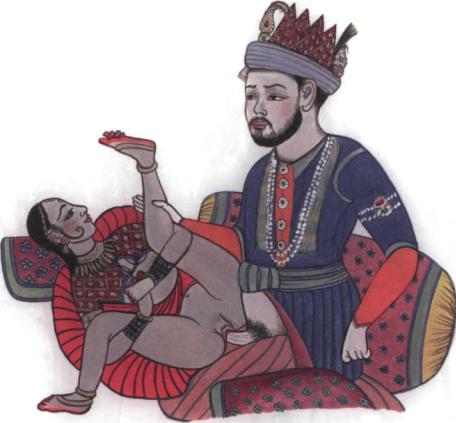
King Nadir Shah in union with a favorite concubine. From a miniature painting in the collection of the King of Nepal, circa 1830.
consciously and creatively utilized. The mystical treatises, known as the Tantras, contain a broad spectrum of practical techniques for enhancing sexual awareness and achieving transcendence. The hidden potency of the sexual act is the seed of all creativity. Through an understanding of the practical teachings of Tantra, a whole new experience of life opens up.
Emperors, kings, and queens had one standard of sexuality for themselves and another standard for their subjects. The sexual secrets were, in the past, reserved for rulers and initiates, who needed to wield power intelligently. Power was achieved through sexual experiences that served to strengthen vitality. The energy found in these practices was consciously channeled to enhance integrity, clarity, and wisdom.
The well-being and prosperity of a country was once believed to be directly related to the vitality of the king. The sexual secrets were not readily available to the general population, although they did find expression in Spring festivals, fertility rites, and forms of pagan worship. Paganism had sexual energy as its firm foundation; many of the rites and rituals were based on a pro -
found understanding of sexuality.
We did not write this book for those who wish to gain power over others by manipulating or using the power of sex for purely worldly ends. The sexual secrets should not be used selfishly. Many of these secrets have been jealously guarded to protect against their misuse. This concealment has resulted in the gradual dispersion of half-truths about mystic sexuality, Tantra, and Taoism, which, in the long run, has done more harm than good. Therefore, we are revealing knowledge that in the past has required initiation, as we believe the ethical cornerstone of this teaching is individual responsibility. Ultimately, progress in Tantric evolution is barred to those who have not shouldered this responsibility.
This is a book for couples or individuals wanting to become couples. It is for those who wish to use the sexual bond as a means to liberation and who desire to transcend the limits of the individual self. It is especially for those to whom love and trust are synonymous and who wish to give, as well as take. The sharing of the ecstatic experience is the key that unlocks the sexual secrets.
introduction 3
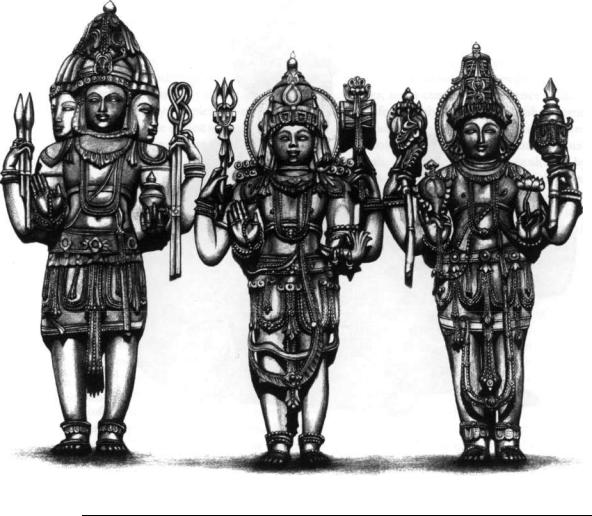
Brahma, Shiva, and Vishnu, symbolic of the creative, transcendental, and preserving powers, respectively. Linked to birth, death, and life, these three forces together evoke the Subtle Body of Tantra. From a stone sculpture, Hoysala, Halebid, India, circa twelfth century.
PRINCIPLE |
RELATIONSHIP |
DIVINE ASPECT |
DIVINE ENERGY |
The Creative |
Birth |
Brahma |
Saraswati |
The Transcendental |
Death |
Shiva |
Kali |
The Preserver |
Life |
Vishnu |
Lakshmi |
|
|
|
|
structure of this book
We have divided our book into three parts, which correspond to the Hindu triad of forces that pervades all activity. This triad is the Creative, the Transcendental, and the Preserver. In our existence these principles correspond to birth, death, and life. They occur at both material and psychological levels and
are the underlying basis of the universe, which is in a constant state of flux. In the Tantric cosmology these forces are formalized as three aspects of one single Divine Unity. Separately they are known as Brahma, the Creative; Shiva, the Transcendental; and Vishnu, the Preserver. Each of these forces is understood as inseparable from a feminine energy counterpart or Shakti. According to Tantra, every higher principle can only exist through a combination of male and female.
The Shaktis of Brahma, Shiva, and Vishnu are known as Saraswati, Kali, and Lakshmi respectively. Saraswati is the patroness of the arts, Kali the initiatress into transcendence,
4 introduction
and Lakshmi the embodiment of preservation and prosperity.
The chart on page 4 is a convenient arrangement of their relationships.
The Tantric neophyte should come to grips with these three basic principles. Their anthropomorphic conceptualization should not present an obstacle to understanding. The triadic conception of the Divine is an archetype found in Christianity, Buddhism, Taoism, Islam, and even in Kabbalistic Judaism. Folk myths throughout the world contain references to threefold forces underlying all phenomena and evolution.
The first part of this book deals with the theme of the Creative and examines the positive attitudes and actions necessary to the seeker after Liberation. The creative is like a seed containing the potential for growth into a fully realized life. It is symbolized by a golden aura, an "egg," of positive energy. The preparations and proper mental attitudes for beginning on a Tantric lifestyle are clearly outlined. Here we tell of the "Sixty-four Arts" and their role in delighting the senses. Foremost of the arts is the "Art of Love," without which no creative activity would be possible. The medium of this noblest of arts is the human body and its sense organs. We therefore consider the senses in this role and explicate the cosmic function of such mun - dane activities as seeing, smelling, hearing, and touching. We tell of the important ancient traditions concerning self-examination, psychological attitude, Yoga technology, food, drink, exercise, bathing, sleep, dreams, circulation of energy, massage, meditation, and ritual acts. The context of sexuality is constantly brought to bear.
This first part of the book is intended to open the reader to higher possibilities. Some of the concepts will no doubt be familiar, while others will seem unusual or even extraordinary. However, we believe that, with the intuition open, everyone is able to receive the understanding of the sexual secrets. Theory is always enhanced by practical application, so try to adapt your lifestyle to enable the teaching to take on a personal meaning. The sexual secrets are best received in the spirit of initiation.
The central part of this book considers the theme of the Transcendental and takes the form of an intimate dialogue between a Tantric couple spontaneously producing the sexual secrets from the ecstasy of union. Af-
ter a prolonged period of love-making, the couple identify themselves, through selfworship, with their divine counterparts, Shiva and Shakti. The couple are now exalted to god and goddess, and they begin the transmission of the sexual secrets.
Generally it is the woman (Shakti, representing intuitive Wisdom-energy) who in the Tantras asks the man (Shiva, symbolic of transcendental power) to reveal the sexual secrets. His viewpoint is that of a "Lord over Death," the Supreme Yogi who has known everything. In the Buddhist Tantric tradition it is Buddha who converses with a Wisdomgoddess; in the Chinese Taoist counterpart, a mythical emperor talks with his Celestiallady. The message is the same: an esoteric transmission of the function and practices of sexuality.
Traditionally, in Tantra, the innermost secrets are revealed and conveyed through the form of intimate dialogue. This practice ensures that the meaning of the teaching is understood spontaneously. Often, in texts of such dialogues, the meaning is concealed by allegory or a kind of "twilight language" of riddles. All lovers share an intimate vocabulary, the meaning of which is often known only to themselves. An outsider, hearing their conversation, would be at a loss to understand them. In Tantra this protects against misuse of potent information.
In Part 2 of the book we explore the sexuality of the couple. The meaning of sexuality and the power of transcendence are discussed. The sexual secrets revealed include the meaning of the Shiva and Kali archetypes, mystic forms, sexual fantasy, magical practices, visualization, teachings on fasting, abstinence, orgasm, drugs, and sexual alchemy. There are other topics covered also, in answer to questions raised by reading the first and third parts of the book. Part 2 will serve as a second initiation to the reader. Here is "heart talk," direct and spontaneous.
The third and final part of the book concerns the theme of the Preserver. In Hindu cosmology Lord Vishnu preserves everything that Brahma has created. As the Lord of all cosmic play, it is Vishnu's constant desire to preserve life and stimulate eros; the goddess Lakshmi, embodiment of all prosperity, is his wife. Here we consider the path of love in all its manifold activities and explore the joy of sexual awareness.
The practical applications of secret tech-
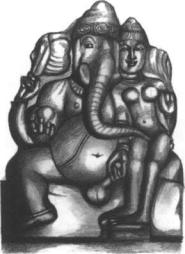
Ganesha with his consort Siddhi (representing supernormal power). This Tantric form of the Elephant Lord symbolizes the awakening of sexuality and spiritual ideals. From a stone carving, South India, circa fourteenth century.
introduction 5
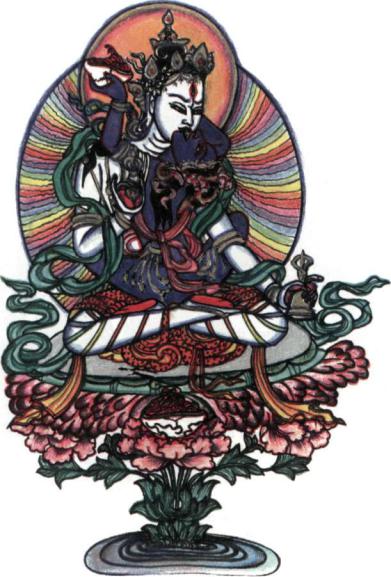
Padmasambhava, the Indian Tantric master who established Tantric Buddhism in Tibet in the eighth century, in ecstatic union with his consort. This mystic form celebrates the unity of celestial Voidness with terrestrial Wisdom. From a Tibetan painting of the nineteenth century.
niques for maintaining a heightened sensuous awareness are outlined and the entire repertory of love-making positions is explored in detail, illustrated wherever possible. We examine the natural cycles of love-making, the esoteric teachings and rituals of love, retention, mutual absorption, ejaculation, oral sex, sapphism, homosexuality, and other aspects of sexuality included within the vast literature of Tantra and Taoism. Our aim has been to update and simplify the information contained in esoteric traditions and make it available in a form practicable for the present time.
Throughout this book we quote extensively from authoritative texts to support or illustrate our theme. Wherever possible we have consulted the manuscripts in their original language and compared texts of different periods. In most cases we have retranslated rather than use existing English renderings.
We consulted numerous rare books, manuscripts, and paintings to bring together the material for this work.
Though the sources are varied, there is a consistency of tone, a direct and spontaneous awareness of the cosmic function of sex, which carries the ring of truth. Tantric and Taoist teachings are generally free of sexual inhibition or repression. It is remarkable that such esoteric material, preserved in so many independent traditions, should have this common ground.
Illustrations have been created to augment the experience of the text and help in the transmission of the sexual secrets. Many of the illustrations rendered were drawn from works originally commissioned by kings and emperors that now are in private collections or museums throughout the world. Others are from traditional Chinese, Japanese, or Indian sources.
Numerous published collections have been consulted and the elements pertaining to the Tantric and Taoist teaching extracted. In doing this we have covered a vast time spectrum, from the ancient to the contemporary, encompassing a variety of media, from temple carvings to Tibetan paintings, employed to express the erotic sentiment.
Some of the illustrations have grown directly out of our involvement with the exploration of material for this book. We have researched modern forms of sexual expression and created new images that are conducive to the elevation of the senses. The drawings are unique works in themselves and represent, as does the text, a gathering together of many streams leading to the same source.
The present time calls for the sexual secrets to be made available to all without distinction, clearing the way for responsible seekers to experience their latent potentials. Each one of us has come into this world through the power of a sexual act. Every person who has experienced sexual love has had at least the taste of ecstasy.
Our own journey into the sexual secrets has deepened and enriched our relationships. By becoming aware of the sexual secrets and applying them to practical everyday life, we hope that our readers will fully experience the alchemy and ecstasy of love. We offer the fruit of our work to those who recognize the futility of existence without spiritual fulfillment.
introduction