Материал: Snote
new discoveries
on the origins of the secrets
When the first edition of Sexual Secrets appeared in the fall of 1979 it entered a Western world in which practically no literature on sacred sexuality was available. Sexuality was viewed in terms of "how-to" manuals focused on biological and physiological techniques and other aspects of applied sciences. Hardly any of the significant esoteric literature in Sanskrit, Chinese, or other Oriental languages was available.
However, the mid-1960s and mid-1970s saw an explosion of experimentation and a focus on the liberation of sexuality from the outdated metaphors of the 1950s and postWorld War II social and moral climate. During the time of this great explosion in sexual energy I found myself in the Orient studying ancient esoteric truths. When I returned to the West, I started the endeavor of compiling some of these secrets into the book you now hold in your hands.
When Sexual Secrets first appeared, nothing of its length and breadth was available in English or in any other European language. Surprisingly, twenty years later there is still nothing of this encyclopedic quality in existence. Sexual Secrets has been and continues to be the key for unlocking the secrets that allow couples to harmonize spirituality and sexuality in their lives.
Since its initial publication there have also been some important new discoveries that reveal the archaic origins of the Taoist and Tantric sexual rites contained in Sexual Secrets. Look closely at traditional African spiritual culture, and traces of Tantric and Taoist teachings become apparent. Beliefs held in common include the immortality of the soul, the cosmic law of "cause and effect" (Karma), the "temple" of the body, mystical power phrases or Mantras, the empowerment of statues and images as representations of spiritual forces or truths, and the sacrament of sex.
Traditions of Indian and Tibetan Tantra tell of original archaic teachers or "lineage holders" who were dark skinned and very short of stature and had tightly curled hair.
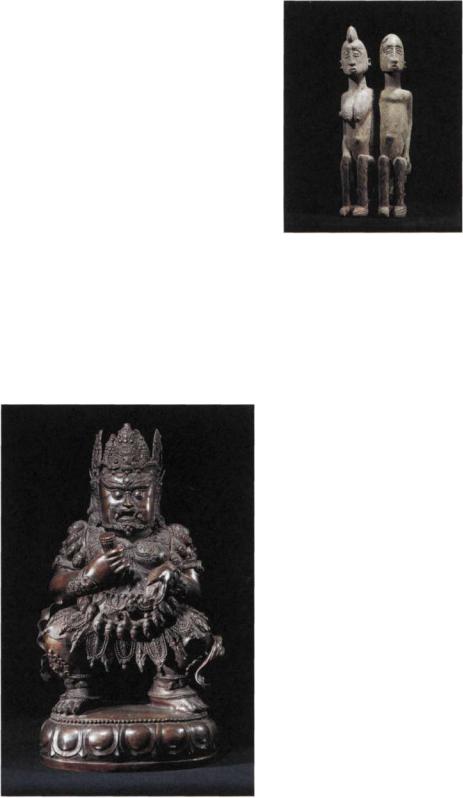
Icons of such lineage holders embody the Negrito physique. Traces of Negritos can be found across western Asia, India, Southeast Asia, Taiwan, Japan, and perhaps in parts of South America. In many places these early peoples were pushed aside or assimilated by later larger-sized migrants of another racial type. The original Tantric icon of Mahakala, the embodiment of Great Time and the archaic "teacher of Tantric mysteries," is consistently portrayed as a Negrito.
Here and there in parts of Africa, isolated archaic communities survived intact until quite recently. With them survived important spiritual artifacts and associated oral tra-
ditions about their meaning and use.
D o g o n w o o d sculptures, from the
Bandiagara Escarpment in present-day Mali, are among the oldest known spiritual art objects from Africa. Some go back almost 2000 years. The Dogon cosmic couple ideal is memorialized by wooden statues of naked couples, normally depicted seated side by
Large wood sculpture of a seated "cosmic couple," also known as "cosmic twins." They represent the original unity, the balance of male and female energies. Dogon culture, Mali. Private collection.
Large metal casting of Mahakala, a form of Shiva, embodiment of Great Time, consort of the Dark Goddess of Tantra tradition and teacher of the Tantra mysteries. This form of the Cosmic Lord is depicted as a Negrito. Sino-Tibetan, circa seventeenth century or earlier. Private collection.
origins of the secrets |
ix |
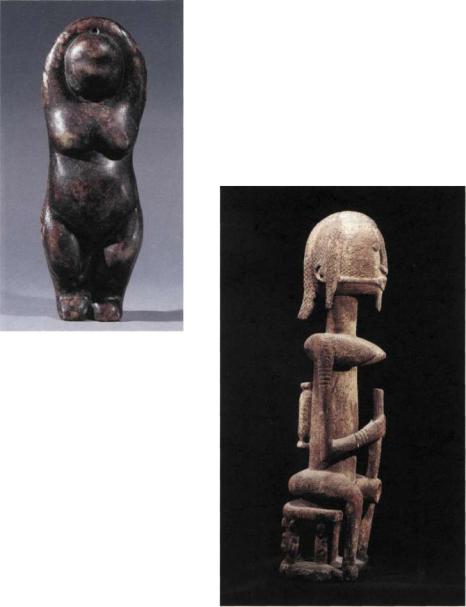
An exquisite and unusually large Neolithic jade statue of an elite female shaman or priestess/matriarch. Depicted naked and posing in a ritual shamanistic dance posture, her belly is distended by pregnancy. She has both arms held over her head and her hands linked. This is a magical gesture associated with rainmaking rites in several archaic cultures. Early Hongshan culture, Inner Mongolia, circa 4000-3500 B.C.
Private collection.
side, the male holding the female, very much in the manner of the Shiva and Parvati images of Hindu tradition.
A pivotal Dogon mystical concept is that the male contains the female, who also contains the male. Such a concept is expressed in the rare primordial hermaphrodite ancestral figures known as "Bombu-Toro," which tell of the dualism existing throughout nature and the mystical ideal of perfection attainable through the unification of female and
An unusually large and early example of a Dogon Bombu-Toro hermaphrodite figure, seated in a chiefly manner on a stool formed by two discs connected by a central axis—the bottom disc representing the earth and the top the heavens supported by caryatids. The figure has a helmetlike head featuring a tab beard, symbolizing wisdom attained, as with the ancient Egyptians. The hair is elaborately plaited and has a high crested ridge, signifying a woman of elevated status freed from daily chores. The naked columnarshaped body has protuberant breasts, foreshortened legs, an elongated neck and long arms, both hands holding a large ladle. A quiver is attached to the back of the figure. In Dogon art, the ladle or ceremonial spoon signifies sustenance and indicates that the holder is a matriarch or woman of spiritual importance. The quiver is the symbol of a successful hunter—an illustrious man. Together, the quiver and spoon remind of the human ideal in Dogon culturewarrior attributes for men, nourishment and procreation for women. Done from a fibrous and very heavy hardwood known as "Pelu." From the Dogon culture, Mali. West Africa. Circa seventeenth century or earlier. Private collection.
male spiritual energies within each individual. This idea of bisexuality or androgyny is at the foundation of Tantra philosophy.
The recent discovery of the amazing Neolithic jade cultures of archaic China, many of which are still in the process of being defined, gives important insight into archaic Taoist practices. Of greatest interest and relevance is the more than 5000-year-old Hongshan culture. This clearly matriarchal and shamanistic society had great Goddess temples and produced exquisite jade sculp-
tures of spirit birds, curled dragon/serpents,
pregnant women in various poses, priestesses, horned and masked figurines, creatures in metamorphosis, and erotic scenarios obviously of a sacred type. These findings explain much about the archaic origins of Taoist and Tantric sexuality.
Tantric sexuality—the Indian radical teachings about sexuality—does not come from the Vedas and it doesn't come from Hinduism as we know it today. It comes from
India's pre-Vedic Aboriginal tribal people.
India is inhabited by many different tribal people and most of these tribal societies are matriarchal. In such societies special importance is attached to the cult of the Mothergoddess, who is viewed as their tribal ancestress. But until now there has been very little
information about these tribal cultures.
We now have evidence that the origins of Tantra's god and goddess cults go back at least to the Indus Valley civilization, now referred to as the Harappan culture. Satellite
i m a g e r y has revealed extensive n e w
Harappan period sites, many of them located near long-ago dried-up river tributaries in present desert areas. These sites cover an area of more than 1.3 million square kilometers, larger than any other archaic civilization.
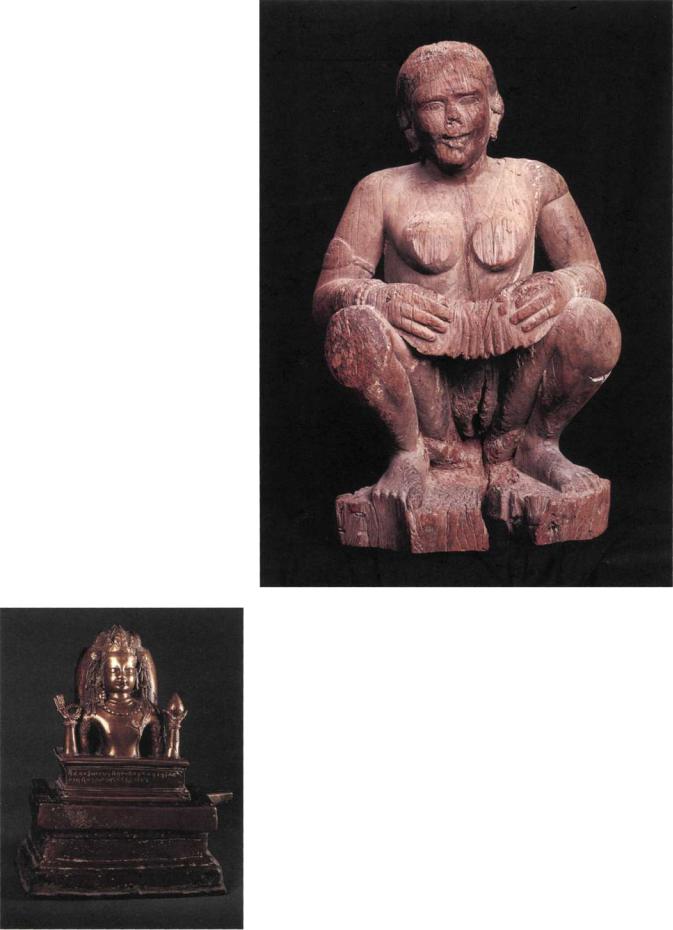
Recent archeological discoveries show us this was a culture most likely run by women. The discovery of a large wooden squatting female figure is pivotal to this conclusion. Scientifically dated to be over 4400 years old, this artifact is now known as the squatting matriarch figure. It is a unique example of pre-Vedic Indus Valley period wood sculp- ture—a veritable masterpiece of the woodcarver's art. This sculpture most likely depicts an original "tribal mother," or ancestress, linked to ideals of fecundity and generation. One of the best-known Harappan artifacts is a small seal engraved with an image identified as Shiva Pashupati, the Yogic "Lord of Beasts."
x origins of the secrets
This seal is often cited as evidence that people of the Indus Valley culture knew Yoga and practiced Tantra. Discoveries such as these give us hard archeological evidence that the "archaic" practices described in the Tantras are not mythological.
The "secrets" presented in Sexual Secrets are primarily the "secrets of women." In Indian society, women have rights only in the Tantric tradition. Much of the Tantric tradition is the goddess initiating the god, and its foundation is in an archaic society where women ran the temple, where tribal culture was kept and nourished.
The same is true in Taoist sexuality—the Chinese radical teachings on sexuality. In Chinese culture, pure eroticism was always linked to the deep philosophical and romantic notions of Taoism. Taoism evolved through close observation of nature and was essentially matriarchal in its philosophy of life. The Tao, "the Way," recognized the order of nature throughout the universe— in causality, change, and the interplay of the female and male cosmic principles of Yin and Yang. The Supreme Tao was compared to water: flowing, yielding, "submissive," and linked to the vital principle of femininity.
Precious metal casting of a Shiva Lingam bearing Shiva's face and bust, with two arms rising up and the hands making mystic gestures as they hold a lemon and a rosary. The Lingam rests on a large Yoni base. Done in classic Kashmir style, in a precious eight-metal mixture, parts once inlaid with silver, and with a detailed dated commemorative inscription. From Chamba, Himachal Pradesh, circa A.D. 850. Private collection.
In ancient China many of the shamans (wu) were women, who emphasized dance and sex techniques and were drummers responsible for rainmaking and the summoning of spirits.
During the Chou dynasty (circa 800-200 B.C.), the philosophy of Confucius (Khung Fu Tzu) was established, promoting patriarchal ideals. Confucianism was essentially opposed to Taoism and its matriarchal foundation; the influence of Confucianism in both China and Japan has lasted until the present. This philosophy had a profound effect on sexual practices, especially those of a mystical type or those in which the woman took an active or dominant role.
Up until the great Yin, or Shang, dynasty, which lasted until about 1100 B.C., Taoists developed many techniques for harmonizing with nature, including various sexual
Pre-Vedic Harappan wood sculpture of a Tantra matriarch or Mother-goddess squatting in the birthing position as she raises the hem of her skirt to expose her Yoni. An initiatory icon from India's most archaic cultural period, the Indus Valley period, radiocarbon dated at circa 2400 B.C. Height 28 inches. Private collection.
origins of the secrets |
xi |
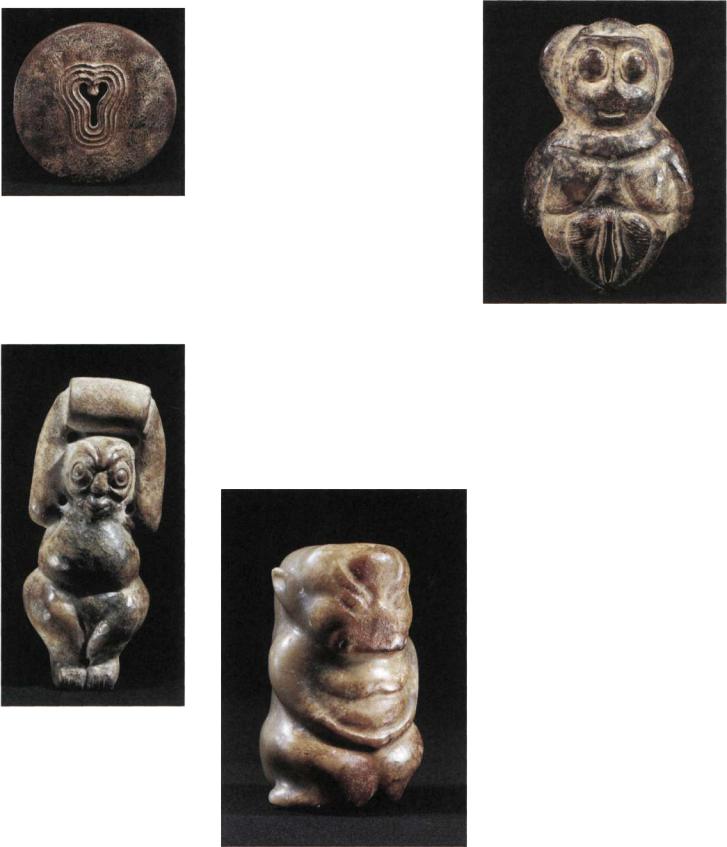
Jade disc, an archaic Chinese symbol of solar and spiritual power, the center perforated and carved to resemble a stylized vagina, the clitoris emphasized. Dawenkou or Songze culture, Shandong Peninsula, China, circa 4000 B.C.
Private collection.
jade carving of a naked female shaman holding a drum above her head. Hongshan culture, northeastern China, circa 3500 B.C.
Private collection.
methods. The sexual act was viewed as part of nature's order, and proper sexual practices were considered the sacred duty of the superior or "spiritually aware" man and woman, without which it was believed that calamities would result. That spiritual view in the Chinese/Taoist tradition goes back to a time when women were the shamans and priestesses. The evidence of the time when women had power has not been tangible until recently—it has largely been covered up.
Probably the most important of such early Chinese matriarchal societies, and certainly the most relevant to understanding the archaic origins of Taoism, is the Hongshan culture. It has been proposed that the Hongshan culture should be viewed as "the dawn of Chinese civilization." Scientific dating has determined that the time period for the developed Hongshan culture is between 4000 and 2500 B.C.
The prominence of female energy and women in general in archaic Taoist society is now evident in the recent discoveries of great Goddess temples featuring unbaked clay statues of pregnant females done up to three times life-size and jade statuettes of female shamans, spirit birds, ornate headdresses, and
Large jade statue of a kneeling pregnant shaman woman or priestess, her face feline or wearing a feline mask. She appears to be in the process of transforming from a woman into a spirit animal. Hongshan culture, northeastern China, circa 3500 B.C. Private collection.
Jade carving of a matriarch exposing her sex. Hongshan culture, northeastern China, circa 3500 B.C. Private collection.
related artifacts. They compare well with what we know of archaic "matristic" societies elsewhere.
Hongshan spiritual rites were led by elite female shamans. Pregnant-looking female figurines in jade and clay, the largely femaleoriented grave-goods of the elite (such as the jade "cloud-combs" and "hoof-shaped hairpieces"), the impressive Goddess temples, and the fantastic and diverse animal-form jade amulets and statuettes commonly depicted in metamorphosis all point to animism, shamanism, and matriarchy at the foundation of the Hongshan religion. These archaic Taoists thought of jade as the ultimate transformation of the earth's vital essence. They believed jade to be the purest form of positive energy (Yang) and considered it highly effective in the worship of spiritual powers and ancestors.
Taoists were fascinated by concepts of bodily transformation and regeneration. To achieve this they developed seven secret disciplines, namely: precise diet, formalized physical exercise, exposure of the naked body to the energies of the sun or moon, breathing techniques, plant and mineral drugs, meditation, and sexual practices. All of these have elements in common with secret techniques practiced by Tantric Yogis and Yoginis in India and elsewhere.
What you will discover and continuously
xii origins of the secrets
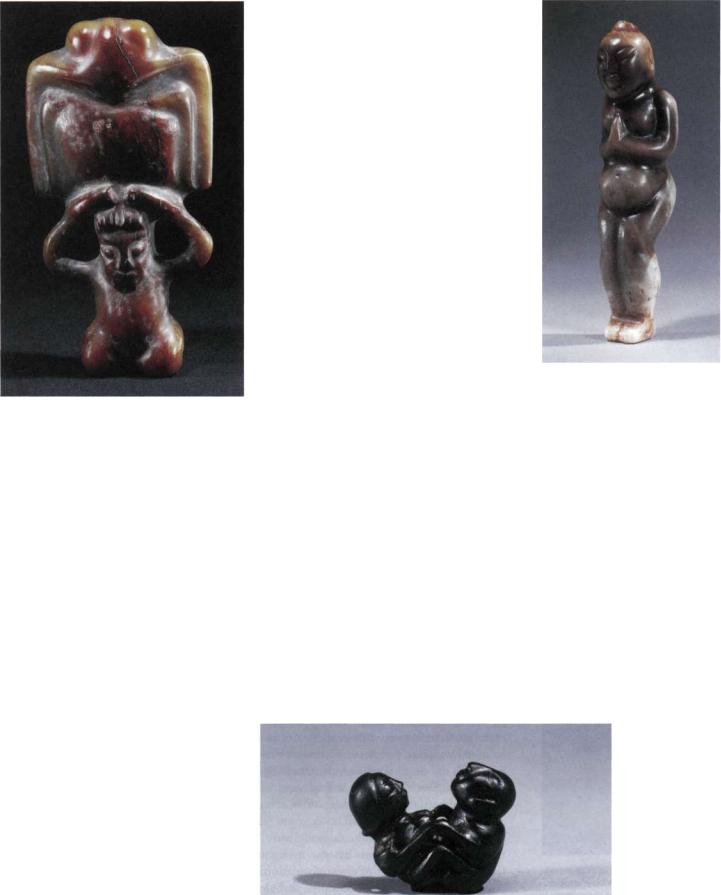
Jade statue of a naked kneeling person, both arms above the head upon which sits a large spirit bird. Hongshan culture, northeastern China, circa 3000 B.C. Private collection.
rediscover in Sexual Secrets is that Tantra is not just the postures and techniques described in the Kama Sutra. Tantra and spiritual sexuality is about the dynamics between men and women. The play between men and women in the sexual context either limits or allows things to happen—it is more than mundane sexuality.
The Tantric tradition, both Hindu and Buddhist, emphasizes the natural interrelationship of microcosm and macrocosm, the "inner" and "outer" realities. These traditions developed an evolved sexual-yogic technology that focused on love postures, breath control, the repetition of power syllables and phrases (Mantras), and visualizations. These intentional, practical, or ritual acts, all done in an ordered way, are the foundation of Tantric practice and are conceived
of as a "weaving together" of the objective and subjective aspects of individual reality,
as a means to overcome the endless cycle of rebirth and to evolve spiritually.
The Tantric and Taoist traditions explored and developed precise techniques for channeling and transforming sexual energy into the bliss of Liberation. It was believed that
the generative powers of nature could be stimulated and directed by following precise sexual practices that were considered to be highly potent and auspicious. Many discoveries of the last twenty years support these radical views of sexuality.
Many Tantric practices are found among Australian Aboriginal peoples. Unfortunately we don't have good archeological evidence of these practices because such archaic cultures mostly used wood, and the ethnographic material about Aborigines is often contradictory. However, the Australian Ab - original peoples are related to the archaic Indian tribal peoples, and they speak related languages.
According to the D N A evidence of author Stephen Oppenheimer in Eden in the East: The Drowned Continent of Southeast Asia
(1998), the Aboriginals of Southeast Asia are at the root of family trees that reach to all points of the compass. Very recently, new archeological findings have shown that the first people to inhabit America were Australian Aborigines who crossed the Pacific by boat. More than fifty Aboriginal skulls, over 12,000 years old, have been discovered in Brazil and Colombia. In Western Australia a cave painting of a large oceangoing vessel has turned out to be 20,000 years old. In Voices of the First Day: Awakening in the Aboriginal Dreamtime (1991), author Robert Lawlor shows that archaic shamanistic, magical, and Tantric yoga practices still exist among
Jade statuette of a naked pregnant woman, her hair piled up on top of her head and both hands raised up and held together at her chest, as if in prayer. Hongshan culture, northeastern China, circa 3000 B.C Private collection.
Small carved black jade amulet of a couple in seated intercourse. They hold hands and lean back in a posture that allows gentle rocking back and forth. This is an effective technique that helps gradually build orgasm in the female while aiding the delay of orgasm in the male. It is described in both Taoist and Tantric teachings. In this rare early rendering the woman has an unusual hairstyle or headpiece reminiscent of the cowls seen on some Paleolithic sculptures found in Europe. The man's face has an intense and ecstatic expression. Hongshan culture, northeastern China, circa 3500 to 3000 B.C. Private collection.
origins of the secrets |
xiii |