Материал: Snote
People of wisdom do not speak of a sense of speech, a faculty of
sight or of hearing, or of meditation, but only of a group of Pranas, which do all these things.
For these are all manifestations of Prana.
CHARAKA SAMHITA
whole body. The mind also benefits and can, by this practice, be brought under conscious control. According to the Hathayoga
Pradapika, "When the breath is in motion, the mind is also in motion; if the breath is controlled, the mind is also controlled." The aim of all Yogic breathing exercises is, ultimately, the prolongation of retention, which leads to supernormal powers and the "burning up" of all Karmas.
W h e n the vital forces in the body are brought under the power of the creative mind, an immediate effect is experienced in the sexual center. Suddenly, you feel an overall increase in energy and sensitivity. The senses are tuned up and are able to function more effectively. Any couple wishing to experience the ecstasies of Tantric love should first develop the complete breath until it becomes totally natural. Then the healing breath should be practiced, so the vital and subtle channels of the body are purified and strengthened. This prevents physical or emotional damage from the high intensity and energy levels of Tantric love.
The motions of the vital air, the mind and sexual energy are all interdependent. Stopping the movement of any one of these three functions also checks the others. Here we can see how closely the flow of breath relates to the sexual function and to the subtle processes of the mind, such as thought and imagination. One of the most important aspects of sexual union is the sharing of a breathing experience, for emotions are directly linked to the breath. True physical love
produces a total convergence of the breath rhythms of the couple. This experience holds the key to tremendous power.
Various other breathing techniques are also helpful in preparing a couple for Tantric lovemaking. One secret technique, known as the Crow-beak, consists in rolling the sides of the tongue inward and protruding it slightly, all the while inhaling air through the tongue and letting it fill the "pot" of the lungs and lower diaphragm. Retain for as long as possible and then exhale through both nostrils. According to the Shiva Samhita, "When a person drinks air through the Crow-beak at both the times of early morning and evening twilight, all diseases or physical weaknesses are destroyed. This practice leads to the powers of clairvoyance and other miraculous abilities."
Yoga traditions constantly refer to a fivefold division of breath, called Prana (life force). It is said that just as a king employs officials to rule over the different portions of his kingdom, so the original Prana contains four other Pranas, each assigned to rule over a specific bodily function. Of these five subtle breaths, the original Prana, which is upward moving, and the Apana, which is downward moving, are particularly important. Tantric Yoga aims to reverse the flow of these two life currents, causing them to combine and bring about a total transformation of the psycho-organism. The Bhagavad Gita declares: "Some Yogis offer the Prana breath into the Apana; others the Apana into the Prana." The Goraksashatakam states: "The Jiva
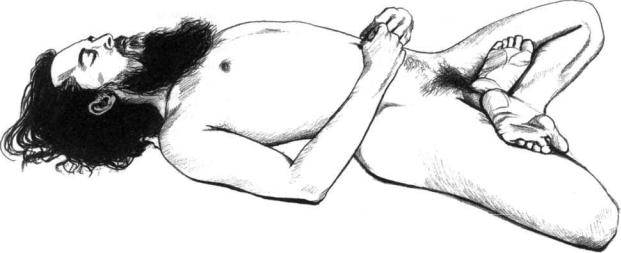
Yogic posture derived from the lotus position, lying flat, with both hands channeling energy back to the navel center of transformation. This is a very relaxing and energizing posture that helps control the upward and downward subtle energies in the body.
[the individual soul] is in the thrall of Prana and Apana. He who knows and controls these two forces is a true knower of Yoga and quickly tastes the ecstasy of Liberation. Drawing up the Apana, one should unite it with the Prana."
The division of the inhaled breath into the five subtle breaths takes place during the period of retention. This natural process can be the basis of an important meditation. Imagine the air entering through the nostrils as if it were a fluid less dense than water. Draw it into the body by creating a pot shape in the lower abdomen. When the process of inhalation is complete, switch to retention and imagine that all the bodily openings (ears, eyes, nose, mouth, anus, etc.) are sealed. Imagine the air dividing into five parts, taking on the nature of the Five Great Elements
(space, air, fire, water, and earth) and nourishing the different parts of the body. Try to "see" this process with the mind's eye. During the period of conscious retention try to extract only the best parts of the inhaled breath. Then switch to exhalation and imagine all impurities, negativities, or physical ailments leaving the body and returning to the earth for regeneration.
Breath control is vital to the correct practice of Tantric or Taoist love-techniques. Breathing exercises should never be practiced immediately after a meal or after heavy exertion. Generally, it is best to introduce conscious awareness of breathing into your life gradually. Don't be afraid of the power of breath; rather, learn to use it carefully. With the breath as your ally, ecstasy is within the reach of you and your partner.
The practitioner of Tantra aims at stopping the unconscious flow of micro-cosmic forces by getting control of the functions of breathing, which represents the outward aspect of vital energy. The initiate must master the breathing process until it becomes a most responsive and subtle tool.
VARAHI TANTRA
solar and lunar breathing
Eastern mystical teachings employ a symbolism that is derived from the belief that the components of man's inner nature are correlated with outer cosmic principles. Solar and lunar symbolism is found in all cultures based on a strong metaphysical belief structure. Since the most ancient times people have attributed specific qualities to the sun and moon. Thus, in the Hebrew tradition the sun is considered masculine in essence and is identified with the paternal archetype, whereas the moon is considered feminine and
is identified with the maternal archetype. Solar and lunar symbolism is very much a
part of the Yogic, Tantric, and Taoist traditions. These teachings identify the right side of the body with the sun (solar forces) and the left with the moon (lunar forces). Tantra identifies solar energy with the masculine "fiery" psyche, the color red, the element fire and the intellectual processes. Conversely, lunar energy is linked to the feminine "cooling" quality (Soma), the color white, the element water, and all intuitive processes.
Yogis who have spent years examining the idiosyncrasies of the breathing process have noticed that the breath changes from one side to the other at regular intervals. You can verify this right now by seeing from which nostril your breath is exhaled and inhaled. If you check this again after some time, you'll find that there has been a change over to the
The solar breath leads to transcendence; the lunar breath is a form-giving substance. Their union is evocative of the Eternal.
PRANA UPANISHAD
Brahma the Creative 23
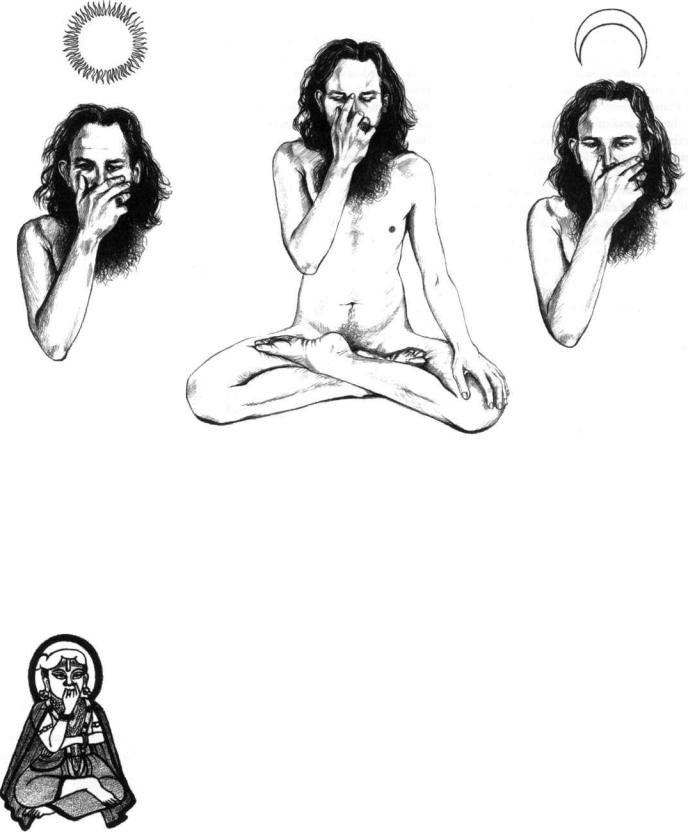
Solar-lunar breathing, also known as alternate-nostril breathing. Highly regarded in all Yogic and Tantric texts, this type of exercise creates balance and harmony throughout the psychoorganism. The fingers are used to block each nostril in turn. The solar side (to the right) is linked to heat, expansion and allconsuming consciousness, whereas the lunar side (to the left) evokes coldness, contraction and intuitive Wisdom-energy.
Alternate-nostril breathing, here practiced by a Jain master. From an Indian painting of the mid-eighteenth century.
other nostril. The Tantras declare that the diurnal pattern of nostril breathing is caused by the influences of the sun, moon, and stars.
Ancient Yogic teachings state that the dominance of breath naturally changes from one side to the other after about two hours and that the periods of change are linked directly to the passage of the moon through the zodiac. The breath sometimes comes out of the right nostril, sometimes out of the left nostril, and sometimes out of both nostrils. The science of breath (Pranayama) is the origin of Hatha Yoga, meaning the conjunction of the sun and moon. The term Hatha in Hatha Yoga refers to the HA breath of the sun and the T H A breath of the moon. Since the breath is linked to celestial influences, when breathing is controlled, these influences are also controlled. Many Tantric texts claim that by balancing the solar and lunar breaths, an individual can be freed from the influence of destiny. The synthesis of HA and T H A breaths in a state of equilibrium is the inner goal of all Yogas.
In 1969 Dr. V. Pratap of the Kaivalyadhama Yoga Institute in Bombay conducted an experiment to determine patterns of diurnal nostril breathing. He found that there
is a rhythmic pattern to alternate-nostril breathing, which differs from individual to individual and from day to day in the same individual. In his report he states:
The cause of the peculiar dominance of nostril breathing may pose a problem to physiologists. It is believed that it has something to do with sympathetic innervation. The author of this research paper feels that air currents which pass through the nose stimulate certain parts of the olfactory nerve filaments, and consequently the olfactory bulb, which is an extension of the brain, allowing impulses to continue after a stimulus has ceased. From the olfactory bulb, fibres pass towards the brain in the olfactory tract. Some terminate in the olfactory tubercle and others cross to the opposite cerebral hemisphere. It is possible that central mechanisms govern nostril breathing in order to maintain homeostasis of the organism. Therefore sometimes right nostril breathing is dominant, and sometimes left nostril breathing. Sometimes breathing takes place equally through both nostrils. It may be surmised that the air currents passing through the right
24 Brahma the Creative
nostril influence excitatory effects, while those passing though the other nostril produce inhibitory effects. As per the claim of this science of breath, it could be used in family planning, diagnosis, prognosis of diseases, and their cure.
There is a very simple practice for gaining conscious control over the breath. Known as alternate-nostril breathing or solarlunar breathing, the technique consists of blocking one nostril with a finger or thumb while slowly inhaling through the other. When the inhalation is complete, retain the breath for a while and then release the finger or thumb and exhale through the other nostril. Then repeat the process in the opposite way: inhale through the nostril you previously exhaled from, retain as before, and then exhale through the original nostril. This constitutes one complete "round" of alternatenostril breathing. It balances the breath and greatly assists in gaining control over parasympathetic processes such as heartbeat, blood circulation, and body temperature, so enabling a person to gain ascendancy over the life force itself
The Shiva Samhita gives a beautiful and precise account of how the novice should practice solar-lunar breathing:
The wise beginner should keep the body firm and upright. Joining palms in supplication, salute the lineage of Gurus and the ancient Mother-goddesses on the left
side and then honor the elephant-headed Ganesha on the right side. Then let the wise practitioner close the right nostril with the right thumb, inhale air through the left nostril and retain the air as long as possible without discomfort. Afterward breathe out slowly, not forcibly, through the right nostril. Again, draw in the breath through the right nostril and retain it as long as is comfortable, then release the air carefully through the left nostril. According to this method, try to practice twenty retentions of breath at each session, while keeping the mind free of all anxieties, doubts, and dualities. This exercise should be practiced four times daily, early in the morning (preferably at sunrise), at midday, at sunset, and at midnight. When it has been practiced daily for three months, all the subtle channels of the body will be fully purified and Karmas will be destroyed.
Solar-lunar breathing can be practiced using equal measure for inhalation, retention, and exhalation, or using the rhythm of the healing breath with its 1:4:2 proportion. The Gheranda Samhita gives a concise account of solar-lunar breathing using the healing breath proportions and including a simple meditation:
Contemplate the primordial seed-sound "YANG," which is linked to the air element and the heart center, and visualize this syllable as of a smoky color, filled with energy. Then draw in the breath
The oracle of breath unfolds its secrets to those who know the keys. The elements in the breath are known as fire, water, earth, air, and space
SWARA CHINTAMANI
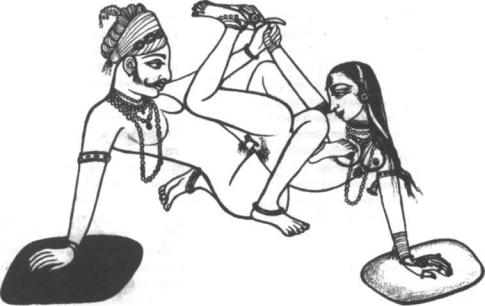
Sexual posture illustrating the spontaneous and joyous ecstasy of Tantra. From a Rajasthani miniature painting, circa eighteenth century.
Brahma the Creative 25
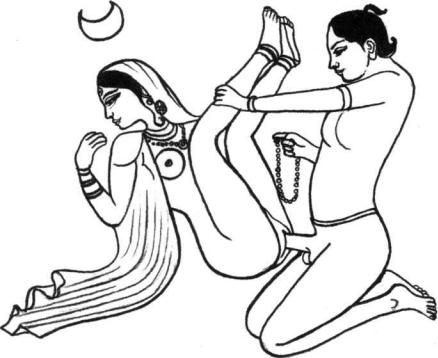
During love-making there is a natural convergence and synchronization of breathing between the couple. Tantra teaches that breathing should be consciously balanced, to enable ecstatic forces to be released and channeled upward. Here, the man is shown measuring his breathing with the help of beads, and his partner concentrates on the cooling lunar energy, so prolonging ecstasy. From a miniature painting, Kangra Hills, late eighteenth or early nineteenth century.
through the left nostril, repeating the syllable mentally sixteen times. Restrain the breath while mentally repeating the syllable sixty-four times and then slowly exhale the air through the right nostril during the period required to mentally repeat the syllable "YANG" thirty-two times.
There are many other breathing techniques outlined in Yogic and Tantric texts, and all of them are designed to balance and unite the solar and lunar forces, the psyche and the Soma. Pranayama is an exact science and any breathing exercise should be undertaken with care and attention to detail.
The application of conscious solar and lunar breathing is a major key to the control of the sexual function. T h e solar breath is equated with the Shiva-principle of transcendental delight; the lunar breath is associated with the Shakti-principle of creative energy. When both breaths are working in balance, the life-force enters the "Great Axis," the central subtle psychic pathway that runs from the perineum at the base of the spine to the top of the head. When solar-lunar forces are in balance during love-making, an ecstatic thrill that "lifts up" the psyche and impels it in an evolutionary direction is experienced.
When a couple practice Tantric love, their Shiva and Shakti principles unite with each other and within themselves. At the same time there is a convergence and synchroni-
zation of their breaths. Their life-forces merge into a singe vortex of pure ecstatic energy and an exchange of physical and subtle energies takes place.
The Tantric teachings contain a wealth of information on the different methods of utilizing solar and lunar breaths during lovemaking. First it is important to know that lying on one side causes the dominance of the opposite nostril's breath. While lying on the left side, for example, the breath will automatically begin to flow through the right nostril. At night, when asleep or dreaming, most people toss and turn. This movement is the result of an unconscious attempt to help the solar and lunar breaths regain their natural balance, lost during the day.
Tantric texts declare that if at the moment of orgasm the solar breath dominates in the man and the lunar breath in the woman, and conception occurs, the child will be male. The opposite situation is said to produce female offspring. The texts further state that if the breath is dominant on the same side, either solar or lunar, in both partners, then any resultant child is likely to have strong homosexual tendencies. Hindu love-postures were created specifically to help stabilize irregularities of breath and create conditions suited to the birth of healthy and emotionally balanced children.
The teachings emphasize that if the man consciously draws in the exhaled air from the woman's left nostril through his right nostril, this will effect a great power of attraction between the couple. It is further stated that this effect is enhanced if the man exhales air from his right nostril and enables the woman to consciously inhale this air through her left nostril. This often happens naturally if a couple make love on their sides, facing each other, since then their breaths naturally work together in a complementary way.
In many ancient cultures breath had strong mystical connotations. In the East "savoring the exhaled breath of a friend" is still a gesture of deep friendship. The Eskimos do not use the kiss to show affection, but instead rub noses and exchange breaths.
Many Tantric and Taoist mystical treatises point to the binding power of complementary breaths. Rituals are outlined for developing a particular kind of breath dominance, in the belief that even destiny can be controlled through conscious breathing practices.
26 Brahma the Creative