Материал: Snote

Agni, the Indian fire god, is two-headed, signifying inner and outer fire. His vehicle is the ram. From a South Indian carving of the eighteenth century.
The pigmentation of the organism, the digestion of food, the vitalization and nutrition of cells, the origination and preservation of eyesight, the germination of heat and the maintenance of bodily temperature, and the origination of the intellectual faculty, all should be regarded as the functions of the five divisions of inner fire within the human body.
SUSHRUTA SAMHITA
sacred fire
The use of fire by our primitive ancestors differentiated them from the animals. Thus, fire became recognized as sacred, an attribute that has influenced spiritual traditions everywhere. A well-known Greek myth describes how Prometheus and his brother were given the job of distributing knowledge among humans. W h e n Prometheus noticed that whereas animals had ample protection from the elements, humans did not, he stole fire from the gods and gave it to mankind. The
Greeks equated the gift of fire with the gift
of culture, since fire is necessary for the development of the arts and sciences. The de-
ity of fire, Hephaestus, was the son of Zeus (the ruler of the world) and Hera (goddess
of all women), but was born ugly and lame. The last of his three wives, Aphrodite, was unfaithful to him; later she was associated with eroticism and became the goddess of Love. Fire is associated with erotic love in many ancient mythologies.
Hinduism includes a number of fiery gods in its pantheon; among these are Surya (the sun god), Mitra (the solar friend) and Agni (the fire god). Agni, the youngest of the Vedic gods, was the son of Heaven (Dyaus) and Earth (Prithivi), the brother of Indra (ruler of the world), and the guardian of this world. He was always portrayed as twin-headed, seven-tongued, and red-colored. His wife is the dawn (Ushas) and he personified fire in a threefold way: as the blazing sun, the flashing lightning, and the sacrificial flame. Inside man he represents the Navel Chakra (the solar plexus), the power of sight and the digestive fire.
Tantric texts frequently refer to fire as the origin and end of all phenomena. Western cosmologists speculate that fire is the main element at the moment of creation and the moment of final destruction of every sun. Fire has the power to level all that is created, so allowing for new acts of creation. Many great Yogis spent years seated in front of a fire, ultimately reaching transcendental perfection through a process of identification with and absorption into its flames.
With the advent of Christianity the West lost its sense of the sacred nature of fire. In-
stead, fire became merely a utilitarian aid or an aesthetic device. Most modern homes are heated by electricity, gas, or fuel oil. People rarely sit in front of an open fire, and as a result the concept of a sacred fire has receded into the unconscious. This is unfortunate, for fire was long a source of inspiration to artists, poets, mystics, Yogis, and lovers alike.
Eastern teachings refer to an inner fire as well as an outer one. They are equally sacred. The inner fire is the vital principle that, when stimulated by the breath, blazes up and consumes the impurities of both body and mind. Inner fire is also said to have the ability to devour destiny or Karma. When centered in the region of the stomach, it is the gastric fire that digests food and allows the body to assimilate life-sustaining ingredients. In the eyes inner fire manifests as the sparkle of clarity and delight; in the sexual region it is the primordial Kundalini, which flashes up the spine like lightning. The main focus of inner fire is at the navel center, where it blazes up; from this point of transformation, the inner fire travels throughout the body and empowers consciousness.
When sitting in front of an open fire try to consider it as a living being. Regard fire as an awesome teacher from which much can be learned. Bearing in mind that fire is both sacred and transcendental will help the Spirit to evolve and mature. Treat fire carefully and with consideration. In the East Yogis and priests generally offer food to the sacred fire, even a small portion of every meal; this assists them in identifying their consciousness with fire. Fire is a potent object of meditation. While watching a fire, meditate on your inner fire, centered at the navel region, imag-
The inner fire is conceived of as a blazing sun centered in the navel region and is linked to the seed-sound "RANG." From a Deccani painting of the eighteenth century.
52 Brahma the Creative
ining that it is burning up all physical impurities, mental confusion and psychic obstacles. Imagine your whole being filling up with spiritual fire and concentrate it in the Third Eye region of the forehead. Tantric texts state that when inner fire is spiritualized and concentrated in the brow, a vision of spiritual worlds is attained.
The flickering of firelight and the red glow of embers are conducive to meditation and visualization. Furthermore, fire can readily evoke the erotic sentiment and its radiant heat is effective in stimulating the Kundalini. Yogis often draw close to the glowing red embers of a long-burning fire and expose their genital region to its radiance, thereby deriving energy.
The Gheranda Samhita gives the following meditation and breathing practice as suited to the cultivation of inner fire:
While breathing in through the right nostril, mentally repeat the seed-sound "RANG" sixteen times and contemplate the navel center. Retain the breath through sixty-four repetitions of the same seed-sound and then expel the air
through the left nostril during thirty-two repetitions. Next, fix the gaze on the tip of the nose and visualize the inner moon of the head center as reflected there. Repeat the whole process in reverse and imagine that a subtle nectar flows from the reflected moon at the tip of the nose and runs back through all the bodily channels, purifying and revitalizing them.
Tantric texts declare that firelight vibrates at specific frequencies, according to its color. The sacred fire can, in the Tantric view, be employed as a communication device and oracle. When precise vibrations of firelight are internalized, psychic powers result.
Eroticism is directly linked to the fiery element. The visualization of an inner fire blazing up from the navel center is stimulating to the glandular system and helps to heighten the erotic sentiment. Outer fire is also erotically stimulating. Let firelight flicker and play over your naked body whenever you get an opportunity; share this experience with your partner and allow it to enrich your love life. Allow the fires of passion to transform physical longing into spiritual fulfillment.
The Kundalini, blazing up at the navel |
center, burns up all psychic obstacles; |
the ego melts and becomes transformed. |
|
|
CHANDAMAHAROSANA TANTRA |
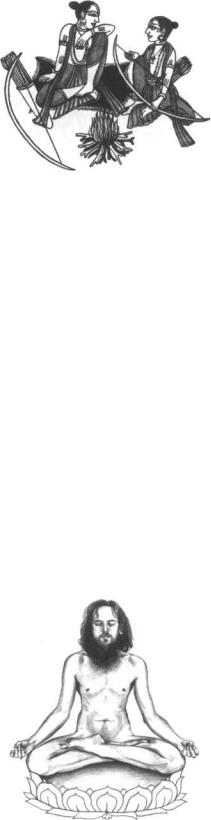
Two heroes sit in front of a sacred fire. From an illustrated Ramayana, Kulu, circa 1670.
The Imperishable is the Real. As sparks fly upward from the blazing fire, from the depths of the Imperishable arise all things,
and to the depths of the Imperishable they in turn descend. To the fire, whence one came, whence one was born.
MUNDAKA/CHANDOGYA UPANISHADS
karma and sex
The understanding and acceptance of the Eastern concept of Karma is particularly important to every person who wishes to apply the Tantric teachings in his or her life. The operation of Karma in everyday life should be constantly studied. The causes of events often seem mysterious, yet if we look carefully at the play of forces from a Karmic viewpoint, we can more easily understand the subtle workings of destiny. Although the general idea of Karma, the law of action and reaction, has been accepted in contemporary Western thought, a highly developed intu-
ition of its precise workings is rarely found. According to the Eastern view, Karma shapes reality; the events we are currently experiencing are a direct result of our past actions, either in this life or a previous one. And our present attitudes and actions likewise determine our future. This principle is as true for the world of physics as it is for the
drama of individual and collective life. According to Tantric teachings, the forces
of Karma pervade the world. As already discussed in "Shiva and Jiva," desires cling to and accompany the individual soul (the Jiva) through its various incarnations. The Jiva enjoys or suffers the fruits of our action; bound into the chains of matter by their Karma, Jivas incarnate again and again, receiving various names and identities. Finally, when all its Karma has been extinguished,
The lotus posture (padmasana) is ideally suited to meditation and contemplation. By visualizing a "lotus seat" and eliminating all desires from the mind, ascendancy over the forces of destiny can be achieved.
Brahma the Creative 53
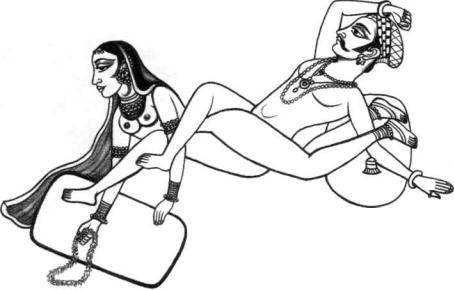
Love-posture for exchanging energy between the couple. The woman holds a rosary of flowers. From a Rajasthani miniature painting of the eighteenth century.
It is said that when a person very eagerly awaits the command of another, with a firm resolution that whatever is commanded must be carried out, then that person will, through the intensity of eagerness and resolution, attain a state of inner equilibrium. Through such a condition of mind the inhaling and exhaling breaths enter the central Great Axis. Then all mental states fade away and a tranquil consciousness emerges.
SPANDA KARIKA
the Jiva is absorbed into its Source, which Sanskrit texts refer to as Parabrahma (beyond Brahma): the universal godhead.
Karmas migrate, like birds, from life to life, attaching themselves to the life-force. These Karmic forces are modified by conscious action during successive lifetimes. The
Prana Upanishad declares that "Whatever is thought of at the moment of death unites a person with his or her primary Prana; then the Prana unites with the soul and leads the individual into rebirth in whatever realm is suitable." We have, in previous sections, referred to the upwardand downward-mov- ing vitalities of the body, and also introduced the concept of the upper and lower gates of our bodily temple. These are the gates through which Prana (life-force, breath) and Karma enter and leave this body; without a combination of these two, an individual would not be reincarnated.
The Prana Upanishad, an early Hindu text, states: "The Prana enters the body at birth, that the desires of the mind, continuing from past lives, may be fulfilled." Personal motivations are the "desires of the mind"; usually these unconscious motivations surface at times of agony or ecstasy. Tantras explain that an individual can learn to dissolve Karma by the action of the inner fire, by sense withdrawal, by meditation and absolute inner stillness, and by participating in the same activities that create the Karma, only with such care and consciousness that the original binding desires are transcended. Furthermore, if a person can live dynamically "in the present," past influences can be transcended. Karmic forces move through the channels of the Subtle Body and also pervade the outer world, manifesting in everyday events. Every moment is a Karmic experience; by contemplating and correlating these m o -
ments we can rediscover the Eternal N o w within ourselves.
The Brihadaranyaka Upanishad, another early text, gives us this interesting view of Karma: "The man who practices sexual intercourse while knowing the formula of Karma and its action takes to himself the accumulated good Karma of the woman; he who makes love without knowing such a formula stands the risk of losing his accumulated good Karma to her." During love-mak- ing the vital forces of the couple blend; their individual Karmas converge and an exchange takes place that can affect their individual or joint destinies. What actually happens depends on the degree of consciousness of the couple. If one is more aware than the other, selfishness will result in a negative Karmic exchange. On the other hand, if loving compassion dominates, a positive Karmic exchange is created. This one of the subtle purposes behind sexual initiations, a secret practice common to most mystery teachings.
A Tibetan legend tells of a famous teacher called Gandapa (or Ghantapa) who inadvertently offended the king of the country by refusing to give him an initiation. The king decided to set a trap for the Yogi, in the hope of ridiculing him publicly. Knowing that Gandapa was practicing a discipline of celibacy, he paid a prostitute a great amount of money to arrange for the Yogi's seduction. The prostitute trained her young daughter for the task and sent a message to Gandapa to the effect that she was a widow and wanted to gain merit by preparing a feast for the Yogi, as was the custom.
The daughter's name was Darima and she was exquisite in every way. Her mother prepared an enormous feast, which was delivered to Gandapa by male attendants accompanied by Darima, who was to serve the delicacies. When the dishes were laid out, the attendants left, according to the prostitute's instructions.
Gandapa was a bit taken aback to find himself attended by such a young and beautiful virgin-girl; however, he didn't want to cause offense by making a fuss. Once his meal was finished, he told Darima to leave, but acting on instructions, she said, "It's going to rain. I'll wait awhile if you don't mind." She remained until dusk and then said, "Oh, I'm afraid of the dark. My mother promised to send an escort; I wonder when they'll come." As it got later, Gandapa told her she might as
54 Brahma the Creative
well spend the night outside his hut and provided her with blankets and a pillow. H o w - ever, during the night Darima pretended to be afraid of demons and kept on crying out. Gandapa then told her to come into his hut and share his sleeping space.
The hut was so small that, inevitably, their bodies drew close together and intertwined. Spontaneously, Gandapa united with Darima and they made love passionately. Together they passed through the four levels of erotic ecstasy and together they traveled the path of Liberation to the very end. By her services to Gandapa, Darima cleared her own Karmic obstacles and became fully liberated. Later, when the king arrived with his retinue, instead of being able to expose Gandapa as a hypocrite, he witnessed a series of miracles that caused him to reevaluate his point of view. Thus, the subtle Karmic exchange b e t w e e n Darima and Gandapa brought about a total change in Darima's destiny as well as in that of the king.
This story is in fact an allegory, illustrating how a single sexual act can, in the right circumstances, alter the course of destiny.
Selfish motivation should not be present during love-making, but rather a desire to benefit the loved one and attain spiritual ideals. In this way the relationship between Karma and sex is best served. Dedicate your union to the enrichment of your lover. Such an exchange happens spontaneously and naturally when two people find themselves totally and completely in love. However, a conscious awareness of the intermingling of the energies of Karma and sex will greatly assist the evolution of the couple.
Promiscuous sex causes Karma to be accumulated rapidly, which can, in turn, effect changes in character totally alien to one's basic nature. Another type of negative Karmic exchange takes the form of a kind of vampirism, in which positive Karma is deliberately tapped in the partner and replaced by negative Karma. Promiscuous sex rites of black magic make use of this type of vampirism to exalt one individual at the cost of another.
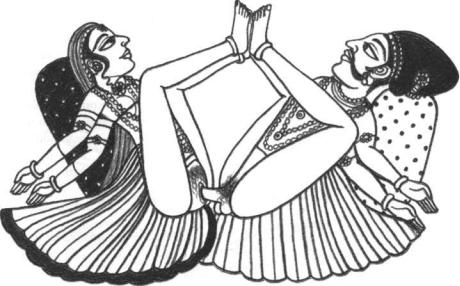
Tantric love-posture for channeling energy. The feet are brought together, creating a closed circuit between the couple. From a Rajasthani miniature, circa eighteenth century.
Such practices are, fortunately, self-limiting, and lead to delusion and corruption.
Karmic exchanges take place when the life-force moves along the central Great Axis (the Sushumna) of the Subtle Body. Generally it is the emotions that cause this movement. Tantric texts state that when a person is truly angry, the life-force commonly enters the Great Axis and a Karmic exchange with the person at w h o m the anger is directed invariably results. Fear can likewise force the life energy into the Great Axis and create a condition of Karmic exchange. Anger and fear are facets of a similar experience, and when these emotions are brought into role playing, Karmic exchanges take place. Sadomasochistic relationships revolve around this type of exchange; glimpses of transcendental tranquillity may be achieved through dominant/submissive role playing, but the long-term result is an unresolved Karmic imbalance that tends to manifest in self-destruction.
By developing an awareness of the subtle workings of Karma in human destiny, we evolve a frame of reference for understanding the seemingly erratic events of everyday life. Far too many relationships go wrong without any recognition of the real cause. It's no use blaming oneself or the other. Rather, the couple should share and discuss their hopes and fears, observing how their intertwined Karmas mold events. By channeling their desires consciously, the couple can become masters of their own destiny.
If a person is falsely accused of something, then the merit of the accuser is transferred to that person and the bad Karma of the accused goes to the accuser. One must never mistreat a guest, for the guest then takes the good
Karma of the host and leaves his or her own bad Karma behind.
PASHUPATA SUTRA /
SHIVA PURANA
Karma leads, Karma moves,
Karma takes, Karma follows; Karma binds, Karma releases, Karma gives, Karma never rests. The intelligent Yogi watches Karma and learns its ways; then, through the power of spirituality, steps aside from Karma.
VARAHI TANTRA
Brahma the Creative 55

The corpse posture (shavasana) requires total relaxation of each part of the body in turn. It clears tension and is a wonderful preparation for rejuvenating sleep.
When a person is entering deep sleep, then all the consciousness goes through the seventy-two thousand subtle channels that lead to the heart center from its circumference. At that time the soul rests in the covering around the heart.
BRIHADARANYAKA
UPANISHAD
sleep
The length of time one sleeps is less important than the quality of the sleep. Most city dwellers do not get as much relaxation and rest in their sleeping hours as they would in a natural environment. Because many environmental factors pollute and distort the quality of sleep, people often awake in the morning to find they've hardly rested at all. For this reason, many people take sleeping pills and tranquilizers to help them obtain the rest that is out of their reach. This, of course, is not a solution; sleep induced in this way is qualitatively different from natural sleep. Many problems in obtaining restful sleep can be overcome by a little conscious preparation. There is certainly no need to rely on pills.
It is not advisable to eat a large meal either late at night or just before sleep. The digestion functions best in harmony with the sun; in the morning, at midday or in the early evening there is plenty of digestive "fire" available. At night the body works at a different rhythm; it cannot break down food as easily as it can during the day.
While overeating tends to induce sleep, this sleep is due to a condition of physical morbidity and, as such, is unhealthful. The toxins in the undigested food clog the system and stop the flow of vitality. Eventually overeating leads to physical malfunctions and disease.
Mental and emotional conditions also affect the quality of sleep. Anyone who works in an office or with machinery should try to exorcise those "vibrations" from the body and mind before sleep. Take a bath or shower,
"switch o f f mentally from the day's work, stretch the body and do some Yoga, meditation, or dance; do whatever you can to get back into your natural inner rhythm. If the day has been particularly difficult, with emotional upsets, try to correct any internal "damage" by consciously regulating the breathing. Solar-lunar breathing is particularly helpful in such instances, as is the practice of the healing breath. Sleeping on the left side makes the breath become dominant on the right side, and vice versa. Normally people toss and turn during sleep, as the breath tries to attain balance between right and left.
The creative attitude also has the power to transmute negative energies, thus allowing a natural entry into sleep. The Yoga asana known as shavasana (corpse position), which consists of lying on the back, without a pillow, and tensing and relaxing each part of the body in turn, is another very helpful method for preparing to sleep.
Sometimes it is difficult to get to sleep because the mind is "racing," turning over ideas or problems. When this happens, it helps to turn the mind backward. The technique is to try to trace visually (not verbally or mentally) whatever came to your mind last, then the thought before that, the one before that and so on. Eventually a kind of "neutral zone" will be reached and natural quiet will take over the mind and lead one into sleep.
Love-making is the most powerful way to relax the body and mind. Sharing the natural energies of love is a form of communion that clears the mind and restores the body. The time spent in bed just before going to sleep holds some of the most precious m o - ments of the day. Removed from worldly concerns, you can contact your own and your partner's natural energies.
Sleep is a most natural activity and should never be viewed simply as an invitation to oblivion. By going to sleep consciously, one can enter the dream world and derive enjoyment and teaching from it.
As, when embraced by the dear woman, one knows neither anything external nor internal, so also a man, when deeply embraced by the inner self, knows neither anything external nor internal.
BRIHADARANYAKA UPANISHAD
56 Brahma the Creative