Материал: Snote
sweet dreams
Sleep and dreams are frequently spoken of as though they were the same thing, yet they are really quite distinct. During sleep the physical body rests and readjusts itself to the rhythms of nature. Eastern teachings state that at this time the consciousness settles into the region of the heart, focusing itself there from all parts of the body. The pattern of breathing is adjusted by the position of the body, which moves from one side to the other until sleep is obtained. While dreaming, the consciousness moves upward and, according to esoteric teachings, exits through the throat or head center. Rapid eye movements accompany most dream states, as do subtle movements of the face, mouth, throat, and extremities.
We spend about one-third of our lives in either deep sleep or dream states, yet most of us are totally oblivious of the significance of this time. Sleep, like breath, is a natural vital function taken completely for granted. With the exception of remembering a vivid dream or enjoying a particularly refreshing sleep, we hardly give any thought to what transpires during all those years of sleep and dream. For the couple, this time is crucial as it may either bind them together or estrange them.
People generally are quite secretive about the dreams they do remember, but the vast majority of dreams are either never remembered or carelessly forgotten upon waking. Yet each dream conveys a message directly related to past or future events. In a dream the unconscious mind strives to become conscious. Tantra views our normal waking state as itself a kind of dream. To liberate ourselves we must awaken from this dream state and face reality as it is. So, too, must we gain a conscious awareness of our dreams. This can be achieved by learning to remember our dreams upon waking. Resolve before going to sleep that you will remember your dreams. In the morning try to wake up slowly, bringing some of your dream into waking consciousness. Most dreams are lost through too-sudden awakening.
Once you learn to remember your dreams, share them with your partner without concealing anything. A subtle understanding will
develop between you, which will begin to permeate the dream world. At times you may even find yourselves sharing the same dream; at other times only some parts of your dreams will be in common. It's a wonderful experience to share a dream with the one you love. It helps deepen understanding and gives new meaning to the relationship.
Try to exchange dreams immediately upon awakening, while they are still fresh. A Dream Book or diary of dreams is helpful and can lead to a deeper understanding of personal destiny. With a Dream Book you'll be able to watch the development of dreams over a period of time and gauge how they relate to your life. Try not to analyze your or your partner's dreams, but rather enjoy their drama and relive them as they are recounted. Let dream interpretation be on the light side; maintain the imagery of the dream instead of trying to explain it all away.
Listen and learn from the communications of the unconscious mind while teaching and gaining control of it. Don't view dream content in the light of personality or ego, because doing so will create problems for you both, leading to petty recriminations. It's amazing how jealous a partner can become of what the other is doing in his or her dreams. Rather than being hypocritical, it's best to totally familiarize each other with your inner worlds. Take care not to tell dreams carelessly, or to entertain casual acquaintances with them. Dreams should only be told to those with whom one has a bond of trust and commitment.
The dream world offers a rich treasure house of symbols, images, and insights that should be shared with your partner rather than jealously guarded. Gaining conscious awareness of the dream experience helps a person to live a fuller life. Many revelations and sudden inspirations come directly from
At the time of deep sleep without dream, the consciousness stays in the region of the heart. At the time of dreaming, the consciousness moves to the neck. When one is not sleeping, it is located mainly in the navel region, and when male and female unite sexually in complete harmony and fulfillment, consciousness rests in the heads of the couple.
BRAHMOPANISHAD; ALSO, YIG CHUNG OF TSONGKHAPA
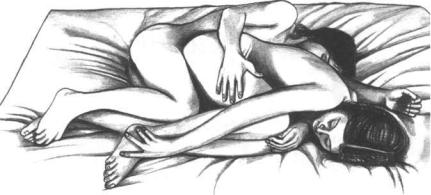
Fetal positions can be effective in gaining conscious control over dreams.
Brahma the Creative 57
a remembered dream, a level of awareness outside the limitations of time and circumstance. Dreams can connect us with the past or future and teach us how to live more fully in the present. They are a wonderful source of insight into the nature of our spirit.
One particularly effective way of entering the dream world in a relaxed manner is through stimulation of the sense of smell. This old folk custom leads to "sweet dreams," and is both relaxing and therapeutic. Select a perfume, sweet-smelling herbs, or flower pet-
als. Flowers and herbs can fill a pillow or a small sachet and be kept near or under the head. Alternatively, perfume can be sprinkled directly on the bed cushions. Being wafted to sleep by the smell of sweet flowers and herbs is a marvelously relaxing experience. The sweet scent creates a form of psychic protection and leads the spirit to sweet dreams. Rose petals, lavender, rosemary, thyme, jasmine, lotus, sandalwood, marijuana leaves, patchouli, and other exotic aromas are all relaxing and aid natural sleep.
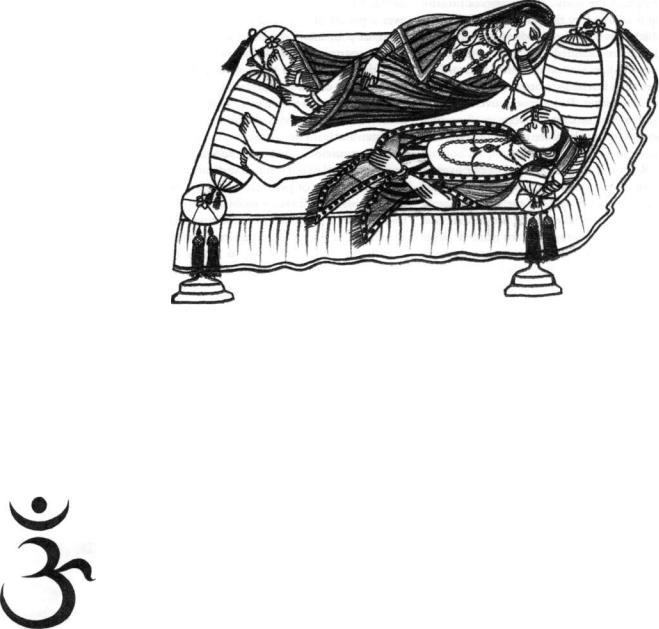
In Indian literature dream interpretation is given great importance. Tantra teaches that deep insights into both past and future can be attained through practice of Dream Yoga. Illustration from the Rasamanjari, Basohli school, circa 1695.
The spirit of the human being has two distinct dwellings: this world and the timeless world beyond. There is also a third place, the ever-changing world of dreams. When the inner spirit is in the land of dreams, then all world belong to that spirit.
BRIHADARANYAKA UPANISHAD
The Sanskrit word OM can be written several different ways. All have a resemblance to the number 3.
dream yoga
In a specialized branch of the Tantric teachings a number of specific techniques for gaining conscious control over the dream state are taught. These are referred to as Dream Yoga and the practices are con-
nected directly with the mind's natural faculty for visualization.
These practices are simple, direct, and especially suited to the highly developed intellectual capacities of the Western mind. In fact, it is surprising that no equivalent technique has emerged from contemporary schools of psychology. Dream analysis is quite different from Dream Yoga, and it leads to complex speculation on the meaning of dreams rather than to simple release or transcendental
58 Brahma the Creative
insight. The net result of dream analysis is often more confusing than liberating.
The first principle of Dream Yoga is to regard everything as a dream. This means that while awake and seeing, eating, smelling, walking, and so on, you should cultivate a kind of dream awareness, the thought that "this is all a dream." Of course one must continue to act with discrimination and responsibility. The object of Dream Yoga is to maintain an unbroken continuity of consciousness throughout both waking and dream states. A creative attitude and faith in your ultimate success are two crucial elements of this practice. It is best to avoid rich foods, overeating, and strenuous taxing of the body while practicing Dream Yoga. History records many instances of individuals receiving profound insights or even whole teachings while dreaming. Examples such as Coleridge's Kublai Khan, Edgar Cayce's medical diagnoses, and Watson and Crick's vision of the structure of the D N A helix testify to the revelatory nature of dreams.
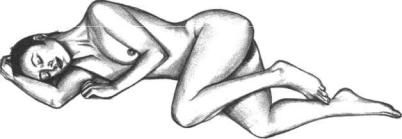
Before going to bed, take a bath or shower to relax the body. In addition, do some light breathing and meditation and then lie down on the right side. Lying on the right side creates a dominance of the lunar breath (linked to the left psychic channel), which is best suited to creative dreaming. The lunar breath, associated with the Shakti-power of creative energy and the intuitive faculty, enhances the learning of the arts and sciences, as well as all peaceful activities.
Use a scented pillow of suitable size, neither too hard nor too soft, to avoid strain on your neck. Be sure to keep your feet warm, either with bed socks or adequate covers. When you practice Dream Yoga with your partner, you both should lie on your rights side, your bodies closely embracing. The man should then imagine the Kundalini, the "inner woman," awakening and taking the form of a goddess. Imagine that you are two sisters, the left and right subtle nerves, intertwined like the caduceus wand of Mercury, each enhancing the finest qualities of the other. Entwine your feet and hands, slightly bending the knees. Try to keep a slight pressure on the right side of the face and throat; this can be done either with the pillow or with the right hand or arm. You'll find that in this position profuse saliva is produced. Let the saliva collect in the mouth and slowly swallow it, all the while imagining that it is feeding
and nourishing the Throat Chakra. Press the chin close to the neck and concentrate on the region of your throat. The most important factor during this stage of Dream Yoga is to fall asleep while maintaining an earnest desire to enter the dream world consciously.
Concentrate on the Throat Chakra and imagine it in your mind's eye as colored red. Visualize a red trident or a red " O M " within the brilliantly radiating red throat center. This visualization stimulates the junction of nerves in the throat and helps fix the consciousness there, which in turn leads to conscious entry into the world of dreams. This concentration of mind will also assist the process of dream remembrance. Another technique found in Tantric texts is to visualize yourself in the form of a dancing red goddess or Dakini. The Dakini is an erotic Wisdom-archetype conceived of as a young girl, very sensual, with full breasts and hips and with a Third Eye blazing with passion. This red Dakini holds a bowl and mystic chopping knife, symbolic, respectively, of compassionate ecstatic non - attachment and cutting through egoistic limitations and dualities. You will find the emotions easily identify with this image, causing them to be aroused. By intentionally invoking the emotions in this manner, a predominantly unconscious emotional reaction is put under conscious control.
One reason for retaining consciousness while dreaming is to develop the faculty for transforming one dream image into another. Once you are conscious of your dream world, the ability to transform dream images will occur naturally. Through such practices a deep insight into the nature of existence will develop.
Various initiatory forms will begin to manifest in dreams as distinct entities with personalities. These may have a sexual implication, taking the form of extremely beautiful male or female figures; if you identify them with your human partner, rather than preserve them as a source of private fantasy, they will enrich the relationship. A number of Western magical texts refer to such male and female initiatory forms as
incubi and succubi, evil spirits that
The Yogi who can recognize
dreams fairly well should practice the transformation of dreams. This means that in the dream state you should try to change
yourself into a bird, a tiger, a lion, a king, a forest, a house, or anything you like. Then trans-
form into a |
Buddha-body, |
sitting |
or standing, |
large or small. |
Also, |
try to transform the things seen in dreams into different objects; for instance, an animal into a man, water into fire, earth into space, one into many, or many into one. Practice the various supernatural powers, such as shooting fire from the upper body and water from the lower part, trampling on the sun and moon, or multiplying your body into millions and billions, to fill the entire cosmos.
SIX YOGAS OF NAROPA
Tibetan texts indicate that dream control can be achieved by lying on the right side, so the left breath is dominant, and focusing consciousness on the throat.
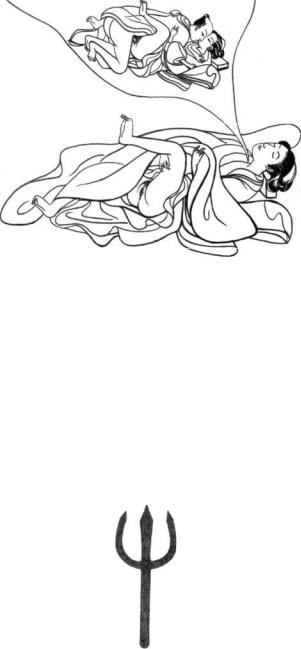
The texts of Dream Yoga suggest that dreams originate at the throat center (Throat Chakra). This illustration depicts a woman having an erotic dream. From a Japanese print of the eighteenth century.
The trident is a symbol of Shiva, the Supreme Yogi. It is also symbolic of the junction of nerves at each psychic center.
seduce sleeping persons. The medieval wizards and witches (who were, essentially, sensitives or psychic mediums) were accused of associating with such phantom beings. Eastern teachings indicate that these spirits are related to past lives; they are protective entities, mystic forms of esoteric teachers or otherworldly beings. Western incubus/succubus folklore is found in connection with sexual superstitions, taboos, witchcraft, and black
magic. Involuntary emission of semen at night, or "wet dreams," was, until recently, associated with the devil or evil spirits. The Christian Church, with its emphasis on guilt and sexual repression, has been largely responsible for misconceptions about incubi and succubi.
Contemporary psychoanalysis fully accepts the sexual nature of most dreams. Whether sexual imagery stems from unfulfilled desires (the Freudian theory) or from the collective unconscious (the Jungian theory), its significance is beyond doubt. The Tantras teach that through knowing and confronting these mystic dream entities one can, in effect, live out all future lifetimes, thus obviating the necessity for rebirth.
Try to identify dream entities with yourself and your partner rather than with a magical or extraterrestrial source. Above all, don't conceal such dream experiences from the one you love, for doing so may cause a feeling of separateness. The Dream Book and all discussion about dreams must be absolutely candid.
The classical Chinese text on Taoist sexual practices, Yu-fang-pi-chuch, describes an ex-
periment for proving the existence of a succubus or incubus. The text advises:
One should go off to live alone, in a place far away from other humans. One should stay there in complete tranquillity, staring into space and concentrating one's thoughts on sexual intercourse. After three days and nights the body will suddenly feel alternately cold and hot, the heart will be troubled and the vision will begin to blur. Then a man who is practicing this experiment will suddenly seem to meet a woman of great beauty, and if a woman is practicing, she will meet a handsome man. If one experiences sexual intercourse with such a succubus or incubus, it will seem that the pleasure is greater than with any normal human being. But at the same time a physical lethargy will be created, which will be hard to cure.
The text later explains that one should refrain from sexual intercourse and conserve sexual energy so that one can "make love to a human woman (or man) for a whole day and night, without ceasing. When the body is so weary that one is unable to continue with the act of sex, the sexual organs should remain united." This will ensure that any disease caused by the succubus or incubus will be cured.
When a dream nears its climax, the unifying thread of the dream should be determined. Select the most significant image or images that give a dream coherence. Try to retain this image and value it as initiation into the realm of the unconscious. This method will enable you to awaken with full knowledge of the dream and the subtle meaning of the experience. Dream Yoga is a source of inspiration and initiation outside the limitations of time and space.
Going up and down in the dream state, the higher aspect of the dream spirit can assume many different forms; this may become enjoyment in the company of beautiful women, or laughing with companions, or even beholding wonderful or terrible sights.
BRIHADARANYAKA UPANISHAD
60 Brahma the Creative
mantra and yantra
The special relationship between sound and form has fascinated philosophers and scientists since the earliest times. Eastern spiritual teachings have included the study of this relationship in the science of metaphysics. In the East the whole visible universe is said to have evolved from a primordial sound that differentiated into approximately fifty "matrix energies" or vibrations during the process of outward expansion. Thus, everything that we can perceive is linked to a primordial sound.
The Tantric teachings refer to four distinct stages of sound emanation: unmanifest sound, becoming manifest sound, luminous enclosing sound, and enclosed sound, the last of which also has form. Unmanifest sound is conceived of as "unstruck," without any vibration, and comparable to the moment just before a thought surfaces in the mind. The
Narada Purana, a text that deals particularly with the properties of sound, states that "struck sound gives pleasure, whereas unstruck sound leads to Liberation."
Yogis of the distant past discovered many of the natural relationships between aspects of the phenomenal world and the source of all phenomena. Their years of solitary meditation helped them to abstract themselves from physical, emotional, and mental activities, thus allowing them to perceive reality as it is. They recognized a number of primordial "seed-syllables" or matrix-sound vibrations, which could be combined to produce a series of Mantras.
A Mantra is a protector of the mind, used to augment consciousness. There are three stages in the use of a Mantra: the outer stage, in which sound is uttered aloud; the middle stage, in which it is uttered softly (barely audibly); and finally the inner stage, in which it is repeated silently in the mind. The third stage is the most powerful, but it is necessary to begin by repeating the Mantra aloud so that its vibration resonates with and transforms the vibration within each Chakra. Gradually, the Mantra should be drawn inward, where it will potentiate the psyche and move the spirit toward reunion with the primordial source.
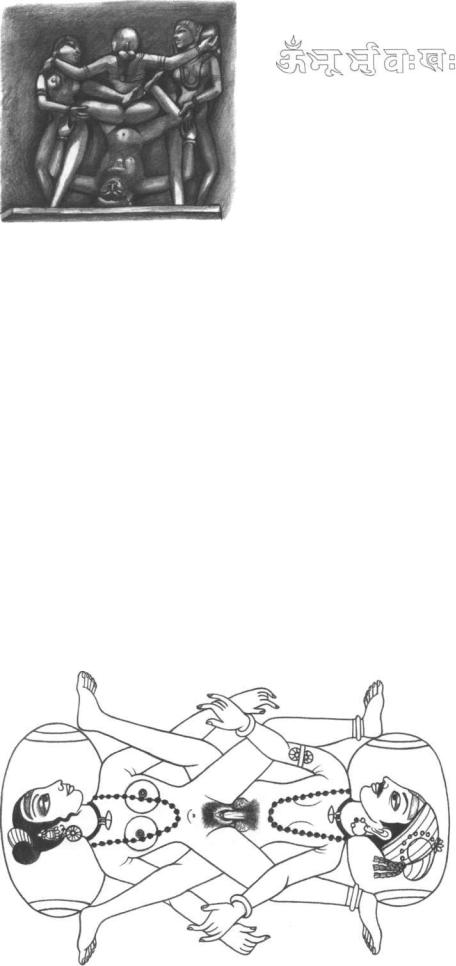
Complex love-posture of a Tantric type. The man is inverted, so energy is channeled to his head. His three female partners mimic the roles of the three main subtle nerves, which instill transcendence. This love-posture is a Yantra designed to create high energy channeling. From a stone sculpture, Khajuraho, India, circa eleventh century.
Traditionally, Mantras are received from a teacher or Guru. There are many kinds, of varying power and effect. Sometimes they are received intuitively or inspired by hearing a natural sound or animal noise. They can also be acquired through trance, vision, telepathy, dream, or a state of prolonged Yogic absorption. They are used to protect the body from negative psychological influences and to concentrate the mind during day-to-day activities. They are also employed in ritual or magical works. It is said that a true practitioner of Tantra always has a Mantra in mind, even it it's not actually being uttered aloud. Mantras are used in association with breathing practices, meditation, ritual, and love-making. They help awaken and channel the Kundalini, and also aid in
The Sanskrit Mantra "OM - BHUR - BHUWAH-SWA," written in traditional Devanagri script. Known as the shorter Gayatri, it evokes the Three Realms (this world, the next world, and Eternity) and is effective in imparting spiritual direction to magical acts.
The source of all names is the word, for it is by the word that all names are spoken. The source of all forms is the eye, for it is by the eye that all forms are seen. The source of all action is the body, for it is by the body that all actions are done.
BRIHADARANYAKA
UPANISHAD
In the Tantric tradition, postures are chosen to create harmonious shapes through which energy can be channeled and resonated.
These love-positions are referred to as Yantras. From a Nepalese painting of the eighteenth century.