Материал: Snote
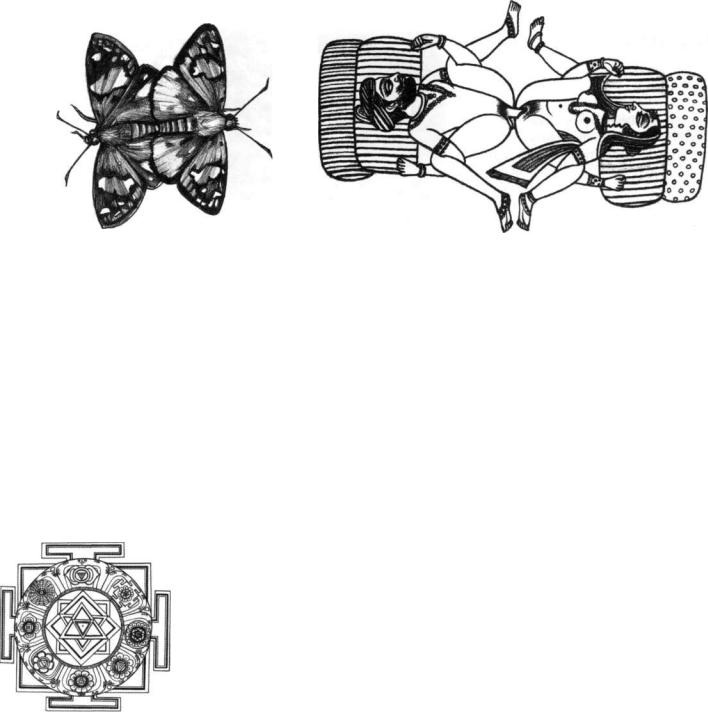
Love-positions evolved from mimicry of postures naturally practiced by animals and other creatures. Here a royal couple make love like moths. From a Jodhpur miniature painting, circa 1830.
Eightfold Yantra of the heart center, with symbols of the elements located on the eight petals. This Yantra is a Tantric meditation device for creating natural harmony of emotions. From a Nepalese painting of the late seventeenth or early eighteenth century.
controlling sexual energy. " O M " is the bestknown Mantra and is, in essence, the manifestation in sound of the creative attitude, the "sphere of Brahma."
Every element and entity is part of a specific evolutionary order, a cosmic "hierarchy." The science of sound (Mantrayana) and the subtle relationship of sound to form and color provide a key to understanding and contacting this hierarchy. Traces of this viewpoint are found in such Western medieval theories as the Doctrine of Signatures, in which herbs, fruits and minerals, among other natural things, were related by their color, shape, and name to the parts of the human body as well as the celestial bodies. Thus, a walnut, resembling in form the cerebral cortex, was used to cure headaches and brain diseases. A number of important medical discoveries came out of this superficially simplistic view.
The Tantras declare that sound and form are directly related. Just as a musical note or tone can be demonstrated to have a particular pattern, so every Mantra has a distinct form; this is known as its Yantra. So it is that a Mantra, or matrix form, is both the shape of a sound and a means of focusing thought on the subtle source from which all phenomena emerge. Tantras speak of our body as our personal Yantra and the sound of the breath as our personal Mantra. And if we follow an evolutionary path, how we live our life becomes our personal Tantra.
Our personal Yantra may alter when we change posture, and our breathing Mantra may alter when we exert ourselves excessively. However, each of us is distinguished by a characteristic form and sound. The Tantric viewpoint recommends continual
awareness of both inner and outer sounds and form or posture. This applies particularly to the Mantra and Yantra of our body and mind. When standing, walking, sitting, lying, during all activities, remember to be aware of the shape of your body. Listen to the sound of your breathing and learn to recognize the subtle variations of breath. When making love, move consciously into position and reflect on the shape of your intertwined bodies. Notice the sounds of your breathing and try to practice either internal or external repetition of Tantric Mantras.
Concentrating the mind on the practice of a Mantra during love-making helps to make the experience both uplifting and liberating. Once again, it is the proper mental attitude that is important. Mantras are tools that aid in maintaining concentration and can be dispensed with if mental distraction is not a problem. But remember that a Mantra protects the mind and don't hesitate to use one with this intent during love-mak- ing, especially if negative thoughts are disturbing you . It will bring clarity and direction to the experience.
Various love-making postures, which are described and illustrated in the last section of this book, are related to animals. Practice of these postures can be accompanied by the Mantras that evoke the sounds of the animals themselves. Remember to contemplate the link between a sexual posture and the special quality of the animal from which the posture was derived. Thus, butterflies and moths make love a certain way (generally reversed to each other) and have the special ability to metamorphose from one type of being into another. A similar Yantra endows us with some of these qualities.
62 Brahma the Creative
There are many complex erotic postures |
ings indicate that Mantra, Yantra, and Tantra |
in the Tantric tradition. Some of these are |
together form the key that unlocks the sexual |
allegorical reminders of the Yantras that hold |
secrets, enabling us to communicate directly |
together the material world. Eastern teach- |
with the divinity within. |
The Yantra is ensouled by the Mantra |
and the personal deity is the expression |
of the personal Mantra. As the body is |
to the Jiva [the individual soul], as oil is |
to a lamp, so is Yantra the established seat of all divinities.
KULARNAVA TANTRA
the mantra "OM"
In an early Hindu scripture, the Mundaka Upanishad, the following beautiful statement
occurs: " O M is the bow, the arrow is the
individual being, and Brahma is the target. With a tranquil heart, take aim; lose thyself in Brahma, even as the arrow is lost in the target." " O M " is the boat that enables one
to cross over the rivers of fear, " O M " is the creative power in evolution, " O M " is the
sound of true love; all other Mantras emerge from and recede back into the Supreme Mantra. Its form and power are certainly worth knowing and perfecting.
An analysis of this Mantra discloses a tripartite composition, the universal "three forces in one." These parts differentiate into the sounds "A" (pronounced "AH"), " U " (pronounced "OO"), and finally " M " (pronounced "MM") . The last is intoned until
the sound dies |
away completely. Thus, |
" O M " or "AH |
OO M M " should be care- |
fully pronounced, using the whole mouth, with a deep tone for men and high tone for women. The texts state that the first part,
"AH," should be short, the next part, |
"OO," |
slightly longer, and the final " M M " |
should |
be longer still. |
|
The Mantra " O M " precedes every complex group of Mantras. It is the emanative support of all created things, the original sound of Brahma, the Creator. It may be practiced either silently or vocally, but in either case the vibration of " O M " should be thought of as permeating your whole being.
" O M " helps purify the physical, emotional, mental, and subtle aspects of the self and brings with it many other benefits.
The traditional Sanskrit form of writing " O M " is rather like the number 3, or a trident turned clockwise a quarter-revolution. Its resemblance to the number 3 calls to mind the three subtle pathways that converge at the Chakras.
Traditionally, the emblem of a moon and sun, surmounted by a flame, is depicted above the Sanskrit or Tibetan word " O M . " This glyph represents the full resolution of all dualities: male and female in harmonious union, sun and moon in eclipse, consonants and
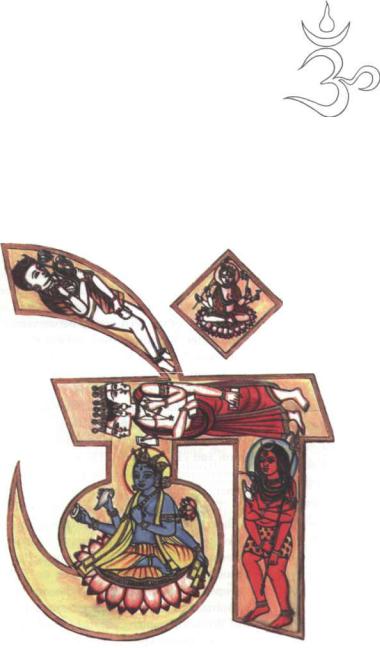
A Sanskrit version of the Mantra "OM."
The Mantra "OM," ornately drawn, with Brahma, Vishnu, and Shiva depicted in the main body of the Sanskrit letters. Above, a Tantric form, known as Sadashiva, is shown ascending, with an androgynous Shiva/Shakti form in the silent "M" of this seed-sound. Traditional texts state that the Mantra "OM" contains the trinity of gods. Painting from Rajasthan, circa eighteenth century.
Brahma the Creative 63
There are two ways of contemplation on Brahma, the Original
Source. These are in sound and in silence. By sound we go to silence. The sound of Brahma is "OM." At the end of "OM" there is silence.
MAITRI UPANISHAD
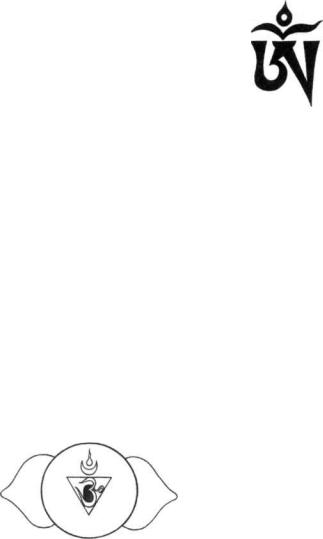
A Tibetan version of the Mantra "OM."
vowels returned to their original primordial point of emergence. For the Tantric couple it symbolizes the consummation of love.
" O M " is also a glyph of the Subtle Body. The sun symbolizes the solar energy at the Navel Chakra and its subtle nerve, the pingala, which reaches from the Sex Chakra, at the base, to the Head Chakra. The moon symbolizes the lunar effulgence of the Head Chakra and its subtle nerve, the ida, which reaches from the sex region to the head, on the left side of the body. The flame symbolizes the ascended Kundalini, dancing in ecstatic union. Thus, the sound of creation " O M " also evokes the cosmology of Liberation.
Let the wise practitioner of Yoga destroy the multitude of Karmas by the Mantra "OM"; let him mystically rearrange his body functions. Thus, he will cease to participate in the consequences of action and need no longer be reborn again.
SHIVA SAMHITA
Depiction of the Ajna or "forehead Chakra" of later Hindu Tantras. It shows a two-petaled lotus containing a circle, a triangle, the syllable "OM," and a Lingam, symbolizing the pineal gland.
Let the Yogi contemplate the inner moon, located in the Head
Chakra. Let him visualize the nectar-containing moon and then learn to drink the nectar flowing from it. By this practice the Drops of Wisdom are absorbed and
Liberation is quickly attained.
SHIVA SAMHITA
drops of wisdom
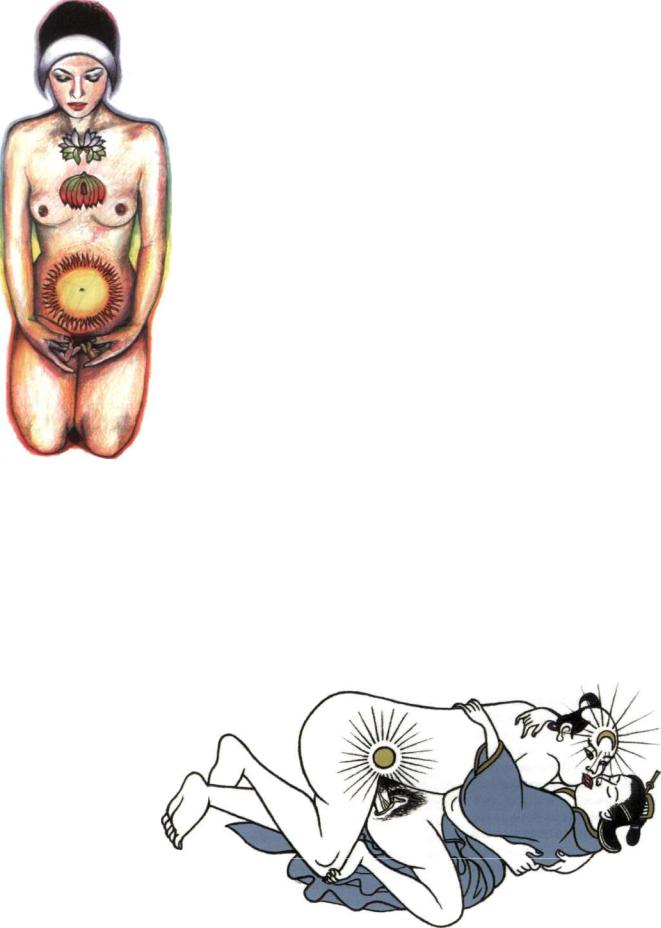
Because of the predominance of these two forces in the heavens, solar and lunar forces pervade all metaphysical treatises. When an awareness of the relationship between inner and outer, the microcosm and macrocosm, developed in man, it was natural to identify this relationship with solar and lunar forces. The solar forces reside in the navel center and are visualized as a lotus with sixty-four petals, or as a blazing sun with sixty-four flames, each of which has a particular function and characteristic. These "solar flares" are referred to as Shaktis or Dakinis and represent the transforming power of the psyche.
The inner moon is located in the Head Chakra. It is visualized as a lotus with thirtytwo petals, or as effulgent rays emanating downward. The downward-pointing "inner moon" showers subtle secretions or "Soma drops," which nourish the psycho-organism. Tantric texts refer to these secretions as Drops of Wisdom, emphasizing that a Yogi should endeavor to prevent them from being "burnt
up by the inner sun." The Gheranda Samhita, for example, states: "The sun dwells at the root of the navel, and the moon at the root of the palate. As the sun eats up the nectar secreted by the moon, humans become subject to death."
The concept of Drops of Wisdom can be understood as involving several different stages, from the purely physical to the subtle biological and finally the mystical. The first stage refers to the profuse secretions of saliva that accompany physical desire; food and sex are the two main agents that cause salivation. When food is eaten, it mixes with the saliva, which aids mastication, and is passed to the stomach for digestion. In the stomach the saliva helps the process of digestion and is itself assimilated by the action of the gastric juices, the "digestive fire."
The second stage, the subtle biological state, is linked to the action of two glands, the pituitary and the pineal. Yogic texts that speak of the "melting of the inner moon" and the "opening of the Third Eye" are undoubtedly referring to the biophysical processes that occur in these two glands when consciousness is focused in the head center. It is interesting that Tantric descriptions of other psychic centers within the head center
64 Brahma the Creative
closely correspond to the physical structures of these two glands.
The pituitary gland is divided into two parts and is located in the middle of the brain ("above the palate," in the Yogic texts). It has an oval form and two lobes, and produces hormones that regulate sperm production, testosterone levels, ovulation, uterine contractions, secretion of breast milk and urine, and bodily growth. In addition, the pituitary governs and stimulates the thyroid gland (which controls metabolism, growth, and development) and the adrenal glands (which control digestion, blood pressure, pulse rate, and other vital functions). Hormones, which are produced by the glands, are biochemical "messengers" that enter the blood stream and travel to all parts of the body, controlling and governing through their catalytic action the various bodily processes.
The pineal gland is located further forward than the pituitary and is conical in shape with two lobes. It is larger in a child than in an adult, and generally is of a greater size in women than in men. The function of the pineal gland is not understood by Western medicine; however, it contains structures very similar to those found in the human eyeball and secretes substances containing high levels of phosphorus salts. ESP activity has been observed in subjects with enlarged or highly active pineal glands. There are many indications that this gland is the "Third Eye" referred to so often in Yoga.
The third stage of the Soma drops is mystical, and acts on both inner and outer levels. On the inner level the action is a subtle communion with the lineage of transcended teachers, departed Wisdom-spirits of those who have liberated themselves from this world, but who still act as subtle guardians and guides, influencing humanity through the unconscious. It is their "Wisdom drops" that one receives as flashes of insight and inspiration. On the outer level, mystic Soma drops are tears shed out of loving communion, ecstasy, and transcendence.
Yogis of the distant past understood the subtle workings of their bodies and used psycho-cosmic symbolism to explain their insights to others. Meditations and practices were developed to consciously cause the Drops of Wisdom to flow on all levels simultaneously. Thus, the physical body can be helped to digest food and control vital
functions, the glandular system can serve its regulating and motivating role, the emotional system can participate in mystic release, and the lineage of "ancestors, guardians, spiritguides, and fully realized beings" can pervade and influence the psyche.
Several Tantric meditations were de-
veloped to stimulate the secretion of Drops of Wisdom from the Head Chakra. In most of these the inner fire of the Navel Chakra is first
stimulated, usually through breathing techniques. As the psychic fire burns up
all bodily impurities and Karmic obstacles, a pressure builds up, rises and "melts the moon" in the head. The Chakrasambhara
Tantra gives the following description of one such process: "Imagine a dazzling white
' O M ' in an inverted position, and
upon that the first letter of the vowels, 'AH,' from which a lunar disc emerges. The rising steam from the inner heat of the Navel
Chakra |
causes the |
' O M ' |
and |
the lunar disc |
to drip |
nectar and |
emit |
rays |
of light. These |
one should conceive of as nourishing and transforming the whole psycho-system."
Yogic texts emphasize that one should try to stimulate the secretion of Drops of Wisdom and at the same time stop them from being wasted. The Goraksashatakam declares:
In the region of the navel there is a burning sun, while at the base of the palate there is an effulgent moon, full of nectar. The downward-looking inner moon showers nectar, and the sun, with his upturned mouth, swallows it. In this connection those secret practices by which the nectar can be obtained and preserved should be known. If a person can retain the nectar of the moon, avoiding the open mouths of the inner sun, then the body ceases to be affected by physical decay and is outside the reaches of death. Furthermore, the semen of a Yogi whose body becomes filled with this nectar moves upward and gives rise to many miraculous powers.
The secret practices referred to are several. The most straightforward is the Yoga head stand (shirsasana), which reverses the natural flow of lunar and solar currents in the body.
Reverse postures stimulate the pineal and pituitary glands in the head. As a result, the whole body is invigorated. From a central Indian miniature painting, circa early nineteenth century.
There is a curved duct from the inner moon to a hollow in the palatal region; this is known as the shankini nerve and leads to the upper lip. This is the curved duct through which the nectar or elixir of the moon can pass. It is described as being like a serpent with mouths at both ends; the mouth of this shankini nerve, through which the Soma pours down from the moon, is called the "tenth door" of the body. It is a great secret.
GORAKSAVIJAYA
Brahma the Creative 65
Simple representation of the Subtle Body. Four psychic centers are shown: a blazing sun at the navel, a downward-pointing lotus at the heart, an upward-pointing lotus at the throat, and a moon in the head region. Spiritualization takes place when the psychic centers interact.
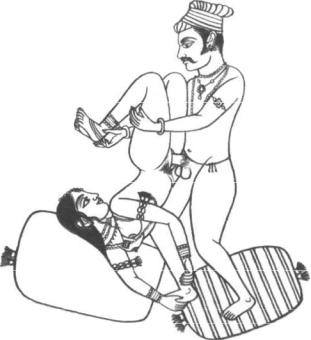
The pituitary and pineal glands become activated by such inverse postures, and salivation is produced and concentrated in the head region. Tantric Yoga texts refer to inverse postures as viparitakarani (reverse system) and the
Gheranda Samhita states that "By the constant practice of such postures, decay and death are destroyed. One becomes an adept and does not perish, even at the conflagration at the end of an eon." Inverse sexual postures are also included in this category.
Another of the secret practices, khechari
(sky flier), consists in the gradual elongation of the tongue (over a period of weeks or months) and the reversal of it to cut off the loss of Soma drops. The Gheranda Samhita describes the technique as follows:
The tongue is milked and stretched until it becomes long enough to touch the space between the eyebrows. Then it is turned upward and backward until it reaches the nostril openings inside the head. These holes are sealed with the tongue, inhalation is stopped, and the gaze is fixed on the space between the eyebrows. When the tongue touches the holes inside the head, it obtains various juices and the person experiences new sensations; first a saltish taste, then alkaline, then bitter, then astringent, then of butter, then of clarified butter, then of milk, then of curds, then of whey, then of honey, then of palm juice; lastly arises the taste of nectar. This practice eliminates feelings of hunger, thirst, and laziness. It prevents disease, decay, and death. The body becomes divine and cannot be harmed by any elements.
Obviously such an evolved technique is out of the range of most people. It should not be attempted or practiced without the guidance of a skillful teacher, and presupposes a total control over the breathing function.
A Yogic technique known as Jalandhara
(liquid holding) Mudra (seal) and linked to the Nabho (navel) Mudra is a far simpler secret practice for retaining the Drops of Wisdom from the inner moon. According to the
Gheranda Samhita, the Jalandhara Mudra consists simply of "contracting the throat, by forming the neck into a hook shape and placing the chin near the chest." This effectively closes channels through which the Soma drops are lost. The Nabho Mudra should be practiced at the same time, and the Gheranda Samhita describes it as follows: "In whatever business the Yogi is engaged, wherever he be, let him always keep his tongue turned upward toward the palate, behind the upper front teeth, and restrain the breath consistently and consciously."
There are a number of secret practices specific to love-making. The most important recognize that the saliva produced during sexual excitement contains rich trace elements and should be exchanged with the partner. The Taoist teachings of China also refer to the importance of saliva to mystic love-making, claiming it contains a unique "wisdom property." The T'ang dynasty classic Fang-nei-pu-i recommends swallowing the saliva of the female partner during love-rites because of its ability to impart health and wisdom: "In order to live long, without growing old, a man should play with and excite the woman and drink in her saliva. He should
Taoist texts advise the visualization of solar and lunar forces in the body as aids to spiritualization. From a Japanese book illustration, circa 1750.
66 Brahma the Creative