Материал: Snote
feature of their dietary system is the categorization of foods by "taste." All the qualities inherent in food are believed to be represented by six primary tastes, which through various combinations create all the flavors we know. These six tastes—sweet, sour, salty, pungent, bitter, and astringent—determine by their proportion, balance, or imbalance the wholesomeness or unwholesomeness of food and its palatability to the individual.
Yogic teachings explain that the taste buds extract the essence of the food before it is passed on to the stomach, where the physical process of digestion takes place. We in the West concern ourselves with the protein, starch and vitamin content of the food we eat, but rarely consider the subtle transformation of food from physical matter to emotional, mental, or spiritual energies.
In general, Westerners have a tendency to be overweight. We eat to excess and then become infatuated with diets. The Yoga tradi-
tion counsels eating in moderation, regularly and at the proper time; it teaches us to become aware of the digestive function and balance intake w i t h the needs of our temperament.
According to Yogic texts, the taste of food has a direct effect on the feelings and sentiments and subtly influences the Spirit. One combination of tastes can cause elation and eroticism, while another can cause irritability or anger. The relationship between "taste" and "feelings" has been researched over a period of two thousand years, as well as expounded by Yogis, who have observed their bodily processes in a heightened state of awareness. Since we know that individuals vary in their temperaments, it seems logical to take this temperamental diversity into account in any study of nutrition. Yogis consider a finely tuned nutritional balance of great help in the achievement of spiritual development and, ultimately, Liberation.
Food is the chief of all material things. It is the medicine for all kinds of disease. From food all things are born.
TAITTRIYA UPANISHAD
food of the gods
Many diverse cultures have evolved rituals centering on the partaking of food as a sacrament. Sacramental food is generally normal food that is believed to possess spiritual qualities because of a conscious identification by a priest, shaman, or other religious figure of the food with a spiritual source. The concept of "empowering" food and taking it as a sacrament is found in the Christian as well as the Hebrew tradition and is usually associated with prayers or "grace" being said over the food. From another point of view, all wholesome food might be considered sacred because it is a life-sustaining gift. In
Tantric philosophy all food is dedicated to nourishing spirituality.
Eating is also a highly erotic experience, akin to love-making in many respects. Take care to extract the very most from shared meals. Eat in moderation and choose food that is seasonal; learn from experience what is suitable or unsuitable. According to the
Gheranda Samhita, at the beginning of Hatha Yoga practice one should refrain from eating excessively acid, bitter, salty, or pungent foods. The same text gives good advice about quantity, advising that "Half the stomach should be filled with food, one quarter with water or other liquid, and one quarter should be kept empty to aid the practice of breath control."
The Yoga teachings point out that the mental attitude of the person who prepares food permeates the food in a subtle way. A
A person who practices Hatha Yoga without moderating the diet falls prey to various diseases. The
Yogi should eat rice, barley, beans, nuts, fruit, and other wholesome things. Pure, sweet, and cooling foods should be eaten to half fill the stomach. This is called moderation in diet.
GHERANDA SAMHITA
One must eat in measure, and the measure of food is determined by the strength of one's gastric
fire. A proper measure of food is
that which is well digested in the appropriate time. The daily diet
should be made up of food that
not only helps to maintain wellbeing but also serves as a prophylactic against disease. From the moment of conception some people are equibalanced as regards the proportion of elemental principles in the body; others have a predominance of one element or another. The person who has an inner physical balance alone enjoys perfect health, while all others are ever liable to disease.
CHARAKA SAMHITA
Brahma the Creative 47
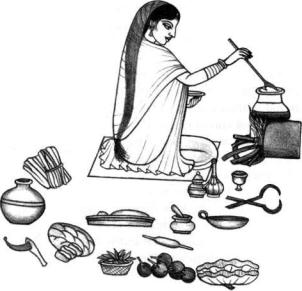
Yogic cookery requires that all ingredients be carefully cleaned and prepared before being mixed. The mental attitude is believed to influence the subtle tastes of food. From an Indian miniature painting, Chamba, circa 1810.
The wise person who seeks happiness in both this world and the next should exercise great care in selecting wholesome and invigorating food to eat. Light articles of food contain a predominance of the qualities of space, air, and fire. The heavier foods contain a larger proportion of the properties of earth and water.
CHARAKA SAMHITA
good Yogi can tell the temperament of the person who has cooked a meal by eating the food. Likewise, the mental attitude of the person eating the food affects the digestive process, so don't brood or let yourself get irritable when either preparing or eating food. It's best to meditate, contemplate or sing while preparing food as these activities help to focus the mind and add to the sacramental quality of the meal. Try also to be aware of the properties of the food as you mix together the various ingredients. Above all, don't taste the food while you are preparing it, for this robs it of its sacramental quality. No meal can truly be served as an offering if it has already been tasted. In the East if a meal has been sampled, it is considered eaten and no longer fit to be served. When cooking, the desires of the self should be set aside.
Yoga teachings categorize food into three main types, according to their effects on body and mind. These three types are related to the triad or trinity of forces that pervades all things. The first category is known as sattvic, which directly nourishes creative energy and attitude. Sattvic foods include milk, honey, butter, dairy products, nuts, grains, most fruits and all vegetables that grow above the ground. All these foods are related to the "sweet" primary taste in particular and are credited with the capacity to stimulate the creative and erotic sentiments. The higher nature of mind is also termed sattvic and has conscious awareness as its essential property. All sattvic foods stimulate the primordial elements of space and air in the bodily vehicle,
and therefore promote growth and creativity. This category is commonly termed the "Food of the Gods," the "milk and honey" of the Biblical tradition.
Indian medical texts declare that the taste essence of food is transformed successively into blood, flesh, fat, bone, marrow, and finally semen or ovum. The taste of food thus influences the taste of sexual secretions. The texts suggest that "The best semen [for healthy offspring] is that which is sweet, nonirritant, and of a transparent white crystallike appearance."
The second type of food, rajasic, induces the passionate sentiment. This category includes all foods that are heating and stimulating, such as the root vegetables, spices, salts, most fish, red meat, and chicken. These foods are related to the salty and pungent primary tastes in particular, as well as to combinations of taste that include the sweet.
Animal products are considered suitable for human consumption only when very fresh and carefully prepared; otherwise longterm side effects are produced. Rajasic foods stimulate the senses, have heating and burning effects, are difficult to digest and produce many waste products. Yogic texts advise those who desire to eat birds or animals to hunt them, as this exercise stimulates both the gastric fire of digestion and the excretion of waste products through perspiration. The effect of such foods on the sexual secretions varies, depending on the ability of the individual to transform these morbid aspects. Generally, the semen becomes thick and slimy, with salty, fleshy, or fetid qualities and odor. The secretions from the Yoni take on the same characteristics.
The third type of food, tamasic, is evocative of the furious and destructive sentiments. In this category are included all foods that derange or distort the senses, either through their excessively pungent, bitter, or astringent tastes or through inner putrefactions. Particularly strong foods such as onions, garlic, and chili peppers, as well as foods that are cooked in heavy oil or deep-fried, create destructive feelings unless prepared with great knowledge and care. The heavier meats and eggs fall into the tamasic group also; generally, any food that creates excessive body odors or flatulence is of this category.
Tamasic foods eventually bring about an increase in the elements of earth and water, which manifest in the body as mucus, fat,
48 Brahma the Creative

and general physical heaviness. Sensitivity is greatly diminished and a very materialistic attitude to life predominates. Sexual secretions take on unpleasant characteristics and sexual intercourse ceases to be sensitive lovemaking and reverts to a blind striving for purely physical satisfaction.
The wise simplicity of this categorization of food makes it a useful and reliable system for determining what is suitable or unsuitable for consumption. Our choice of food should relate to our lifestyle and goals. A materialistic person will find that the Food of the Gods tastes insipid, whereas a Yogically attuned individual will delight in the simple and subtle tastes of fruit and vegetables. The
sportsman will usually prefer to eat the animal protein foods, such as steak and eggs, since these are drawn upon and broken down by the extremes of physical exertion. Sattvic or "spiritual" food is best for the Tantric couple. Foodstuffs from the rajasic category can be added to this basic diet, especially when extra stimulation is needed. A basic blend of these two categories provides great range and variety, the secret being the correct balancing of the elements. Incorrectly balanced or stale food falls into the tamasic category. Experiment with different combinations and use the spicy elements delicately to create infinite and subtle variations of the Food of the Gods.
A wholesome diet promotes healthy physical and spiritual growth in a person. Indulgence in an unwholesome diet produces disease and worldly problems.
SUSHRUTA SAMHITA
In India food is commonly still eaten with the hands, which are well washed before the meal. Meals are often served on plates made from leaves, as was the custom in ancient times. From an Indian miniature painting, Bilaspur, circa eighteenth century.
water
Fresh water is necessary to the well-being of the body. Most water is fluorinated, chlorinated, and contaminated from its passage through miles of metal pipe. Therefore, if you live in a city, it's well worth spending the money to purchase fresh spring or mineral water in bottles. On the average, we require about seven glasses of liquid a day. Fresh water is the most purifying and invigorating of all drinks. Taken first thing in the morning, its capacity to tone up the organs and
senses has earned it the title of "nectar" in the Tantric tradition.
Rainwater is especially purifying and ancient Yogic teachings declare that the season of its collection changes the quality of the water and its therapeutic effect. Mineral water with high calcium or silica content is particularly suitable for the table, as is the naturally sparkling water from health springs. Avoid drinking large amounts of water near or during mealtimes. Doing so dilutes the digestive juices, and thus impairs the digestion of food. Drink only enough to purify your taste buds during the meal. Generally it is not advisable to drink water late at night, or water that is excessively cold. For digestive problems, a glass of warm water works wonders.
For all the six primary tastes, water is the common source; water and the sense of taste are intimately connected.
CHARAKA SAMHITA
The fish posture (matsyasana) evolves from the lotus posture and is ideal for relaxation. It is particularly suited to follow bathing, prior to Tantric ritual. During practice of this posture meditate on yourself as a fish swimming against the current, while slightly moving the hips and pointing the fingers. It helps you gain control over watery elements in the body and endows your whole being with vitality.
Brahma the Creative 49

Fruit juices and liquid foods have a very high water content. As such, they are easily assimilated and are ideal for revitalizing and invigorating a tired body. Fresh fruit juices, rich in natural sugars, vitamins and minerals, are highly recommended for the Yogic way of life. Modern juice extractors make fresh
fruit and vegetable juices easily available. Such liquid food is highly energizing and healing. The healthy habit of providing the body with wholesome liquids will prove a remarkable preventive measure against physical and mental illnesses of all types.
Water nourishes and sustains the spirit as well as the physical body. Water is considered foremost among the elements, since it purifies and uplifts the individual from the mundane to the transcendental. Mountain water, spring water, and collected rainwater are highly beneficial and are considered noble by the wise.
GARUDA PURANA
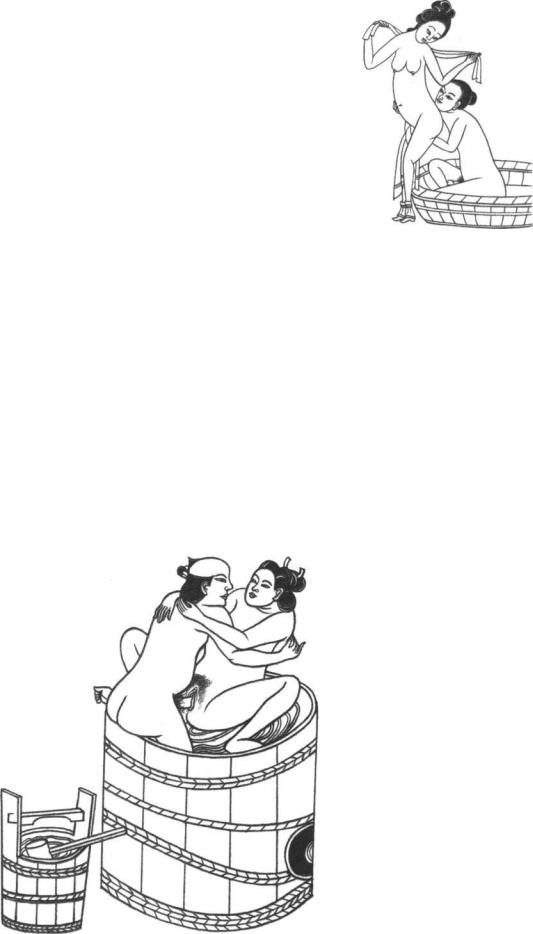
Bathing is invigorating and has both spiritual and erotic qualities. From a Chinese print of the eighteenth century.
One should first bathe the body properly with running water; then apply perfumes or ornaments. This type of bathing should be combined with breath control.
The effect is to destroy both inner and outer dirt and make a person fit for spirituality.
LAKSHMI TANTRA
bathing
Water is a powerful agent of purification for the body and mind. Many religions have baptism rituals and also prescribe precise methods of bathing. In the West we shower or bathe every morning or evening, thinking nothing particular about it; it is a habit, practiced in the name of hygiene. Nevertheless, bathing, whether in a tub, shower, lake, pool, or ocean, has both spiritual and erotic qualities.
Any intentional act has a power that far transcends the specific nature of the act itself. If you view bathing as a process of spiritual purification, and intentionally ritualize the practice, the benefits will be greater than if you bathe merely for the sake of hygiene. Start with the head and hands and finish with the feet, or contrariwise if you prefer, the point being to maintain an order. Always be sure to imagine that you are purifying more than just the physical body.
A cold shower produces a sudden charge of negative ions, which are healthful, invigorating, and effective in creating a feeling of relaxation and psychic regeneration. Water is "negative" and "magnetic," and has a potent recharging effect on the psycho-organism. Use the natural qualities of water to help yourself
overcome the stress and strain of city life. A bath or shower before Yoga is tremendously beneficial; its purificatory power restores the body to its natural responsiveness.
In the Bible there are many accounts of foot washing. Mary Magdalen, when washing the feet of Jesus, was giving the respect customary to an honored guest. It is still customary in the East to wash the hands and feet when entering the inner part of a house. A bowl and water are also provided for washing before and after a meal. The reasons for this are partly cultural, since most meals in the East are eaten with the hands, but the physical and psychic aspects of hygiene are also significant. This is reflected in most spiritual traditions, where the washing of hands and feet prior to prayer is obligatory.
After all worldly activities, washing is advisable, especially before any intimacy. Bringing the office or kitchen "into the bedroom" dissipates the potency of love-making. The simple gesture of washing the hands and feet can make a great difference in your mental state, as well as discharging the accumulated tensions.
A simple Yogic trick to assist in maintaining natural equilibrium is to inhale a small quantity of cool or lukewarm water through each nostril separately, then blow it out again into a basin. First block one nostril with a finger and snort up water held in your cupped hand. Then blow it out and repeat for the other nostril. This clears the sinuses and bal-
50 Brahma the Creative
ances the polarity of the breath. Another simple technique for restoring vitality is to put your feet under a running tap of cold water for a few minutes. This is particularly effective after a day spent walking around in shoes, and will cause an immediate discharge of tension.
Yogic texts refer to the importance of washing the anal orifice with cold water. This helps the contraction of the anus and also is commonsense hygiene. Since anal contraction is an essential practice of Tantric Yoga, aiding the drawing up of ecstatic energies, this practice is especially important.
Whenever taking a bath or shower, call on the Lord of the Waters to help maintain your inner vitality and joy. Do the same for your partner. In the Hindu tradition Vishnu, the Lord of the Waters, is also the Preserver and ruler over the erotic sentiment (see Part 3). His counterpart is called Lakshmi, the goddess of prosperity and the provider of all material gain. When bathing in the sea, call on the waters to carry your spirit back to the source for replenishment. The main point is to imbue your daily ablutions with the sacred.
Many of the complex love-postures are best practiced in the sea or a pool, as water makes the body much lighter. If you do this, you will find it easier to attain these postures in the bedroom. Practicing love-postures in rivers and pools used to be a fairly common occurrence in the East, but with the advent of Western influence it became very rare.
Hot baths or showers are very relaxing and cause the physical and Subtle Body to expand. However, drowsiness can easily be produced and the mind can then become dull from the excessive heat. The action of hot water on the skin opens the pores and permits accumulated poisons to be expelled, purifying the body and clarifying the mind. The combination of hot baths and cold show-
ers counteracts the tiring effect. After prolonged immersion in a hot tub, step out and pour cold water over your body. This will contract the body and sharpen the consciousness. It is a traditional practice for Yogis to dive into ice-cold waters in order to shock the body into wakefulness and concentrate the mind.
The common tendency to rush off to the bathroom to wash, douche, or shower after love-making is condemned in the Eastern love treatises. The perspiration produced on bodies making love contains subtle minerals and vital secretions that are beneficial if absorbed. Yoga texts advise the couple not to bathe or shower for at least an hour after climaxing. The absorption of love-secretions is of great benefit to the couple. These essences contain many vital elements that are beneficial to both body and mind. Certain Yoga techniques (see Part 3) enhance the natural capacity of the sensitive membranes of the sexual organs to absorb love-juices.
Our bodies are composed mostly of water and the watery element covers the majority of our planet. Without water, we can live but a brief time. One of the most important elements to our well-being, water plays a sustaining and purifying role in our life. As such, it is worthy of honor for its symbolic as well as its physical qualities.
Shared bathing helps establish deep and lasting communication. From a Chinese print of the Ming period.
Water for bathing should be warm, rather than too cold or too hot, though this should be determined by circumstances. When the solar breath is dominant, it is good to remain in the water, and when the lunar breath prevails, it is best to come out. Protect the eyes from heat during steam baths, using a cool cloth for this purpose.
SWARA CHINTAMANI
Hot tubs are very much a part of Japanese and Chinese hygiene. This humorous illustration, from a Japanese book of the late seventeenth century, shows a traditional tub in unorthodox use.
Brahma the Creative 51