Материал: Snote
site to the correct practice of Tantra.
Hatha Yoga can be learned from books, TV programs or classes, but whatever the mode of instruction, moderation and common sense must prevail. For example, one should never try to practice complex Yoga postures when physically ill, except under the guidance of a doctor or teacher, nor should one do so just before or after mealtimes. Yoga should be practiced neither immediately before nor just after extreme physical exertion. Reverse postures should not be practiced by a woman during menstruation.
The state of mind in which a person enters into any practice will largely determine the result. Therefore, do not be over-ambi- tious and force the postures, but let the body
come to them gradually and naturally, when it is ready. The best times for Hatha Yoga practices are the early morning and early evening. Try to get into a regular routine. It really isn't necessary to spend hours each day on physical Yoga; ten minutes or half an hour is sufficient, provided it is practiced regularly and with concentration. Remember that the physical exercises of Hatha Yoga are not ends in themselves but means to develop and strengthen your body and mind.
Many people who embark on Yogic practices are too quickly disappointed by what they experience as their limitations. This is a mistake, for each individual's capacity is unlimited. Practices or postures that one day seem impossible may be accomplished easily
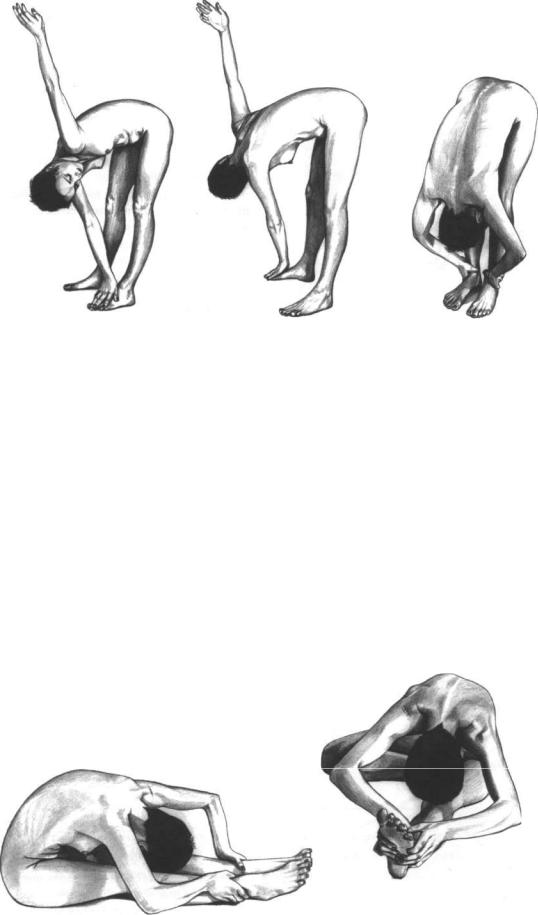
Toe touching is a recommended starting procedure for any series of Hatha Yoga asanas. It helps the circulation, stretches the muscles, and prepares the body for more complex positions. This series of illustrated exercises lengthens the tendons of the legs, enabling difficult postures to be attained.
Human unhappiness results from mankind's acceptance of the lowest conditions of our minds. By the practice of Yoga, all such conditioning ca be overcome.
PATANJALI YOGA SUTRAS
Calmness and steadiness of the body and senses are known as Yoga.
KATHA UPANISHAD
Formidable posture (ugrasana), also referred to as paschimottanasana, is a back stretch that is brought about from a floor-seated position. The legs should be kept straight, while the head is pulled down by the arms. This type of position helps the release of Kundalini-energy and aids conscious control of the sexual function.
Brahma the Creative 37
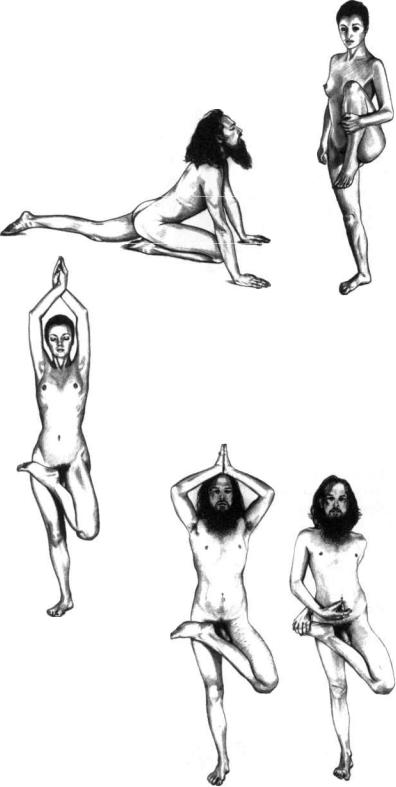
By drawing up the knees, in turn, and stretching the rest of the body, the abdominal muscles are strengthened, circulation is improved, and the inner "fire" is stimulated. Sexual vigor is largely dependent on the healthy condition of the abdominal region and Navel Chakra.
This type of standing position, with one leg up, is helpful to the development of balance and posture. Known as crane posture (goldasana), it stimulates all the internal organs and improves the hips and legs.
This type of standing posture requires balance and should be used to focus the mind and channel vital energy to different subtle centers (Chakras) by the placement of hand or hands. The "bound" position of the body creates a special circuit that concentrates energy. Both these positions tone up the internal organs (liver, spleen, and intestines, especially) and aid the development of mental and spiritual intensity.
and naturally a week later. It is, however, important to persevere and have faith in the long-term benefits. The powers of a creative attitude and Will are tremendous. Since all the techniques of Hatha Yoga are eminently
suited to the human organism, it's the unnatural conditioning of the body and mind that we must strive to overcome. Each of us is a natural Yogi or Yogini (female Yogi) if only we permit ourselves to be. Get to know your body and learn to discern its real from its imaginary needs. Be receptive and let your body speak to you directly. Above all, treat it as an intelligent friend and ally; get to know every part of it and, if necessary, coax or talk it into a state of harmony.
When two people live together, spontaneity is a crucial element to their survival as a couple. Yoga fosters this essential spontaneity and can be a shared and mutually appreciated practice. Yogic positions are evocative of natural elements or forces; many are named after animals, birds, or other creatures. Hatha Yoga postures can be performed for your partner rather than for yourself alone. Watching your partner perform the different postures stimulates the erotic sentiment. When practiced with confidence and in the right spirit, they are certainly erotic.
Many of the sexual postures outlined in the third part of this book are facilitated by a grounding in Hatha Yoga. We recommend practicing Yoga either in the nude or with minimal clothing for the aesthetic value, as well as to allow for maximum freedom of movement. When the body is naked, the life energies circulate more freely than when it is clothed. Furthermore, naked Yoga creates an atmosphere charged with erotic energy. Naturally, if the temperature is cool, it is advisable to wear s o m e t h i n g light but unrestricting. Synthetic fabrics are not suitable because they obstruct the free flow of vital energies; natural fabrics such as cotton, light wool, or silk are preferable. When Hatha Yoga becomes a natural part of your lifestyle, many obstacles to spiritual progress will be removed, allowing Tantric and Taoist Yogas of Love to be more easily mastered.
A person should resort to Yoga, which is like the fruit of the Wish-Granting Tree. The Yogi destroys diseases by the postures, Karmas by breath control, and mental disturbances by the withdrawal of the senses from the external world. A
Yogi in the highest state of Samadhi is not affected by time or any other action.
GORAKSASHATAKAM
38 Brahma the Creative
yoga asanas and techniques
Asana means a position that is both firm and pleasant. The practice of Yoga postures, or asanas, helps in the development of a stable and healthy body, tuning its capacity to withstand powerful ecstatic experiences. Though hundreds of thousands of postures are said to exist, the authoritative texts state that if only a few of them are practiced correctly, more than adequate results will be attained.
A posture may prove easy for one person and difficult for another. One person will find the lotus posture perfectly natural, whereas another will find it difficult or near impossible. One should not, therefore, feel discouraged if certain Yoga asanas seem out of reach. Practice those that come naturally and develop confidence. Leave the more difficult ones until later, when the muscles have become loosened and more flexible. Sometimes a new posture may be tried spontaneously. It's amazing how the body sometimes suddenly changes to accommodate a new form.
Many of the Yoga asanas were inspired by the flowers, animals, and other creatures whose names they bear, for example, the lotus posture, the lion posture, and the serpent posture. Yoga postures are a type of body language that communicates with the divinity within. There is a magical potency inherent in their form. Anyone who takes the trouble to practice Yoga asanas quickly becomes aware of this.
Many primitive tribes mimic the movements, postures, and sounds of animals, believing that in so doing, they create a magical contact with them. It may well be that Yoga asanas, which mimic other creatures, allow us to contact earlier forms in our evolutionary heritage. Numerous sexual postures (described in the third part of this book) are based on life forms other than our own. When energies are exchanged and channeled through Tantric love-postures, they cause a resonance that travels beyond the dimensions of our world. Several Tantric texts refer to sexual postures as vehicles for supernormal or out-of-body travel.
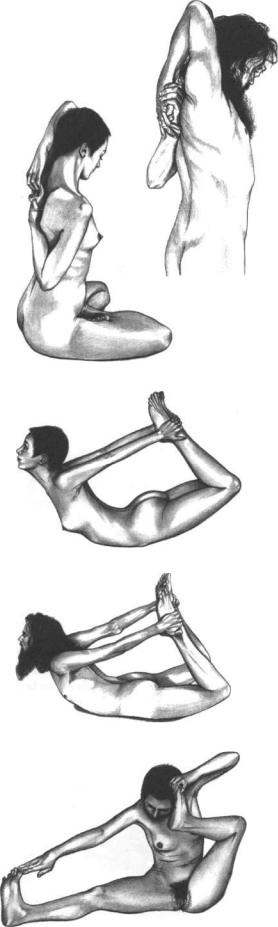
The posture known as head of a cow (gomukhasana) is created by linking the hands in turn, as shown. It creates a special energy circuit, opening up the heart and throat centers, effectively releasing tension. Several variations of this posture also involve the lower part of the body; in these the legs are either crossed in the lotus posture or directly over each other as in the heroic posture.
The bow posture (dhanurasana) evolves from lying on the stomach, reaching back to hold the ankles, and pulling up into a tension, as if the arms and legs are a bowstring. This posture is very effective in strengthening the gonads, which govern sexuality. It stretches the abdominal and back muscles and effectively relieves fatigue.
The near-ear bow posture (akarna dhanurasana) should be practiced with each leg extended in turn. It makes the legs and back very flexible, improving posture and aiding control of sexual energy. It should be practiced with the thought that one is an archer shooting arrows at a distant target. During the period of tension, when the posture is held, breathing should be natural and focused on the abdominal region.
Brahma the Creative 39
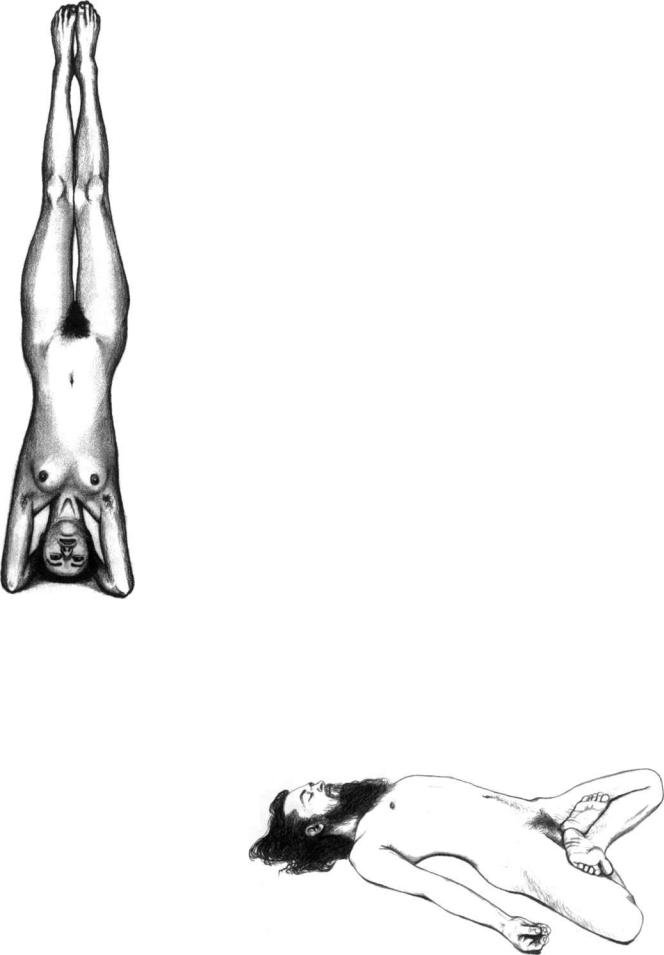
The Yoga head stand (shirsasana) is one of the most effective postures for reversing the outward flow of sexual energy. When practicing it, one should visualize all energy flowing to the head.
The fish posture (matsyasana) is ideal for total relaxation and meditation. First take up the full lotus posture and gradually lean back until the head rests on the floor. Practice arching up the back while keeping the head in position. This posture helps correct improper breathing, strengthens the lungs, and stimulates the circulation. It is also helpful in regaining involuntarily lost sexual energy.
The main purpose of the Yoga asana is to circulate subtle energies in a precise way. A well-balanced body, firmly positioned, does not encounter hindrances to meditation or conscious ecstasy. Postures create a particular form for the body that serves as a me - dium for communication with the Self. In advanced Tantric practices precise body postures are used during rituals to evoke particular archetypes and familiarize the Yogi with them.
As previously mentioned, the early part of the morning (especially sunrise) or the early evening (especially sunset) are particularly good times to practice Yoga asanas. First thing upon rising in the morning, drink a little pure fresh water to tone up the organs. Then take a bath or shower and clean the nostrils and tongue. The techniques for this are described in the section called "Bathing." Stretch the body and do a few light exercises. Proceed to the most simple asanas, such as the corpse posture (shavasana), which entails lying on one's back on the floor and relaxing completely. You can evolve your own order of practice or follow the instructions of a good Yoga manual. Generally, you should advance gradually to the more complex positions as you warm up during the session.
Breathing techniques are very much a part of Yoga asanas and should be practiced at the same time. But don't force them and always be sure to use your common sense. For example, don't move from an asana that requires exertion to a breathing technique without first allowing the body to adjust. R e - verse positions, such as the Yoga head stand, should not be attempted before you feel truly ready, and are best practiced with the support of a friend, wall, or pillow. All the fine details of Hatha Yoga routines can be found in the many good books currently available.
People commonly perform Hatha Yoga postures without the benefit of visualizations
to help loosen muscles and sinews and aid in the channeling of life currents through the body. Many Yoga asanas were developed largely to release latent energies, which are effective in causing physical and psychological transformations. It therefore benefits your practice to know the paths that the life energies take and to hold these in mind. Conscious visualization of the subtle pathways of the body while practicing Hatha Yoga postures will speed your progress. The more complex asanas can be easily achieved by first meditating and visualizing the form and flow of energy through the posture. Then, when you physically attempt the posture, you will be surprised to find a new ease and ability. The body opens up and becomes flexible once the mind has understood and gained ascendancy over a posture.
For example, in the Yoga head stand it is helpful to imagine golden filaments streaming from the navel center and hooking onto the floor, ceiling, or walls, providing support. This visualization should be mentally reabsorbed into the navel center when the body is accustomed to holding the position.
Hatha Yoga is best practiced as a creative activity rather than a mere task. Let the positions "speak" to you, and learn to flow naturally from one to the other. The practice of Yoga asanas will deepen your insight into the meaning of life, enable your body to function effectively and harmoniously, and help you to develop a deep awareness of the Subtle Body and its energies.
In all transcendental sexual experiences a healthy and relaxed body is an ally. A stiff torso is a real hindrance to sexual exploration; it reflects physicality, guilt, and psychological retentiveness rather than ecstasy or liberation. Hatha Yoga is the antithesis of heavy physical exercise. A good Yogi is not muscle-bound; rather, his strength lies within, ready to be drawn on at any time.
40 Brahma the Creative
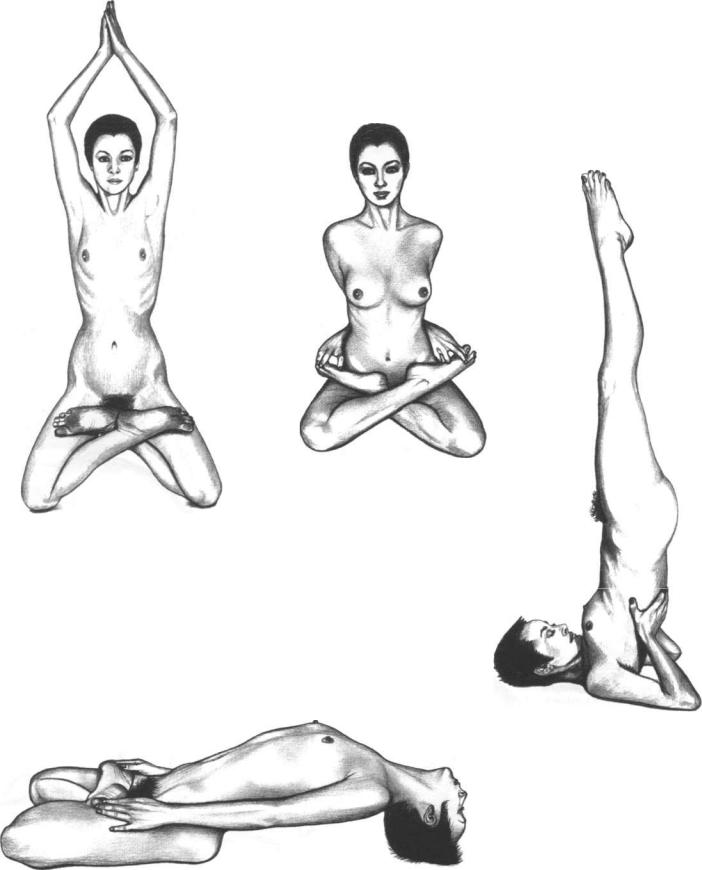
The cow herder posture (goraksasana) is named after Guru Gorakhsa, an Indian Tantric teacher who, as a cow herder, gained Liberation through service to a Yogi prince called Chaurangi and to Mina, his own teacher. Legend has it that Chaurangi levitated in this posture. First the lotus posture should be attained; then one should jump up onto the knees and bring the hands together over the head. This posture creates a strong sense of balance, tones up the glands, and aids the control of sexual energy.
There are as many Yoga asanas as there are species of animals and other creatures. Of these, eighty-four positions are particularly important. If one considers these, then the lotus posture and the half lotus posture are among the very best.
GORAKSASHATAKAM
The bound lotus posture (bandha padmasana) creates flexibility in the neck, shoulders, and back. Once the position is achieved, the head should be thrown back and a number of deep breaths inhaled. Then bend forward while exhaling and touch the forehead to the ground. This helps awaken the latent Kundalini and should be accompanied by constriction of the anal sphincter muscles.
The supported complete body posture
(salamba sarvangasana) or shoulder stand is an inverted position that has a direct beneficial effect on the whole glandular system, especially the thyroid. This posture aids the balance of hormonal levels in the body, tones up the organs, and helps relieve asthma, bronchitis, colds, and headaches. It invigorates the whole being and improves overall health and beauty.
Brahma the Creative 41