Материал: Snote
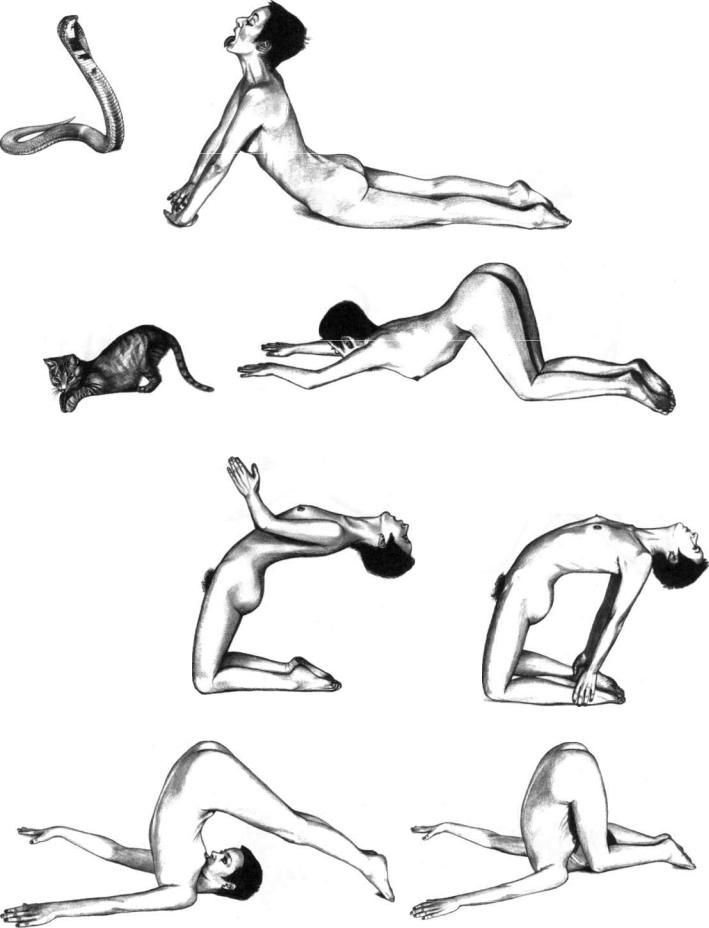
The cat posture (biralasana) instills flexibility of body and mind, both of which are important to the correct practice of Tantric Yoga. The stretching and yawning antics of cats should be mimicked during this posture. Enter the pose while exhaling and relax the pose when inhaling.
The camel posture (ushtrasana) evolves from a bow-like shape, linking hands and feet. The hands are lifted up and brought together as illustrated. This posture is very beneficial to the back and stimulates the glandular system. It also helps one gain control of sexual energy.
The plow posture (halasana) should be practiced as slowly as possible. It is helpful to the muscles of the back and neck, increases the flow of blood to the legs and effectively reduces fatigue.
42 Brahma the Creative
The serpent posture or cobra (bhujangasana) exercises the spine and tones up the internal organs. From a totally relaxed recumbent position, the body is stretched and tensed while the breath is held, causing an expansion of consciousness and heightened sensual awareness. It improves circulation and stimulates the sexual organs.
In this variation of the plow posture (halasana) the legs are brought right over, while the hands give support. This position stimulates the internal organs and relieves fatigue.
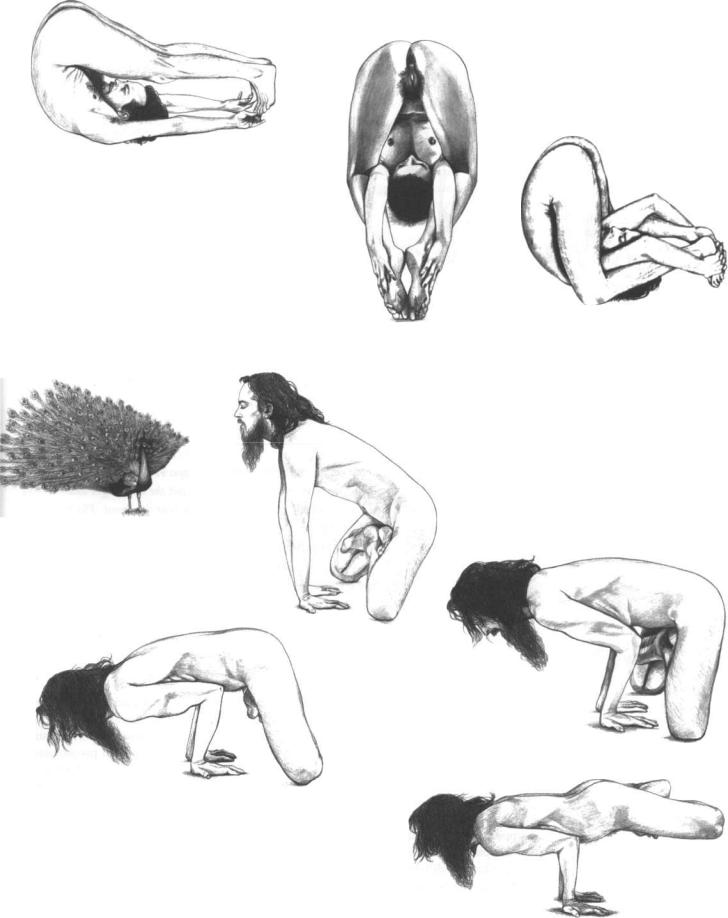
Forward-bending postures (variations of paschimottanasana, the back stretch) are essential to avoid premature aging. These postures stimulate the internal organs, release latent energies, and aid the establishment of a creative mental attitude toward life.
Sequence leading up to the peacock posture (mayurasana) from the lotus posture. The palms are placed on the floor, as shown, and the elbows bent into the abdominal region. The natural leverage created lifts the body into a horizontal position. The mayurasana is very effective in eliminating toxins from the body. It helps regulate digestion, tones up the internal organs and stimulates the sexual glands. Named after the peacock, which has the power to digest poisons and is an enemy of snakes, the mayurasana should be maintained for only a few moments at a time, and then repeated. It aids the development of a strong Will and helps keep the body youthful.
Once the forward-bending postures are perfected, the body will become flexible enough to reach Vishnu's sleep posture (yoganidrasana), also known as posture of the intermediate state. It is extremely relaxing, effective in balancing internal disharmony, and sexually invigorating. The posture should never be rushed; each foot should be gently brought up to and over the shoulders in turn.
Brahma the Creative 43
Sitting in the lotus posture, and becoming aware of the movements of Prana and Apana, the Yogi should perform breath control and visualize the flow of energy. Thus, Liberation becomes attainable.
SHIVA SAMHITA
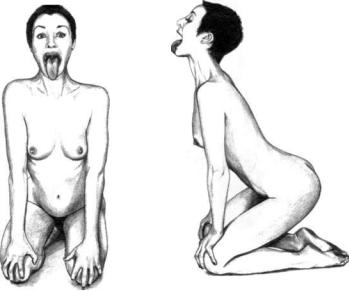
The lion posture (simhasana) evolves out of the kneeling heroic posture (virasana). The main feature is that the jaws should be wide open, the tongue extended as far as possible toward the chin and the hands stretched. This is a posture of tension, with the eyes widened and fixed either at the end of the nose or at the center of the brow. A feeling of "being a lion" should be evoked and the breath should be inhaled through the mouth. This posture instills psychological strength, tones up the senses, and clears mucus.
In this section we have illustrated some of the simplest Yoga asanas, as well as a few complex ones. Generally it is best to learn at least two sitting postures, several stretching positions, simple reclining positions, a squatting position, a reverse position (like the head stand), and at least one complex asana. When
Hatha Yoga becomes a natural part of your life, you'll be amazed to find how much extra energy and spirit you have for day-to- day activities. For couples wishing to expand the parameters of their physical relationship, there is no greater preparation than shared participation in Hatha Yoga.
Place the hands level and equipoised below the navel center. While thus sitting in the lotus posture, straighten the spinal column, throw out the diaphragm and bend the neck to the shape of a hook, pressing the chin near to the throat. Place the tongue against the roof of the mouth, just behind the teeth. All these factors help the practitioner of Yoga to experience true meditation.
SECRET DOCTRINES OF MAHAMUDRA
natural urges
One general principle that repeatedly appears in the Tantric teachings is to refrain from suppressing natural urges. Any suppression of our physical natures causes an inner reaction, a kind of distortion that destroys inner harmony. The whole range of physical, emotional, and mental urges should be included in this admonition, even though such a state-
ment may seem like an endorsement of selfindulgence. Self-indulgence is rarely the product of a natural urge. Rather, it results from a lack of emotional and psychological maturity. Of course it is all-important to be able to distinguish between the natural and the unnatural. Discernment is the key to putting this principle into practice. This point of view is unique to the Tantric tradition; almost without exception the other spiritual teachings prescribe strict rules for the suppression of natural functions such as hunger, sleep, and above all, sex. Tantra teaches that the suppression of natural urges is potentially
44 Brahma the Creative
harmful to both mental and physical health and can lead to neurosis or morbidity. Though suppression of natural urges may bring about desirable effects temporarily, the long-term result is limiting and true spiritual evolution is rarely achieved by this means.
There is a common misconception that the Tantric teachings condone licentiousness. On the contrary, Tantra requires great discipline. It enjoins, for example, a disciplined effort to uproot unnatural and unhealthy habits. As soon as a natural urge is understood, it can be either satisfied or transcended. Tantric texts state that unnatural urges should be replaced by natural ones rather than suppressed.
A Tibetan story concerns a man called Sarvabhaksha who had an obsessive compulsion to eat whatever he could lay his hands on. One day he met a Tantric Guru called Saraha and begged for some advice to help him with his problem. The Guru initiated him and taught him to visualize his belly as the empty sky and his digestive fire as the ultimate conflagration of all the worlds. He told him to view all food and drink as mere worldly phenomena and, while eating, to imagine himself devouring the whole universe. Finally the Guru advised him to meditate on the essential emptiness of all phenomena.
Sarvabhaksha followed his teacher's instructions and, instead of suppressing his urge to eat, replaced a gluttonous mental attitude with a meditation. After some years he achieved self-realization and became revered as a teacher, illustrating that it is not so much what we do but how we do it that transforms us.
Self-discipline should be undertaken willingly and consciously, and performed from a position of inner strength. Learn to distinguish the real from the unreal, the natural from the unnatural in yourself. For example, it is natural for the body to need food every few hours, but unnatural for it to crave food every ten minutes; the former urge should be gratified and the latter transformed. By indulging the unnatural urges of body and mind, one loses the capacity to recognize true needs.
Once again, don't suppress authentic physiological urges. If you have the urge to sneeze, vomit, or go to the toilet, then by all means do so as soon as possible. If you don't obey these natural urges, the accumulation of pressure on the internal organs may lead to disease. The same principle applies to sexual urges, which should be viewed with similar common sense. If you wish to free yourself of an unwholesome habit, do so by degrees, replacing the negative habit with a positive one.
By degrees a person should become free of unwholesome and unnatural habits; similarly, one should try to develop wholesome natural habits. The way of doing this is to replace the unnatural with the natural. If withdrawal is gradual, addiction does not reappear; wholesome habits, gradually acquired, become firmly implanted.
CHARAKA SAMHITA
heaven and earth
The mystic teachings of the East recognize the forces of Heaven and Earth as the two fundamental principles that pervade everything. Hinduism names them Shiva and
Shakti, Tibetan Buddhists call them Yab (father) and Yum (mother), and Taoism refers to them as Yang and Yin. These two forces are operative throughout the phenomenal world: light and dark, hot and cold, dry and wet. They are interdependent and mutually sustaining.
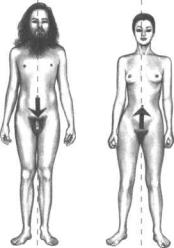
The Force of Heaven determines the structure of the male sex organ, whereas the Force of Earth creates the shape of the female sex
Heaven's
Heaven's Force
Force
Earth's
Earth's Force
Force
The Yang-force of Heaven is dominant in man and the Yin-force of Earth is dominant in woman. The former causes an outward penetrating shape to the Lingam, whereas the latter creates an inward receptive shape to the Yoni. Thus the forces of Heaven and Earth complement each other during sexual contact.
Brahma the Creative 45
Heaven is lasting and Earth enduring. The reason for this is that they do not live for themselves alone; therefore they live long.
TAO TE CHING
The tree of Eternity has its roots in Heaven above and its branches hang down to Earth. It is the pure Immortal Spirit upon which all worlds rest.
KATHA UPANISHAD
organ. As the Yang-force of Heaven descends from above, it creates the outward shape of the Lingam. Conversely, as the Yin-force of Earth ascends from below, it creates the inward shape of the Yoni.
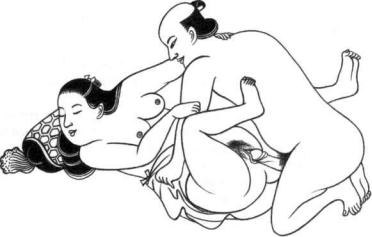
The Yajur Veda, an early Hindu text, contains the following account of the relative movement of Heaven and Earth: "This Earth revolves through the Heavens and space; it revolves with its mother, the waters. Turning and turning, it moves around its father, the sun." An ancient Taoist text links the rotation of the Heavens and the Earth to the sexual act performed by man and woman. T h e Japanese rendering of it, known as
Ishimpo, states: "Just as Heaven rotates to the left and Earth turns to the right, so a man
should move his body to the left and the woman to the right while making love. Sexual union performed in this manner is called Heaven pacified and Earth resolved."
W h e n male and female forces are balanced, cosmic harmony results. Orgasm resolves the bipolarity of "outer" and "inner," expansion and contraction, positive and negative, solar and lunar. Rumi, a Sufi mystic of the thirteenth century, advised: "Heaven is man and Earth is woman; Earth fosters what Heaven lets fall. Regard Heaven and Earth as endowed with intelligence, since they do the work of intelligent beings." The esoteric function of sexual love is the resolution of the complementary intelligences of Heaven and Earth.
Taoism teaches that the force of Heaven rotates naturally to the left, whereas the force of Earth turns to the right. Sages saw this movement mirrored in the sexual act. From a Japanese woodblock print by Torii Kiyonobu, circa 1703.
The spending of the seed of Heaven and the giving shape to that seed by Earth are the natural way of man and woman, as natural as a fire blazing upward and water running downward. There is a method known as the Heavenly and Earthly "net," whereby men and women indulge in sexual intercourse like the birds and beasts in order thereby to avert worldly calamities.
TS'AN-T'UNG-CH'I / TAO AN
food: the supporter of life
Although food and drink are indispensable, being the primary physical supports of life, most people take them for granted. On the other
hand, there is a current obsession with diet. Among the most popular diets today are health foods, Zen macrobiotics, and vegetarianism. Unfortunately the Yogic teachings on the subject of food and drink have not yet been fully explored in the West. Eastern-oriented health cults have emerged, but these tend to present only partial truths about the philosophy of food expounded in the Yoga texts.
Oriental medicine and Yoga have much to offer on the subject of diet. The unique
46 Brahma the Creative