Материал: Management-and-Organization-Behavior
Change |
|
|
|
|
Response |
|
|
|
|
|
|
|
|
|
|
|
|
|
|
|
|
|
Attitudes |
|
|
|
|
|
|
(sentiments) |
|
|
|
|
|
|
|
|
|
|
|
|
|
|
|
|
|
|
Personal |
|
|
|
|
Social Situation |
|
History |
|
|
|
|
at Work |
|
|
|
|
|
|
|
|
|
|
|
|
|
|
|
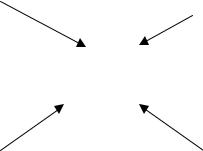
Figure 24.1.: Roethlisberger’s x-chart
From the above chart, it is obvious that how people feel about change ultimately determines the response to change. People as individuals interpret change with attitudes in the back ground. The response is expressed through the group behavior. All changes have some costs, economic, psychological and social costs. Because of these costs associated with change, initiatives for change require analysis to determine their usefulness. Hence, cost benefit analysis of change is required. The goal of any organization is to maximize the benefits. Organizational members are affected in different ways by a change. Some may benefit while others suffer losses. This is the reason why employees tend to resist work change because of the associated costs. The following are reasons for, and consequences of, resistance to change.
Three Types of Resistance to Change
They are Logical, psychological and sociological
Logical: arises from the time and effort needed to adjust to change. It is also due to new job duties to be learnt. These are short run costs to be paid by employee, though in the long term they are benefited by change.
Psychological: may arise due to attitudes and feelings of individuals about change. They fear the uncertainty, mistrust the management and feel insecurity. Therefore prefer status quo.
Sociological: political conditions, opposing union values, narrow outlook, vested interests, and desire to retain existing friendship are some of the reasons for resisting change.
Alternatively, resistance to change can also be studied under individual resistance and organizational resistance.
290
Individual resistance: The source of resistance resides in basic human characteristics, which are presented hereunder in a summary form:
Habit: To cope with life complexity, human beings rely on habits or programmed responses. Confronted with a change, the tendency to respond in habitual ways is a source of resistance.
Security: persons with high need for security resist change. In technologically intensive society, people perceive threats to the jobs and economic security. Hence, they resist change.
Economic factor: one’s concern that change will lower one’s income is another source of resistance. When pay is tied to performance, people fear that they may lose their income by not being successful in performing their new job, more so when they need to apply new set of skills.
Need for security blanket (Fear of the Unknown): apart from economic and job security, people prefer predictability and structured patterns in their lives. The need for this security blanket also makes them apprehensive about the change that characterizes ambiguity and uncertainty. Therefore, the preference for known for the unknown is obvious.
Selective information processing: people see the world through their perceptions.They see and try to understand and accept information that is palatable to them. They ignore information that challenges the wolld they wish to operate in.
Apprehension about understanding of status and authority: change in technology of work methods “undermining authority and status” is a source of resistance to change.
Resistance is stemming from retooling and retraining: knowing that one has to learn new things is a source of resistance to change as any learning involves unlearning.
Resistance due to non-involvement in the change process: when changes are incorporated with little input from those who are affected by them, resistance to change is expected.
Resistance due to sunk costs: older employees seem to resist change more than younger ones. They have more psychological investment in older traditions. This is otherwise known as ‘sunk cost’ of energy and time.
Organizational Resistance: organizations by their very nature are conservative. They also become blindfolded and resist change. Six sources of organizational resistance to change are explained in what follows:
291
Structural inertia: organizations have built in mechanisms to produce stability such as selection process which chooses certain persons, training and socialization process reinforcing specific role requirements and skills and formalization of jobs for employees to follow. When change confronts organizations, their structural inertia acts as a counter force to organizational stability.
Limited focus of change: limited changes in sub-systems of the organization are likely to be opposed.
Group inertia: here group norms act as constraints for change. Threat to Expertise: organizational changes may be threat to the expertise of specialized groups. For example, decentralized end user computer was a threat to the specialized skills held by the centralized information systems departments.
Threat to established power relationship: any redistribution of authority for decision-making can be threat to established power relationships. For example, participative management is a kind of change seen as a threat to the authority of middle level managers.
Threat to established resource allocation: change is seen as a threat by those groups controlling sizeable resources of the organization.
Consequences of Resistance to change: consequences are both positive and negative
Positive consequences
-- Resistance may force management to reexamine change proposals so that they are appropriate.
-- Resistance also pinpoints specific problem areas so that management can take corrective action before problems become serious.
-- It also encourages management to communicate change which in the long run ensures acceptance of change.
Negative consequences
Organizations failing to overcome resistance to change have to pay a price. Change of greater magnitude introduced without gaining employee acceptance may lead to overt consequence such as employee unrest leading to strike, gherao, sabotage, etc. Implicit reactions to change may lead to alienation from the job i.e., tardiness, absenteeism and turnover.
Change Process
Since management initiates more changes in the organization, its primary responsibility is to implement change successfully. Management is
292
called a change agent because its role is to initiate change and make it work. Many changes also originate in external environment. Rate of change varies according to nature of environment. Stable environment means less change. Dynamic environment means more change.
Kurt Lewin, the father of change process, stated three stages in initiating and establishing any change unfreezing, changing and refreezing.
Unfreezing: It is a process of preparation for change through disconcontinuation of the old practice, attitudes, or behaviours. This is the initial stage where change agents sense need for something new and are impatient with status quo. Thus the system is to be unfrozen from its complacency.
Changing (or moving): In this stage planned change is initiated and carried out. Change could relate to any aspect of the organization. With the participation of members affected by change, changes have to be carefully implemented.
Refreezing: This phase ensures that the planned change introduced is working satisfactorily and there is a reasonable guarantee that the change will indeed fill the gap and bring the system to the desired state of equilibrium. If the refreezing phase is neglected, the change will not bring desired result and may be even total disaster.
Management of Change
Organizationatanygiventimeisadynamicbalanceofforcessupporting and restraining any change. The organization system is in a state of relative equilibrium. The current practice continues until the change is introduced. Change is introduced with in a group by increasing the supporting forces for it and/or reducing the restraining forces.
Strategies to build support to change: Chin and Benne describe three strategies managers commonly use in introducing organizational change:
Empirical – Rational Strategy: Managers acting as change agents must subscribe to the belief that people are rational beings and if they understand that the proposed changes will benefit them, they tend to accept change.
Normative – Reeducative Strategy: In this strategy, the belief is that people are guided by the socio-cultural norms they subscribe to. Hence, the change agent and those who will be influenced by the change should participatively and collaboratively plan and implement the necessary change.
Power – Coercive strategies: are used by the change agents assuming that people with less power will accept change brought by people with more power in the system.
293
Resistance could be to change itself, to the strategy to implement change, to the change agent or to the timing of change. Since there is no one best way of dealing with resistance to change in all situations, the following general approaches are used in handling resistance.
(i)Education and Communication: where there is a dearth of information or when inaccurate information is floating around, the change agent can discuss the change contemplated or apprise the employees about the logic of change and its attendant benefits. Once the employees are educated and enlightened about the positive aspects of change, they accept change.
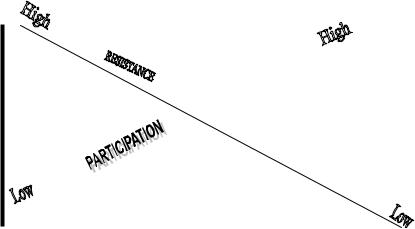
(ii)Participation: Participation encourages commitment rather than mere compliance with change. Greater the participation, lesser the resistance to change. This is illustrated in the following figure.
Figure 24.2: Participation Curve
(iii)Facilitation and Support: because of fear of inability to readjust, people resist change. To overcome it, the support in terms of empathic listening and training help the individuals to deal more effectively with their adjustment problems.
(iv)Negotiation and Agreements: individuals and groups may resist change because they will be at a disadvantage when the proposed change is introduced. In such situations incentives or special benefits are offered to those resisting change so that they cannot block change.
(v)Coercion: Implicit and explicit coercion can be used when changes have to be speedily enforced or when changes are of temporary nature.
294