Материал: Management-and-Organization-Behavior
The definition suggests:
ӹӹManagement is a continuous process;
ӹӹSeveral interrelated activities have to be performed by managers irrespective of their levels to achieve the desired goals;
ӹӹManagers use the resources of the organization, both physical as well as human, to achieve the goals;
ӹӹManagement aims at achieving the organisation’s goals by ensuring effective use of resources in the best interests of the society.
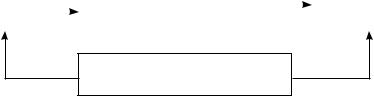
It is evident that the emphasis is on achieving the objectives by using material, machinery, money and the services of men. These inputs are drawn from the environment in which the organization exists. Whether an organization is engaged in business or non-business, the various inputs are judiciously used to produce the outputs. The process involving the conversion of inputs into outputs is common to all organizations and is shown in figure 1.1
|
|
|
|
|
|
|
INPUTS |
|
TRANSFORMATION |
|
OUTPUTS |
||
|
|
|
PROCESS |
|
|
|
|
|
|
|
|
EXTERNAL
ENVIRONMENT
Figure 1.1: INPUT – OUTPUT MODEL
Depending on the nature of business or activity that a firm is engaged in, the output of the firm may be a physical product or service. Since a business organization is an economic entity, the justification for its existence lies in producing goods and services that satisfy the needs of the people. As could be seen in the figure, the organization draws several inputs from the environment, converts them into products or services and sends them back to the environment. Environment here means the larger system, i.e., the society in which the firm exists. Therefore, it goes without saying that how effectively the goods and services are produced is a matter of concern for any society, given the scarcity of resources. Effective management therefore plays a crucial role in this context.
5
Nature of Management
The practice of management is as old as human civilization. In fact, much of the progress of mankind over the centuries may be attributed to the effective management of resources. The irrigation systems, the public utilities, the construction of various monuments like Taj Mahal, and the Egyptian Pyramids of the bygone era amply demonstrate the practice of management in the olden days. Similarly, the ancient civilizations of Mesopotamia, Greece, Rome and Indus-valley displayed the finest practices of management of those periods. However, the study of management in a systematic way as a distinct body of knowledge is only of recent origin. That is why, management is often described as “oldest of the arts and youngest of the sciences”. Thus, the practice of management is not new. It has been practiced for thousands of years. But the science part of it ‘the systematic body of knowledge’ is, no doubt, a phenomenon of the present century.
The traditional management practices remained quite stable through the centuries until the birth of industrial revolution in the mid 18th century. The industrial revolution brought about the substitution of machine power for man power through several scientific inventions. As a result, within a few decades, the landscape of industrial activity had undergone a metamorphic change. Man’s quest for new ways of doing things, coupled with his ingenuity in adopting the scientific and technological inventions in the production of goods and services resulted in:
ӹӹMass production in anticipation of demand;
ӹӹAdvent of corporate form of organization which facilitated large scale production;
ӹӹSpectacular improvements in the transport and communication facilities;
ӹӹIncreased competition for markets;
ӹӹThe establishment of new employer – employee relationship; and
ӹӹA radical change in the aspirations and expectations of the various stakeholders of business.
Industrial revolution had thus sown the seeds of modern management. The early scientific enquiries into the practice of management began. Despite the growing importance of management
6
as an academic discipline immensely contributing to the quality of human life, it is disheartening to know that the concept is still clouded by certain misconceptions. No doubt, management as an academic body of knowledge has come a long way in the last few decades. It has grown in stature and gained acceptance all over the world. Yet, it is a paradox that the term ‘Management’ continues to be the most misunderstood and misused. Certain questions like whether management is a science or art or profession are yet to be answered in a satisfactory way.
Management as Science
To gain a correct perspective as to what management is, let us examine the exact nature of management – whether it is a science or an art? An understanding, therefore, of the exact nature of science as well as art may help in understanding the discipline in a better. Any branch of knowledge to be considered a science, (like the ones we have – physics, chemistry, engineering, etc.) should fulfill the following conditions:
ӹӹthe existence of a systematic body of knowledge encompassing a wide array of principles;
ӹӹprinciples have to be evolved on the basis of constant enquiry and examination;
ӹӹprinciples must explain a phenomenon by establishing causeeffect relationship;
ӹӹthe principles should be amenable for verification in order to ensure accuracy and universal applicability.
Looked at from this angle, management as a discipline fulfils the above criterion. Over the years, thanks to the contributions of many thinkers and practitioners, management has emerged as a systematic body of knowledge with its own principles and concepts. Principles help any practicing manager to achieve the desired goals. However, while applying the principles, one should not lose sight of the variables in the situation, since situations differ from one to another. Thus, the importance of personal judgment cannot be undermined in the application of principles. Further, management is a dynamic subject in that, it has drawn heavily from economics, psychology, sociology, engineering and mathematics, to mention a few. It is multi-disciplinary in nature, but a word of caution. Though management considering its subject matter and the practical
7
utility may be considered as ‘science’, for reason discussed below, it cannot be viewed as an ‘exact science’. In other words, it is a science, but an ‘inexact science’ because:
ӹӹFirstly, management by definition involves getting the things done through people. Compared to the other inputs, ‘people’, who constitute the human resource of any organization are unique in respect of their aspirations, attitudes, perceptions and the like. Dissimilarities in the behavior pattern are so obvious that standard research may not be obtained in otherwise similar conditions.
ӹӹSecondly, the behavior of the human beings cannot be accurately predicted. Hence, readymade and standard solutions cannot be prescribed.
ӹӹ Thirdly, management is more concerned with future which is complex and unpredictable. As the saying goes, ‘many a slip between the cup and the lip’, changes in the environment may affect the plans and render even the most well drawn plans ineffective.
ӹӹLastly, since a business organization exists in an environment, it has a two way interaction with the environment. The organization influences the environment by its several decisions and in turn is influenced by the various elements of the environment. Important among these are technological, economic, sociocultural and political factors. The whole thing is so complex that however effective the plans are, one is prone to be taken over by the unexpected changes in the environment.
Unlike the pure or exact sciences where the results are accurate in the case of management, the various factors discussed above may force even the excellent plans and the strategies go haywire. Too many complexities and uncertainties render management an ‘inexact science’
Management as an Art
Art refers to the ‘know-how’ – the ways of doing things to accomplish a desired result. The focus is on the skill with which the activities are performed. As the saying goes ‘practice makes a man perfect’, constant practice of the theoretical concepts (knowledge) contributes for the formation and sharpening of the skills. Therefore, what is required is the right blend of the theory and practice. In a way, the attributes of science
8
and art are the two sides of a coin. Medicine, engineering, accountancy and the like require skills on the part of the practitioners and can only be acquired through practice. Management is no exception. As a university gold medalist in surgery may not necessarily turn out to be a good surgeon, similarly a management graduate from the best of the institutes may not necessarily be very effective in practice. In both the cases, the application of the knowledge acquired through formal education, requires ingenuity and creativity on the part of the practitioner. Correct understanding of the variables of the situation calls for pragmatism and resourcefulness.
Effective practice of any art requires a thorough understanding of the science underlying it. Thus science and art are not mutually exclusive, but are complementary. Executives who attempt to manage without the conceptual understanding of the management principles and techniques have to depend on luck and intuition. With a sound knowledge and the necessary skills to use such knowledge, they stand a better chance to succeed. Therefore, it may be concluded that ‘management is both a science and an art’.
Management as a Profession
These are the days where we hear a lot about professional managers and their contribution to the economic development of the nation. Therefore, it is appropriate to know whether management is a profession. McFarland gives the following characteristics of a profession:
ӹӹexistence of an organized and systematic body of knowledge,
ӹӹformalized methods of acquiring knowledge and skills,
ӹӹexistence of an apex level body with professionalization as its goal,
ӹӹexistence of an ethical code to regulate the behaviour of the members of the profession,
ӹӹcharging of fees based on service, and
ӹӹconcern for social responsibilities.
A closer examination of management as a profession reveals that unlike medicine or law, management has to go a long way to attain universally acceptable norms of behaviour. There is no uniform code of conduct that governs the behaviour of managers. The apex level body, the All India Management Association (AIMA) or NIPM [National Institute
9