Материал: Management-and-Organization-Behavior
Motivation |
: |
the act of stimulating the people so |
|
|
that they give their best to the |
|
|
organisation. |
Leading is a function predominantly interpersonal in nature. In the organizational context many problems arise because of the failure of managers to understand the people, their aspirations, attitudes, and behaviour as individuals and in groups. If the manager fails in leading the people towards better performance, any amount of planning and organizing, however effective they are, may not help the organisation.
Controlling
Planning and controlling – the two functions are closely interrelated in that while plans specify the objectives to be achieved, control as a managerial function facilitates to know whether the actual performance is in conformity with the planned one. So that, in the event of deviations, appropriate corrective measures could be taken. In the absence of adequate control mechanism, unexpected changes in the environment may push the organisation off the track. Thus, controlling implies measuring and correcting the activities to ensure that events conform to plans. That is why planning and controlling are often described as the ‘Siamese’ twins of management. It involves four main elements:
ӹӹEstablishing standards of performance;
ӹӹMeasuring the actual performance and comparing it against the standard performance;
ӹӹDetecting deviations, if any, in order to make corrections before it is too late; and
ӹӹTaking appropriate corrective measures.
Review Questions
1.“Management is oldest of the arts and youngest of the sciences”. Discuss
2.Is management an exact science? Substantiate your answer with examples.
3.Examine the status of management as a profession in India?
4.Briefly describe the functions of management?
15
5.Identify 5 organizations / industry groups which moved from family based to professional management and describe the process drawing from all accessible sources – public domain [web pages, for instance], your interviews with personnel from such organizations,….]
***
16

Lesson – 2 : Levels In Management
Contents:
ӹLevels Of Management
ӹTop Level Of Management
ӹMiddle Management
ӹFront Line Management
ӹManagerial Skills
ӹTechnical Skills
ӹHuman Skills
ӹConceptual Skills
ӹManagerial Roles
ӹReview Questions
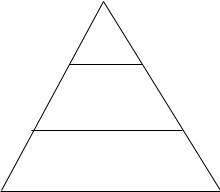
In any organization all those who are responsible for the work of others are known as managers. Though their primary task remains the same – getting the things done by other people, wide variances exist with regard to the authority and responsibility of managers. These differences are largely due to the differences in the levels of management. Based on the scope of authority and responsibility, management job requires many skills and talents. As a matter of custom and convenience, we normally visualize a company’s management as a pyramid as shown in figure 2.1.
17
Levels of Management
The three levels of management that are commonly found in any organisation are lower or front-line, middle and top management.
TOP LEVEL MANAGEMENT
MIDDLE LEVEL MANAGEMENT
FRONT-LINE/SUPERVISORY
MANAGEMENT
Figure 2.1: Levels of Management
Front-Line or Supervisory Management
This is the lowest level in the hierarchy of management. Usually the jobs at this level are the entry level positions into management profession. Managers at this level direct the operating employees (workers). They are close to the action for their job involves supervising the activities of operatives. Front-Line managers in the production department are called foreman, supervisor, superintendent, inspector and so on. For instance, in a manufacturing concern, in marketing, finance and others departments, they are called management trainees or junior executives. Similarly, in a government office, the term superintendent or section officer is preferred.
Middle level Management
Middle management level includes in many organizations more than on level. Managers who work at levels between the lower and top levels constitute the middle management. Departmental heads, Regional managers, Zonal managers and so on fall in this category. They report to top managers. Their principal responsibilities are to direct the activities of lower level managers who implement the organization’s policies.
18

Top level Management
Top management constitutes the highest level in the management hierarchy. This is the policy making level in any organization. This level consists of a small group of executives. Board of Directors, Chairman, Managing Director and the top functional heads such as COO, CIO, and such other C-suite managers, and divisional managers comprise this level. Top managers are responsible for the overall management of the organization. They decide the enterprise objectives, policies and strategies to be pursued to achieve the objectives. They provide direction to the organization by guiding its interactions with the environment.
Managerial Skills
Management job is different from other jobs. It requires elements of stewardship and commitment to the purpose. It involves the obligation to make prudent use of human and material resources. It requires sound judgment to handle complex situations. Further, the nature of the job becomes increasingly complex at each higher level because of the increase in the scope of authority and responsibility. Therefore, each higher level requires increased knowledge, broader perspective and greater skills.
For the purpose of analysis, skills required of a manager are classified under three heads – technical, human (employee relations skill) and conceptual skills as shown in Figure 2.2. The exhibit helps in understanding the levels of management responsibility, the principal skill requirements, and the extent to which each kind of skill is required at each level.
Top
Management
Middle
Management
Supervisory
(Lower Level)
Management
Technical Skills |
Human Conceptual Skills |
Figure 2.2: Management Levels and Skills
19