Материал: Management-and-Organization-Behavior
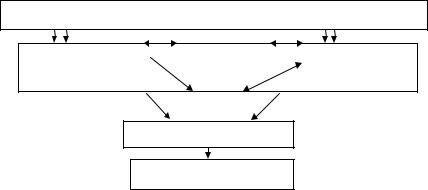
A theoretical model for planned organization change and development is presented below:
Intervention activity
Organizing arrangements  social factors physical setting
Individual behavior
Organizational outcomes
Figure 25.1: Theoretical model for OD
This model is predictive. The three implications of this model are:
1. As a starting point change agents should focus on systematic change in organizational work setting and on individual behavior change as a key mediator associated with organizational outcome.
2. The results of technological intervention in organizational setting indicates negative individual behavior change need not necessarily lead to negative organizational outcome change.
3. This theory provides a better framework of choosing interventions than the case where intervention is decided by change agent’s preferences, values and styles.
Potential areas of OD Intervention: Areas where OD Interventions help include people side of the organizations, the technical and job related aspects and structural aspects.
People side of the organization: OD interventions under people side encompass a)interpersonal or individual level -personnel counseling
and career planning; b) dyadic (two-person) level solving problems in interpersonal communication and in superior sub-ordinate relationship;
c) group level- helping people to get along with each other and clarifying
perceived incongruencies in goals; and d) family level –helping couples to get adjusted to new transfers and relocations, and conducting work-shops for dual career family members to better manage the work-family interfaces.
OD techniques used to address “people concerns” are sensitivity training, transactional analysis, process consultation, third-party peacemaking, team building, individual counseling, life and career planning, role clarification, and workshops.
300
Technical and job related aspects: Areas of OD intervention include work flow inter-dependencies, job evaluation and job redesigning and the like. Some of the techniques that come handy are socio-technical system analysis, flexible production, job evaluation techniques and role analysis techniques (JET and RAT).
Structural aspects: They include interventions to change the physical settings, work group structuring as autonomous (self-managed) work groups, changes in the extent or formalization and control etc. Other techniques used to increase the effectiveness of the organization are the management grid and Likert’s system in techniques.
OD Programmes and Techniques
OD field is largely technique driven. The most established and popular techniques are presented below. A study of these techniques reveals a lot about what OD is.
Laboratory training methods:
(a) Role playing: it is spontaneous acting of a real situation involving two or more people under class room conditions. Dialogue is spontaneously developed by the trainees assigned to role playing. Role playing is a substitute for experience. But it is more than that because it permits techniques of observation and discussion unlike experience. In role playing, trainees can broaden their experience by trying different approaches while in real situation they have only one chance.
It has certain weakness. It is time-consuming and expensive. Experienced trainers are required, since it can easily turn sour without effective direction. Some trainees resent it as being a childish approach to serious problems. Some others are hesitant to take part in role playing. Yet some others focus more on acting than in problem solving.
(b) Gaming: it is not extensively used. It differs from role playing in the sense that it focuses more on administrative problems while role playing tends to emphasis on feelings and tone between people. It is a group exercise in sequential decisions under simulated organizational conditions. Participants work in small groups, each group in competition with others. Groups make decisions in a created system model at least partly unknown to them. Decisions are processed through a computer according to the model, thus providing feedback for subsequent decisions. Usually time is compressed. For example quarter year operations may be covered in a single morning or afternoon session. The fact that time can be compressed, makes it possible to gain much experience with different approaches in a short period of time. The learning process can be hastened through feedback and discussion with a trainee after each decision unit.
301
(c) Encounter groups: they involve unstructured group interaction under a stressful situation requiring people to be sensitive to one another’s feelings in order to develop reasonable group activity. Encounter groups are not role playing, because participants act their own true roles. But their environment is so artificial that their ordinary social patterns prove to be no more workable. Encounter groups seek to improve understanding of self, others, group processes, culture and general behavioral skills. The emphasis in this kind of training is on group processes, that is how group works and on the learning from group experience.
Transactional analysis: first introduced by Eric Berne, it analyses the nature of people’s verbal interactions with each other. The basic principle of TA is that each one of us operates from three ego states and there are compatible and incompatible messages we send to each other.
The three Ego stages:
The parent state: it reflects our feelings of superiority, authority, being judgmental, etc.
The child state: it reflects childish tendencies such as dependence, impulsive, rebellious, and the like. We operate from all three ego states from different times. But we resort to one mode of interaction.
Complementary transactions: they come from compatible states where expected responses naturally occur.
Crossed transactions: they occur when the message from one ego state is responded to by a message from an incompatible ego state in another person.
Ulterior transactions: they take place when the two parties say things to each other which circumvent the main issue.
Process Consultation: From the organizational effectiveness point of view, it is important for the manger to understand the processes by which things get done. He to perceive, understand and act upon process events with which he must deal. PC is more task directed than sensitivity training. The essence of PC is the skilled consultant’s work with the managers, other individuals, groups in the system to develop their process skills i.e., diagnose and resolve process-related problems.
Survey Feedback: it is a tool for assessing attitudes held by organizational member perceptions, identifying discrepancies among member perceptions and solving these differences. Attitude surveys of individuals and groups at all levels in the organization serve as data points to trace ends. Three significant
302
steps are involved in the system. First, persons holding primary positions in
the organization plan what data need to be collected. Second, data are analyzed and feed back is given to the top management, and to the teams down the
hierarchy. Third, each superior call for a meeting in which data are fed to the subordinates. The group members are asked to interpret data, suggest constructive changes necessary and tell how changes could be brought about.
Survey feedback is a good diagnostic tool used for several types of interventions. It is an effective intervention strategy since people realize that they are working with data that they themselves have provided. In other words they ‘own’ the data which spurs them on to initiate and implement the needed changes.
Team Building: Since people are often asked to work in groups, considerable attention has been focused in OD on team building. It aims at improving intra-and inter-group effectiveness. The activities considered in team building typically include goal setting, development of interpersonal relations among group members, role analysis to analyze member’s role and responsibilities and team process analysis. When combined with survey feedback, team building is more effective.
Organisational Mirroring: it is a technique to both assess and improve organizational effectiveness by obtaining feedback from several other groups outside of the organization. Key representatives from the various outside organizations are invited to participate to mirror to the host organization on how it is perceived, what it can do to improve its effectiveness, and the plan of action to rectify the issues. The consultant interviews the people attending the meeting before the meeting is scheduled to assess the magnitude of issues and facilitate the problem solving process. Sub-groups of both host organization and invited organizations work together during the meetings to identify the problems and changes needed. The total group meeting subsequently identifies critical issues and recommends needed changes.
Review Questions
1.The field of OD has been based on humanistic values. Discuss how its skills and intervention methods would be different if those values were not important.
2.Create a list of the kinds of organisational behaviour skills that would be useful to an OD consultant.
3.How role playing, simulation and behaviour modeling do differs as training methods? Do they have similarities also?
4.Examine in the OD assumptions. Which of these do you agree or disagree most strongly with? Explain your feelings.
303
5.Discuss the strengths and weaknesses of encounter groups?
6.What are the objectives of OD?
7.What are the benefits and limitations of OD?
304