Материал: Management-and-Organization-Behavior
Michigan Studies
The Institute for Social Research at the University of Michigan conducted empirical studies to identify styles of leader behavior that results in higher performance and satisfaction of a group. The studies identified two distinct styles of leadership.
Employee Centred leadership and Production Centred (task oriented) leadership:
The employee centred leaders concentrate on human relations and emphasize delegation of authority, concern for employee needs, welfare, advancement, etc. Leaders who are described as employee oriented stress the relationship aspects of the job. They feel that every employee is important and take interest in everyone, accepting their individuality and personal needs. Production centred leadership is more concerned with maximizing regardless of the employees needs, welfare and aspirations. Managers don’t attach much importance to the human element.
The Michigen Studies found that both the styles of leadership led to increase in production, but it was slightly more in case of production centred style. However, the use of direct pressure and close supervision led to decreased satisfaction and increased turnover and absenteeism. The employee centred approach led to improved work flow and more cohesion in interactions resulting in increased satisfaction and decreased turnover and absenteeism. This suggested the superiority of the employee centred leadership style over the production centred style.
Evaluation of Michigan Studies
The value of Michigan studies lies in the analysis of two leadership styles, task and employee oriented leadership. Instead of restricting to traits of leaders, they concentrated on the behavior of leaders. These studies are criticized on the following grounds:
i.The Michigan studies failed to suggest whether leader behavior is a cause or effect. They did not clarify whether the employee centred leadership makes the group productive or whether the highly productive group induces the leader to be employee centred.
ii.The Michigan Studies did not consider the nature of the subordinates’ tasks or their personal characteristics. Group characteristics and other situational variables were also ignored.
iii.The behavioural styles suggested by Michigan Studies have been termed as static. A leader is supposed to follow either of the two styles, viz., task orientation and employee orientation. But in practice, a particular style may succeed in one situation and fail in another. Moreover, leaders don’t restrict themselves to a particular
265

style. They adopt both the orientations in varying degrees to suit the particular situation.
Ohio State Leadership Studies
The leadership studies initiated by the Bureau of Research at Ohio State University attempted to identify various dimensions of leader behavior.
Chart : OHIO STUDIES: LEADERSHIP
|
|
|
|
HIGH |
|
|
|
|
|
|
|
|
|
|
|
|
|
|
|
|
|
|
HIGH |
HIGH |
|
|
|
|
|
|
|
|
|||
|
|
CONSIDERATION |
|
CONSIDERATION |
CONSIDERATION |
|
||
|
|
|
AND LOW |
AND HIGH |
|
|||
|
|
|
STRUCTURE |
STRUCTURE |
|
|||
|
|
|
|
|
|
|||
|
|
|
|
|
|
|
|
|
|
|
|
|
|
LOW |
LOW |
|
|
|
|
|
|
|
CONSIDERATION |
CONSIDERATION |
|
|
|
|
|
|
|
AND LOW |
AND HIGH |
|
|
|
|
|
|
|
STRUCTURE |
STRUCTURE |
|
|
|
|
|
|
|
||||
LOW |
|
|
INITIATING STRUCTURE (TASK BEHAVIOUR) |
HIGH |
||||
|
|
|
|
|
|
|
|
|
Figure 21.1: Ohio Studies - Leadership
Ultimately, these studies narrowed down to the identification of two dimensions of leader behavior: Initiating Structure and Consideration.
Initiating Structure refers to the relationship between himself and of communication, and methods or
the leader’s behavior in delineating members of the work group and procedures. On the other hand,
Consideration refers to the leader’s behavior indicative of friendship, mutual trust, respect, and warmth in the relationship between the leader and the members of his staff. The research studies also showed that initiating structure and consideration are two distinct dimensions and not mutually exclusive. A low score on one does not require high score on the other. Thus, leadership behavior can be plotted on two separate axes rather than on a single continuum. The four quadrants in Fig. 16.1 show various combinations of initiating structure and consideration. In each quadrant, there is a relative mixture of initiating structure and consideration and a manager can adopt any one style.
266
Managerial Grid
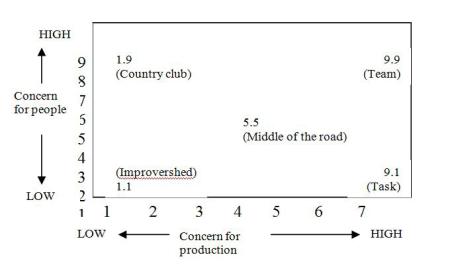
The two dimensions of leadership, viz. concern for people and concern for production have been demonstrated by Robert R. Blake and James S.
Mouton in the form of a grid. The word ‘Grid’ means an iron grating, a frame work of parallel bars.
Figure 21.2: Managerial Grid
Blake and Mouton identified five basic leadership styles of practicing managers representing various combinations of the aforesaid two dimensions as shown in the above diagram. It is, however, important to point out these basic styles are a matter of convenience rather than a fact. A brief description of these styles is given below.
1. The 9, 1 managerial Style (Task)
People are regarded as an instrument of production under the 9, 1 management style. It is an autocratic style of leadership. This style places a heavy emphasis on task and job requirement. Human relationships and interactions are minimized. Subordinates are expected to carry out orders with an unquestioning obedience. They are taken as merely means for doing the tasks assigned to them. Little attention is given to their development or communicating with them beyond the issue of instructions and orders. If there is a conflict between a subordinate and the boss, the goal of the boss is to win.
2. The 1, 9 Managerial style (Country Club)
Under this style of management, work is done leisurely. At best people are regarded rather than driven. Subordinates are expected to turn out some work to avoid trouble. The boss is more of a big brother rather than an autocratic leader. Social relationships are more important. The group, not the individual is the key in the organization. The aim is to achieve friendliness and harmony among the members of the organization.
267
3. The 1, 1 Managerial Style (Impoverished)
A manager with this orientation exerts minimum influence on the contacts with group members. He expresses little concern for production or people. In a supervisory position, he is most likely to be found executing messenger – carrier functions, communicating orders from the layer above to the layer below. He is an expert in passing on blame to others for failures in such a way that he absolves himself from responsibilities and rarely initiates. His criticism is strictly in self defense. Minimum involvement in organization’s purpose and with its people is all that he wants. Through minimum contact and noninvolvement, the 1, 1 style reduces the need to take active steps with respect to managerial responsibilities. Subordinates or members of the group are left to find for themselves the ways of doing the job.
4. The 5, 5 managerial Style (Middle Road)
The “people” dimension in the work situation is as important as the “production” dimension. The 5, 5 style seeks to maintain a balance between the two. A basic assumption of this style is that people will work willingly and they are told the reasons for doing so are explained to them. However, just enough is communicated so that people have a general sense of what is going on. If too much is told, it is feared that they might resist. Enough concern is shown for the people so that adequate production may be achieved. This is seen in the 5, 5 approach to management development, communication, and performance reviews. Meetings are held to listen to their suggestions and to create a sense of participation in decision - making.
5. The 9, 9 Managerial Style (Team)
A major difference between 9, 9 style and other managerial styles is in goal setting and its use as a basic management approach to a large variety of problems. The capability of people in achieving organizational objectives through commitment is fundamental. In other words, the 9, 9 orientation aims at integrating the people and production dimensions of work under conditions of high concern for growth. The key is the involvement and participation of those responsible for it in planning and execution of work. This brings about the kind of team spirit that leads to high organization accomplishment.
Each of the five styles given by Blake and Mouton points out the relative concern for production and people and implies that the most desirable leadership behavior is 9, 9 i.e., maximum concern for both production and people. It may be noted that the five positions emphasized in the Managerial grid are rarely found in their pure form in actual life. That means, a manager may have a style of 8, 2, or 4, 6 or some other. Nevertheless, Managerial Grid is widely used as a technique of managerial training and for identifying various combinations of leadership styles.
In essence, the managerial Grid has given popular terminology to leadership styles within the four quadrants of the Ohio State Studies. However, there is one basic difference between the two. In managerial Grid, ‘concern for’ is a predisposition about something or an attitudinal dimension.
268
Thus, managerial Grid tends to be an attitudinal model that measures the predispositions of a behavioural model that examines how leader actions are perceived by others.
Choice of Leadership Style
We have observed that different management experts have suggested different styles and there is no unanimity among them as to which is the most suitable for an enterprise. For example Rensis Likert suggested democratic leadership. As different leadership styles have their merits and demerits, it is difficult to prefer one leadership style to another. The selection of a leadership style will depend on the consideration of a number of factors. According to Tannenbaum and Schmidt, the important factors that affect the choice of a style of leadership are as follows:
Forces in the Manager : These include manager’s personality, experience, and value system, his confidence in subordinates, leadership inclination, feeling of security in an uncertain situation, etc.
Forces in the Subordinates : These include readiness of subordinates to assume responsibility for making decisions, need of subordinates for independence, interest in the problem at hand, knowledge to deal with the problem, etc.
Situational Theory of Leadership
This theory advocates that leadership is strongly affected by the situation from which a leader emerges and in which he works. It is based on the assumptions that there exists an interaction between a group and its leader and that people tend to follow the person (known as leader) who is capable of fulfilling their aspirations. Thus, leader is a means of achieving the goals of the group and the members. The leader recognizes the needs of the situation and then acts accordingly.
The focus in the situational approach to leadership is on observed behavior and not on any hypothetical inborn or acquired ability or potential for leadership. In other words, the emphasis is on the behavior of the leaders and their followers and the type of situation. In other words, a person becomes a leader not only because of his personal attributes, but also because of various situational factors and the interactions between the leader and the group members.
Review Questions
1.What is leadership? Discuss the trait and situation theory of leadership.
2.“Leadership is situational.” Comment on the statement.
3.“Leaders are born and not made”. Discuss
269