Материал: Management-and-Organization-Behavior
Steps in Organizing Process
Organizing is a multi-step process consisting of the following:
-- Detailing all the work that must be done to attain the objectives; (identification of tasks involved);
-- Dividing the total work into activities that can logically and comfortably be performed by one person or by a group of persons; (differentiation);
-- Grouping the related tasks in a logical manner (departmentation); -- Setting up a mechanism to coordinate the work of members into a
unified whole by establishing authority – responsibility relationships, (delegation and decentralis ation of authority); and
-- Monitoring effectiveness of the organization and making adjustments to maintain or increase its effectiveness.
The various steps in organizing process results in a structure that facilitates the performance of tasks in a cohesive way. The resulting structure, however, is not a static form, like the structure of a building. Since structure is based on plans, major revision of plans may necessitate a corresponding modification of structure. As such, organizing and reorganizing are ongoing processes. Successful organizations continuously assess the appropriateness of their structure and change it in accordance with the dictates of the environment. It is anybody’s knowledge that many Indian companies are restructuring their activities to meet the new challenges in the present liberalization era. Organization structures are modified periodically in response to the environmental demands. Management expert Tom Peters estimates that about 50 percent of organization problems arise from inappropriate organization structure. Because adaptation is a key to competitive survival, the ‘right’ structure for an organization is determined by numerous factors. For this reason, selecting an organization structure might best be described as an evolutionary, trial-and-error process.
Organization Chart
Organization structure may be presented in the form of on organization chart that shows all the positions in an organization and their formal relationships to one another. It illustrates an organization’s overall
100
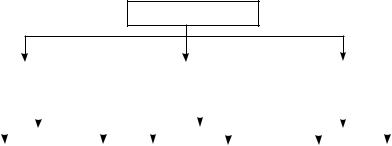
shape and the levels of management in a comprehensible manner. The organization chart of a typical company structured on functional basis is presented in the following chart.
Chairman
|
|
|
|
|
|
|
|
|
|
|
|
|
|
|
|
|
|
|
|
|
|
|
|
|
|
|
Manager |
|
|
|
|
|
|
|
Manager |
Manager |
|||||||||||||||
|
Production |
|
|
|
|
|
|
|
Marketing |
|
|
|
|
Finance |
|
||||||||||
|
|
|
|
|
|
|
|
|
|
|
|
|
|
|
|
|
|
|
|
|
|
||||
|
|
|
|
|
|
|
|
|
|
|
|
|
|
|
|
|
|
|
|
|
|
|
|
|
|
|
|
|
|
|
|
|
|
|
|
|
|
|
|
|
|
|
|
|
|
|
|
|
|
|
|
|
|
|
|
|
|
|
|
|
|
|
|
|
|
|
|
|
|
|
|
|
|
|
|
||
Manufacturing |
|
Quality |
|
Sales |
Advertising |
|
|
|
Accounting |
Taxes |
|||||||||||||||
|
|
|
|
|
|
|
|
|
|
|
|
|
|
|
|
|
|
|
|
|
|
|
|
|
|
Figure 9.1: Organisation Chart
As could be seen in figure, an organization chart shows:
-- The hierarchical structure that is typical of most organizations; -- The number of management levels;
-- Scope of authority and status of the individuals as indicated by the location of their position in relation to other positions;
-- How an organisation’s activities are grouped in terms of departments (whether by function, by product, territory and so on);
-- The work being done in each position (indicated by the labels in the boxes);
-- Interaction of people as indicated by the horizontal and vertical lines connecting various positions/ departments;
-- Relationships between superiors and subordinates in terms of who reports to whom, that is, the chain of command;
-- How many subordinates report directly to each manager, that is the span of management;
-- Career progression, and
-- Formal channels of communication (indicated by the connecting lines).
However, an organization chart does not show:
-- Interactions between people who have no official reporting relationships, that is, the informal organization;
101
-- The ongoing dynamics of workplace behavior; -- Personal preferences and coalitions;
-- Informal communication channels; and -- Interference by outsiders.
The organization chart of any company, therefore, enables one to understand easily three classical principles of organizing, viz., chain command, unity of command and span of control.
Chain of Command
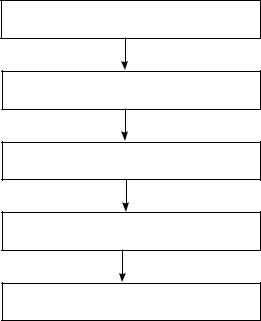
The type of arrangement of various positions in an orderly way is termed scalar chain or chain of command. The chain of command exists wherever an individual is made subordinate to another. Since ancient times, it has been recognized that the only way to structure unified systems involving large number of people is through a chain of command. The resulting hierarchy is found in every company or in any human system including a family. Following chart depicts the chain of command in a typical manufacturing company. In addition to defining different degrees of authority of people, Chain of Command also suggests the routes through which information flows within an organization.
CHAIRMAN
MANAGER PRODUCTION
PLANT MANAGER
DEPARTMENT HEAD
SUPERVISOR
Figure 9.2: Chain of Command
102
Unity of Command
The Chain of Command principle implies another feature of organizing: one subordinate-one boss. If the efforts of subordinates are to be effectively coordinated, it is necessary that they must have a reporting relationship with only one superior. Unity of command principle avoids the confusion as to who should report to whom and who should issue orders to whom.
Span of Management
It is anybody’s knowledge that a manager cannot effectively supervise the activities of an infinite number of subordinates. This is because of the limitations of time, energy and skills. These limitations place natural limit on the number of subordinates that a manager can effectively supervise. But for this limit, organizations would have not taken the pyramid shape. Span of management refers to the number of subordinates that report directly to a manager. The traditional thinking was that an effective span involved some definite number of subordinates. For example, Lyndall Urwick found “the ideal number of subordinates for all superior positions to be four and at the lower level of the organization, the number may be eight or twelve”. Often, one of the first things done by an organizational analyst or consultant was to count the number of subordinates reporting to each manager. In each instance, when the number exceeded a definite figure, say – six or eight, there would be a recommendation to narrow the span. Thus, the thinking of the classical theorists about the span revolved around a definite number.
Classical Thinking on Span of Control
As explained above, the traditional theory of management was much concerned with the specific number of subordinates that could be supervised by a manager. For instance, Lyndall Urwick suggests that no executive should attempt to supervise directly more than five. Different thinkers suggested different spans both at the top and lower levels of organization.
The contribution of V.A. Graicunas was however, significant to the span of management theory. According to him, in selecting a span
103
managers should consider not only the direct one-to-one relationship with their subordinates, but also two other kinds of relationships, namely, direct group relationships and cross-relationships. As such, if A has two subordinate B and C, the following relationships would emerge.
i.Direct one-to-one relationships: These relationships relate the superior directly with his subordinates, A in this case will have two direct relationships with B and C, viz., A to B and A to C.
ii.Direct Group relationships: This refers to the relationships of superior with the various possible combinations of subordinates. In the above example, A may interact with B in the presence of C or with C in the presence of B. Graicunas argues that though the individuals are same, the two situations have different implications.
iii.Cross – relationships: This type of relationships is created when subordinates consult one another. In our example, the two cross relationships are B with C and C with B. Graicunas gave a formula to ascertain the number of all the three kinds of relationships:
|
2n |
Number of Relationships, n = |
---- + 2 -1 |
|
2 |
n stands for the number of subordinates. One can easily ascertain how the number of relationships increases as the number of subordinates rises by applying this formula.
With four subordinates, the total relationships go up to 44, with five subordinates to 100, with six subordinates to 222, and with 10 subordinates to 5,210. Though Graicunas formula explains the complexities involved as the number of subordinates increase, it suffers from the following inadequacies.
-- The formula ignores the frequency and importance of relationships, and
-- Several other factors which have a bearing on the superior subordinate relationships have not been taken into consideration.
104