Материал: Konrad Muzyka Russian Forces in the Western Military District

Another parachute division in the Western MD, the 106th Airborne Division, is in Ivanovo, 250 km northeast of Moscow. It is also composed of two maneuver regiments supported by air defense and artillery regiments.
The sole air assault division, the Pskov-based 76th Air Assault Division, fields three airborne regiments, artillery and air defense regiments, and a tank battalion, as well as three support battalions (logistics, engineer, and reconnaissance).
The VDV has several important roles to play in the Russian armed forces. First, taking into consideration all war-going ground components, the VDV represents the best trained highreadiness force: it requires little preparation and notice (perhaps 48-72 hours) to be forward deployed, using strategic airlift aircraft to undertake combat operations. Therefore, it forms the backbone of the Russian rapid-reaction forces. Second, it is the main reserve force for the General Staff that is capable of undertaking nonconventional and conventional operations. Tactically, plans to include organic rotary-wing assets in the VDV structure, as well as an already-implemented plan to incorporate main battle tanks into the VDV TO&E, make it an agile, flexible force that not only can parachute (or repel/dismount) to create tactical advantages but also can be used as a motor rifle infantry that can penetrate defenses in order to bring tactical victories. Strategically, the VDV’s mobility and training exercises make it suitable for being deployed to operations in different theaters at short notice in order to support units already deployed there (Kaliningrad, the Arctic).
Since 2014, the VDV has been undergoing expansion, which again is linked to its role in combat operations in Ukraine—particularly in Donbas. The addition of tank battalions, along with organic helicopters, is coupled with an increase in the size of the force. Plans from post-2014 called for doubling the size of the force, to 72,000 personnel, by 2020. VDV divisions were slated to grow from two maneuver regiments to a traditional three-regiment configuration. This goal is unlikely to be achieved in the long term.49 As of mid 2020, the VDV had around 42,000 personnel, of whom 30,000 were serving under contract.50 This gap between rhetoric and reality will prevent, or at least significantly delay, the MoD’s plans to add a third maneuver regiment to division-level units. Indeed, a lack of manpower was reportedly one reason why
49Российская газета, Численность ВДВ России планируется увеличить до 72 тысяч человек, Aug. 6, 2014, https://rg.ru/2014/08/06/vdv-anons.html.
50Michael Kofman, “Rethinking the Structure and Role of Russia’s Airborne Forces,” Russian Military Analysis: A
Blog on the Russian Military (blog), Jan. 30, 2019, https://russianmilitaryanalysis.wordpress.com/2019/01/30/rethinking-the-structure-and-role-of-russias- airborne-forces/.
CNA Occasional Paper | 30

the 72,000 figure was revised to 60,000.51 That said, small expansions of the VDV force have occurred. In 2017, a VDV battalion (171st Airborne Battalion), subordinated to the Southern MD 7th Guards Airborne Assault Division (Mountain), was established in Crimea.52 By 2021 it is to be expanded to a regiment in order to “strengthen the defense of the Crimean Peninsula.”53
It remains to be seen whether the Crimean blueprint will be repeated in other areas, such as the Kaliningrad Oblast. In 2018, the 76th Airborne Division also reinstated the 237th Air Assault Regiment (disbanded in 2001),54 which added the third regiment to the already existing 104th and 234thregiments.
Airborne troops will form the backbone of the new Russian rapid-reaction forces in the coming years. The new forces will be able to maintain operations as self-sufficient units and as part of the land force on a separate attack axis.
A VDV regiment comprises three air assault or parachute battalions, an artillery battalion, a reconnaissance company and tank companies, an antitank battery, an air defense battery, a signal company, and an engineering company. Offensive operations rest on the first three battalions and the newly established tank company. On a battalion level, they utilize a mix of 31 BMD-4M airborne infantry fighting vehicles and 16 BTR-MDMs. The former are equipped with 100mm guns, which generate sufficient firepower to enable an airborne regiment to undertake independent operations without the need for additional supporting units. The vehicle is designed to engage targets of a similar kind (APCs, IFVs). For bigger threats, the VDV is testing the Sprut-SDM1 lightweight tank. Based on a BMD-4M’s chassis, the vehicle will feature a 125mm smoothbore gun and will thus be able to destroy main battle tanks.
The BMD-4M/BTR-MDM duo has been delivered to the Airborne Forces since 2016. As of mid 2020, eight battalion sets and one company set have been delivered, which indicates that around 320 BMD-4Ms and 180 BTR-MDMs have been handed over.55 (See Table 1.)
51Тасс, Источник: Россия на постоянной основе развернет батальон ВДВ в Крыму в 2017-2018 годах, Тасс,
Feb. 17, 2016, https://tass.ru/armiya-i-opk/2677585.
52Телеканал «Звезда», Первый в Крыму батальон ВДВ получил боевое знамя, Телеканал «Звезда», Dec. 4, 2017, https://tvzvezda.ru/photo-gallery/201712041011-mp2q.htm/.
53Тасс, Аксенов: новый полк ВДВ позволит укрепить оборону Крыма, Тасс, Dec. 17, 2019, https://tass.ru/armiya-i-opk/7359959.
54Лента.ру, Старейшей дивизии ВДВ вернули созданный при Сталине полк, Dec. 17, 2019, https://lenta.ru/news/2018/12/17/diviziya/.
55Центр АСТ, 234-й десантно-штурмовой полк Псковской дивизии ВДВ получил второй батальонный комплект БМД-4М, June 20, 2020, https://bmpd.livejournal.com/4065141.html#cutid1.
CNA Occasional Paper | 31
Table 1. BMD-4M/BTR-MDM duos delivered to airborne forces as of mid 2020
Airborne force |
No. of duos delivered |
|
|
234th Air Assault Regiment (76th Airborne Division) |
2 x Battalion BMD-4 / BTR-MDM |
104th Air Assault Regiment (76th Airborne Division) |
2 x Battalion BMD-4 / BTR-MDM |
137th Airborne Regiment (106th Airborne Division) |
2 x Battalion BMD-4 / BTR-MDM |
|
|
31st Airborne Brigade |
1 x Battalion BMD-4 / BTR-MDM |
|
|
108th Air Assault Regiment (7th Airborne Division) |
1 x Battalion BMD-4 / BTR-MDM |
|
|
242nd VDV Training Centre |
1 x Company BMD-4 / BTR-MDM |
|
|
Source: CAST.
CNA Occasional Paper | 32

The 6th Air and Air Defense Army
In 2012, Shoigu reverted Serdyukov’s reforms and returned to the regiment-division-army organization and the regiment-airbase concept of basing of air force assets. All seven 1st grade air bases, along with their subordinated air groups, were disbanded and converted into aviation division headquarters. Consequently, a regiment was again the main combat unit of the air force, a structure that had been in place since the late 1930s and changed only briefly when Serdyukov managed the MoD.
In August 2015, the Russian Air Force merged with Aerospace Defense Troops, creating the Aerospace Forces (Vozdushno-Kosmicheskiye Sily: VKS). This move served to integrate air assets responsible for air defense under one unified command, in order to increase readiness and force cohesion, and improve information sharing across the forces responsible for air defense of Russia. At the same time, the regiments’ dispersal increased the general readiness of the air forces to respond to various threats in different theaters and increased their survivability in case of a surprise armed attack (because fewer assets were stationed at one base).
The creation of air and air defense armies followed as a result. Such an army combines all air (fixedand rotary-wing) assets on its territory as well as air defense regiments and divisions with their SAM and early warning systems.56 Each army also fields air defense divisions, comprising air defense (SAM) and radio-technical (radar) regiments that create unified, integrated, layered air defense network whose main task is to repel air and ballistic missile strikes on Russia. Moscow remains the most heavily guarded city in Russia. It is followed by St. Petersburg, which in recent years has seen a significant upgrade in the quantity and quality of SAM systems deployed to defend the city.
Figure 10 shows the locations of the 6th Air and Air Defense Army units.
56 The VKS commander manages direct reporting units, which include the Long-Range Aviation Command (operationally subordinated to the Supreme High Command of the Russian Armed Forces), tasked with providing nuclear deterrent and power projection in out-of-area operations; and the Military Transport Aviation, also operationally subordinated to the Supreme High Command, which provides strategic and operational airlift.
CNA Occasional Paper | 33
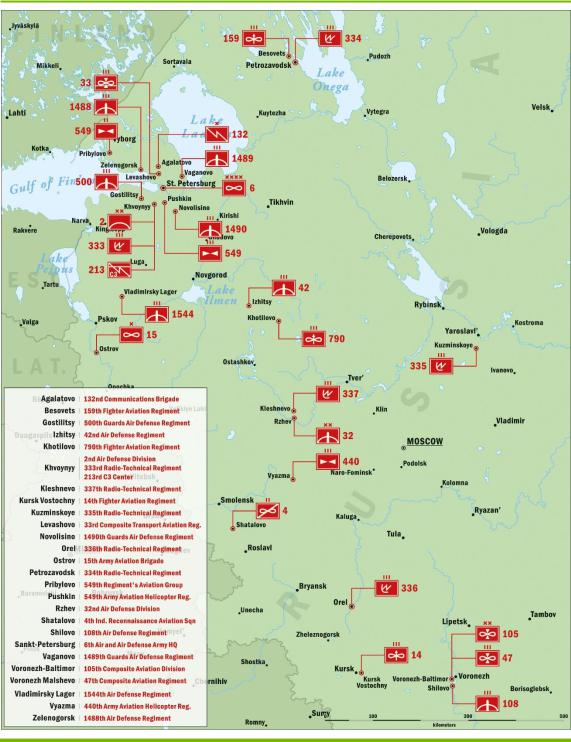
Figure 10. Units under the command of the 6th Air and Air Defense Army
Source: Author’s findings.
CNA Occasional Paper | 34