Материал: Konrad Muzyka Russian Forces in the Western Military District
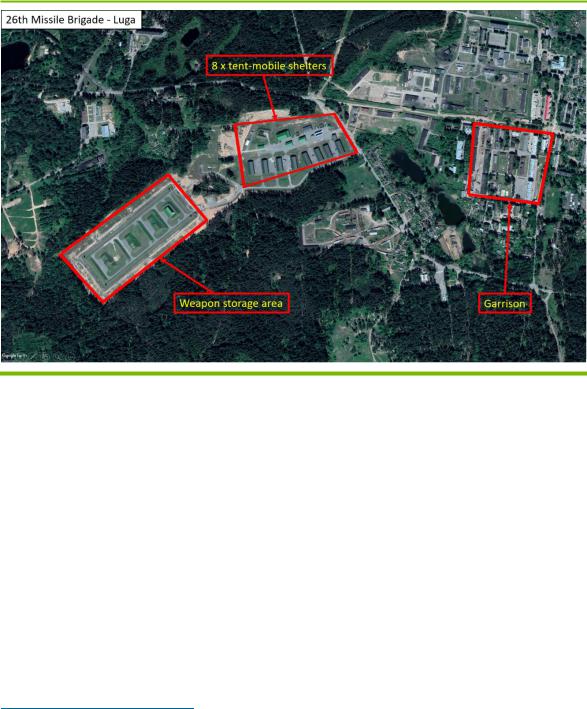
Figure 6. The 26th Missile Brigade, Luga
Source: Google Earth. Image date: 25 May 2018.
During Zapad-17, the core task of the 6th CAA was to cover the right flank of the advancing 1st GTA, keep NATO forces engaged in Estonia and Latvia, and safeguard northern approaches into Western Russia. As the initial push into Belarus was held by the joint Russo-Belarusian task force, the counteroffensive pushed NATO forces back into the Baltic States. The 6th CAA was likely involved in conducting operations both in Estonia and in Latvia. As stated earlier, with its current structure the army does not allow for combined arms operations. For this reason, the army could be supported by airborne forces, presumably the Pskov-based 76th Airborne Division, as well as the heavy combat helicopter presence near St. Petersburg.
For the offense, a motor rifle or tank brigade operates at a front 6 km (3.7 miles) wide with a breaking point 2 km (1.2 mile) wide and 10-15 km (6.2-9.3 miles) deep.31
Geography severely limits the offensive points of Russian forces into Estonia. Only the areas near Narva to the north and near Sesniki to the south of the country offer both rail and road
31 В. И. Александров, А. М. Кабаченко, В. В. Куликов, А. Н. Леунов, И. В. Пестроухов, Мотострелковая
(Танковая) Бригада В Основных Видах Боя Часть 1, Учебное Пособие, Московский Государственный Институт Международных Отношений (Университет), Moscow, 2011, p. 142.
CNA Occasional Paper | 20

entrances into Estonia. The southern corridor is just 30 km (18 miles) from Pskov, which, apart from the 76th VDV Division, also hosts the 2nd Spetsnaz Brigade, elements of which are located in Pechory, on the border with Estonia. Passage across Lake Peipus could also be built, a capability which was practiced during the Zapad-17 and Centre-19 operational-strategic exercises.32
32 During Zapad-17, a 700-meter-long (2,300-foot) brigade was set up over the Volga River. Centre-19 saw the setting up of at least four bridges, the longest of which was 3,500 meters (2.1 miles). The capability exists to restore 3,700 meters of bridge crossings per day. Журнал «Материально-техническое обеспечение Вооруженных Сил Российской Федерации» Jan. 2020, pp. 7, 18, 19.
CNA Occasional Paper | 21
The 20th Combined Arms Army
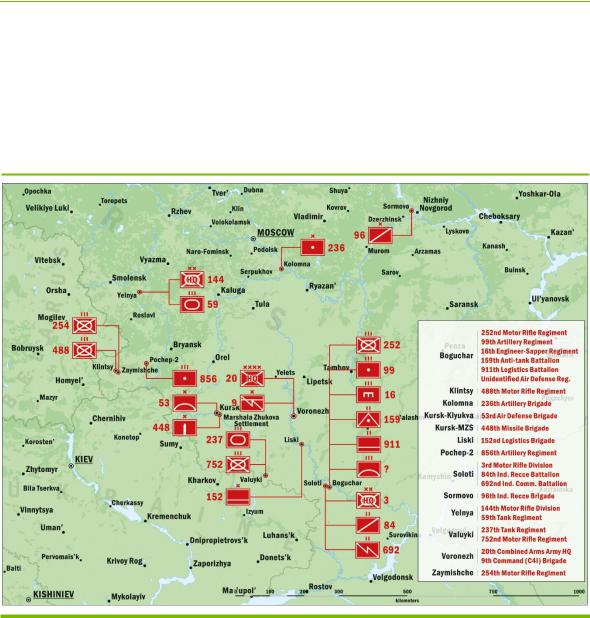
After its operations in Ukraine, Russia needed to strengthen its units in the border regions. Therefore, in 2015, the headquarters of the CAA was relocated from Nizhny Novgorod back to Voronezh, where it had been stationed between 1994 and 2010. Figure 7 shows the locations of the 20th Combined Arms Army units.
Figure 7. Units under the command of the 20th Combined Arms Army
Source: Author’s findings.
Establishment of the unit took significant logistics, financial, manpower, and procurement efforts, especially as most of its maneuver components were either created from scratch or developed from units redeployed from the Central Military District. At the same time, there was no infrastructure to support the basing of an army-level grouping; thus, garrisons along the 20th CAA area of responsibility had to be built to house equipment and manpower.
CNA Occasional Paper | 22
Wide, open battlespace favors deployment of motor rifle divisions for combined theater operations. To this end, and because there was no military infrastructure near Ukraine, a decision was made to establish two new motor rifle divisions. The army now covers the northern part of Ukraine (it can ultimately conduct an offensive straight into Kyiv) and the eastern Russian-Ukrainian border; it likely serves as a quick-reaction force to cover the Russian proxy units in the Donbas. On a strategic level, the role of the CAA is to protect the left flank of the 1st GTA. Given the vicinity of its maneuver units to Belarus, elements of the 20th CAA could also be tasked with quick-reaction operations in the country, should such a need arise.
The 20th CAA is composed of two motor rifle divisions. The 144th Motor Rifle Division is headquartered in Yelnya. It is a five-regiment division consisting of two motor rifle regiments (488th and 254th), one tank regiment (59th), and an artillery regiment (856th), as well as a likely, yet unconfirmed, air defense regiment. The full structure of the division is also unclear, although it is safe to assume that other elements of the 144th Motor Rifle Division have also been stood up and include logistics, antitank, communications, and reconnaissance battalions, and an engineer-sapper regiment.
Whereas the above-mentioned division was developed from the 28th Motor Rifle Brigade, previously deployed in Yekaterinburg, the 3rd Motor Rifle Division was developed from the elements of the 9th and 23rd Motor Rifle Brigades as well as the 262nd Weapon Storage Base. It also has two motor rifle regiments (252nd and 752nd), one tank regiment (237th), reinforced by the 99th Artillery Regiment, and an as-yet-unidentified air defense regiment. Open-source information also gives a clearer picture of the support structure of the division. It includes the 16th Engineer-Sapper Regiment, and the 692nd Independent Communications Battalion, the 84th Independent Reconnaissance Battalion, the 159th Antitank Battalion, and the 911th Logistics Battalion.
Other army-level formations include the Iskander-equipped 448th Missile Brigade, 53rd Air Defense Brigade that fields the Buk-M3s, and the 2017-established 236th Artillery Brigade.
A September 2018 Google Street View image from Nizhny Novgorod also indicates that the 96th Independent Reconnaissance Brigade is subordinated to the 20th CAA. Although the reference to the 20th CAA disappeared from Yandex Street View (dated 2019), it is unclear whether the subordination changed as well or whether it was just the poster that was replaced. Otherwise, the unit is subordinated to the 1st Guards Tank Army.
During full peacetime, the 20th CAA fields four motor rifle regiments and two tank regiments. Assuming that a motor rifle regiment in a standard configuration deploys three motor rifle battalions (3 x 41 BMPs) and a tank battalion (1 x 31 T-72B3s), and that a tank regiment has one motor rifle battalion (1 x 41 BMPs) and three tank battalions (3 x 31 T-72B3s), the army can deploy around 560 BMPs and 300 MBTs.
CNA Occasional Paper | 23

Units Subordinate to the Western MD
Apart from the two combined arms armies and one tank army, approximately 23 units are subordinated to the Western MD commander; they mostly serve in combat support roles. They include the 1st Engineer-Sapper Brigade (Murom), 45th Engineer-Sapper Brigade (Nakhabino), and 45th Engineering-Camouflage Regiment (Inzhenernyy 1).
Also in Murom is the 28th Pontoon-Bridging Brigade, which is solely dedicated to the provision of bridging capability on a front level; however, it is reportedly subordinated to the General Staff33 rather than to the Western MD commander.
Railway transport, which is absolutely key for long-distance troop mobility on a district level, is provided by the 29th, 34th, and 38th Independent Railway Troops Brigades, based in Bryansk, Ryazan, and Yaroslav, respectively.
Also subordinate to the General Staff are the 2nd and 16th Spetsnaz Brigades, stationed in Pskov and Tambov, respectively. The units are tasked with conducting long-range reconnaissance, target acquisition, and diversionary operations behind enemy lines (especially against high-value targets). Despite their subordination to a higher echelon, in times of war the brigades are tasked with conducting special operations within the Western MD areas of responsibility.
An additional force multiplier comes in the form of the 15th and 16th Independent EW Brigades (Stroitel and Kursk). They have proved their effectiveness, or Russian EW capability, in the conflicts to which their personnel have been deployed. Consequently, EW assets have been integrated into land forces at every echelon: combined arms brigades, divisions, corps, and military districts. Just as air defense brigades at the district and army levels provide a flexible response to air threats, the EW brigades could also be utilized on a strategic level to protect front-level operations at selected locations. EW brigades are tasked with eavesdropping and denying communications and degrading opposing forces’ information superiority. EW brigades field some of Russia’s most powerful systems—such as RB-109A Bylina, Krasukha, Leer-3, Moskva, and Murmansk-BN—which offer ranges of several hundred miles.34 In addition to the EW brigades, the ground forces in the Western MD field two special
33Алена Романова, Под Муромом выбрали победителя конкурса "Открытая вода", Владимирские ведомости, July 10, 2019, https://vedom.ru/news/2019/07/10/35847-pod-muromom-vybrali-pobeditelya- konkursa.
34Roger N. McDermott, Russia's Electronic Warfare Capabilities to 2025, ICDS, Sept. 2017, p. 7, https://icds.ee/wpcontent/uploads/2018/ICDS_Report_Russias_Electronic_Warfare_to_2025.pdf; and Анатолий Аркадьевич
CNA Occasional Paper | 24