Материал: Konrad Muzyka Russian Forces in the Western Military District
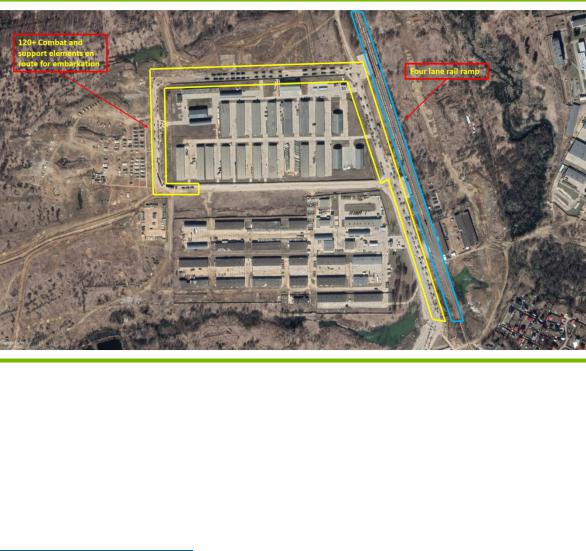
Moving a tank or motor rifle division would necessitate the utilization of around 1,950 to 2,600 railcars,23 which is at least three times more than what was scheduled for Zapad. Given that a typical train echelon has 57 cars, just one division would require as many as 34 to 50 trains.24 To put this into perspective, the number of wagons that reportedly were deployed into Belarus (627) translates exactly into 11 trains—a third of what a division would demand for movement. (Figure 3shows rifle brigade elements before being loaded on a train.)
Figure 3. Elements of the 2nd Motor Rifle Division (battalion) before being loaded on a train during an April 2019 exercise
Source: Google Earth, image date Apr. 17, 2019.
As already stated, the role of the 1st GTA depends on whether the unit will conduct operations in offense or defense. In defense, because of the build-up of the 20th CAA near Belarus and Ukraine since 2015, the GTA serves as the strategic, armored reserve earmarked for counteroffensive operations. There is an understanding within the Russian political-military circles that the period of an increased threat, which allowed the Soviet Union and Russia to
23Michael Sadykiewicz, Soviet-Warsaw Pact Western Theater of Military Operations (Santa Monica, CA: RAND, 1987), p. 92.
24This can change for wartime.
CNA Occasional Paper | 15
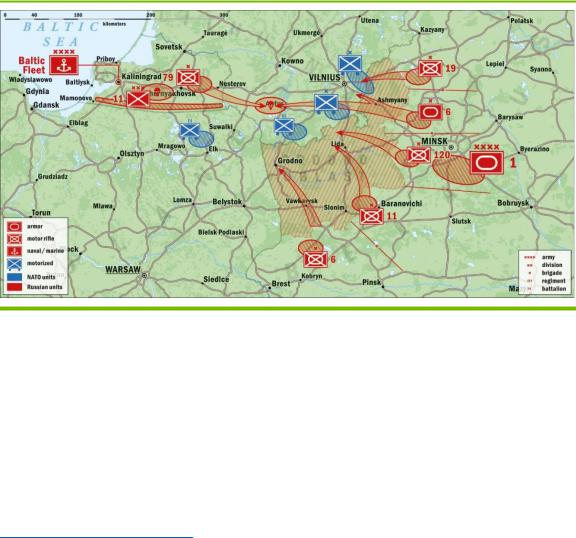
mobilize and strategically redeploy its forces, has decreased substantially, which was clear during operations in Georgia and then Ukraine. Therefore, high-readiness, self-sufficient maneuver forces are key in ensuring Russia’s ability to respond appropriately during initial hostilities. This was tested during Zapad-17, where reinforced elements of the 6th Tank Brigade had been deployed into Belarus before the active phase of the exercise began. (See Figure 4.)
Figure 4. Deployment during Zapad-17 counteroffensive operation
Source: Author’s assessment.
According to Lieutenant Colonel Dr. Marek Depczyński from the Polish War University, these elements were later strengthened with additional subunits, and after the defensive part of the exercise was over, they conducted a counteroffensive, probably into the Baltic States.25 Therefore, the tank army is capable of a wide spectrum of operations depending on the circumstances and the plans assigned to them.
According to Depczyński, one lesson learned during Zapad-17 was that even though a force the size of the 1st GTA is insufficient to reach the Vistula-Wieprz line26, it is adequate to seize the
25Lieutenant Colonel Dr. Marek Depczyński, Zasadnicze Parametry i Przebieg Strategicznego Ćwiczenia Dowódczo
– Sztabowego Zachód 2017, Akademia Sztuki Wojennej, Warszawa, 2017.
26In Poland, the Wieprz River has its sources near Tomaszow Lubelski, some 40 km (25 miles) from the border with Ukraine. It flows into the Vistula River 50 km (31miles) south of Warsaw. The line forms a natural obstacle for any mechanized/armored forces pushing from Belarus towards southern and central Poland.
CNA Occasional Paper | 16

Baltic States, especially if additional support comes from air mobile forces and Kaliningradbased naval infantry units.
One of the less pronounced reorganization decisions that was pursued after 2012 pertains to the logistical support system that would allow the main components of the land forces to be continually engaged in military operations across a wide spectrum of military operations. One lesson learned during the “Centre-2011” strategic-operational exercise was that the CAA-level logistics brigade was inefficient in supporting army operations, because it was able to service five to eight brigades (or 2 x motor rifle/tank divisions and 2 x motor rifle/tank brigades).27 Consequently, additional logistics support will be provided by units at the Military District level, in order to ensure that materiel is appropriately provided to the battlefield. The 1st GTA has an organic support brigade in Dzerzhinsk, west of Mulino.
In a classical sense, the Russians assess that they need to possess at least a force ratio of 3:1, preferably 4:1, to defeat a US division (three brigade combat teams) in an open battle. Naturally, the outcome of a battle also depends on asymmetrical means of combat, such as electronic warfare; however, in terms of force correlation, Moscow would like to possess enough fire superiority in the initial period of war to ensure an immediate breakthrough of front lines. Before 2012, the Russian Land Forces would have required at least seven to nine combined arms brigades just to defeat a US division. As a result, and given the complexities of commanding combined arms brigades, a decision was made to return to the pre-Serdyukov model of C2 of regiment-division-army to match NATO’s potential in the western operational direction.28
27Marek Depczynski, Ewolucja Rosyjskich Sił Lądowych, Przegląd Sił Zbrojnych, Warsaw, Mar. 2018, p. 114.
28Marek Depczynski, Ewolucja Rosyjskich Sił Lądowych, Przegląd Sił Zbrojnych, Warsaw, Mar. 2018, p. 116.
CNA Occasional Paper | 17
The 6th Combined Arms Army
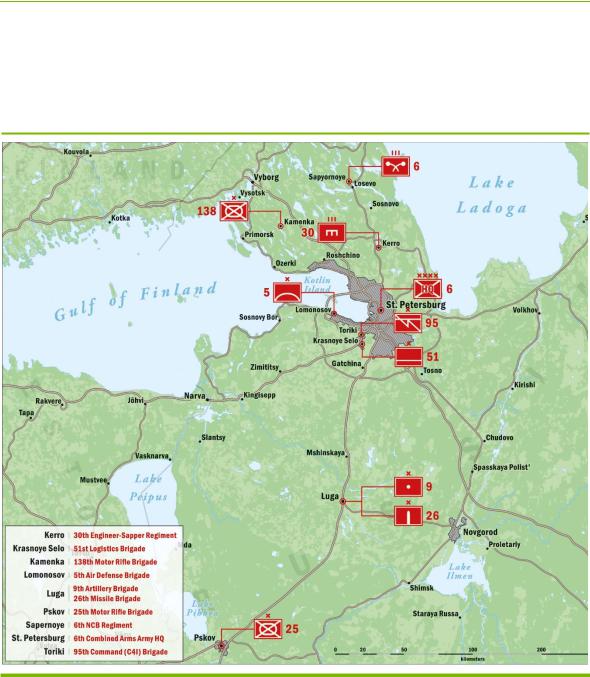
The 6th Combined Arms Army is headquartered in St. Petersburg and is composed of nine brigades and regiments. Figure 5 shows the locations of the 6th Combined Arms Army units.
Figure 5. Units under the command of the 6th Combined Arms Army
Source: Author’s findings.
CNA Occasional Paper | 18

Command of the army is exercised through the 95th Command (C4I) Brigade. Its maneuver forces are based in the 25th and 138th Motor Rifle Brigades, which are stationed in Pskov and Kamenka, respectively. Although each brigade fields just one tank battalion,29 with armored support they possess enough capability to engage two Estonian land forces brigades. In addition, once a motor rifle brigade captures an area, the Estonians will have difficulties conducting a counteroffensive because of their lack of armor.
Additional combat support is provided by Luga-based 9th Artillery Brigade. Also based in Luga is the 26th Missile Brigade, which was the first ground forces unit to convert from the OTR-21 Tochka-U to the 9K720 Iskander ballistic missiles complex in 2011.30 The base was fully modernized between 2013 and 2015 to house the new system. Since then, each new Iskander missile base has had a similar structure, the most obvious one being green tent mobile shelters. These shelters do not seem to be hardened, and therefore are vulnerable to an aerial attack and ballistic missile strikes. (See Figure 6.)
The 6th CAA is the least developed combined arms army in the Western MD; its structure resembles a division rather than a combined arms army. There are several possible explanations as to why the 6th CAA has not been prioritized in terms of receiving new equipment and expanding its units. First, an increase of the army’s combat potential (addition of new brigades and expansion of existing ones) would be perceived by NATO as a hostile act, and would force the alliance to respond in kind by forward deploying additional assets to the Baltic States. Second, despite the post-2014 breakdown in relations between NATO and Russia, the latter chose not to escalate further by increasing its presence on NATO’s doorstep. Finally, post-2014 modernization priorities forced the army staff to focus on developing combat potentials near Ukraine in order to deter Kyiv from conducting any significant counteroffensive operations in the Donbas.
29The number of tanks in a Russian motor rifle tank battalion varies. A standard number is 31; however, this can increase to 42, depending on the unit and role assigned to it. See Московский Государственный Институт,
Международных Отношений (Университет), Мотострелковая (Танковая) Бригада В Основных Видах Боя,
Moscow, 2011, p. 11.
30Лента.ру, В России появилась первая бригада ракетных комплексов "Искандер", Oct. 20, 2011, Лента.ру.
CNA Occasional Paper | 19