Материал: Konrad Muzyka Russian Forces in the Western Military District
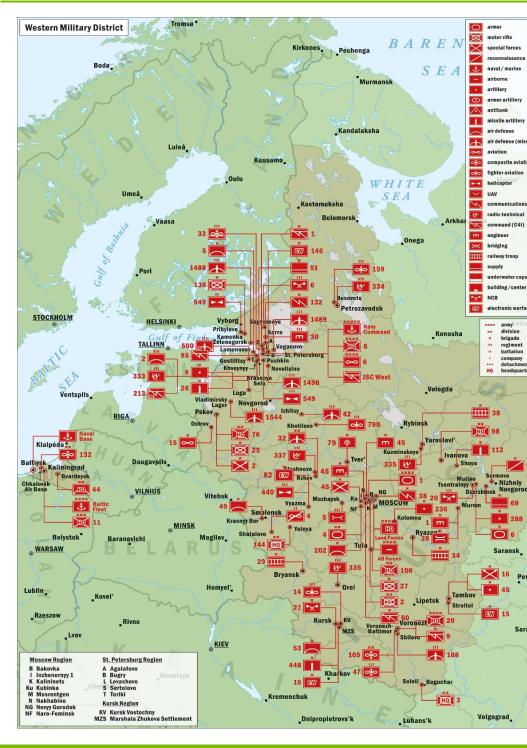
Figure 1. The Western Military District
Source: Author’s findings. (All maps were designed and created by Piotr Wawrzkiewicz.)
CNA Occasional Paper | 5

In the Western MD, Russia fields two combined arms armies (CAAs) that can conduct selfsustaining combat operations in their areas of responsibility. In terms of echelonment, an army group is an intermediate organizational structure between the Joint Strategic Command (JSC)/ military district command, on the one end, and brigades/regiments on the other.
Because those CAAs differ significantly in terms of size and capability, the roles assigned to them indicate the areas that the Russian General Staff considers to be most threatened. A Russian CAA does not seem to have a fixed maneuver composition, and its structure depends on the roles and missions the army is tasked with, as well as the theater to which the army is deployed.5
The 6th CAA is located opposite the Baltic States and is the least developed army in the Western MD. It is mostly composed of brigades; its armor capability is limited to just two tank battalions, which indicates the low priority given to this particular theater. Despite this, the unit is tasked with protecting the ground approaches to Saint Petersburg and, farther east, the northern approaches to Moscow. During a period of increased tension, and if Russia believes that war is likely to break out, this unit will need to be significantly strengthened, both numerically and qualitatively, to ensure that it can undertake those missions.
Farther south, the 20th CAA is headquartered in Voronezh. The unit’s core composition is starkly different from that of the 6th CAA. Instead of motor rifle brigades, it features two motor rifle divisions; this indicates the prime focus given to Ukraine, and the need to have a heavy motorized and tank force present near the border with Ukraine that can immediately deliver a preponderance of power against opposing forces. Current force prepositioning within the 20th CAA also makes it suitable to undertake combat operations in Belarus.
A lot of attention is paid to the 1st Guards Tank Army (GTA), which is predominantly deployed on the outskirts of Moscow. It has a tank division and a motor rifle division, augmented by a motor rifle brigade, a tank brigade, and other combat support units. The present location of the 1st GTA makes it suitable only for defense of Moscow. Substantial logistics efforts would be needed to move the entire GTA to Russia’s western borders; such a move would be visible to NATO planners and likely to the open-source intelligence (OSINT) community as well. The current defensive positioning of the tank army does not mean that it will not conduct offensive operations. Indeed, during the 2017 iteration of the Zapad strategic-operational exercise, its elements were engaged in both defense and offense.
A further breakdown of those armies and divisions shows different compositions. These compositions, again, indicate threat levels and areas where significant, conventional
5 Note, however, that each combined-arms army now fields an Iskander-equipped brigade to provide long-range strike options against high-value targets. Other fixed elements include artillery, logistics, air defense, NCB (nuclear, chemical, biological), and engineer-sapper brigades/regiments.
CNA Occasional Paper | 6

capabilities will be needed. Although some brigades have been converted into larger divisions in recent years, Russia will maintain a mixed force structure. This diverse force application has its own advantages and drawbacks, but Russia employs the brigades and regiments/divisions in different roles to ensure that it can respond to different scenarios in its neighborhood.
Also directly reporting to the MD commander are those units that provide supplementary support at selected axes. Specifically, the MD commander orders two Spetsnaz and two electronic warfare brigades that back front-level operations. That said, most of the units directly subordinated to the MD are those that logistically support combat operations. These include repair and evacuation regiments, railway troops, and engineer forces. Interestingly, the Western MD also has a unit dedicated solely to concealment and maskirovka (military deception) operations.
Out of the four airborne divisions in the Russian armed forces, three (one air assault, two parachute) are based in the Western MD, confirming the priority of maintaining a heavy presence of airborne forces (Vozdushno-Desantnye Voyska: VDV) in the western operational direction. These forces have high readiness levels; they are the best trained and best equipped forces in the entire ground component of the Russian armed forces. Their role, however, is not limited to airborne operations behind a line of contact. In Ukraine, they were utilized in infantry roles, and the addition of tank battalions to each division can place them directly on the front line. This, coupled with increased readiness, means that the General Staff will continue to rely on VDV units for quick-alert operations, both as a standalone force and as an additional component that can tip the balance in Russia’s favor in direct combat engagements.
Ground operations will be supported by the 6th Air and Air Defense Army (AADA). It combines all air (fixedand rotary-wing) assets on its territory as well as air defense regiments and divisions with their surface-to-air missiles (SAMs) and early warning systems.6 Each army also fields air defense divisions that comprise air defense (SAM) and radio-technical (radar) regiments that create a unified, integrated, layered air defense network whose main task is to repel air and ballistic missile strikes on Russia. Moscow remains the most heavily guarded city in Russia. It is followed by St. Petersburg, which in recent years has seen a significant upgrade in the quantity and quality of SAM systems deployed to defend the city. The 6th AADA is headquartered there. It comprises a composite aviation division, three army aviation regiments, an army aviation brigade, and two air defense divisions. Its area of responsibility is vast: it provides air coverage from just south of Arkhangelsk down to the north of Volgograd.
6 The VKS commander manages direct reporting units. These include the Long-Range Aviation Command and Military Transport Aviation, both of which are operationally subordinated to the Supreme High Command of the Russian Armed Forces. The former is tasked with providing nuclear deterrence and power projection in out-of- area operations, and the latter provides strategic and operational airlift.
CNA Occasional Paper | 7
A self-sufficient fighting force has been established in the Kaliningrad Oblast. Units based there can undertake both defensive and offensive operations. However, without reinforcements, their main role seems to be maintaining pressure on NATO forces based in the region and ensuring that the alliance’s combat potential is first engaged in combating Kaliningrad-based units. Forces based in the oblast can be divided into three main parts: the Baltic Sea Fleet; the air and air defense components, which include the 44th Air Defense Division and the 132nd Mixed Aviation Division; and the 11th Army Corps. The addition of naval infantry provides expeditionary capability, albeit limited by the state of the fleet’s assets. Ground and naval forces equipped with ballistic and cruise missiles provide long-range strike capability that can engage high-value targets almost everywhere in Europe.
CNA Occasional Paper | 8
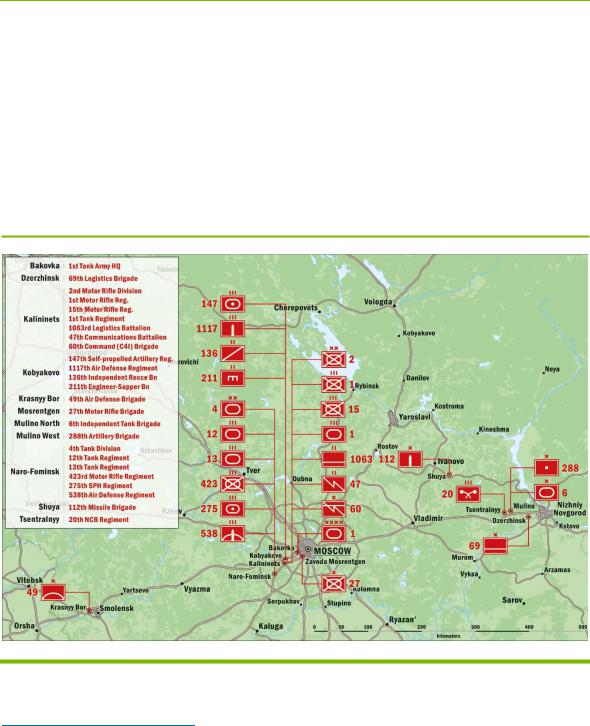
The 1st Guards Tank Army
The 1st Guards Tank Army was stood up in late 2014 (announced in mid 2015).7 In 2013, the 4th Guards Tank Brigade and the 5th Motor Rifle Brigade were converted back to divisions (4th Tank Division and 2nd Motor Rifle Division, respectively) in order to increase the potential of available forces deployed in the outskirts of Moscow. The main goal was to create a fighting force composed of light to heavy units, which could undertake combat operations across the entire spectrum, from low-level counterinsurgency to high-tempo maneuver operations against a near-peer adversary. Figure 2 shows the locations of the 1st GTA units.
Figure 2. Units under the command of the 1st Guards Tank Army
Source: Author’s findings.
7 Роман Крецул, Россия закрывает «черную дыру» на границе с Украиной, Взгляд, June 1, 2015, https://vz.ru/society/2015/6/1/748541.html.
CNA Occasional Paper | 9