Материал: Konrad Muzyka Russian Forces in the Western Military District

undertake cooperative engagements, which depends on the fusion of various (seaborne, airborne) radar sensors to provide target engagement data to S-400 battle management system (BMS) systems and thus nullify effects caused by the curvature of the earth. However, there are reasons to assume that Russia has not yet acquired the latter capability, which significantly decreases its ability to engage aerial targets in over-the-horizon mode.70 There will definitely be an increase in this capability once the A-100 AWACS and the Su-57 aircraft enter service.
For this reason, each air division is also composed of additional radio-technical regiments71 that, when placed away from batteries, provide additional data collection capability that can be used later for target engagement. The 36D6 Tin Shield is one of the acquisition components of S-300/S-400 SAM systems and is used as “a general-purpose medium/high altitude search radar.”72 There are at least 18 such radars in the 2nd Air Defense Division’s areas of operations with additional early warning radars, such as 1L119 Nebo, P-35/37 Bar Lock, and P-12/18 Spoon Rest. In addition, it seems that the 96L6 radars are also being employed in a standalone configuration, detached from S-400 batteries, to provide greater radar coverage and increase the readiness of air defense forces in the Western Military District.
Farther south, the 32nd Air Defense Division is scattered between Vladimirsky Lager, 60 km north of Pskov, to Voronezh. It fields three radio-technical regiments (the 335th, 336th, and 337th) and two air defense regiments (the 42nd and 108th).
The 1544th Air Defense Regiment is equipped with two S-400 battalions, received in early 2018.73 The Voronezh-based 108th Air Defense Regiment is equipped with two S-300PS/PM battalions and is scheduled to upgrade to S-300PM2.74
The 108th Air Defense Regiment is based near Voronezh and is equipped with two batteries of S-300PMs.
The 42nd Air Defense Regiment is equipped with two batteries of S-300PS/PMs. It is located 200 km northwest of Tver. Both regiments are tasked with the provision of air defense for the
70For further reading see: FOI, Bursting the Bubble? Russian A2/AD in the Baltic Sea Region: Capabilities, Countermeasures, and Implications, Mar. 2019, https://www.foi.se/rest-api/report/FOI-R--4651--SE.
71The 2nd Air Defense Division commands the 334th and 333rd Radio-Technical Regiments.
72Dr. Carlo Kopp, Search and Acquisition Radars (S-Band, X-band), Jan. 27, 2014, https://www.ausairpower.net/APA-Acquisition-GCI.html#mozTocId55304.
73Altyn73, Догоняемся по размещению новых дивизионов С-400, Mar. 12, 2019, https://altyn73.livejournal.com/1426325.html and https://altyn73.livejournal.com/1375792.html.
74Елена Черных, Воронежские ракетчики получат аналог С-400, Dec.1, 2018, https://infovoronezh.ru/News/Voronejskie-raketchiki-poluchat-analog-S-400-61455.html.
CNA Occasional Paper | 40

Central Economic Region, which is located in the central area of the European part of Russia. It is the most populous, urbanized, and industrialized region of Russia and houses approximately 20 percent of the Russian population.
Also, note that each S-400 battalion is guarded by up to six Pantsir-S1 air defense missile-gun systems, which are designed to engage tactical aircraft, UAVs, and precision-guided munitions at ranges up to 40 km.75 It is effectively a close-in weapon to be used when missiles have penetrated other layers of the air defense network. Interestingly, in one video showing a Kaliningrad-based Pantsir during an exercise, the system was used to engage ground targets. It is unclear whether it was only target practice or whether the Pantsir-equipped units could also be tasked with providing indirect fire against ground targets.76
75According to the Military Russia page on “Complex 96K6 Pantsir-S / Pantsir-C1 - SA-22 GREYHOUND” (http://militaryrussia.ru/blog/topic-558.html), the exact number of Pantsir units deployed to defend a S-400 battalion depends on the threat environment and the number of other short-range air defense assets employed to defend strategic SAM systems.
76“Russia: Pantsir-S1 anti-missile systems in Kaliningrad drills,” Ruptly Channel, Mar. 21, 2019, https://www.youtube.com/watch?v=g_p_Dw-4yn4.
CNA Occasional Paper | 41

The Kaliningrad Oblast
For many years, the Russian forces stationed in the Kaliningrad Oblast presented a mixed picture of capabilities. On the one hand, between 2007 and 2014, the Baltic Sea Fleet received four Project 20380 Steregushchiy-class corvettes; on the other hand, the subsurface force relied on two antiquated Kilo-class submarines. The oblast-based strategic S-300 SAMs began to be replaced by S-400s in 2012, and the process is mostly completed (more on that below); however, air assets deployed in the Kaliningrad Oblast are still a mix of Su-27Ps and Su-24M/MRs. They have had only a limited increase in capabilities since 2016, through the delivery of eight Su-30SM fighters.
Except for the 336th Naval Infantry Brigade, ground components were significantly underdeveloped until recently, especially in terms of armor and ability to conduct long-range artillery (both missile and shell) strikes. This was particularly evident when comparing ground capabilities of those in the oblast to those in mainland Russia: in the latter, modernization was steady, whereas in Kaliningrad it was uneven and rudimentary.
However, over the last few years, forces in the oblast have undergone a significant expansion and reorganization, to ensure that they are capable of conducting and maintaining offensive ground operations in the theater. At the same time, should a conflict break out, these forces would maintain pressure on NATO assets deployed in the region and would “occupy” the alliance’s military potential during initial stages of the conflict. The control of the land components by the 11th Army Corps was re-established in 2016, as an additional C2 structure between brigades/regiments and the Baltic Sea Fleet command.
Figure 11 shows the locations of the Russian forces in the Kaliningrad Oblast.
CNA Occasional Paper | 42
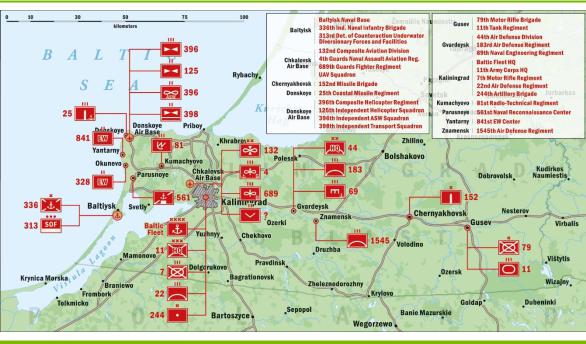
Figure 11. Russian forces in the Kaliningrad Oblast
Source: Author’s findings.
Ground components
The The army corps now fields a self-sufficient fighting force that can conduct mediumintensity combat operations along two axes of advance.
Until 2018 the forces in the oblast fielded just one tank battalion, as a part of the 79th Motor Rifle Brigade based in Gusev. Although it has not been officially confirmed, it appears that the tank battalion was detached from the brigade, which resulted in the brigade being converted into a regiment that has three BMP-2-equipped battalions.
The above-mentioned detached tank battalion served as a basis from which the 11th Tank Regiment was stood up in 2018, also in Gusev. This move increased the number of MBTs deployed to the oblast from around 30 to 90 (excluding naval infantry); thus, it increased
CNA Occasional Paper | 43

offensive capability, especially vis-à-vis those NATO forces stationed in Orzysz in northeastern Poland. In late 2018 the regiment also received a battalion set of 2S19M1 Msta-S SPHs.77
The land component also features the 7th Motor Rifle Regiment, which is based in Kaliningrad. This unit, along with the 11th Tank Regiment and the 79th Motor Rifle Brigade, will form the core of a new motor rifle division, which is to be established in Gusev.78
As of mid 2020 only one tank battalion of the 11th Tank Regiment was equipped with T-72B3 MBTs, whereas remaining armor subunits within the 11th Army Corps field antiquated T-72B1s. According to press reports, all T-72B1s are earmarked for replacement with T-72B3/B3Ms by the end of 2021, which will harmonize the tank fleet across the oblast and increase its firepower79.
Support elements of the 11th Army Corps include the 2nd Air Defense Regiment and the 244th
Artillery Brigade, both stationed in Kaliningrad. The latter’s capabilities have also been a subject of modernization in recent years, after it received BM-27 Uragan and BM-30 Smerch heavy MLRSs. Smerch can fire its 12 rockets in 38 seconds, after which the reload time is about 25-35 minutes, depending on how well trained the crew is. The BM-30 increases the area covered by one launcher, and it offers a significant range expansion as well, especially compared to other MLRS systems. One Smerch launcher can cover 67 hectares, compared to 4 hectares for BM-21 and 29 hectares for BM-27. One battery of eight launchers can disorganize the opposing force’s division-level operations. Three launchers can provide a level of destruction comparable to that of two Tochka-U-equipped brigades.
The BM-30 battalion could be the basis upon which a brigade will be formed to create a fully developed reactive artillery brigade. In such a case, a BM-30 brigade would deploy three battalions, each with two batteries of four launchers, which equals 24 launchers per brigade. In times of war, the number of battalions could be increased to four, the number of batteries to three, and the number of launchers per battery to six. This would equal a total of 72 BM-30 launchers per brigade, and a single salvo of 864 missiles.
77Rochan Consulting, “Kaliningrad’s 2S19M1 SPHs land in a tank regiment,” Rochan-Consulting.com, May 3, 2020, https://rochan-consulting.com/kaliningrads-2s19m1s-land-in-a-tank-regiment/.
78Интерфакс-Россия, Группировку в Калининградской области усилят мотострелковой дивизией,
Интерфакс-Россия, Feb. 12, 2019, https://www.interfax-russia.ru/northwest/main/gruppirovku-v- kaliningradskoy-oblasti-usilyat-motostrelkovoy-diviziey. The 79th Motor Rifle Brigade holds the honorary name, insignia, and regalia of the 18th Guards Motor Rifle Insterburg Red Banner Order of the Suvorov Division, which indicates that the new division will bear this name: Виталий Хвалей, В Калининградской области отметили юбилей 18-й гвардейской мотострелковой дивизии, Вести-Калининград, Aug. 10, 2019.
79Антон Лавров Роман Крецул, Перевооружен и опасен: западные границы РФ усилят ракетные супертанки, Известия, Nov. 9, 2020, https://iz.ru/1084350/anton-lavrov-roman-kretcul/perevooruzhen-i- opasen-zapadnye-granitcy-rf-usiliat-raketnye-supertanki.
CNA Occasional Paper | 44