Материал: Assessment of the situation on the regional housing market in Russia
(Caldera and Johansson, 2013) tested
cross-country sample for presence of sustainable differences between groups of
countries that were combined according to a certain principle (geographical,
economic development level, etc.). They found that in countries with many
available residential construction land lots and weaker construction regulation
price elasticity of housing supply is relatively lower. presumable reasons of
some kind of insensitivity of construction activity to housing price dynamics
are historical (the period under observation is long enough and captures
several Soviet Union years, Perestroika years and further recovery of the
market). estate built in the Soviet Union was practically unified - within one
region and between different regions there were almost no differences in
construction style, so people had no choice but to live in standard apartments.
It is also should be mentioned that many people that days lived in the halls of
residence which were provided by government. the toughest part of the
transitional period in Russian economy privately-owned companies started
building up regions with constructions, which were distinguishable from Soviet
style of housing construction in order to cover the free market share and
fulfill appeared demand for better housing practically regardless price
situation.that time the quality of construction became higher, buildings taller
and placed with higher density in the most demanded parts of the regions due to
the fact that market became competitive. And those people who could afford
buying a new apartment created demand on primary market of real estate whereas
those who could not afford a primary real estate could buy a flat on secondary
market, which as a result pushed prices up. in turn encouraged more
construction however by the time when price instead of market share became the
matter regional market were already saturated to some extent and finding
unsatisfied demand became the bigger problem. So after the period of
construction boom prices also could be overshadowed by other factors such as
for instance availability of suitable residential construction land lots,
rising regulatory requirements and etc.other factors that were proved to be
important drivers of housing construction are construction costs. Within the
framework of the developed theoretical model they were assumed to be consisted
of labor costs which were approximated with average wage level and capital
costs which included expenses for materials, machinery, design, etc. Both of
these type of costs affect negatively construction activity which complies with
common sense and economic theory. So the hypothesis H3 can be confirmed.value
of the coefficients shows that more influential factor is capital cost
inflation because when it goes up by 1% the prices will drop by 0.35% whereas
the increase of workers’ wage by 1% will diminish housing prices by only
0.085%. Despite the fact that wage is more statistically significant and rose
more quickly compared to capital costs it should be noted that these costs
account for more than 80% of the total cost of construction. Therefore even
moderate inflation of their value can lead to considerable contraction of their
operational marginality or to increase of the prices on primary real estate
market and corresponding decrease of demand. should be noticed that as in the
case of risk-aversion parameter that was included intodemand function the
parameter alpha which reflects the marginal rate of substitution of capital
costs by labor in total costs function is also unobservable. Due to the lack of
company-level data on construction companies of each region about the structure
of their expenditures this parameter was not estimated separately of the final
coefficients of the structural model. This can be attributed to the
shortcomings of the model.variables that affect housing construction activity
indirectly (through their influence on housing prices) the most influential
factor is housing stock per person. This variable has significant negative
influence on construction activity when the indicator rises by 1% net size of
dwelling fall by 0.38%. Therefore it could be concluded that when housing
market is insufficiently saturated with living spaces construction companies
build up more actively in order to gain market share and cover potential
demand. And vise-a-versa when most areas suitable for residential construction
had been already built up companies moderate their activity or move it to other
regions where market is relatively free. influence of current consumption on
the net size of dwelling is positive and significant: when current consumption
grows by 1% construction activity increases by 0.15%. As was observed earlier
current consumption and housing prices are directly related - when housing
prices inflate households postpone housing consumption and chose other
consumption opportunities. So far it could be concluded that the higher level
of current consumption means higher housing prices,and current situation on the
market in its turn promotes formation of positive expectation by construction
companies and by this stimulates construction activity as well.of buying
residential real estate relative housing returns negatively influence net
construction. The indirect effect of this indicator is the most moderate among
all of the demand-side variables: when this ratio increases by 1% the net size
of dwelling drops by only 0.11%. And this result seems to be pretty
straightforward because this variable reflects relative cost of buying for
households not for construction companies. Due to the fact that indicator
negatively influences housing prices it acts in opposite way compared to
current consumption and facilitates the formation of negative expectations
about future prices and depresses housing construction activity. things
considered it could be concluded that all the demand-side and supply-side
factors that were included in to the theoretical model of Russian regional
housing markets some way participated in equilibrium formation process. Besides
due to the fact that the estimated structural model as a whole appeared to be
significant all the paths of influence of all indicators can be believed as
reliable and therefore used not only for further research but also for studying
the regulatory effects on the market. except discussion of direct and indirect
effects of different micro and macro indicators on housing demand and supply
one of the most interesting implication of this research is that the model
predicts equilibrium states of the system, because all the coefficients were
extracted out of interaction between prices estimated within demand function
and amount of construction dependent on these prices. The analysis of residuals
of each equation of the model will allow concluding about was the equilibrium
on housing market in Russian regions persistent at each moment of time in past
sixteen years. to the fact that the sample covers a really long period which
includes at least two whole business cycles, two severe financial crises and a
period of boom on housing market it is a question of special interest about the
rationality of economic agents that moved prices that high or that low
regarding their fundamentally justified level. It should be mentioned that by
fundamental factors hereonly those factor included into the model were meant.
the analysis of supply equation residuals were calculated as a difference
between empirical values of net size of dwelling and those estimated within the
model. The
figure 9 below represents supply equation residuals.
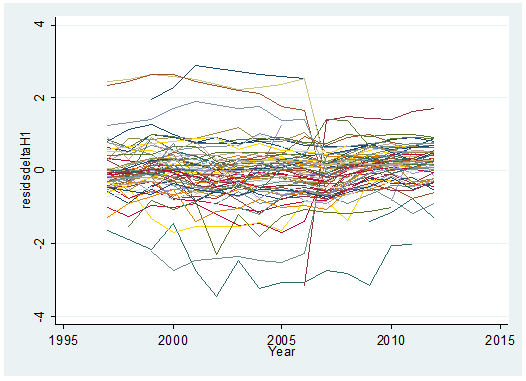
Fig.9. Residuals of supply equation.
could noticed that even though
residuals are highly dispersed for different regions which one more time
supports the idea that regions are highly heterogeneous in their economic
development they majorly do not have any trend in time and seem to be quite stable.
There are almost no significant deviations from average value for each region
and all the values lie in the close neighborhood of zero. This result tells
that the model quite precisely described variation of net construction variable
and data fits theoretical models pretty well. So it could be concluded that
supply for most regions was driven by fundamental factors even during periods
of economic instability and even the period of construction boom was consistent
with rational assumptions theory. equation residuals were calculated the same
way as supply equation residuals as a difference between empirical market data
and forecasted within the model data. The graph of their dynamics over time is
presented below.
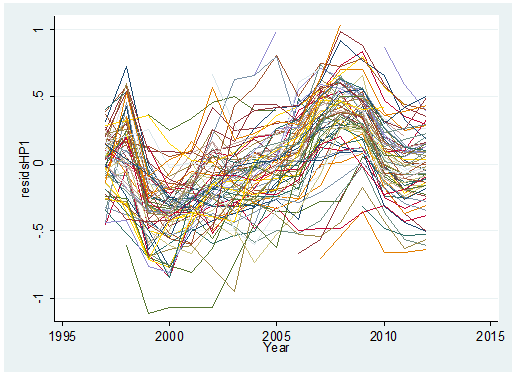
Fig.10. Residuals of supply equation
graph is much more interesting because residuals are volatile not only over different regions but also they are highly volatile in time. Taking into account deviations from zero there are obvious peaks and bottoms that reflect booms and bursts on housing market in Russia. first peak reflects the default of Russia in 1998 when there was hyperinflation and prices rocketed up very quickly but normalized within a year after that and even fall too much by the early 00’s. The drop in real income of citizens and weak demand contributed to the drawdown of prices. Considering the start of construction boom which created the situation of oversupply on the housing market prices fall unexpectedly low and some sort of anti-bubble existed. along with economic recovery in the country the housing market recovered too.The following years were a period of rapid growth in many industries including construction itself and related to it. Real income of households increased and their savings and particularly investment in housing increased as well. So housing market reached its equilibrium in mid-00’s but it persisted not long because the inflation of housing prices continued up to the crisis of 2008-2009. to the model and those fundamentals on which it is based there was a real estate bubble that time, because rapid growth of housing prices was not supported with the corresponding rise of real disposable income, drop of relative cost of buying additional housing or shortage of housing supply. Therefore it can be suggested that bubble was caused by irrational behavior of households that experienced some kind of money illusion. The link between money illusion and housing prices was established in the paper of (Shafir, Diamond and Tversky, 1997).market could not persist for a long time and eventually in 2008 it burst and prices experienced serious drawdown compared to their peak values. The bubble had been over by 2010 in most regions. Several of them, presumably regions with lowest level of income per person even experienced an anti-bubble again. After 2010 prices stayed at their equilibrium level according to the developed model of supply and demand on regional housing market. sum up, during the period in observation Russian regional real estate experienced several bubbles and even anti-bubbles which implies that price dynamics during that time could not be explained with those factors that were included in the model. The source of these bubbles is presumably the irrational behavior of households. and discussion
regional housing market
All things considered quite
satisfying results were obtained - the model of equilibrium on Russian regional
housing market was constructed based on economically justified assumptions and
was proved overall significant. Therefore it could be concluded that the aim of
the study stated in the very beginning was reached. Besides, not only overall
model appeared to be relevant but each equation and both demand-side factors
and supply-side factors used for modeling equilibrium states are significant as
well.was proved on empirical data covering a long period of time that housing
prices are heavily dependent on the amount of living spaces available at the
market, other alternatives of consumption or savings and historical performance
of residential real estate as an asset class relative to the cost of buying it
such as mortgage expenses, depreciation and alternative rate of return on
financial assets.the initial indicator of housing demand - housing stock per
person - was an endogenous variable presumably connected to the availability of
spare residential land lots. It was instrumented with indicators of regional
and national business cycle, whereas these variables were excluded out of the
initial model estimation because the insignificant direct impact on housing
prices. Anyway it was proved that they participate in housing price
determination through their connection to housing construction activity.result
one more time supports the idea presented by(Leamer, 2007) that housing market
is highly connected with overall economic situation. Therefore it should be
noted that in order to avoid the problem of endogeniety the additional
indicators of residential land market need to be included into the modeling or
a different than housing stock per person indicator should be used. activity in
each region in its turn mainly orients on expected housing prices that were
assumed to be based on observed current prices. A little bit less influential
both by statistical significance and the absolute value of the regression
coefficient are cost components: labor-related and capital-related. But at the
same time the power of capital goods inflation influence is much higher
compared to wage inflation. It can be explained by the fact that expenses of the
construction companies on materials, machinery, design, etc. amount up to 80%
in overall construction costs and even moderate inflation of these costs can
have significant impact on marginality of the business. This result
particularly supports the estimates conducted by (Gyorko and Saiz, 2006) who
studied the influence of cost composition on housing supply. comparison of
fundamentally justified equilibrium housing prices forecasted within the model
and observed prices that existed on the market allowed drawing a conclusion
that housing prices periodically sharply deviated from the equilibrium state.
Peaks of these deviations match not only with crisis events such as 1998 or
2008 years when pricesdropped significantly but also considerable upward
deviation can be observed between 2005 and 2007 when there was a period of
rapid economic growth in Russia.to the fact that these leap of housing prices
was not implied by economic fundamentals it could be suggested that it was
caused by households’ irrationality and overly optimistic expectations that
lead to the housing bubble and the ensuing burst. The similar situation could
be observed on the US housing market during the pre-crisis period and according
to the conclusions of Robert Shiller presented in his book “Irrational
exuberance” (2000) one of the main reasons of that was irrational behavior of
American households. a separate important implication the relevance of the used
method of data processing can be outlined. Structural model estimation allowed
not only concluding about the factors that drive housing prices but also
determining the path through which households’ and companies’ decisions
influence equilibrium states on the using market of Russian regions. This paper
fills the gap in the research field not only because it was implemented using
structural estimation approach instead of reduced-form approach but also due to
the fact that developing Russian market was studied whereas this method of
analysis is usually used for studying developed markets (mainly the USA). are a
few limitations of this research that need to be discussed. First of all, one
of the core assumptions used for demand function modeling was that individuals
maximize their utility function which was based on consumption CAPM model. This
model can be challenged by certain number of economists that criticize the
whole concept of this model or its particular assumptions. , the strong
assumption about homogeneity of all the households was made. Within the
framework of this model all the households are rational and have same wealth
and utility function which in reality can be not that way. As in papers for
instance (Iacoviello and Neri, 2008) the individuals can be divided into
patient and impatient and their interaction on loan market might define
interest rates in the model and participate in housing equilibrium
determination process. among limitation the assumption of competitive structure
on residential real estate construction market should be mentioned. It is
implied in the model that construction companies have the same total cost
function and they are price-takers on both housing and resources markets. This
condition was used for simplification of the calculations, but in reality the
industry structure can be different in each region. The construction companies
also may compete not only within one region but also on cross-regional market
and this kind of interaction was also omitted.it should be noticed that the
lack of individual-level and company-level data did not allowed the estimation of
such unobservable variables as risk-aversion parameter (denoted in the model as
delta) and marginal rate of substitution of capital by labor (denoted in the
model as alpha). These parameters in the estimated model were incorporated into
assessed coefficients of corresponding variables.following suggestions for
further research in the field can be outlined. First of all a straightforward
approach of endogeniety elimination can be suggested - simply to include some
variables that were considered as omitted in this research. Among them could be
the amount of spare land appropriate for residential construction, an average
price of square meter of this land, probably other qualitative characteristics
of constriction in particular connected to air quality, neighborhood, etc. Also
the influence of strictness of construction regulation and some measures of
bureaucratic difficulties can be taken into account. , as was mentioned earlier
instead of competitive structure of construction industry other forms of competition
can be modeled and more realistic and comprehensive picture of housing price
driver can be obtained. to the fact that according of the model estimators
there were a serious deviations of housing prices from equilibrium the whole
separate research can be devotedto understanding this phenomenon. Besides, one
also could try to measure theconvergence speed towards equilibrium with help of
error correction model.
list of references
Aoki, Kosuke, James Proudman, and Gertjan Vlieghe. 2004. “House Prices, Consumption, and Monetary Policy: A Financial Accelerator Approach.” Journal of Financial Intermediation 13 (4): 414-35. , Patrick, Phoebe Chan, Dirk Krueger, and Daniel Miller. 2013. “A dynamic model of housing demand: estimation and policy implicatios” International Economic Review 54 (2): 409-442., Michael. 1973. “Recent Empirical Work on the Determinants of Relative House Prices.” Urban Studies 10 (2): 213-33.J. J. et al. Optimal Durable and Nondurable Consumption with Transactions Costs. - Board of Governors of the Federal Reserve System (US), 1993. - №. 93-12., Olympia, John Muellbauer, and Anthony Murphy. 1989. “Housing, Wages and UK Labour Markets.” Oxford Bulletin of Economics and Statistics 51 (2): 97-136.
Caldera, Aida, and Åsa Johansson. 2013. “The Price Responsiveness of Housing Supply in OECD Countries.” Journal of Housing Economics 22 (3): 231-49.
Calomiris, Charles W., Stanley D. Longhofer, and William R. Miles. 2013. “The Foreclosure-House Price Nexus: A Panel VAR Model for U.S. States, 1981-2009: The Foreclosure-House Price Nexus.” Real Estate Economics 41 (4).D., Helsley R., The fundamentals of land prices and urban growth, Journal of Urban Economics, Volume 26, Issue 3, 1989, Pages 295-306. , Karl E., and Robert J. Shiller. 1988. The Efficiency of the Market for Single-Family Homes. National Bureau of Economic Research Cambridge, Mass., USA., Pietro, Nathalie Girouard, Christophe André, and Robert Price. 2004. “Housing Markets, Wealth and the Business Cycle.” OECD Economics Department Working Papers 394.
Cheshire
P., Sheppard S. Estimating the demand for housing, land, and neighbourhood
characteristics //Oxford Bulletin of Economics and Statistics. - 1998. - Т.
60. - №. 3. - С. 357-382.B. A.,
Heathcote C. R., O'Neill T. J. Estimating cohort health expectancies from cross‐sectional
surveys of disability //Statistics in Medicine. - 2001. - Т.
20. - №. 7. - С.
1097-1111.DiPasquale, William C. Wheaton, Housing Market Dynamics and the
Future of Housing Prices, Journal of Urban Economics, Volume 35, Issue 1, 1994,
Pages 1-27, Marjorie. 2001. “Owner-Occupied Housing in the Presence of
Adjustment Costs: Implications for Asset Pricing and Nondurable Consumption.”
Manuscript, UCSD.B. Housing supply, housing demand, and affordability //Urban
Studies. - 2008. - Т.
45. - №. 8. - С. 1545-1563.,
Andreas, and Basit Zafar. 2014. “The Sensitivity of Housing Demand to Financing
Conditions: Evidence from a Survey.” FRB of New York Staff Report, no. 702, Li,
and Qinghua Zhang. 2013. “Market Thickness and the Impact of Unemployment on
Housing Market Outcomes.” National Bureau of Economic Research., Andra C., and
Michael T. Owyang. 2010. “Is Housing the Business Cycle? Evidence from US
Cities.” Journal of Urban Economics 67 (3): 336-51., Edward L., Joseph Gyourko,
and Albert Saiz. 2008. “Housing Supply and Housing Bubbles.” Journal of Urban
Economics 64 (2): 198-217., Allen C. 1978. “Hedonic Prices, Price Indices and
Housing Markets.” Journal of Urban Economics 5 (4): 471-84.R. K., Malpezzi S.,
Mayo S. K. Metropolitan-specific estimates of the price elasticity of supply of
housing, and their sources //The American Economic Review. - 2005. - Т.
95. - №. 2. - С. 334-339., Arthur,
and Andrew Aitken. 2010. “Housing Supply, Land Costs and Price Adjustment.”
Real Estate Economics 38 (2): 325-353.J., Saiz A. Construction costs and the
supply of housing structure* //Journal of regional Science. - 2006. - Т.
46. - №. 4. - С. 661-680.E. A.,
Quigley J. M. What is the price elasticity of housing demand? //The Review of
Economics and Statistics. - 1980. - С.
449-454., Hideaki, M. Ayhan Kose, Christopher Otrok, and Marco E. Terrones.
2012. “Global House Price Fluctuations: Synchronization and Determinants.”
National Bureau of Economic Research.S., Jones N. House prices since the 1940s:
cointegration, demography and asymmetries //Economic Modelling. - 1997. - Т.
14. - №. 4. - С. 549-565., Min,
and John M. Quigley. 2006. “Economic Fundamentals in Local Housing Markets:
Evidence from US Metropolitan Regions.” Journal of Regional Science 46 (3):
425-453., Matteo. 2004. “Consumption, House Prices, and Collateral Constraints:
A Structural Econometric Analysis.” Journal of Housing Economics 13 (4).,
Matteo. 2005. “House Prices, Borrowing Constraints, and Monetary Policy in the
Business Cycle.” American Economic Review, 739-764., Matteo. 2010. Housing in
DSGE Models: Findings and New Directions. Springer, Matteo M., and Stefano
Neri. 2008. “Housing Market Spillovers: Evidence from an Estimated DSGE Model.”
National Bank of Belgium Working Paper, no. 145., Deniz, and Prakash Loungani.
2012. “Global Housing Cycles.”, Keith, and Tom Mayock. 2014. “Housing Bubbles
and Busts: The Role of Supply Elasticity.” Land Economics 90 (1): 79-99.A.
Expected returns on major asset classes. - 2012.G. Modelling the demand and
supply sides of the housing market: evidence from Ireland //Economic Modelling.
- 1999. - Т. 16. - №. 3. - С.
389-409., N. Kundan, and Hardik A. Marfatia. 2016. “The Dynamic Relationship
Between Housing Prices and the Macroeconomy: Evidence from OECD Countries.” The
Journal of Real Estate Finance and Economics, January., John, and James A.
Wilcox. 2013. “Evidence and Implications of Regime Shifts: Time-Varying Effects
of the United States and Japanese Economies on House Prices in Hawaii: Regime Shifts
in Real Estate Markets.” Real Estate Economics 41 (3)., Edward E. 2007.
“Housing Is the Business Cycle.” National Bureau of Economic Research.,
Stephen, and others. 2003. “Hedonic Pricing Models: A Selective and Applied
Review.” Section in Housing Economics and Public Policy: Essays in Honor of
Duncan Maclennan.N. G., Shapiro M. D. Risk and return: Consumption versus
market beta. - 1984.S. K. Theory and estimation in the economics of housing
demand //Journal of Urban Economics. - 1981. - Т.
10. - №. 1. - С. 95-116.A., Supply
constraints and housing market dynamics, Journal of Urban Economics, Volume 77,
September 2013, Pages 11-26N., Westaway P. Modelling structural change in the
UK housing market: a comparison of alternative house price models //Economic
Modelling. - 1997. - Т.
14. - №. 4. - С. 587-610., James
M. 1984. “Tax Subsidies to Owner-Occupied Housing: An Asset-Market Approach.”
The Quarterly Journal of Economics 99 (4): 729.J. M., Weil D. N., Shiller R.
House price dynamics: the role of tax policy and demography //Brookings Papers
on Economic Activity. - 1991. - Т.
1991. - №. 2. - С.
143-203., Sherwin, and Robert H. Topel. 1986. A Time-Series Model of Housing
Investment in the US. National Bureau of Economic Research Cambridge, Mass.,
USA.E., Diamond P., Tversky A. Money illusion //The Quarterly Journal of
Economics. - 1997. - С.
341-374.R. J. Irrational exuberance //Princeton UP. - 2000., Kostas, and Haibin
Zhu. 2004. “What Drives Housing Price Dynamics: Cross-Country Evidence.” BIS
Quarterly Review, March., Mr Jerome, Ms Ursula Vogel, and Ms Enrica
Detragiache. 2012. Macroprudential Policies and Housing Prices A New Database
and Empirical Evidence for Central, Eastern, and Southeastern Europe. 12-303.
International Monetary Fund. , Wolf. 2008. “The Homogenization of the Financial
System and Financial Crises.” Journal of Financial Intermediation 17 (3),
Nafeesa, and Peggy E. Swanson. 2013. “A Closer Look at the U.S. Housing Market:
Modeling Relationships among Regions: A Closer Look at the U.S. Housing
Market.” Real Estate Economics 41 (3)
Appendix
of research papers based on reduced-form models
|
Article attributes |
Sample |
Variables |
Results |
(Hirata et al. 2012)
“Global House Price Fluctuations: Synchronization and Determinants”
IMF
Working paperSample:
18 advanced OECD (Organization for Economic Cooperation and) countries;period:
quarterly series from January 1971 to March 2011Housing prices determinants:
GDP, equity prices, credit, short- and long-term interest rates
|
Method: Factor Augmented Vector Autoregression (FAVAR)Authors found the evidence of strong linear relationship between housing prices and credit conditions, but no evidence of intertemporal interaction between housing prices and business cycle, equity market movements and interest rates. |
|
|
|
(Igan and Loungani 2012)
“Global Housing Cycles” Working paper Sample: 22 advanced countries;period: different for each country (quarterly data)Housing prices determinants: lagged affordability; Income per capita growth rate; working-age population growth rate; equity market growth rate; credit growth rate; short-term interest rate; long-term interest rate
|
Method: Pooled OLS regressionHousing affordability negatively affects real estate return for more than eighty percent of observed regions. Besides change in personal disposable income was proved as a significant factor of pushing prices up. There is also a positive relation between house price changes and population growth. |
|
|
|
(Vandenbussche, Vogel, and Detragiache 2012)
“Macroprudential Policies and Housing Prices-A New Database and Empirical Evidence for Central, Eastern, and South-Eastern Europe”
IMF
Working paperSample:
16 CESEE countries (including Russia);period: different for each country but
generally beginning from 2000 (quarterly data).Housing prices determinants: GDP
per capita, Domestic real interest rate; Foreign real effective interest rate;
Working population data; Macroprudential policy measures (for Russia only
liquidity measures such as reserve requirements rate on fc and lc deposits and
reserve requirements base): Fixed-effect OLS regressionRussia has an almost
flat curve of macroprudential policy indicator constructed by authors, so this
factor was not proved to be important, however for majority of other countries
the changes of macropolicy led to shocks on housing markets.
|
It was proved that after shock prices are tend to converge towards equilibrium rather fast. Moreover there was determined an intertemporal dependency structure of housing prices. Estimates for lagged changes in per capita GDP and interest rates, changes in working-age population are not significant |
|
|
|
(Calomiris, Longhofer, and Miles 2013)
“The foreclosure-house price nexus: a panel VAR model for U.S. states, 1981-2009” Real Estate Economics. - 2013. - Т. 41. - №. 4. - С. 709-746.Sample: all the states of the USA
Time period: 1989-2009 (quarterly data)Housing prices determinants: growth of home prices, foreclosure rate; growth rates of employment, single-family permits, existing home sales,
|
Method: Panel Vector Autoregression (PVAR)Foreclosure and housing prices are highly correlated with each other. This dependence results from the fact that housing is collateral for the mortgage and housing price shocks disturb credit market and these conditions in turn affect prices. Foreclosures negatively impact home prices. But the negative impact of prices on foreclosures is larger. The variance decompositions show that prices explain 16% of the variation in, while foreclosures explain only 5% of the variation in prices. |
|
|
|
(Krainer and Wilcox 2013)
“Evidence and Implications of Regime Shifts: Time‐Varying Effects of the United States and Japanese Economies on House Prices in Hawaii” Real Estate Economics. - 2013. - Т. 41. - №. 3. - С. 449-480.Sample: Real House Price Indexes in Hawaii, in the USA and in Japan
Time period: 1976-2008 (annual data)Housing prices determinants: demand factors such as relative housing prices (US/ Hawaii and Japan/Hawaii), Stock prices, Net Worth, GDP, Net Worth*High income share
|
Method: Constant-coefficient model VS Time-Varying coefficient modelThe time-varying coefficient model appeared to be significantly better than constant-coefficient model, so the regime shift existed. Relative house prices, Net Worth, GDP and Net Worth*High income share appeared to be significant for housing price index determination. |
|
|
|
(Fuster and Zafar 2014)
“The Sensitivity of Housing Demand to Financing Conditions: Evidence from a Survey” FRB of New York Staff Report. - 2014. - №. 702.Sample: 1211 household heads in the USA
Time period: 2014 (monthly data)Housing prices determinants: change of down payment, non-housing wealth shock and change of mortgage rate
Method: OLS (panel regression)of mortgage conditions (such as decrease of down payment) and external increase of income positively influence constructed by authors indicator “willingness to pay” (WTP). This effect is higher for households with income lower than the median in the sample. However the influence of particularly mortgage rate is moderate.
|
|
|
|
|