Материал: Assessment of the situation on the regional housing market in Russia
Assessment of the situation on the regional housing market in Russia
Introduction
The majority of Russian citizens have some real estate in their propertyoneway or another - either for living or for investment purposes. Formany people their real estate is the most valuable asset they have, that is why housing defines and reflects quality of life and plays a significant role in the formation of public wealth.And at the same time the increase of personal income usually boost housing consumption, prices and construction activity (Aoki, Proudman, and Vlieghe 2004), which enhances GDP, additional job creation and finally redistribution of wealth. real estate is a separate class of investment assets that attracts more and more attention in the global investment community and in particular in Russia. There are several reasons for that. First of all, real estate is believed as a good inflation-hedging instrument due to the fact that in average the value of real estate in many countries increases at least as fast as inflation rate or even faster. Furthermore it is usually considered as an asset that has negative correlation with “bad times”: this feature relates to the belief of the investors that real estate is a “safe haven” during the crisis, because it is able to store the value even when financial markets crash. Finally real estate outperformed in comparison with other asset classes such as fixed-income, index, etc. in long run. (Ilmanen, 2012)is also relevant regarding housing market in Russia(see figure1).Compared to real return of broad Russian equity index MICEX, the real return of housing was much smoother and experienced less considerable drawdown during numerous crises that occurred at that time. Besides real return remained positive for a really long period of time - at least 11 years, which means that housing prices outperformed inflation and allowed not only saving but multiplying capital of real estate owners.
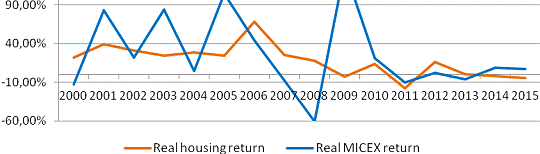 . 1. Real return of residential
housing vs. real return of financial market 1998-2015
. 1. Real return of residential
housing vs. real return of financial market 1998-2015
real estate market is highly opaque because of incredible amount of factors that influence the price, which are studied in hedonic models such as (Goodman 1978), (Malpezzi and others, 2003), etc. This aspect complicates research in this field, especially macroeconomic and regulatory aspects are currently underinvestigated. In particular, little had been done for understanding real estate market in Russia despite the fact that questions connected to pricing of such assets are urgent for Russian investors as well as for any other investors in the world. past years housing prices in Russia were quite volatile (see figure 2). Before the recent global economic crisis they rocketed due to not only general upward trend in the Russian economy with all its consequences in the form of rising personal income, easing of credit conditions, etc. but also due to mortgage loan market expansion. Mortgage mass market appeared in Russia in 2005 and the financial product became popular very soon: in 2006 there was a considerable real estate demand increase which pushed pricesup in average by 48%. However during the crisis of 2008-2009 prices had plummeted down up to 42% (in Kirov region) and since then they are recovering but with much slower paces compared to pre-crisis period.
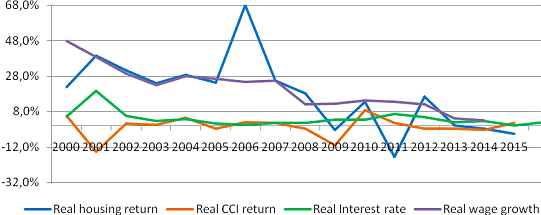
Fig.2. Real return of RE compared to real growth of construction costs, wages and interest rates
the importance of these fluctuations’ consequences for the Russian economy this topic was not really popular among researchers. As one could have noticed before crisis of 2008-2009 real housing prices appreciated much faster than for example such supply-side factor as growth of production costs or traditional demand-side price driver - real disposable income (named wage on the graph). And after the crisis culmination prices plummeted also faster than all those indicators. The questions about was the housing market in equilibrium at that time and what was the mechanism of price adjustment to the shocks that occurred during that period are still unanswered. Howeverthey become increasingly important because of current economic instability in Russia which provokes the similar type of shocks that have already happened several years ago. That is why the further research of housing pricing mechanism in Russia is an urgent issue. majority of research papers are devoted to real estate indexes design, real estate value estimation and real estate portfolio management. Some studies are aimed at finding prices or return determinants, e.g. papers written by Ball (1973), (Hirata et al. 2012), (Krainer and Wilcox 2013). Whatsoever there is no convincing theory behind them, which means that value drivers that had been found significant are appropriate for each particular region in certain time period and cannot be considered as fundamental factors. This leads to the conclusion that simple rearrangement of variables in the equations is not the most efficient tool not only for understanding the market but especially for forecasting purposes. Therefore in order to investigate housing price dynamics more comprehensive approach that would consider equilibrium formed under demand and supply influence is needed. That is why the purpose of this study is stated as follows: to develop anequilibrium model of residential real estate markets in Russian regions. To achieve this goal several steps should be implemented.
Firstly, a review of the recent studies that describe operation mechanism of real estate market including participants, their goal and behavior on that market; exogenous factors that can influence equilibrium on local housing market; channels through which the regulation of the market is implemented. Secondly, based on the result of previous research the relevant assumptions about economic agents that participate inprice formation process on the housing market in Russia should be made and theoretical model of the housing prices should be developed. After that hypotheses of the research need to be formulated and the relevant data should be collected in order to test whether theoretical model developed beforehand fits the empirical data and to test stated hypotheses. After the model parameters assessment, the conclusions about model preciseness will be made and limitations will be discussed.
The results
of the study are expected to be useful for the whole understanding of housing
pricing mechanism in Russia including how different economic agents participate
in price formation making their day-to-day decisions, how housing prices would
change if some sort of market shock occurred or how the regulator can influence
prices through different channels. Therefore the results of the study
can be implemented by almost all types of economic agents: from citizens
concerned with the question is it worth buying additional real estate unit to
Russian regulatory forces such as the Central Bank of Russian Federation or the
Ministry of Finance and investors who have long-term investment horizon, such
as pension funds, developers or other investors.
Basic issues about housing prices
formation process
Historically real estate in Russia performed as an alternative way of savings instead of financial assets such as stocks, bonds, deposits, etc.Prices of residential housing for extended periods rose at least with inflation paces or in some periods even much faster, and during crises real estate value dropped significantly less than the value of most financial assets.Therefore real estate can be considered as non-traditional store of value however it is not that any real estate object can be deemed as an investment asset. order to define what we are going to consider as an asset on real estate market let’s turn to legislation. According to the Civil Code of Russian Federation (article 130, Civil Code of RF) «The immoveable property includes plots of land, subsoil and all that is firmly connected to the ground, that is objects that cannot be moved without disproportionate damage to their usability, such as buildings and construction objects in progress, aircrafts and sea vessels, inland navigation and space objects». Within the framework of this research only those pieces of real estate that can be inhabited will be studied, that is why among all of the real estate objects only buildings will be taken into account. estate is divided into two groups: commercial and residential property. Some high-class business center is an example of commercial real estate; its main distinguishing feature is generation of a rent for owner. Houses and apartments in order to live are the residential property. Even if a private owner of real estate decides to rent it, the house, flat or land plot does not become commercial property. Due to the fact that commercial property generates cash flows its pricing is dependent from dynamics of these flows that in turn are majorly influenced by the variety of factors individual for each piece of property such as, for example, purpose of using (e.g. warehouse, office center, etc.). So it could be concluded that commercial property even more heterogeneous than residential property, pricing of different types of objects differs and therefore it is hard to determine fundamental factors. Therefore, within the framework of this research only pricing of residential houses will be studied.
Besides real estate market like equity market can be divided into primary and secondary segments. Primary real estate market implies selling the object to its first owners. Usually these objects are buildings in progress or new buildings, which can be bought straightly from the developer. In opposite, real estate objects that already had at least one owner are traded on the secondary market. Despite the fact that both - primary and secondary real estate markets - are highly heterogeneous within themselves, primary market can be considered as even more heterogeneous than secondary. Developers can offer apartments without finishing, with primary finish or with full decoration depending on needs and wishes of buyers. Each type has its own average price that is why within this research secondary real estate prices will be studied.in real estate market is highly opaque.There are several reasons for that. Information asymmetry is higher on this market in comparison with other traditional financial assets (stocks, bonds, currency, etc.) markets. The reason why this happens is that for external investor it is time consuming and costly to carry out a comprehensive assessment of real estate objects, poor information can be obtained from open sources. Moreover there is nosuch financial institute in Russia as Real Estate Investment Trusts that operate in the USA, which means that real estate is not traded on exchange, there is only low-liquid private market.
These issues
motivated the classical and widely known research conducted by Karl Case and
Robert Shiller «The efficiency of the market for Single-Family Homes», where
week-form efficiency of the residential housing market was tested. Authors
found an empirical evidence of prices inertia on American real estate market,
which means that prices theoretically can be predicted based on the previous
history. (Case and Shiller 1988)This result found implications in
furtherdynamic models of housing market of different countries such as
(Poterba, Weil and Shiller, 1991) and in particular in dynamic models of
general equilibrium such as (M. Iacoviello 2010)(M. Iacoviello and Neri 2008),
etc.conservative way of housing prices drivers’ determination is reduced-form
models estimation which usually implies analysis of panel (Tsatsaronis and Zhu
2004) or time series data (Rosen and Topel 1986) in order to find statistical
correlation between housing prices and other different variables or to find
predictability of prices in the past. to the fact that residential housing is
highly heterogeneous not only between the regions but also within them, there
are few markets studied on wide, at least cross-regional, sample. Also it
should be noted that the irregularity of the following sort exists: simple
reduced-form models were proposed for both developed and developing regions and
no coherent result was obtained. There are almost no similar factors that drive
the prices in these two types of markets and furthermore one could have noticed
that correlations between so-called fundamental factors such as GDP growth,
unemployment rate, ageing, etc. are unstable in the time (see appendix
1).instance the research conducted by (Krainer, Wilcox 2013) proved that the
Hawaii regional housing market was boosted by the Japanese who massively moved
there and made heavy contribution in the GRP of the region. Other research of
American regions such as(Calomiris, Longhofer, and Miles 2013)or (Hwang and
Quigley 2006) showed the opposite - in average GRP growth appeared to be
irrelevant for housing market, presumably due to the fact that mortgage
conditions were more powerful driver at the period under study. the question
“is GDP a fundamental factor of housing prices?” is not the only controversial
issue. The causal relationship of GDP and housing price also can be questioned:
for example right before the recent crisis of 2008-2009 Edward Leamer wrote his
famous paper alleging that residential housing market defines medium term
business cycles and supported that hypotheses with persuasive empirical
results. (Leamer 2007) However this paper caused a wave of counter-research
such as for example the paper of (Ghent and Owyang 2010) that stated the
opposite causation. And this is the only one of many cases of inconsistencies
that exist in the research field, which one more time emphasize the importance
of reliance on economic theory first and on the empirical evidence further.form
analysis is more widespread compared to structural modeling and the majority of
early or even current research papers are based on results obtained with help
of this method.However this type of models usually relies on unrealistic
assumptions about data features and economic agents behavior, furthermore it is
widely known that correlations does not imply causation. It could be noted that
determinants of housing prices which have already been found by researchers
vary from country to country and from period to period.number and the structure
of indicators that were proved to be price or return predictors are also different
in listed studies, which mean that there is still no unanimity between
economists on what factors should be considered as fundamentals, because there
is thin theoretical background behind these reduced-form models. Moreover these
models can capture the influence of observable variables, some unobserved
parameters can only be substituted with help of proxy indicators that can be
inaccurate or cannot be traced at all (for instance, such behavioral parameter
as risk-aversion). drawbacks can be mostly eliminated with help of structural
modeling which puts the economic model first and econometrics after, so this
type of models allows relying on causation a priory. Besides they allow
assessment of unobserved parameters comparing theoretical, economic model with
observed empirical data. Moreover with help of such tools of estimation the
researcher can answer different types of questions such as “what happens in the
case of some shocks?” or “what happens if there is s systematic shift, for
example if regulator decided to increase key rate or profit tax rate?”. Ability
to estimate that type of influence makes results of the model estimation more
interesting, viable and useful for practical, including regulatory, purposes.
In order to investigate what had been done in this research field let’s study
the literature devoted toestimation of housing market structural models. The
most relevant papers are presented in the table 1 below.pioneer of structural
equilibrium studies on housing market was the paper of James Poterba published
in 1984 where the dynamic interconnection of inflation expectations, housing
prices and housing stock was described within the intertemporal model of
individual wealth accumulation. This research allowed drawing several
conclusions. First of all, it showed that households solving the optimization
problem given the inflation expectations make more significant contribution in
housing price formation than suppliers. Secondly, residential real estate
prices are the core drivers of construction investment activity. Finally, the
model allowed the simulations of tax-subsidies effect on the market. the
importance of this study for the formation of new trend in real estate research
it was heavily criticized for a number of reasons. In particular the author
ignored cost structure of construction - this problem was fulfilled in other
papers such as for example (DiPasquale and Weaton, 1997), where the land cost
was outlined as a matter of special importance. Despite the fact that
theoretical framework described in that paper as a whole was proved to be
consistent, cost structure empirically was insignificant for price formation
process, probably because of non-suitable proxy for land costs (the researchers
used price of farm land). This problem was solved on the New Zealand data in
the study of(Grimes and Aitken 2010), who used an actual residential
construction land cost. For other markets the issue is still underinvestigated
due to unavailability of proper data. the irrelevance of supply which was
stated by Poterba had been challenged by a number of studies such as(Caldera
and Johansson 2013)and (Glaeser, Gyourko, and Saiz 2008). Construction
constrains were proved to explain instantaneous stickiness of the housing
prices in dynamic models. Due to the fact that the amount of vacant land which
is suitable for residential construction is highly restricted especially in
metropolitan areas, it takes time and considerable amount of resources to pass
through all the governmental procedures to obtain a building permit and start
construction works.
Table 1. Literature review on empirical estimation of housing market structural models
|
Article attributes |
Sample |
Variables and Method |
Results |
Housing market spillovers : evidence from an estimated DSGE model (M. M. Iacoviello and Neri 2008)USA 1695-2006 quarterly dataDSGE model. The goal: to study core drivers of housing prices in the USA; to study the effect of housing market on external economic environment: prices are mostly driven by the availability of land and the difference in technological progress between housing and non-housing sectors; monetary factors explain only 20% of housing price variation;
|
Wage rigidity increases the sensitivity of output to shifts in aggregate demand; collateral effect increases the elasticity of consumption to wealth. So spillovers of the housing market matter more and more |
|
|
|
|
Supply constraints and housing market dynamics (A. Paciorek, 2013) |
USA 1975-2008 yearly data |
Dynamic structural model |
The goal: to investigate the mechanism of interconnection between housing supply and housing prices Results: bureaucratic processes diminish developer’ reaction on demand shocks and create additional expenses for them; geographic limitations restrict opportunity for quick response for demand shocks which leads to housing prices volatility |
Housing Bubbles and Busts: The Role of Supply Elasticity (Ihlanfeldt and Mayock 2014)63 counties of Florida, 1990-2010 yearly dataHousing supply Stock-adjustment model The goal: to find a solid way of supply elasticity calculation; to find key determinants of housing supply elasticity in Florida counties
|
Results: the most solid approach is repeated-sales method; elasticity depends on the amount of undeveloped land, planning expenditures and average housing value. Key determinants vary depending on the period under observation - boom or burst on the housing market. |
|
|
|
The model of housing in the presence of adjustment costs: a structural interpretation of habit persistence (M.Flavin; S. Nakagawa 2001)USA 1975-1975 yearly dataStructural modeling, GMM estimatedThe goal: to investigate whether consumers’ habit persistency and the presence of adjustment cost play a significant role in housing price formation process
|
Results: little evidence of habit persistence influencing consumers’ choice were found; estimated substitutability between housing and perishable goods is very low |
|
|
|
Consumption, house prices and collateral constraints: a structural econometric analysis (M. Iacoviello 2005)USA 1986-2002 quarterly dataStructural modeling, GMM estimatedThe goal: to study the effect created by housing prices shocks on consumption throughout borrowing capacity tightly related to real estate value
|
Results: home equity gains can be transferred into higher borrowing and higher consumption (the parameter of elasticity was estimated) |
|
|
|
A dynamic model of housing demand: estimation and policy implications (Bajari et al. 2013)USA 1975-2009 yearly dataReduced-form estimation: Multinomial Logit and panel regression; Structural modeling: non-parametric estimationThe goal: to specify, estimate and simulate structural model of housing demand (considering the effect of the following variables: adjustment costs, credit constraints, uncertainty about evolution of income and housing prices)
|
Results: during price or income shocks households reduce the consumption of non-durable goods and their wealth as well in attempt to keep their houses and avoid adjustment costs associated with buying or selling of real estate |
|
|
|
|
Modeling structural change in the UK housing market: a comparison of alternative house price models (N.Pain, P.Westaway, 1997) |
UK 1968-1990 quarterly data |
VAR modeling, Dynamic structural modeling, |
The goal:to develop a new approach to the modeling of housing prices in the UK, considering consumer expenditures as a main determinant of real estate demand Results:created model appeared to be more consistent in comparison with conservative models such as NIDEM or HM Treasury Model |
The dynamic relationship between housing prices and the macroeconomy: evidence from OECD countries (Kishor and Marfatia 2016)15 OECD countries 1975-2013 quarterly dataError-correction model, Dynamic OLS estimatedThe goal:to find fundamental macroeconomic determinants of housing prices by decomposition of prices movements into permanent and transitory components
|
Results:income and interest rate are the forces that provoke long-run changes in the housing prices in OECD , other factors influence was classified as transitory |
|
|
|
Tax subsidies to owner-occupied housing: an asset-market approach (Poterba 1984)USA 1974-1982 quarterly dataReduced-form nonlinear rational expectations modelThe goal:to study inflation’s effect on the tax subsidy to the owner occupation as a factor of housing prices volatility
|
Results:tax subsidies alongside with rising inflation rate reduce the real mortgage expenses and boost housing prices; the core driver of supply was the real price of houses |
|
|
|
Market thickness and the impact of unemployment on housing market outcomes (Gan and Zhang 2013)Texas (28-38 cities), 1990, 2000 and 2010Structural model, non-parametric estimationThe goal:to identify the channel through which unemployment affects the housing market considering the thickness of this market
|
Results:unemployment generates thinner marketwhich leads to the poorer matching quality, and as a consequence housing prices decrease more than if there were no thickness effect |
|
|
|
|
House prices since the 1940s: cointegration, demography and asymmetries (S.Holly, N.Jones, 1997) |
UK, 1939-1994 |
Error-correction model, OLS-estimated |
The goal:to develop a broader vision of UK housing market, to observe it for the long period of time during different business-cycles and different inflation conditions and to develop a long-run model for it Results:the core determinant of housing prices in the long-run is real income, the influence of other factors such as the change in demographic pattern or the rise of building societies was more serious when housing prices deviated too much from equilibrium level implied by real income |
Housing Supply, Land Costs and Price Adjustment (Grimes and Aitken 2010)New Zealand (regional-level data), 1991-2004 quarterly data Error-correction model, MLE estimatorsThe goal: to explore the mechanism connecting housing supply elasticity, land costs and housing prices response to various shocks, e.g. demand shock or bubble
|
Results: The higher relative cost of construction land unit, the more inelastic supply is and therefore the more volatile housing prices (demand shocks deviate prices for a long time from their equilibrium values) |
|
|
|
idea of residential land rarity inspired a new branch within the residential real estate research field - spatial equilibrium models that currently focused on the equilibrium urban growth model developed by(Capozza and Halsley, 1989). As a result the importance of the interaction of the supply and demand in the housing price determination was proved in previous research so both of the market sides should be studied on the Russian market as well. core problem in structural equation modeling is to construct an appropriate functional form of the equations. This means not only the compliance of the model to common sense and economic theory, but also that the model needs to be “estimateable”. For instance, ordinary data procession technics such as General Method of Moments (GMM) or Maximum Likelihood estimation can be applied only to the closed-form equations sets where the number of endogenous variables corresponds to the number of equations so the system can be solved with the only one set of parameters’ values. Anyway even if the model could be properly estimated it still can appear inconsistent when tested on the empirical data.
Each author or the set of authors suggested different variations of the model that would describe the housing market. After the publication of Poterba’s results many research papers were mainly devoted to demand function estimation. Most of them modeled the behavior of the representative household that at each point of time decides whether to stay in the current accommodation or move to the bigger one, continuously maximizing its’ expected lifetime utility on the condition of constrained personal income. The majority of housing equilibrium research such as (Beaulieu, 1993) which was one of the first who connected durable and non-durable consumption under one utility function and after that(M. Iacoviello 2004), (Grimes and Aitken 2010) and others started using the utility function based on consumption CAPM model developed by(Mankiw and Shapiro, 1984). And this approach was proved to be empirically relevant for many regional US markets. an extension of housing demand model(M. M. Iacoviello and Neri 2008) suggested differentiate households by their ability to safe into patient (those whosave money until they decide to expand their living space, and therefore those who lend their savings through financial assets) and impatient (those who increase current consumption and therefore are forced to borrow money when they decide to buy a new square meters of real estate). These types have different constraint functions but the same anticipations about the future states of the world, so the model is more complex than traditional one but still solvable. set of authors (Flavin and Nakagawa 2001) supplemented to the theory of (M. M. Iacoviello and Neri 2008)with the presence of adjustment costs and habit persistence when household makes a decision to move.The model proposed by the authors suggests that these costs decrease the elasticity of demand for housing which makes the process of price adjustment more difficult and prices themselves more volatile. Despite the fact that the model was constructed with accordance to the strict economic logic the empirical evidence of the importance of adjustment costs was not found which supports the statement that even theoretically solid model can be wrong.things considered, most attempts to significantly complicate the initial equilibrium model on the national or regional housing market were not persuasive enough for considering such theoretical functional forms of supply and demand equations as valid. Some of them just failed empirical testing, others were proved to be significant but only for a certain territories (for instance some states of the USA or New Zealand) and certain periods of time. That is why within the framework of this research classical set of assumption about economic agents’ behavior would be implemented. Which means that all the households as well as construction firms would be considered as identical, therefore they would have the same anticipations about future and the same utility function and total costs function. is also worth noticing that research conducted under structural equilibrium approach is a standard for developed countries mainly for USA housing market (see table 1). Despite all the advantages of structural estimation modeling before reduced-form models there are few (if there is some) papers devoted to studying housing market of developing countries. Especially rare this type of research is for Russian market because of the number of factors such as for example unavailability of durable data, because the earliest data which could be obtained from official sources starts from 1996. That means that the researcher now can observe all-transactions housing price index only for 19 years, whereas the analogous indicator for USA market is available since 1975, i.e. 40 years. Besides, mortgage market statistics in Russia is available only since 2005, whereas the majority of indicators describing the situation on mortgage market of the United States cover the whole observation period of housing prices. , there is such a data source as United States Census Bureau which allows getting comprehensive information on representative households’ behavior for vast period of time, so the ready-to-use panel dataset is available for the researchers. This dataset allows analysis of housing market on the base of repeated sales basis, Russian statistical services bureau do not use such a methodology - only average level of deal prices is calculated.is no centrally accumulated dataset of indicators describing Russian consumers’ behavior, all the information need to be collected by hands from different sources of information such as official sites of Russian Federal and Regional Statistics Services, Central Bank of Russian Federation and sites of different Ministries. Therefore, only fragmentary representation of such behavior in particular regarding housing market can be observed. Anyway all those difficulties could be overcome by applying sufficient effort and resources.sum up, Russian housing pricing mechanism is underinvestigated, fundamental factors that influence prices were not defined in the previous research papers. That is why this study will be devoted to formalization of housing price formation process through the finding the appropriate functional form of regional housing supply and demand. This means not only finding indicators that make their contribution in consumers’ demand or in construction activity, but also finding the channels through which they participate in the residential real estate pricing process. the research question of the study can be formulated in the following way: what are the fundamental driving forces of housing prices in Russia? Achievement of the research goal and finding the answer to the stated question will make it possible not only to conclude about factors that influence prices but also to judge whether prices where in equilibrium during the whole period in study. Equilibrium models can also be useful for making projections about prospective of the housing prices in Russian regions and for regulation purposes as well.