Материал: Assessment of the situation on the regional housing market in Russia
model of housing prices
function’s
assume that there are N (= workforce*employment level) identical individuals
(all those who earn income and can spend it on consumption and saving) with
homogenous utility function and expectation about future states of the world.
Each of them earns a certain amount of money in any form - salary, rent or
profit. The representative individual in each period divides the income between
current consumption of goods and services including for example such durable
goods as household appliances, cars, etc. and savings in the form of either
housing consumption or financial assets. So the budget constraint of the
representative household can be written as following:
|
|
(1) |

Yit is a total income at t-th period
(average monthly value for each year); CGSt is a value of fixed set of goods
and services at the t-th; FAit is an amount of individual’s spending at the
t-th period of time on financial assets such as stocks, bonds, deposits, etc.;
Ht is a quantity of housing consumed at the time t; HPt is a housing prices at
the time t.to the fact that accumulation of capital assets is associated with
some of rate of return and at the same time real assets such as house or flat
depreciate with time, the intertemporal constraint for individual wealth can be
formulated as follows:
|
|
(2) |

Wt is accumulated by t-th period
amount of individual wealth;  is a real
after-tax rate of return on financial assets (FAt);
is a real
after-tax rate of return on financial assets (FAt);  is
a cost of borrowing money for buying real estate - mortgage rate; d is a rate
of housing depreciation (for simplicity let’s assume that it constant across
all the periods);
is
a cost of borrowing money for buying real estate - mortgage rate; d is a rate
of housing depreciation (for simplicity let’s assume that it constant across
all the periods);  - growth rate of
real housing prices between (t+1)-th and t-th periods.
is assumed to be exogenous in this model framework, because the existence of
competitive financial market is suggested. individual gets utility from current
consumption of durable and non-durable goods as well as from consumption of
housing services. Under housing services the convenience of possession instead of
renting real estate will be meant, so this variable is unobservable. Therefore
it was assumed that the value of housing services is proportionate to housing
stock per person with some coefficient - k. The utility function which is
identical for all the individuals is derived from Consumption CAPM model and it
is convex function with constant relative risk-aversion, which can be presented
in the following way:
- growth rate of
real housing prices between (t+1)-th and t-th periods.
is assumed to be exogenous in this model framework, because the existence of
competitive financial market is suggested. individual gets utility from current
consumption of durable and non-durable goods as well as from consumption of
housing services. Under housing services the convenience of possession instead of
renting real estate will be meant, so this variable is unobservable. Therefore
it was assumed that the value of housing services is proportionate to housing
stock per person with some coefficient - k. The utility function which is
identical for all the individuals is derived from Consumption CAPM model and it
is convex function with constant relative risk-aversion, which can be presented
in the following way:
|
|
(3) |

rational individual maximizes his
utility with respect to current consumption and housing consumption - the
variables that he can choose and vary every period. Solving the maximization
problem taking into account intertemporal wealth constraint one could obtain
the following equality, which reflects the optimal ratio of housing consumption
with respect to current consumption:
|
|
(4) |

Calculus appendix.
|
|
(5) |
|
|
(6) |


|
|
|
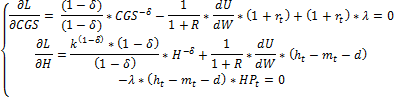 (7)
(7)
By dividing first-order conditions
to each other and by expressing the variable of interest  with
help of other variables, individual demand function will be obtained.order to
make this demand function aggregate, let’s sum it up over N consumers and solve
it with respect to h, which means finding inverse demand function
with
help of other variables, individual demand function will be obtained.order to
make this demand function aggregate, let’s sum it up over N consumers and solve
it with respect to h, which means finding inverse demand function
(8) (9)
linearization, let’s rewrite the
equation in the logarithmic form considering the fact that all values under
logarithm are not negative in accordance with their economic sense
|
|
(10) |

should be noted that within the
model all the consumers as well as developers for simplicity will be
price-takers - none of them as a single agent cannot significantly influence
the average price of real estate formed on the market. For future research in
this field it can be suggested observing other industrial structures other than
perfect competition, because construction and development is an industry with
high barriers. That is why regional market most likely takes form of oligopoly
with a few big players that can interact with each other in many different ways.for
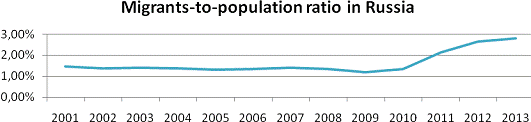
real estate in each particular region is presented majorly by the population of
this region. Due to the fact that interregional mobility in Russia is not high
(see picture 1 below) - from 1.33% to 2.8% of total population during the
period from 2001 to 2013, and 1.63% in average - within the framework of this
study interregional demand for real estate will not be considered. Therefore
demand in the region is created by inhabitants of the region and cross-regional
demand component is omitted out of the model.
due to the fact that competitive
construction and development market was assumed, it can also be suggested that
cross-regional housing supply is negligible. Competitive market structure
implies zero economic profit and low industry entrance barriers, so if there is
an excessive profit in some region firms from other regions instantaneously can
use this situation for additional financial gains until there is no such gain.
Therefore profitseventually become equal among regions again and that is why
cross-regional supply can be omitted out of the model as well.
Supply function
homogenous construction and
developing firms form the regional housing supply. Each of them decides to
built additional housing up to the point where their replacement costs that can
be determined as full cost of construction of a new house per one square meter
are equal to the expected market price at the period of sale - let it be period
t+1. Let’s assume that all the construction costs can be divided into capital
expenditures including cost of materials, machinery, construction and
installation activities; labor expenditures which can be approximated by
average salary and cost of borrowing betweenperiods t and t+1.can be suggested
that labor and capital can be considered as substitutes to some extent in the
process of real estate building - for example, the company can rent special
equipment such as elevators, concrete mixers, etc. to meet their construction
deadlines or it can just employ more workers, however both types of these
expenditures should be incurred in order to build a house. Therefore the total
cost function can be constructed as some sort of Cobb-Douglas function with
constant return to scale:
|
|
(11) |

 is a
region-specific proportion coefficient which reflects the extent of total cost
inflation if capital and labor prices go up;
is a
region-specific proportion coefficient which reflects the extent of total cost
inflation if capital and labor prices go up;  is
average capital expenditures in i-th region at t-th period;
is
average capital expenditures in i-th region at t-th period;  is
average labor expenditures in i-th region at t-th period; α
and (1-α)
are total cost elasticities of capital costs and labor costs respectively; is
a financial cost for t-th period which is equal among all the regions because
there exist the unified national financial capital market. companies in each
region (denoted by index i) form their expectation about the future period t+1
based on the all information available to them at the period t -
is
average labor expenditures in i-th region at t-th period; α
and (1-α)
are total cost elasticities of capital costs and labor costs respectively; is
a financial cost for t-th period which is equal among all the regions because
there exist the unified national financial capital market. companies in each
region (denoted by index i) form their expectation about the future period t+1
based on the all information available to them at the period t -  where
where
 is
an information set of t-th period. Current housing prices and cost of funding
will be considered as exogenous for companies, because of competitive market
structure. Expectations of construction firms are based on the current market
situation, but also they can consider region-specific factors such as general
growth of GRP, mortgage subsidy program, etc. and time-specific effect related
to nation-wide economic cycles. So expected prices will be defined in the
following way:
is
an information set of t-th period. Current housing prices and cost of funding
will be considered as exogenous for companies, because of competitive market
structure. Expectations of construction firms are based on the current market
situation, but also they can consider region-specific factors such as general
growth of GRP, mortgage subsidy program, etc. and time-specific effect related
to nation-wide economic cycles. So expected prices will be defined in the
following way:
|
|
(12) |

 is a
regional-specific growth factor calculated as a function of Gross Regional
Product (GRP) growth rate;
is a
regional-specific growth factor calculated as a function of Gross Regional
Product (GRP) growth rate;  is time-specific
growth factor;
is time-specific
growth factor;  and
and  are
associated coefficients. GRP is considered as an exogenous variable within this
model - despite the fact that construction and development companies
participate in GRP formation, their influence is negligible within the whole
regional economy. to the fact that secondary real estate market is observed in
this study, the main indicator of supply is real estate stock which is
available at a certain moment in time, which can be calculated as follows:
are
associated coefficients. GRP is considered as an exogenous variable within this
model - despite the fact that construction and development companies
participate in GRP formation, their influence is negligible within the whole
regional economy. to the fact that secondary real estate market is observed in
this study, the main indicator of supply is real estate stock which is
available at a certain moment in time, which can be calculated as follows:
|
|
(13) |

- real estate stock, available by
the end of period t; SoDt - size of dwelling for period t;UHt - value of
uninhabitable real estate for period t. change of housing supply in t-th period
can be defined as a difference between size of dwelling and the disposal of
uninhabitable housing in the i-th region at t-th period. Therefore the growth
rate of housing supply at t can be calculated as:
|
|
(14) |
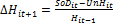 ,
,
Where  is
a rate of housing supply growth between period t and t+1 in i-th region;
is
a rate of housing supply growth between period t and t+1 in i-th region;  is
a size of dwelling that had been started at t-th period and was offered for
sale at t+1 at i-th region;
is
a size of dwelling that had been started at t-th period and was offered for
sale at t+1 at i-th region;  is a size of
uninhabitable residential real estate which was removed from housing market;
is a size of
uninhabitable residential real estate which was removed from housing market;  is
a housing stock available at the market at t-1 period.supply can be determined
as a function of expected real estate prices relative to full replacement cost
of construction according to Q-theory formulated by J. Tobin. In the context of
real estate market this theory implies that construction firms make their
investment decision to build a house based on benefit-cost analysis: they build
additional housing is expected prices are higher than current total costs. Therefore
housing supply equation will be determined as follows:
is
a housing stock available at the market at t-1 period.supply can be determined
as a function of expected real estate prices relative to full replacement cost
of construction according to Q-theory formulated by J. Tobin. In the context of
real estate market this theory implies that construction firms make their
investment decision to build a house based on benefit-cost analysis: they build
additional housing is expected prices are higher than current total costs. Therefore
housing supply equation will be determined as follows:
|
|
(15) |
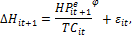
taking a logarithm of both
right-hand and left-hand sides for linearization and by substitution of  and
and
 with
correspondinglogarithmic expressions, the following log-linear supply function:
with
correspondinglogarithmic expressions, the following log-linear supply function:
|
|
(16) |
 ,
,
 is price elasticity
of supply parameter;
is price elasticity
of supply parameter;  is a coefficient
which reflects the influence of region-specific factor;
is a coefficient
which reflects the influence of region-specific factor;  is
a coefficient which reflects the influence of time-specific factor;
is
a coefficient which reflects the influence of time-specific factor;  is
an overall error term.appendix:’s create a logarithmic form of expected housing
prices and total costs equations:
is
an overall error term.appendix:’s create a logarithmic form of expected housing
prices and total costs equations:
|
|
(17) |
|
|
(18) |


form of housing supply equation is:  .
By substitution of two former expressions into supply function, the following
log-linear form of housing supply will be obtained:
.
By substitution of two former expressions into supply function, the following
log-linear form of housing supply will be obtained:
|
|
(19) |

final form of housing supply equation can be obtained by grouping items on the basis of their compliance - mathematical and economic.
formulation
theoretical framework that was
formulated above is based on the plain idea of equilibrium between supply and demand(see
figure 3), which are formed in turn under the influence of outlined
characteristics of the whole Russian economy, regional specific features and
personal characteristics of individual households.
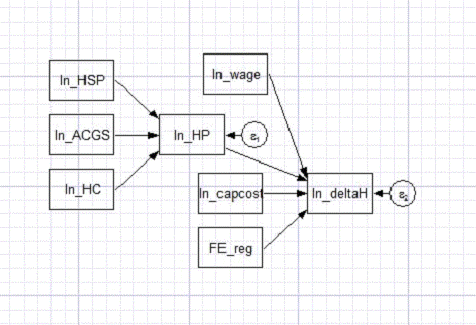
Fig. 3. Graphic representation of
the theoretical modelinfluence of the national economy as a whole is
represented by borrowing and lending terms: loan rate for construction and
developing companies which is suggested equal to the rate of return at which
households invest their funds and mortgage rate for households. Despite the
fact that mortgage rate varies over the regions it is based on the Russian key
rate which defines the cost of the money in the economy and on observed and
expected inflation rate. That is why mortgage rate can be considered more as a
factor reflecting the situation in the whole economy rather than in the
separate regions. coefficient  included into the
demand function reflects the relative expensiveness of investing in the housing
(which presented by cost of borrowing (mt) and depreciation rate that assumed
to be constant over time and regions) instead of placing saved funds in
financial instruments that brings some rate of return - rt. So the higher costs
of buying of an additional real estate the lower demand should be which
eventually would depress housing prices. : The higher relative costs of buying
real estatecompared to an alternative rate of return the lower housing prices
arethe influence of business cycle and the overall trend in the economy is
accounted in the supply function through time-specific effect. The presence of
this effect implies a positive trend in housing construction, which could
include technology improvement over time which allows building real estate
faster and/or cheaper, the increase of labor productivity or the fact that over
time population becomes richer due to for instance trade unions activities and
increase of minimal wages. All these factors can facilitate the increase of constructors’
profit margins and push prices higher relative to the cost of construction
dynamics. So the positive influence of time factor which is included into the
expected price formation process goes without saying. regional-specific factors
of demand there are working force of the region, employment level and housing
stock of the region. Due to the fact that housing stock is naturally higher for
regions with higher population, it was scaled by employed population of the
region (those who create efficient demand). So real estate stock per capita is
included in the demand function. The law of demand connects the price of real
estate and the amount of the occupied housing: the higher the price is, the
lower the amount of housing is purchased. regional-specific growth factor
calculated as (1+ GRP growth rate) in the supply function as a part of
anticipations of construction companies about future prices. The dynamic of
production which accurately reflects the situation in the economy appeared to
be highly significant in the majority research papers such as (Grimes and
Aitken, 2004), (Kishor and Marfatia, 2016), (Berger et al, 2015) and some
others. So the assumption about fact that economic agents base their
expectations on the past was validated. However these models were tested on
quarterly data so it could be concluded that this result was proved only for
short-term periods. Besides the significance was shown mainly for developed
countries and on country-wide data, the importance of cross-regional
differences has not been yet tested for developing countries. Therefore the
following hypothesis can be suggested. : Gross Regional Product plays
significant role in the formation of price expectations on housing market in
Russian regionstotal cost function of construction companies is based on the
distribution of expenses between human and capital resources. So theoretically
this function should be individual for each company. Howeverdue to the
existence of the assumption about competitive industrial structure all the companies
are price-takers on the labor market and market of construction materials,
machinery, financial resources, etc. And considering regional economy level
this assumption seems to be reasonable because if there was higher than average
salary in the construction industry there would be an inflow of workers on that
market and wages would converge to the average level. Therefore the average
regional value of such variable as labor cost and capital cost were used.
Anyway themore expensive resources to the company relative to the anticipated
housing prices are the less incentive to build additional living spaces
constructors and developers have.: The inflation of total cost which is not
supported with corresponding increase of housing prices holds back construction
activityof unavailability of information about cost structure of each builder
in each region such cost equation coefficients as the elasticity of
substitution (alpha) and proportion coefficient (gamma) are unobservable and
therefore impossible for separate estimation. They are assumed as constant and
would be incorporated into estimated empirical parameters of the linear supply
function.individual features that participate in the demand formation there is
a share of current consumption of perishable and non-housing durable goods in
the households disposable income (not only wage, but rent, profit from
entrepreneurship or any other type of income). Housing consumption and
consumption of goods and services are connected through the income constraint which
means that the household have to distribute its income between these positions
-if it spends more on current consumption it has less to invest in housing. At
the same time the law of demand implies inverse relationship between the amount
of housing purchased and the price of housing. Therefore the lower demand for
real estate is the higher the prices are. That is why theoretical model
formulated beforehand suggests that housing prices and consumption of goods and
services are connected directly to each other. the fact that all the
unobservable variables in the demand equation such as the risk-aversion and
coefficient of housing services are theoretically individual to each household
there is no ability to measure them separately for every individual and
therefore test hypotheses about their influence. That is why these coefficients
considered as constant in the equation and therefore will be incorporated into
the estimated parameters of the empirical model.order to test whether developed
theoretical model describes the real situation on the regional housing market
in Russia the appropriate data should be collected from reliable sources of
information. The process of data collection and discussion of data features are
presented in the following sections.
included into the
demand function reflects the relative expensiveness of investing in the housing
(which presented by cost of borrowing (mt) and depreciation rate that assumed
to be constant over time and regions) instead of placing saved funds in
financial instruments that brings some rate of return - rt. So the higher costs
of buying of an additional real estate the lower demand should be which
eventually would depress housing prices. : The higher relative costs of buying
real estatecompared to an alternative rate of return the lower housing prices
arethe influence of business cycle and the overall trend in the economy is
accounted in the supply function through time-specific effect. The presence of
this effect implies a positive trend in housing construction, which could
include technology improvement over time which allows building real estate
faster and/or cheaper, the increase of labor productivity or the fact that over
time population becomes richer due to for instance trade unions activities and
increase of minimal wages. All these factors can facilitate the increase of constructors’
profit margins and push prices higher relative to the cost of construction
dynamics. So the positive influence of time factor which is included into the
expected price formation process goes without saying. regional-specific factors
of demand there are working force of the region, employment level and housing
stock of the region. Due to the fact that housing stock is naturally higher for
regions with higher population, it was scaled by employed population of the
region (those who create efficient demand). So real estate stock per capita is
included in the demand function. The law of demand connects the price of real
estate and the amount of the occupied housing: the higher the price is, the
lower the amount of housing is purchased. regional-specific growth factor
calculated as (1+ GRP growth rate) in the supply function as a part of
anticipations of construction companies about future prices. The dynamic of
production which accurately reflects the situation in the economy appeared to
be highly significant in the majority research papers such as (Grimes and
Aitken, 2004), (Kishor and Marfatia, 2016), (Berger et al, 2015) and some
others. So the assumption about fact that economic agents base their
expectations on the past was validated. However these models were tested on
quarterly data so it could be concluded that this result was proved only for
short-term periods. Besides the significance was shown mainly for developed
countries and on country-wide data, the importance of cross-regional
differences has not been yet tested for developing countries. Therefore the
following hypothesis can be suggested. : Gross Regional Product plays
significant role in the formation of price expectations on housing market in
Russian regionstotal cost function of construction companies is based on the
distribution of expenses between human and capital resources. So theoretically
this function should be individual for each company. Howeverdue to the
existence of the assumption about competitive industrial structure all the companies
are price-takers on the labor market and market of construction materials,
machinery, financial resources, etc. And considering regional economy level
this assumption seems to be reasonable because if there was higher than average
salary in the construction industry there would be an inflow of workers on that
market and wages would converge to the average level. Therefore the average
regional value of such variable as labor cost and capital cost were used.
Anyway themore expensive resources to the company relative to the anticipated
housing prices are the less incentive to build additional living spaces
constructors and developers have.: The inflation of total cost which is not
supported with corresponding increase of housing prices holds back construction
activityof unavailability of information about cost structure of each builder
in each region such cost equation coefficients as the elasticity of
substitution (alpha) and proportion coefficient (gamma) are unobservable and
therefore impossible for separate estimation. They are assumed as constant and
would be incorporated into estimated empirical parameters of the linear supply
function.individual features that participate in the demand formation there is
a share of current consumption of perishable and non-housing durable goods in
the households disposable income (not only wage, but rent, profit from
entrepreneurship or any other type of income). Housing consumption and
consumption of goods and services are connected through the income constraint which
means that the household have to distribute its income between these positions
-if it spends more on current consumption it has less to invest in housing. At
the same time the law of demand implies inverse relationship between the amount
of housing purchased and the price of housing. Therefore the lower demand for
real estate is the higher the prices are. That is why theoretical model
formulated beforehand suggests that housing prices and consumption of goods and
services are connected directly to each other. the fact that all the
unobservable variables in the demand equation such as the risk-aversion and
coefficient of housing services are theoretically individual to each household
there is no ability to measure them separately for every individual and
therefore test hypotheses about their influence. That is why these coefficients
considered as constant in the equation and therefore will be incorporated into
the estimated parameters of the empirical model.order to test whether developed
theoretical model describes the real situation on the regional housing market
in Russia the appropriate data should be collected from reliable sources of
information. The process of data collection and discussion of data features are
presented in the following sections.
Data collection and processing methodology
order to determine a type of relationship between the set of independent variables and housing prices and obtain marginal effects, the empirical model need to be estimated. Due to the fact that housing prices varied a lot during the period after the collapse of the Soviet Union to our days as well as the majority of predictors, time variance also should be considered. Therefore panel data analysis should be implemented.housing prices in Russian regions are modeled with help of yearly data which covers the period between 1996 and 2012, so data need no seasonal correction.Due to the fact that mortgage became mass financial product only in 2005-2006 in Russia, statistics on mortgage conditions (i.e. mortgage interest rates) is available only for the period from 2006 to 2012.is also worth mentioning that during the period in study there were a different number of regions in Russia - some of the regions were included into the others: some, vice versa, were separated. Those regions that stopped their independent existence between 1996 and 2012 were included as separate object of observation if all the variables were available for at least 5 years. Otherwise the values of each variable for the region were from the beginning added to the values of the region which turned out to be its absorber. Those regions that were separated during the period in study were included whatever the time they appeared (anyway the minimal length of time series for such regions was 5 years). As a result 85 regions were observed during 17 years, so the total number of observation is 1445. demand side and supply side indicators can be collected from official free sources such as Federal and Regional Statistics Services and The Central Bank of Russian Federation.Regional-level data is availableonly in “Russian regions Handbook” which is published by Russian Federal Statistic Service on a yearly basis.
The Bank of Russia provides analysts with regional-level information on mortgage rates, but regional differences of loan rates are unobservable.Cross-regional difference of borrowing rates is negligible for a couple of reasons. First of all, large constructors and developers are borrowing money not only in one particular region - they can optimize their choice and find cheaper funds, which makes space arbitrage impossible. Besides, if somewhere loan rates were higher in comparison with other regions, banks would have been started allocating more resources and issuing more loans there. At the same time banking can be considered as competitive industry - they “sell” undifferentiated product (money), so in order to “sell” more they compete on price (loan rate), and as a result interest rates become more or less equal to each other. (Wagner 2008)
2.of information about factors studied in the research
|
Factors |
Source of information |
|
Housing prices, residential real estate stock, total population, Gross Regional Product (GRP), Consumer Price Index (CPI), size of dwelling, uninhabitable housing, disposable income per person, total workforce, unemployment level, inflation rate, construction cost index, average salary, non-housing consumption prices, current consumption share in personal income, housing consumptions share in personal income, financial assets consumption share in personal income |
Publications of Russian Federal and Regional Statistics Services |
|
Average mortgage rate, interest rates |
Official cite of The Central Bank of Russian Federation |
the indicators have numerical values; however they are measured with help of different units. The Table 3 reflects each variable name in the research and their units of measurement.
3.names and units of measurement
|
Indicator |
Variable name |
Units of measurement |
|
Dependant variables |
||
|
Housing prices |
Real_HPI |
Rub |
|
Stock of real estate available by the end of the year |
HS |
thousand square meters |
|
Demand-side indicators |
||
|
Total population of the region |
Total_pop |
mln. citizens |
|
Regional consumer price index |
CPI |
% |
|
Average monthly disposable income |
Real_disp_income |
|
|
The share of current consumption of perishable and durable goods in disposable income |
CGS |
% |
|
The share of housing consumption in disposable income |
HC |
% |
|
The share of financial assets consumption in disposable income |
FA |
% |
|
Average mortgage rate |
Mortgage_rate |
% |
|
Unemployment |
Unemployment |
% |
|
Supply-side indicators |
||
|
Size of dwelling |
Size_of_dwelling |
thousand square meters |
|
Uninhabitable residential real estate |
UnH |
thousand square meters |
|
Average salary |
Wage |
Rub |
|
Construction Cost Index |
CCI |
Index units |
|
Average rate at which companies borrow money in Russia |
Loan_rate |
% |
|
Gross regional product |
GRP |
mln.rub |