Материал: Assessment of the situation on the regional housing market in Russia
should be mention that the trickiest issue for real estate researchers is measurement of real estate prices. Generally there are two methods of coping with that task: housing price index construction and prices of registered deals. Using indexes allows more or less frequent and precise estimation, however there are several problems connected with their implementation. First of all, smoothing problem that appears because of illiquidity - estimated prices of real estate objects are usually used for index calculation instead of deal prices, but revaluation of these object occurs not as often as the frequency of calculating the index. This leads to lower volatility and seasonality in time series of prices because revaluation of dwelling is usually made in the last quarter of the year. One more drawback of house price indexes is time-lag of calculation. As a rule, information that appraiser has about the object is insufficient, so the specialist has to spend quite lot of time for doing precise estimation.
On the other
hand deal prices formation is really opaque, prices depend on a plenty of
indicators such as center location, neighbors, specific features of the object
itself, etc. (Krainer and Wilcox 2013)(Yunus and Swanson 2013) It is hard to
find two identical objects that totally match according to all the parameters,
so each piece of real estate is unique, that is why it is hard for external
investor to evaluate it precisely. However average price of real estate of each
Russian region is calculated by Federal State Statistics Service, which is
considered as an official and reliable source of information, whereas there is
no housing price index in Russia that would be calculated on permanent basis by
some well-known agencies. Therefore within this research the choice was made in
favor of deal prices. methodology of average real estate price calculation
presented by Russian Federal Statistics Service implies collection of primary
information from companies and/or sole entrepreneurs, whose operations include
buying and selling real estate objects in particular territories - cities,
suburbs, regions, etc. All the information is collected on the regular basis;
all the figures are calculated as of the 25th day of the last reporting quarter
month (or the next working day after it). On the secondary market the average
price per square meter of apartment is calculated as a weighted average based
on actual transaction prices per square meter of total area and on the total
amount of square meters of all apartments that were sold during the period. So, the
formula used for calculation is the following:
|
|
(19) |
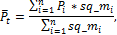
Where  -
average price per square meter for the period t;
-
average price per square meter for the period t;  - actual deal price per square meter of i-th object of real estate;
  - total area footage of i-th object of real estate;
  - total number of real estate objects sold tor t period.
Data description
graph of real housing prices of all
Russian regions during the period in study is presented onthe figure4. First of
all, similar dynamic of real prices in each region can be observed - there was
a slight positive overall trend between 1996 and 2012, however there were
obvious boom and burst of prices after 2005. The boom had been caused by
mortgage loan market expansion - mortgage mass market appeared in Russia in
2005 and the financial product became popular very soon: in 2006 there was a
considerable real estate demand increase which pushed prices in average up by
48%.
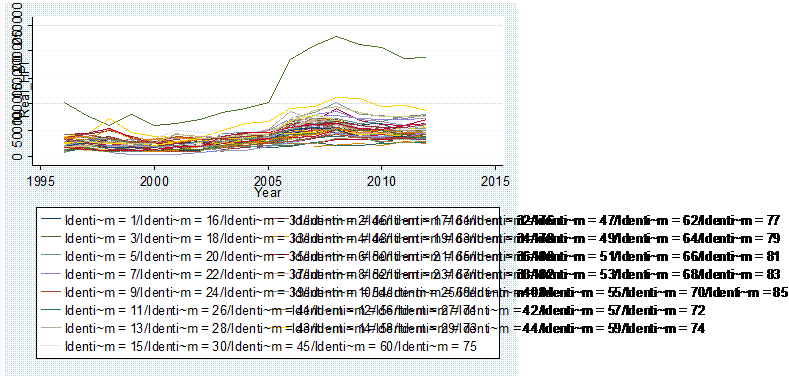 . 4. Real housing
prices of all Russian regions in 1996-2012
. 4. Real housing
prices of all Russian regions in 1996-2012
phenomenon can also be an evidence
of the fact that Russians consider real estate as real asset, which can help to
ensure the safety of capital. After the period of hyperinflation the majority
ofRussian people lost their savings and cut their consumption, however the
moment mortgage market appeared they made the great demand for such expensive
and illiquid asset as real estate. So it can be suggested that they hoped to
save the capital from another possible round of inflation. However after the
period of boom there was a period of burst - because of financial crisis in
2008-2009 real wages of Russians dropped quite dramatically, so demand for real
estate and prices plummeted as well. high volatility of prices within each
region, the difference between regions was quite high: the highest line on the graph
reflects housing prices in Moscow region and it is quite obvious that prices
there were almost 50% higher before mortgage boom in 2006 and 100% higher after
it. It is also worth mentioning that the period in study is long enough and it
covers at least two economic cycles. The sample includes two crises (in 1998
and in 2008), two period of recovery after them and one period of growth
between them. All the period can be characterized with different economic
conjuncture, different risk aversion parameters, etc. which affect both demand
and supply on real estate market.the fact that the sample is not homogenous
there is no need to get rid of outliers, because as it was mentioned before the
general population is studied.Unobservable individual characteristics can be
taken into account in the model in both cases: if there is no reason to believe
that they are correlated with independent variables and if there can be assumed
such correlation, but appropriate method of endogeniety correction is used for
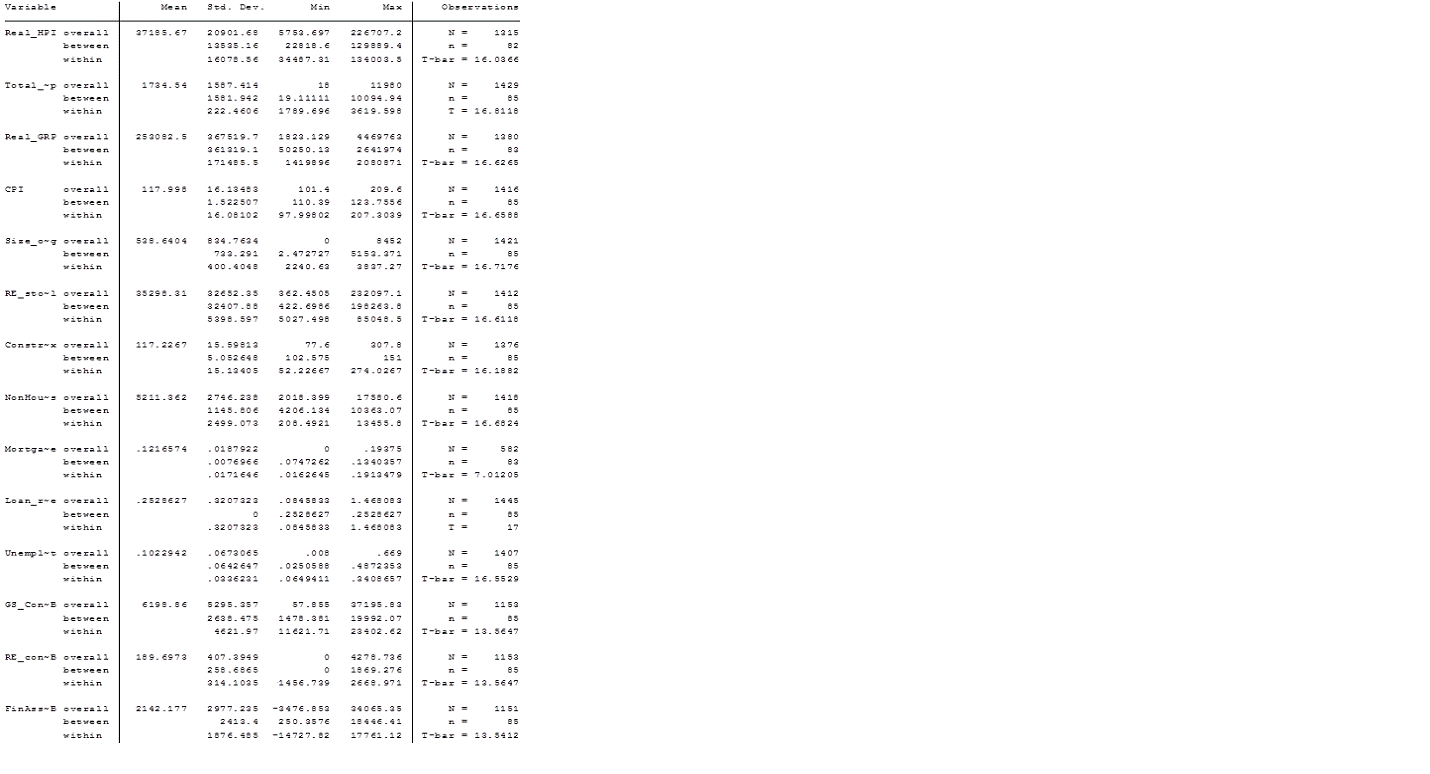
coefficients assessment. statistics of all the variables are presented in the
Table 4 below.There isempirical evidence that real housing prices in Russia
were highly dispersed during the period in study - the standard deviation of
the indicator is about 56% of overall mean value.Anyway it also should be
mentioned that during the period under observation the demand for housing
(measured in square meters per person) also fluctuated significantly - for
instance in Moscow area it had rocketed up to 47% before crisis.
Table. 4.statistics of the variables
price indexes of different region did not vary a lot, because neighbor regions usually have tight economic connection and according to purchasing power parity prices in different regions were more or less the same if only regional government didn’t take some restricting actions. But there was a high intertemporal variance, because during recessions - in 1998-2000 and in 2008-2009 there were inflation shocks in Russia. Because of hyperinflation in some periods financial industry in Russia could not work properly that is why loan rateduring 1996-2012 varied from 8.4% to 147%.may wonder why the real amount of financial assets consumption can be negative whereas the amount of current and housing consumption is non-negative. This phenomenon goes from Russian Statistical service methodology of financial asset value calculation. This indicator accounts accumulated change of financial assets on year-to-year basis. During several crises that occurred during the period of observation there were inflation shocks when consumer prices could rose up to 200% a year so the real value of the assets decreased because of inflation. Besides during crises financial assets may experience significant drawdown which also diminishes their value. As a result negative values can be observed. At the same time the methodology of housing consumption calculation does not imply accounting for depreciation or appreciation and therefore it can be at least zero.’s also worth noticing that at the same time construction cost index which is calculated as a year-on-year change of materials, machinery, details and design costs as well as other non-salary costs of construction demonstrated very unstable dynamics during the whole period under observation though it was similar for all the regions (see figure5). This graph shows that time-series data of CCI is non-stationery, which makes impossible inclusion of time-series variation into the model because of unit root. Therefore the first difference of this indicator should be included into the final model in order to get rid of this problem.
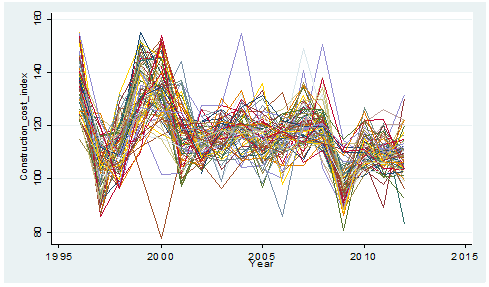
Fig. 5. Construction cost index dynamics
of the relative wage to capital costs (CCI) also deserves attention. The graph of this indicator demonstrates that inflation of labor cost for construction companies during past 16 years was much more severe compared to changes in cost of materials. And it is quite straightforward because the technology usually becomes cheaper with time - new technologies of construction are developed, new cheaper materials are used, and mechanization of construction becomes more widespread. At the same time labor union pressure, development of workers’ rights protection laws, overall increase of life quality and employees compensation after the collapse of the Soviet Unionlead to such a rapid growth of labor cost/material cost ratio.should be mentioned that the calculated ratio reflects only dynamic of the labor cost/material cost indicator but not the actual value because labor cost is approximated with real salary whereas material costs were calculated as index. These regional time-series are also non-stationary; therefore first differences (which have no unit roots) will be used for model estimation. The rest of the variables are more or less stationary in time so the level of variables will be used for estimation of theoretical model parameters
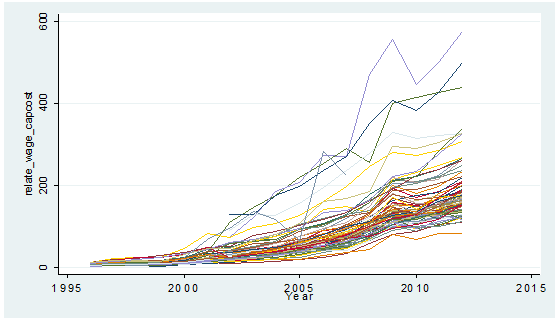
Fig. 6. Labor cost/material cost ratio dynamics
order to identify the connection
existence between endogenous and exogenous variables the correlation
coefficients were studied. The majority of independent variables have strong
linear impact on housing prices. The signs of correlation coefficients are
mostlyin line with expected signs which comply with economic theory.
Table. 5.coefficients.
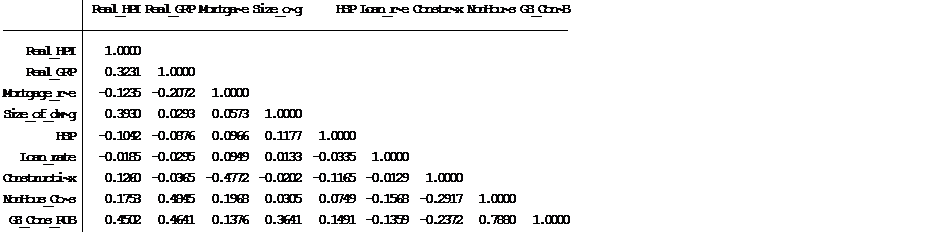
As it was assumed stricter loan conditions negatively affect housing prices, whereasthe amount current consumption is positively correlated to housing prices. It also can be noticed that the state of the regional economy reflected through real GRP comparatively strictly linked to consumption variables and to the mortgage conditions and at the same time it is rather highly correlated with the housing prices. Despite the fact that there is no multicollinearity in the strict sense it could be assumed that one of these variables could be insignificant because some of them can drag influence one from another. the components of the supply equation a positive linear correlation between the size of dwelling and loan ratesseems to be quite unexpected. Anyway the coefficient itself is quite small and probably correlations can vary from region to region therefore the final conclusions could be made only after the whole model assessment.the multicolinearity is tested the empirical model can be estimated. The estimation of the model parameters is implemented with help of the package of statistical analysis Stata 12th Version. The empirical analysis of the theoretical model on the Russian regional-level data will allow testing the significance of the whole suggested framework of the interaction between supply and demand on the housing market. And if the model is proved to be valid for forecasting equilibrium states of the market, the analysis of model residuals will allow drawing some conclusions about the possibility of non-equilibrium states. Theseresults in turn may give a basis for further research devoted to Russian real estate market efficiency, estimation of housing demand and supply elasticity, modeling of the price adjustment mechanisms, etc.
estimates
model was estimated with help of maximum likelihood method which allows to obtain consistent, asymptotically normal and efficient (there is no alternative estimator which allows achieving lower asymptotic variance) estimates if the sample is big enough and Gauss-Markov conditions are fulfilled.
6. results of estimation of the initial structural model.

Dataset was already checked for multicolinearity, however heteroscedasticity was detected with help of Breusch-Pagan test. The influence of heteroskedasticity can be taken into account when assessing the significance of a particular variable by implementing robust estimation. Anyway none of the variables changed its significance level noticeably, so the influence of heteroscedasticity can be considered as negligible. model as a whole is significant which means that the joint test of all the coefficients being equal to zero allowed reject the null hypothesis and therefore the specification of the model describes the reality quite well. This statement can also be supported with the high R-squared of the each equation included into the model and the overall goodness-of-fit (see table 7 below)
.7.of-fit of the initial model.
|
Endogenous variables |
R^2 |
|
Ln_HP |
39.89% |
|
Ln_deltaH |
11.97% |
|
Overall |
40.32% |
However the results that were
obtained after model estimation appeared to be quite unexpected. First of all
due to the fact that such variable as construction cost index and wages were
taken as a first differences in order to eliminate unit root in the initial
data inclusion of trend variable (FEyear) was a bad idea, because it became
insignificant at any level. influence of regional-specific growth factor which
was approximated with help of GRP growth rate appeared to be insignificant as
well. The reason of such result may lie in the fact that there is no
significant cross-regional variation of GRP growth rate and all the regions
during the period under observation were developing along with the national
economy. And the influence of the national business cycle had already been
accounted into other variables in particular in the credit market conditions
(loan rate and mortgage rate) reflected in the variable ln_HC =  .
So, both time trend and regional-specific growth rate were removed from the
initial model which allowed increasingthe goodness-of fit of the supply
equation and the whole structural model as well. most unexpected result is the
positive influence of the housing price on the households’ demand which follows
from the positive coefficient of the ln_HSP (housing stock per person)
variable. This result contradicts the basic law of demand and common sense that
higher prices restrict some households’ real estate consumption. The problem
can be caused by the wrong model specification, data features (which means that
that phenomenon really existed in Russian housing market during the period in
study) or endogeniety problem which could become a reason of biasedinconsistent
estimates and the wrong sign in the demand function. to the results of Wald
testwhich allowed testing the joint hypothesis of non equality to zero for all
the coefficients the model as a whole is significant. Therefore the first
reason of the incompliance of empirical results to economic theory can be rejected.the
same time the existence of the positive connection between the price of the
housing and the amount of housing consumption can be explained as a phenomenon
of Veblen good. That means housing can be considered as a positional good for
Russians, however this violates the main assumption of the model about rational
households’ behavior. And besides that effect usually implies the high income
of the consumers however the average real income in Russia grew with much more
moderate paces compared to the growth of housing prices. And finally there is
no statistical evidence of such phenomenon according to the linear correlation
coefficient which is negative (see Table 5) Therefore the second reason of
wrong sigh in demand function with high likelihood can be also rejected.the
existence of the endogeniety problem can be assumed. This problem can be caused
by wrong measurement of the indicator, simultaneity problem, self-selection
bias or omitted variables in the model. Due to the fact that the same indicator
was proved to be a relevant and suitable in many other research papers such as
(Kenny,1999), (Cheshire and Sheppard, 1998), (Fingleton,2008), etc. because the
results that were obtained complied totally with economic theory. So housing
stock per person can be believed as a reliable measurement of the amount of
housing available on the secondary market for a particular household. problem
means that the amount of housing changes immediately along with housing prices
fluctuations which seem to be absolutely unrealistic assumption. In average the
building process of apartment house in Russia lasts more than one year and the
assumption used in the model implies that the housing becomes available on the
secondary marketat the period which follows its commissioning. selection is a
problem which is connected to the sampling process, however due to the fact
that all the regions participate in the model estimation there actually no such
a process because general population is studied. Therefore this cause can be
rejected as well which in turn leads to the conclusion that the most possible
reason of housing quantity endigeniety is the presence of omitted variable. For
instance the availability of the land lots that are suitable for residential
construction is an important factor of housing prices and construction itself,
it can be assumed that it vary from region to region, but this indicator cannot
be directly measuredtherefore cannot be included into the model. this means
that there is a correlation between the housing stock per person and individual
error term in the model. In order to eliminate the effect sucha bias this
variable should be instrumented with help of other variables that cannot be
connected to the error term. Instrument variables have to be valid and relevant,
which means that they should be exogenous and provide high descriptive capacity
(e.g. influence significantly on endogenous variables) subject to other
Gauss-Markov’s conditions.
.
So, both time trend and regional-specific growth rate were removed from the
initial model which allowed increasingthe goodness-of fit of the supply
equation and the whole structural model as well. most unexpected result is the
positive influence of the housing price on the households’ demand which follows
from the positive coefficient of the ln_HSP (housing stock per person)
variable. This result contradicts the basic law of demand and common sense that
higher prices restrict some households’ real estate consumption. The problem
can be caused by the wrong model specification, data features (which means that
that phenomenon really existed in Russian housing market during the period in
study) or endogeniety problem which could become a reason of biasedinconsistent
estimates and the wrong sign in the demand function. to the results of Wald
testwhich allowed testing the joint hypothesis of non equality to zero for all
the coefficients the model as a whole is significant. Therefore the first
reason of the incompliance of empirical results to economic theory can be rejected.the
same time the existence of the positive connection between the price of the
housing and the amount of housing consumption can be explained as a phenomenon
of Veblen good. That means housing can be considered as a positional good for
Russians, however this violates the main assumption of the model about rational
households’ behavior. And besides that effect usually implies the high income
of the consumers however the average real income in Russia grew with much more
moderate paces compared to the growth of housing prices. And finally there is
no statistical evidence of such phenomenon according to the linear correlation
coefficient which is negative (see Table 5) Therefore the second reason of
wrong sigh in demand function with high likelihood can be also rejected.the
existence of the endogeniety problem can be assumed. This problem can be caused
by wrong measurement of the indicator, simultaneity problem, self-selection
bias or omitted variables in the model. Due to the fact that the same indicator
was proved to be a relevant and suitable in many other research papers such as
(Kenny,1999), (Cheshire and Sheppard, 1998), (Fingleton,2008), etc. because the
results that were obtained complied totally with economic theory. So housing
stock per person can be believed as a reliable measurement of the amount of
housing available on the secondary market for a particular household. problem
means that the amount of housing changes immediately along with housing prices
fluctuations which seem to be absolutely unrealistic assumption. In average the
building process of apartment house in Russia lasts more than one year and the
assumption used in the model implies that the housing becomes available on the
secondary marketat the period which follows its commissioning. selection is a
problem which is connected to the sampling process, however due to the fact
that all the regions participate in the model estimation there actually no such
a process because general population is studied. Therefore this cause can be
rejected as well which in turn leads to the conclusion that the most possible
reason of housing quantity endigeniety is the presence of omitted variable. For
instance the availability of the land lots that are suitable for residential
construction is an important factor of housing prices and construction itself,
it can be assumed that it vary from region to region, but this indicator cannot
be directly measuredtherefore cannot be included into the model. this means
that there is a correlation between the housing stock per person and individual
error term in the model. In order to eliminate the effect sucha bias this
variable should be instrumented with help of other variables that cannot be
connected to the error term. Instrument variables have to be valid and relevant,
which means that they should be exogenous and provide high descriptive capacity
(e.g. influence significantly on endogenous variables) subject to other
Gauss-Markov’s conditions.
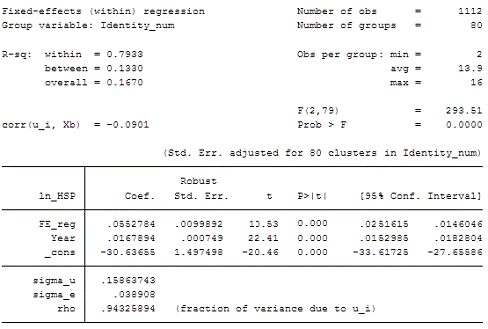
Fig. 7. FE estimates of intermediate model
it was
assumed both regional level and national-level indicators of business cycle
appeared to be significant factors of construction activity in Russian regions
despite the fact that the absolute values of both coefficients are relatively
small.Furthermore this result also supports the statement that residential real
estate construction is a pro-cyclical variable. It is also worth noticing that
the model better describes intertemporal variation compared to cross-regional
probably because the regional-specific effect did not varied a lot across
regions but its variation precisely describes dynamics of construction in time
and at the same time an overall trend is also supposed to reflect the influence
of time effect. order to check the model for possible endogeniety consistent
fixed-effect estimators should be compared to random-effect estimators. If
there is no statistically significant difference between those two sets of
estimators then the model predicted values of housing stock per person can be
used for the estimation of the structural model. results of random effect model
estimation are presented on the figure 8 below, this model as a fixed-effect
model was checked for heteroskedasticity and as a result robust estimation was
implied. Even without testing both sets of estimators for statistical compliance
one could notice that the coefficients are almost the same which means that the
intermediate model does not cause further endogeniety and the predicted values
of endogenous variable (housing stock per person) can be used for estimation of
the structural model of Russian regional housing market.
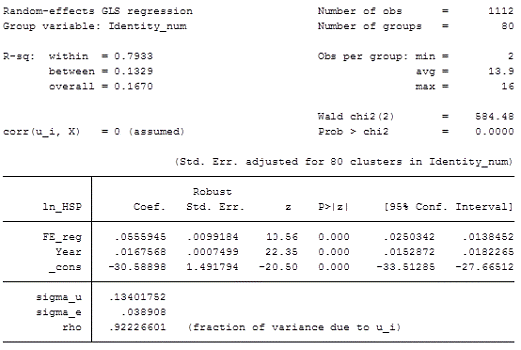
Fig. 8. RE estimates of the intermediate model
new variable
which was extracted out of the reduced-form model was inserted into the whole
model under the name lnHSP_hat and as it was assumed earlier this step helped
to improve the initial model significantly. The results of the new model
assessment are presented in the table 8 below.
Table 8. results of the final model estimation

of the predicted variable allowed to some extent eliminate the influence of endogeniety and the sign of the coefficient before the amount of housing in the demand equation become negative as it is required by economic theory. So at that point the model can be considered as a suitable for further interpretation and discussion of the results.goes without saying that the model stayed significant an all levels and what is more the total quality of the final model improved compared to initial model for both separate equations and the overallmodel (see table 9 below).
.9.of-fit of the final model.
|
Endogenous variables |
R^2 |
|
Ln_HP |
46.02% |
|
Ln_deltaH |
12.31% |
|
Overall |
46.57% |
Therefore it could be concluded that the suggested theoretical framework is basically relevant however housing stock per person which was taken as an indicator of quantity in the demand function appeared endogenous presumably because of omitted variable. For further research of Russian regional housing markets one should use another variable for measurement for quantity of housing, include the indicators connected to residential building land availability and quality of construction measurements in the model or include an additional equation in the model which would describe the connection of the demanded quantity of housing with other variables that participate in the equilibration on the housing market.
of the model estimation
final model almost totally fulfilled the expectations about all the exogenous variables influence on endogenous ones (housing prices and net amount of residential real estate construction). Besides, due to the fact that the model as a whole is also significant according to rejected joint hypothesis about all coefficients being equal to zeros it could also be concluded that the suggested paths of influence of each of the demand-side and supply-side indicators are correctly determined as well. model estimation approach implies that the signs of the regressions coefficients are dictated mostly by the economic theory and less by the researcher’s assumptions. It should be noted that all the estimated coefficients correspond to the economic theory and most of the explored variables appeared to be highly significant. All the components of theoretical demand function - consumption and housing related are equally significant for price determination. However supply function is mostly driven by housing prices rather than cost inflation, because both components of total cost function - labor expenses and cost of capital goods - are significant only at 5% and 10% levels respectively.phenomenon can be explained in the following way. Construction companies in reality are not perfectly competitive and therefore they can have some market power to persist marginality of their business at a stable level. Within the framework of the research companies have to reduce construction activity and inflate prices back to the level which would keep their operational margin stable when their total expenses increase.
The
mechanism of the interaction between housing prices and conditions on the labor
market was described in the paper of (Bover, Muellbauer, and Murphy 1989).
Authors found similar evidence of negative connection between wage level and
housing construction but the positive influence of labor cost inflation on
housing prices on the UK housing market. The wage in their model was
incorporated in both demand and in the supply functions through its inverse
relationship with unemployment level. in order to answer the question about the
power of influence of demand-side and supply-side indicators on equilibrium
housing price both direct and indirect effects should be studied. Their values
are presented in the table 10 below.
Table 10., indirect and total effects of exogenous variables on endogenous ones

Direct effect of each variable
reflects the influence of a particular exogenous variable on corresponding
endogenous variable in the equation which contains both of them. This effect is
actually equal to the estimated coefficient in structural themodel. Indirect
effect on the other hand reflects the path of influence of exogenous variables
from one equation on the endogenous variable from another one. Total effects
are the effects that incorporate both direct and indirect ones and allow
researcher to observe the influence of all the exogenous factors on all the
endogenous ones.effect appears when the endogenous variable from one of the
equation is used for modeling the other endogenous variable. In the estimated
model housing prices that were determined within inverse demand equation
participated in the determination of net size of dwelling. Therefore the
exogenous variables from the demand function such as housing stock per person,
aggregate current consumption and the relative costs of buying real estate
coefficient indirectly affect net size of dwelling.of the most influential
housing demand factors in Russian regions is the amount of housing available on
secondary marketper one household: when this amount rises by 1 % real estate
prices drop by 0.59%. If the direct demand equationwould be constructed instead
of reverse demand function the causal relation could be inverted: when housing
prices go up by 1% the demand for residential real estate contracts by 1.69%.
fact reflects the simple idea of the law of demand and the value of the
coefficient indicates that demand for housing is price elastic. This result
supports estimation conducted by (Mayo, 1981) on state-level data for the USA
sample and partly results of the city-level research conducted by (Hanushek and
Quigley, 1980) who proved that housing demand is more elastic for relatively
expensive objects of residential real estate. is not a surprise that such
result was obtained for Russian sample because for most people housing is a
very valuable asset, often - the most valuable asset they have. So even
moderate housing price inflation which is not supported with corresponding
increase of personal income can prevent people from buying additional real
estate and make them chose other saving or consumption opportunities.conclusion
can be supported with the positive sign of the estimated coefficient of current
consumption (as it was mentioned before that it includes not only perishable
goods but some durable goods except housing as well). Anyway, taking into
account the fact that Consumption CAPM framework was used for utility function
determination and unobservable parameter delta (risk-aversion parameter) was
incorporated there it seems impossible to define the exact marginal rate of
substitution of additional living space with amount of current consumption. now
only the existence of significant positive relationship between housing prices
and amount of current consumption can be ascertained. However assessment of the
model on individual-level panel data would presumably allow estimation of the
unobserved risk-aversion parameter and drawing more precise conclusions about
the elasticity of current construction by housing prices. housing prices raise
households make their choice in favor of more current consumption - for
example, the individual may choose buying a new car over saving further in
order to buy a new flat. This can be explained with high uncertainty about the
future - there is a possibility that prices will go down - or inthe general
case that expected return on housing can be considerably less compared to
mortgage expenses, depreciation, adjustment costs, etc.costs of buying an
additional living space relative housing return are reflected in the housing
coefficient (ln_HC = ). As it was
assumed when these expenses grew and were not backed with proportionate housing
prices inflation households contracted their consumption of housing at that
period, as a result the volume demanded on real estate market dropped and
prices moderated further. Therefore it can be concluded that hypothesis H1
about negative significant influence of relative cost of buying housing on
priceswas confirmed on Russian sample. However the influence of this indicator
is much less compared to current consumption and housing stock per person: when
relative costs go up by 1% housing prices will be diminished only by 0.17%.
direct influence of time-specific and region-specific effects on housing prices
appeared insignificant due to the fact that other variables that were included
into the equation took over a quite big share of explained variance of prices.
However because of endogeniety of housing stock variable time trend and GRP
growth were used as instruments for endogenous variable and were proved to be
valid and relevant. So their influence on housing prices was accounted for
indirectly, therefore the hypothesis H2 could not be accepted unconditionally.
It should be said that housing stock is mainly prone to cyclical adjustments
and overall economic trends whereas it affects housing prices only through this
variable.the same time the most influential driver of net residential real
estate construction is housing prices themselves. The increase of prices by 1%
will encourage constructors to build 0.65% more living spaces. The positive
link between these indicators reflects the idea of the law of supply. The value
of the coefficient indicates the fact that construction is not price elastic
and it is worth mentioning that there are evidences that supply is inelastic in
some other mainly developing regions. results were obtained in papers of
(Green, Malpezzi and Mayo, 2005) who studied housing supply elasticity in large
cities of different States of the USA. Authors found the evidence that in
industrial states of the country elasticity of construction is significantly
less compared to agricultural, technological and political centers of the
country.