Материал: turuk_if_petukhova_mv_chebotarev_ius_gulaia_tm_kurs_povtoren

1.4. Grammar1
Прочтите и запомните материал раздела 1.4.
|
|
|
|
|
|
|
|
|
|
|
|
Table 22. |
|
The Present and Past Continuous Tenses. Word Order. |
|||||||||||||
|
|
|
|
|
|
|
|
|
|
|
|
||
|
|
|
|
|
Subject |
|
Predicate |
|
Object |
||||
|
|
|
|
|
|
I |
|
|
II |
|
|
III |
|
|
|
|
|
|
|
He |
|
is reading |
|
|
a letter. |
|
|
|
|
|
|
|
|
|
|
was reading |
|
|
|
||
|
|
Is |
|
|
|
he |
|
reading |
|
|
a letter? |
|
|
|
|
Was |
|
|
|
he |
|
reading |
|
|
a letter? |
|
|
What |
|
is |
|
|
|
he |
|
reading? |
|
|
|
|
|
|
|
|
|
|
Who |
|
is reading |
|
|
a letter? |
|
||
|
|
|
|
|
|
|
|
|
|
|
|
Table 23. |
|
The Present and Past Continuous Tenses of the Verb "to read" |
|||||||||||||
|
|
|
|
|
|
|
|
|
|||||
Affirmative |
|
|
|
Interrogative |
|
|
|
Negative |
|
||||
|
|
|
|
|
|
|
|
|
|||||
|
|
|
The Present Continuous Tense |
|
|
|
|
||||||
|
|
|
|
|
|
||||||||
I am reading. |
|
Am I reading? |
|
I am not reading. |
|
||||||||
He |
|
he |
|
|
|
He |
|
|
|
|
|||
She is reading. |
|
Is she reading? |
|
She is not reading. |
|
||||||||
We |
|
|
we |
|
|
|
We |
|
|
|
|
||
|
|
|
|
|
|
|
|
|
|
|
|
|
|
You are reading |
|
Are you reading? |
|
You are not reading |
|
||||||||
They |
|
|
they |
|
|
|
They |
|
|
|
|||
|
|
|
The Past Continuous Tense |
|
|
|
|
||||||
|
|
|
|
|
|
||||||||
I was reading. |
|
Was I reading? |
|
I was not reading. |
|
||||||||
He |
|
|
he |
|
|
|
He |
|
|
|
|
||
She was reading. |
|
Was she reading? |
|
She was not reading. |
|
||||||||
We |
|
|
|
we |
|
|
We |
|
|
|
|||
|
|
Were |
|
|
|
You |
|
|
|
|
|||
You were reading |
|
you |
reading? |
|
were not reading |
|
|||||||
|
|
|
|
|
|
|
|
|
|
|
|
||
They |
|
|
|
they |
|
They |
|
|
|
||||
1 Времена группы Continuous обозначают действие соотнесенное с определенным моментом времени, действие в процессе его развития в настоящем, прошедшем или будущем.
86
Сводная таблица форм времен группы Continuous
Continuous |
Present |
|
Past |
|
Future |
am |
|
was |
shall |
||
(действие в |
|
|
asking |
|
|
is asking |
|
were |
|
be asking |
|
определенный момент, |
are |
|
|
will |
|
|
|
|
|||
в процессе, в развитии) |
|
|
|
|
|
|
II. Practice |
|
|
|
|
|
A |
|
|
|
|
1. Read the following groups of words (see Table 11).
ring, sing, thing, clang, hang bank, tank, thank, link, think she, show, shy, wish, fish chess, chair, chalk, lunch, check
fetch, catch, branch, match, bench knife, knee, knelt, know, knave wrong, write, writer, wreck, wrap
2. Read the following words.
knee, wrangle, knife, wrong, theft, written, these, ship, black, check, match, long, wrestle, cell, catch, bank, fetch, knelt, scratch, chin, thus, thin, branch, clock
3. Listen and then read the following groups of words.
a) The movies; to the movies; go to the movies; to go to the movies; you do go to the movies, don't you?
b) The game; to the game; go to the game; to go to the game; do you go to the game?
c) They show you; they show you how; they show you how to do it. 4. Listen to the speaker and check your pronunciation (ex. 1,2,3).
B
1. Analyse the usage of the Present Continuous Tense in the following sentences.
1. What a lovely weather we are having now, aren't we? 2. What are you thinking of? 3. It was the middle of the day and everyone was resting. 4. At this time two tourists were visiting the town. 5. He was still sleeping. 6. We were looking at some pictures. 7. I'm looking for my keys. 8. You are looking
87
very well. 9. Why are you not looking after your children? They are crying. 10. He was looking out of the window every time when somebody came into the house. He was waiting for a letter.
2. We are at an English lesson, write what the students of your group are doing now. Use the verbs given below.
to listen to, to read, to write, to translate, to discuss, to speak, to ask, to talk
3. This is a language laboratory, write down what the students are doing. Use the verbs given below.
to record, to repeat, to look, to answer, to pronounce, to watch
4. Use the Present Continuous Tense instead of the Present Indefinite Tense in the following sentences.
Examples: |
I study every day. → I'm studying now. |
1. We work every day. 2. I ring up my friend very seldom. 3. I have tea every evening. 4. She works at the library every day. 5. He goes to the University four days a week. 6. They learn English.
5. Listen to the statements about Peter and ask questions about his brother.
Examples: |
Peter is studying English. What is his brother |
|
studying? |
Peter is studying Economics. Peter is ringing Paul up. Peter is teaching in Tomsk. Peter is translating a new text. Peter is sending a registered letter.
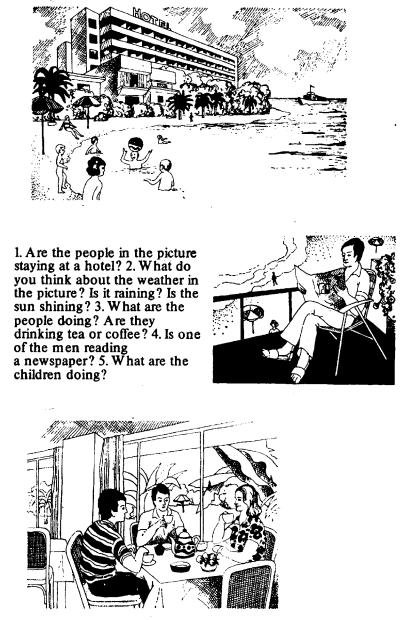
6.Look at the picture (p. 88) and
a)answer the questions.
b)compose a story.
7.Put all possible questions to the following sentences.
1. A group of students is speaking with a well-known American scientist. 2. They were going to the theater when he saw them in the street. 3. The students of our University attend lectures every day.
8. Listen to the dialogue and reproduce it.
(Nina came to see her friend Ann. They are talking in the living-room.) Ann: I'm glad to see you, Nina. How are you?
Nina: Thank you, I'm fine.
Ann: And how are your mother and father?
Nina: Father is quite all right, but mother isn't feeling well, it's her head again.
Ann: It's bad.
88
Nina: What's on TV tonight?
Ann: We'll see now. (Ann is turning on the TV set.) They are filming a famous play, shall we see it?
Nina: I'd like to. Ann: Let's see it then.
Nina: Is your TV set working well.
Ann: Yes, it is. I see you are enjoying the film. And what about a cup of tea? Nina: With pleasure.
9. Translate into English.
1. Куда ты сейчас идешь? Я иду домой, а ты? А я - в университет. В университете будет собрание студентов. 2. Где ты был вчера, когда я тебе звонил? Отправлял заказное письмо. 3. Ты вчера много занимался? Да, я учил английские слова, делал упражнения. У меня не было учебника, и я позвонил своему товарищу. 4. Что ты сейчас делаешь? Ты свободен? Я сейчас жду товарища. Он придет через несколько минут.
89
10. Read the following text and write a letter to your friend.
A letter to a friend
Dear Paul,
Thank you for the invitation to come to Kiev and spend the holidays with you. I hope I shall come after my examinations. The examination in Statistics is the most difficult one for me. But I am sure I shall pass it successfully. I am working hard.
The weather in Moscow is dull, it is raining now. My parents are at home today. Mother is teaching our Bob English and father is reading a book on his speciality. They ask you to remember them to your family.
Hope to see you soon. Yours, Peter.
III. Test
Part I
Phonetics
В каждой строчке найдите два слова, которые содержат указанный
звук. |
1) tan |
2) ring |
|
3) kind |
4) link |
5) rang |
|
|
1. |
η |
|
|
|||||
[ ] |
1) cope |
2) cite |
|
3) lock |
4) lace |
5) chap |
|
|
2. |
[k] |
|
|
|||||
3. |
[ ∂ ] |
1) thin |
2) that |
|
3) myth |
4) think |
5) bathe |
|
4. |
[t∫] |
1) catch |
2) hang |
|
3) path |
4) chess |
5) fish |
|
5. |
[θ] |
1) thus |
2) leather |
3) thank |
4) these |
5) teeth |
|
|
6. |
[w] |
1) wrap |
2) when |
|
3) whole |
4) wait |
5) low |
|
7. |
[r] |
1) bar |
2) colour |
3) rate |
4) pare |
5) wrong |
|
|
8. |
[h] |
1) whale |
2) whom |
3) hair |
4) chop |
5) whip |
|
|
|
|
|
|
|
Part II |
|
|
|
|
|
|
|
|
Grammar |
|
|
|
|
Выберите |
форму |
глагола, |
соответствующую |
данному |
|||
предложению. |
|
|
|
|
|
|
||
9. |
... you ring up your friend yesterday? |
|
|
|
||||
|
1) do |
|
2) did |
|
3) are |
4) were |
|
|
10. ... she reading an English book? |
|
|
|
|||||
|
1) do |
|
2) does |
|
3) is |
4) are |
|
|
11. ... he work at your plant? |
|
|
|
|
|
|||
|
1) do |
|
2) does |
|
3) is |
4) was |
|
|
12. They ... discussing a problem when he entered the room. |
|
|||||||
|
1) do |
|
2) did |
|
3) are |
4) were |
|
|
13. She ... very busy last week. |
|
|
|
|
|
|||
|
1) is |
|
2) was |
|
3) did |
5) does |
|
|
14. What ... they doing now? |
|
|
|
|
|
|||
|
1) is |
|
2) are |
|
3) do |
4) did |
|
|
90