Материал: surgical knot tying manual covidien
VIII. two-hand tie techniques — square knot (1=1) formation of the second throw (cont’d)
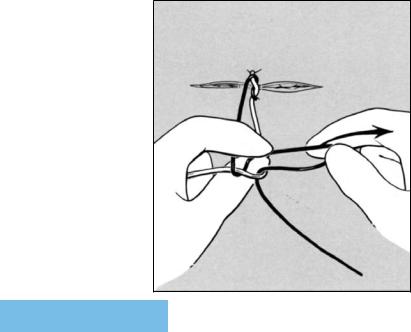
Step 11.
Pass Free Suture End
Up Through the Suture Loop to Form Second, Single-Wrap Throw
The free suture end grasped between the tips of the left thumb and index finger is advanced upward through the suture
loop. The right hand releases its free suture end to allow its passage through the suture loop, after which it regrasps the free suture end to withdraw (arrow) through the suture loop.
52
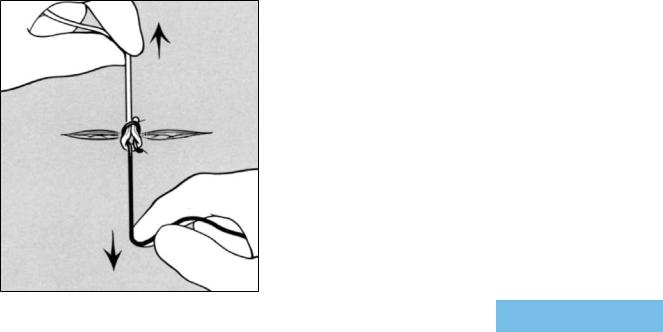
Step 12.
Advance Square Knot (1=1) to Wound Surface
The second throw is advanced and set against the first throw by applying tension in a direction (arrows) perpendicular to that of the wound. Advancement of the second throw is complete when the second throw contacts the first throw to form a square (1=1) knot. Ideally, the surgeon should be able to advance the two-throw, square knot to allow meticulous approximation of the wound edges. Once exact approximation of the wound edges is accomplished, the surgeon will construct a knot with a sufficient number of throws and 3mm cut “ears” so that knot security is determined by knot breakage, rather than by slippage.3
53
VIII. two-hand tie techniques — surgeon’s knot square (2=1) formation of the first, double-wrap throw
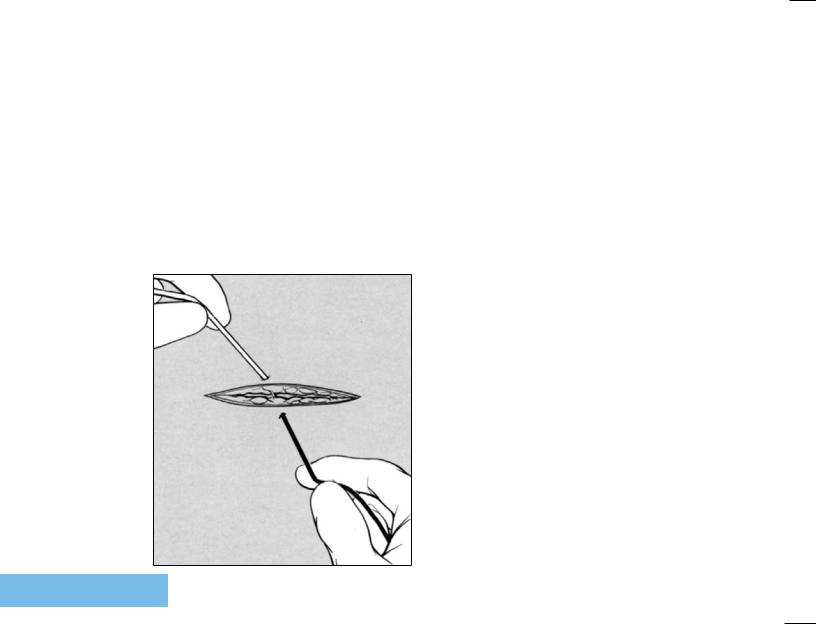
Step 1.
Hold Suture Ends
The suture end exiting from the side of the wound farther from the surgeon is grasped between the tips of the distal phalanges of the left thumb and index finger (tip-to-tip pinch), while the tips of the distal phalanges of the right thumb and index finger grasp the suture end exiting from the closer side of the wound. The grasped fingers apply constant tension
to the suture ends. The security of this tip-to-tip pinch of the suture ends can be enhanced by grasping the suture ends between the tips of the long fingers, ring
fingers, small fingers and the palm of each hand (grip activity).
54
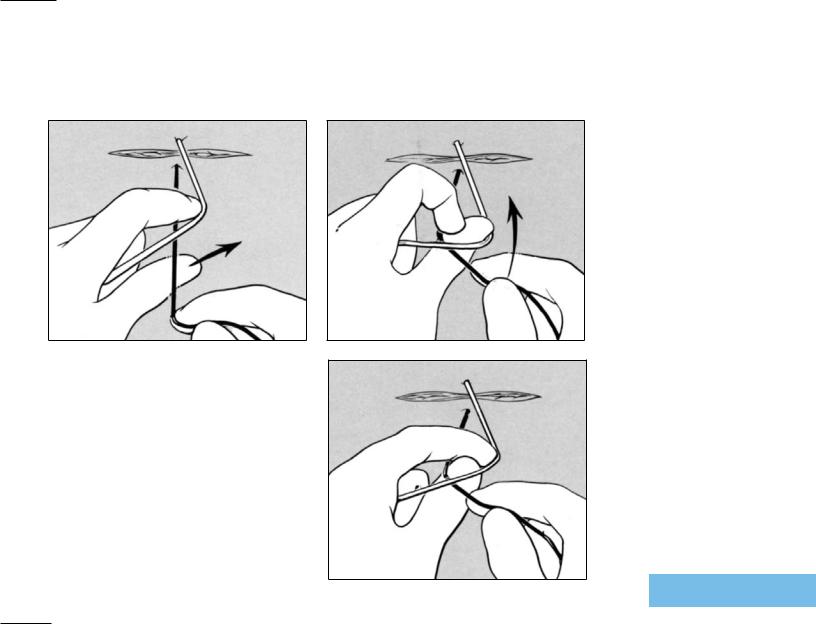
Step 2.
Form the First Suture Loop
The first suture loop is formed by the tip of the left index finger that passes its suture end over the other suture end held by the right hand. As the tip of the left index finger passes its suture end over the suture end held by the right hand, the left thumb passes under (arrow) the suture end held by the right hand.
Step 3. Pass Thumb Up Through the Suture Loop
The tip of the left thumb advances up through the suture loop, replacing the tip of the left index finger.
Step 4.
Pass Free
Suture End
Over the Suture Loop
The free suture end, held by the right hand, is passed over (arrow) the suture loop.
55
VIII. two-hand tie techniques — surgeon’s knot square (2=1) formation of the first, double-wrap throw (cont’d)
Step 5.
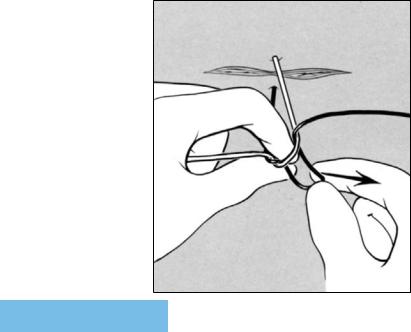
Pass Free Suture End Down Through the Suture Loop to Form Single-Wrap Throw
After the free suture end is grasped between the tips of the left thumb and index finger, the pinched suture end is passed downward through the suture loop. The right hand releases its free suture
end so that it can be passed through the loop. The tips of the right thumb and index finger regrasp the free suture end to withdraw (arrow) it through the suture loop to form a single-wrap throw.
56