Материал: part02

Page 76 |
DICOM PS3.2 2020a - Conformance |
A.4.3.3 IPv4 and IPv6 Support
ThesupportforspecificIPv4andIPv6featuresandassociatedoptionalIPv6securityandconfigurationfacilitiesshallbedocumented.
A.4.4 Configuration
Anyimplementation'sDICOMconformancemaybedependentuponconfiguration,whichtakesplaceatthetimeofinstallation.Issues concerning configuration shall be addressed in this section.
A.4.4.1 AE Title/Presentation Address Mapping
An important installation issue is the translation from AE title to Presentation Address. How this is to be performed shall be described in this section.
Note
There does not necessarily have to be a one to one relationship between AE titles and Application Entities. If so, this should be made clear in the tables.
A.4.4.1.1 Local AE Titles.
The local AE title mapping and configuration shall be specified. The following table shall be used:
Table A.4.4-1. AE Title Configuration Table
Application Entity |
Default AE Title |
Default TCP/IP Port |
AE (1) |
Name |
Specify |
AE (2) |
Name |
Specify |
AE (x) |
|
|
If the implementation conforms to the Application Configuration Management Profile as an LDAP Client actor (see PS3.15), any use of LDAP to configure the local AE titles shall be described. Any conformance to the Update LDAP Server option shall be specified, together with the values for all component object attributes in the update sent to the LDAP Server.
A.4.4.1.2 Remote AE Title/Presentation Address Mapping
Configuration of remote host names and port numbers shall be specified here.
A.4.4.1.2.1 Remote SCP 1
Configuration of the remote AET port number, host-names, IP addresses and capabilities shall be specified. If applicable, multiple remote SCPs can be specified.
If the implementation conforms to the Application Configuration Management Profile as an LDAP Client actor (see PS3.15), any use of LDAP to configure the remote device addresses and capabilities shall be described. The LDAP queries used to obtain remote device component object attributes shall be specified.
Note
In particular, use of LDAP to obtain the AE Title, TCP port, and IP address for specific system actors (e.g., an Image Archive, or a Performed Procedure Step Manager) should be detailed, as well as how the LDAP information for remote devices is selected for operational use.
A.4.4.1.2.2 Remote SCP 2
Etc.
- Standard -

DICOM PS3.2 2020a - Conformance |
Page 77 |
A.4.4.2 Parameters
The specification of important operational parameters, and if configurable, their default value and range, shall be specified here. The parametersthatapplytoallApplicationEntitiesshouldbespecifiedina"GeneralParameters"sectionwhilethosespecifictoparticular Application Entities should be specified in separate sections specific to each AE. The following table, which is shown here with a re- commended baseline of parameters, shall be used:
Table A.4.4-2. Configuration Parameters Table
Parameter |
Configurable Default Value |
|
(Yes/No) |
General Parameters |
|
Time-out waiting for acceptance or rejection Response to an Association Open Request. (Application Level timeout)
 General DIMSE level time-out values
Time-out waiting for response to TCP/IP connect request. (Low-level timeout)
 Time-out waiting for acceptance of a TCP/IP message over the network. (Low-level timeout)
Time-out for waiting for data between TCP/IP packets. (Low-level timeout)
 Any changes to default TCP/IP settings, such as configurable stack parameters.
Definition of arbitrarily chosen origins
 Definition of constant values used in Dose Related Distance Measurements Other configurable parameters
AE Specific Parameters
 Size constraint in maximum object size (see note)
Maximum PDU size the AE can receive
 Maximum PDU size the AE can send
AE specific DIMSE level time-out values
 Number of simultaneous Associations by Service and/or SOP Class
<SOP Class support> (e.g., Multi-frame vs. single frame vs. SC support), when configurable
 <Transfer Syntax support>, e.g., JPEG, Explicit VR, when configurable
Other parameters that are configurable
Note
In particular when accommodating Multi-frame objects (e.g., Ultrasound Multi-frame, NM, XA, RF), a receiver might have a certain restriction with regard to its maximum length. This restriction should be specified here.
Additional configuration parameters such as hardware options for e.g., a printer shall be specified as well.
A.5 Media Interchange
A.5.1 Implementation Model
TheImplementationModelshallidentifytheDICOMApplicationEntitiesinaspecificimplementationandrelatetheApplicationEntities to Real-World Activities.
A.5.1.1 Application Data Flow Diagram
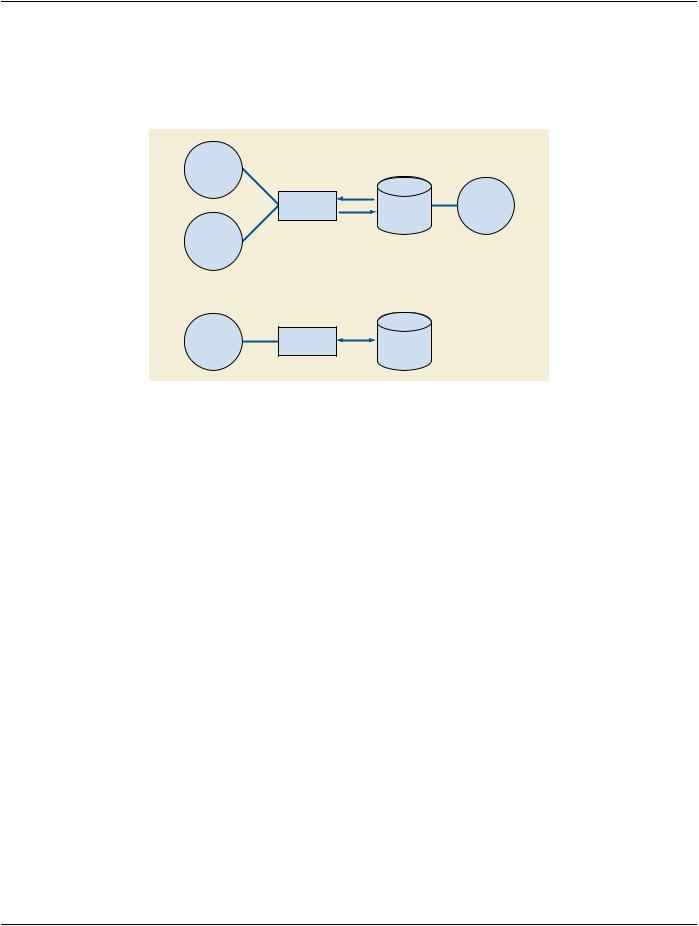
As part of the Implementation Model, an Application Data Flow Diagram shall be included. This diagram represents all of the Applic- ation Entities present in an implementation and graphically depicts the relationship of the AEs use of DICOM to real world activities. Figure A.5.1-1 is a template for such a Data Flow Diagram. Accompanying the Application Data Flow Diagram shall be a discussion of the Application Data Flow represented.
- Standard -
Page 78 |
DICOM PS3.2 2020a - Conformance |
In this illustration, according to Figure A.5.1-1, an occurrence of local Real-World Activity A or B will cause the local Application Entity 1 to initiate either creation of a File-set on a medium (FSC) for the purpose of interchange with a remote Real-World Activity X or to access a File-set on a medium for reading (FSR). The remote Real-World Activity X accesses the medium physically transferred from Real-World Activity A or B.
An occurrence of Real-World Activity C will cause the local Application Entity 2 to update a File-set (FSU) on a mounted medium.
Local
Real-World
Activity A
Application |
DICOM |
Remote |
|
Real-World |
|||
Entity <1> |
|||
Storage |
Activity X |
||
|
Medium
Local
Real-World
Activity B
Local |
Application |
DICOM |
|
Real-World |
|||
Entity <2> |
|||
Storage |
|||
Activity C |
|||
|
|||
|
Medium |
||
|
|
Figure A.5.1-1. Application Data Flow Diagram
Note
If the AE expects a remote Real-World Activity to access the media for a specific purpose, this should be shown in the Ap- plication Data Flow Diagram as well as described in Section Section A.5.1.1.
A.5.1.2 Functional Definitions of AEs
The next part of the Conformance Statement shall contain a functional definition for each local Application Entity. This shall describe in general terms the functions to be performed by the AE, and the DICOM services used to accomplish these functions. In this sense "DICOM services" refers not only to DICOM Service Classes, but also to lower level DICOM services, such as the Media File System and mapping to particular Media Formats.
A.5.1.3 Sequencing of Real World Activities
If applicable, this section shall contain a description of sequencing of Real World Activities that the AEs require.
Note
An example of a situation in which a such a description is required is an AE that supports roles as a File-set Updater and File-set Reader. In some instances, the File-set will be updated then read (e.g., for verification); and in other instances, may be read first to determine if the File-set needs to be updated.
A.5.1.4 File Meta Information for Implementation Class and Version
This section shall be used to list the values assigned to the File Meta Information attributes (see PS3.10) that pertain to the Imple- mentation Class and Version. These are:
•File Meta Information Version
•Implementation Class UID
•Implementation Version Name
- Standard -

DICOM PS3.2 2020a - Conformance |
Page 79 |
A.5.2 AE Specifications
The next section in the DICOM Conformance Statement is a set of Application Entity Specifications. There shall be one such specific- ation for each Application Entity type.
A.5.2.1 "Application Entity <1>" - Specification
The following table, Table A.5.2-1, shows that for one or more Application Profiles in the first column, there are a number of Real- World Activities in the second column and the roles required for each of these Real-World Activities in the third column
Table A.5.2-1. AE Related Application Profiles, Real-World Activities, and Roles
Supported Application Profile |
Real-World Activity |
Roles |
STD-AP1 |
RWA A |
FSR |
|
RWA B |
FSR, FSC |
STD-AP1, AUG-AP2, etc. |
RWA C |
FSU |
|
RWA D |
FSC |
This section shall also contain any general policies that apply to all of the AEs described in subsequent section.
A.5.2.1.1 File Meta Information for the "Application Entity <1>"
This section shall contain the values of the File Meta Information that pertain to the Application Entity (see PS3.10). These are:
•Source Application Entity Title
If Private Information is used in the Application Profile File Meta Information, the following two File Meta Information attributes may be documented:
•Private Information Creator UID
•Private Information
A.5.2.1.2 Real-World Activities
The first sentence in this section shall state the Roles and Media Storage Service Class Options supported by the "Application Entity <1>".
A.5.2.1.2.i "Real-World Activity <i>"
TheAESpecificationshallcontainadescriptionoftheReal-WorldActivities,whichinvoketheparticularAE.Therewillbeonesection, A.5.2.1.2.i where i increments for each RWA, per Real-World Activity.
A.5.2.1.2.i.1 Media Storage Application Profile
The Application Profile that is used by the AE described in A.5.2-1 is specified in this section.
A.5.2.1.2.i.1.y Options
The options used in the Application Profiled specified in Table A.5.2-1 shall be detailed in this section. There will be separate sections for each option specified for the AP. If there are no options used in the Application Profile specified in A.5.2.x, this section may be omitted.
A.5.2.2 "Application Entity <2>" - Specification
Each individual AE Specification has a subsection, A.5.2.x. There are as many of these subsections as there are different AEs in the implementation. That is, if there are two distinct AEs, then there will be two subsections, A.5.2.1, and A.5.2.2.
- Standard -

Page 80 |
DICOM PS3.2 2020a - Conformance |
A.5.3 Augmented and Private Application Profiles
This Section shall be used for the description of Augmented and Private Application Profiles.
A.5.3.1 Augmented Application Profiles
Any Augmented Application Profiles used by an AE shall be described in these sections. The rules governing the structure of an Augmented AP shall be described.
A.5.3.1.1 "Augmented Application Profile <1>"
Each Augmented Application Profile shall have a section A.5.3.1.x that describes the specific features of the Application Profile that make it Augmented. These shall be described in the three repeating sections that follow.
A.5.3.1.1.1 SOP Class Augmentations
The additional SOP Classes beyond those specified in the Standard AP on which this Augmented AP is based shall be detailed in this section.
A.5.3.1.1.2 Directory Augmentations
Any additions to the Directory IOD that augment this AP shall be described in this section.
A.5.3.1.1.3 Other Augmentations
Any additions to, or extensions of the Application Profile shall be described in this section. An example of such another augmentation is addition of a role (FSR, FSC, FSU) to the Standard Application Profile set of defined roles.
A.5.3.1.2 "Augmented Application Profile <2>"
To be repeated for the second, third, etc. Augmented Application Profile.
A.5.3.2 Private Application Profiles
The rules that govern construction of a Private Application Profile shall be described. This section shall be used to describe the details
of the Private AP.
Note
1.Refer to PS3.11 for a description of constructing a Private Application Profile.
2.If the AP deviates from the rules governing a Private AP in any manner, it is non-conformant and is outside the scope of this Standard.
A.5.4 Media Configuration
Any implementation's DICOM conformance may be dependent upon configuration that takes place at the time of installation. Issues concerning configuration shall be addressed in this section (e.g., the configuration of the Source AE Title in File Meta Information).
A.6 Transformation of DICOM to CDA
The supported SR objects and corresponding template identifiers shall be described. The release version and template identifier of the generated valid CDA documents shall be documented. The transformation process may be described by reference to a specific Annex of PS3.20.
A.7 Support of Character Sets
Any support for Character Sets beyond the Default Character Repertoire in Network and Media Services shall be described here.
•The behavior when an unsupported character set is received shall be documented.
- Standard -