Материал: Категории падежа существительного в современном английском языке
4) From the table drawer he took out a penholder, a bottle of ink, and a thick, quarto-sized blank book with a red back and a marbled cover.
5) She was a bold-looking girl, of about twenty-seven, with thick hair, a freckled face, and swift, athletic movements;
6) A handsome, tough-looking boy of nine had popped up from behind the table and was menacing him with a toy automatic pistol, while his small sister, about two years younger, made the same gesture with a fragment of wood;
7) The eyeless creature at the other table swallowed it fanatically, passionately, with a furious desire to track down, denounce, and vaporize anyone who should suggest that last week the ration had been thirty grammes;
8) He was a monstrous man, with a mane of greasy grey hair, his face pouched and seamed, with thick negroid lips.
Также нами были найдены примеры употребления предлога с местоимением:
It was because of the atmosphere of hockey-fields and cold baths and community hikes and general clean-mindedness which she managed to carry about with her.
Теперь обратим наше внимание на случаи, в которых был представлен непосредственно инструментальный падеж:
1) With the tip of his finger he picked up an identifiable grain of whitish dust and deposited it on the corner of the cover, where it was bound to be shaken off if the book was moved;
2) Then, with a movement which was as nearly as possible unconscious, he crumpled up the original message and any notes that he himself had made, and dropped them into the memory hole to be devoured by the flames;
3) Even the streets leading up to its outer barriers were roamed by gorilla-faced guards in black uniforms, armed with jointed truncheons;
4) The pen was an archaic instrument, seldom used even for signatures, and he had procured one, furtively and with some difficulty, simply because of a feeling that the beautiful creamy paper deserved to be written on with a real nib instead of being scratched with an ink-pencil.
Таковы основные примеры употребления инструментального падежа в исследуемом произведении.
английский существительный падеж оруэлл
2.3 Анализ в рамках теории
ограниченного падежа
Данная теория основывается на оппозиционном представлении категории: категория падежа выражается через оппозицию двух противопоставленных грамматических форм: первая форма, форма родительного падежа (the genitive case), является сильным членом оппозиции, поскольку маркируется с помощью постпозитивного форманта «-s» после апострофа в единственном числе и просто апострофом во множественном числе. Вторая, немаркированная форма представляет собой слабый член оппозиции и обычно называется формой «общего падежа». Категория падежа реализуется в английском языке в полной мере одушевленными существительными, и ограниченно - неодушевленными существительными, отсюда и название - «теория ограниченного падежа».
Обратим наше внимание непосредственно на примеры. Итак, в соответствии с этой теорией, нами было проанализировано порядком 130 примеров. Для начала остановимся на реализации категории падежа с одушевленными существительными.
1) Behind Winston's back the voice from the telescreen was still babbling away about pig-iron and the overfulfilment of the Ninth Three-Year Plan;
2) Then there was a wonderful shot of a child's arm going up up up right up into the air a helicopter with a camera in its nose must have followed it up;
3) The man's face, already very pale, turned a colour Winston would not have believed possible;
4) The man in the white coat bent down and looked closely into Winston's eyes, felt his pulse, laid an ear against his chest, tapped here and there, then he nodded to O'Brien.
Отдельный интерес представили собой следующие случаи. К примеру, указание не на конкретного человека, а на часть его тела:
Soon he was within arm's length of the girl, but the way was blocked by an enormous prole and an almost equally enormous woman, presumably his wife, who seemed to form an impenetrable wall of flesh.
Нами были найдены примеры употребления форманта с неодушевлёнными существительными, например:
1) The clock's hands said seventeen-twenty;
2) In the preceding quarter, it appeared, the Tenth Three-Year Plan's quota for bootlaces had been overfulfilled by 98 per cent.
Довольно редки были и примеры употребления с числительными:
It was a noise that set one's teeth on edge and bristled the hair at the back of one's neck.
Своё отражение нашел и «адвербиальный» генетив (употребим для определения обстоятельств места и времени):
By leaving the Ministry at this time of day he had sacrificed his lunch in the canteen, and he was aware that there was no food in the kitchen except a hunk of dark-coloured bread which had got to be saved for tomorrow's breakfast.
Наиболее распространенным случаем является замыкание. К примеру, между частями аналитической формы расположено прилагательное в превосходной степени:
Winston's greatest pleasure in life was in his work.
Winston's working week was sixty hours, Julia's was even longer, and their free days varied according to the pressure of work and did not often coincide. Julia, in any case, seldom had an evening completely free.
В процессе нашего исследования мы столкнулись с примеров употребления «двойного генетива»:
1) Winston had never been able to feel sure - even after this morning's flash of the eyes it was still impossible to be sure whether O'Brien was a friend or an enemy;
2) It was therefore necessary to rewrite a paragraph of Big Brother's speech, in such a way as to make him predict the thing that had actually happened;
3) He saw himself standing there in the dim lamplight, with the smell of bugs and cheap scent in his nostrils, and in his heart a feeling of defeat and resentment which even at that moment was mixed up with the thought of Katharine's white body, frozen for ever by the hypnotic power of the Party.
Таковы основные случаи употребления категории падежа на базе романа Дж.Оруэлла «1984» .
Вывод по второй главе:
Тщательному рассмотрению подверглось порядка 300
примеров различных категорий. На основании наших результатов мы составили
сводную диаграмму, в процентном соотношении демонстрирующую частотность
употребления рассмотренных падежей.
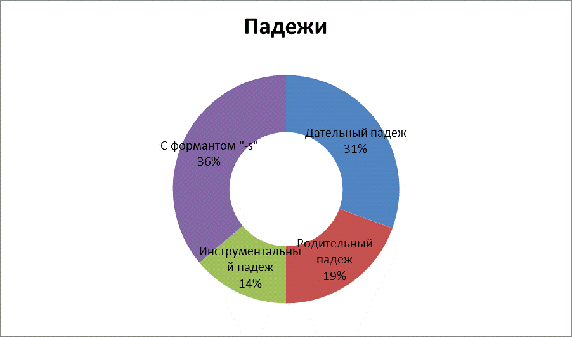
Исходя из данных нашей диаграммы, мы видим, что наиболее часто был употребим родительный падеж, маркированный формантом «-s». Видимо, для автора являлось наиболее важным указания на обладателя и агента того или иного действия. Следует отметить, что раз автор использует формант «-s» это говорит нам о том, что большинство агентов действий - одушевленные существительные.
На втором месте по употребимости стоит дательный падеж. Как известно, данный падеж выражает какое-либо действие, направленное к предмету. Большое число указаний на действие говорит нам о том, что произведению присуща динамика и автор уделяет большое внимание развитию действия.
Следующим стоит родительный падеж. Как мы можем заметить число его употребимости гораздо меньше, чем использование родительного падежа, маркированного формантом. Это говорит нам о том, что автор редко использует указание на неодушевлённый агент действия.
И наконец, инструментальный падеж. Число его употребления крайне мало. Большую часть составляют конструкции, носящие описательный характер, что необходимо для раскрытия характера и внешности главных героев произведения. А вот указаний на предметы, которыми было выполнено то или иное действие, автор явно избегает, так как они практически отсутствуют в данном произведении.
Именно такие выводы мы моем сделать на базе
проанализируемого произведения.
Заключение
Проблема падежа существительных в современном английском языке является во многих отношениях спорной и неясной. Этот вопрос по праву считается одним из самых запутанных в грамматике английского языка. Разногласия существуют и относительно количества и номенклатуры падежных форм существительного в английском языке, и относительно семантики этих форм; более того, само существование категории падежа существительных в английском языке ставится под сомнение. Как мы увидим ниже, для такого различия в трактовке падежа существуют глубокие объективные причины.
Изучение материала по выбранной теме исследования позволяет сделать вывод, что проблема определения языкового статуса категории падежа в современном английском языке и выявления специфики выражения ее значений не без оснований все еще остается одной из самых дискуссионных в теоретической грамматике.
Количество и номенклатура падежных форм существительного, как и их семантика, находят различную трактовку в трудах лингвистов. Кроме того, у некоторых исследователей само существование категории падежа вызывает сомнение. Однако, основываясь на системном подходе к языку, характеризующемся, в частности, описанием и оценкой каждого грамматического явления в строгом соответствии с той ролью, которую оно играет в системе предложения как коммуникативной единицы, нельзя не признать, что языковой материал, используемый лингвистами в трудах по теоретической грамматике, предоставляет убедительный доказательства в пользу существования категории падежа в современном английском языке.
В первой главе нашего исследования нами была предпринята попытка дать определение понятию «категория падежа» и рассмотреть основные подходы к проблеме падежа (теория позиционных падежей, теория препозиционных падежей, теория ограниченного падежа, теория притяжательного постпозитива)
Вторая глава посвящена рассмотрению различных падежных категорий на примере романа Дж. Оруэлла «1984». Нами была произведена выборка примеров, затем мы произвели их анализ в рамках теории ограниченного падежа и теории препозитивных падежей. Особое внимание было уделено примерам, содержащим сложные грамматические конструкции (эллипс, замыкание)
Первая глава нашего исследования может быть
использована при подготовке к семинарским занятиям, а также на лекционных
занятиях по теоритической грамматике иностранного языка. Вторая глава может
быть использована на лекционных занятиях в качестве примеров, иллюстрирующих
особенности такой категории, как падеж.
Список литературы:
1. Бархударов Л.С. Очерки по морфологии современного английского языка - М., 1981.
2. Бархударов Л.С., Штелинг Д.А. Грамматика английского языка. - М.,1973.
. Блокх М.Ю. Теоретическая грамматика английского языка. - М.,1983
. Булыгина Т.В., Шмелев А.Д. Языковая концептуализация мира. - М., 1997.
. Воронцова Г.Н. Очерки по грамматике английского языка. - М.,1960.
. Ежкова Р.В. К проблеме падежа существительных в современном английском языке. Автореферат канд. дисс. - Л., 1962.
. Иванова И.П., Бурлакова В.В., Почепцов Г.Г. Теоретическая грамматика современного английского языка. - М., 1981.
. Корнеева Е.А., Кобрина Н.А., Гузеева К.А., Оссовская М.И. Пособие по морфологии современного английского языка. - М., 1974.
. Мухин А.М. О категории падежа в современном английском языке. // «В.Я.», 1972, №2
10 Оруэлл Дж. «1984». - М., 1993.
11.
Смирницкий А.И. Морфология английского языка. - М., 1959.
Приложение
Примеры с использованием предлогов to и for:
1. At one end of it a coloured poster, too large for indoor display, had been tacked to the wall.
2. He moved over to the window: a smallish, frail figure, the meagreness of his body merely emphasized by the blue overalls which were the uniform of the party.
. Winston kept his back turned to the telescreen.
. He went back to the living-room and sat down at a small table that stood to the left of the telescreen.
. For the first time the magnitude of what he had undertaken came home to him.
. The dull rhythmic tramp of the soldiers” boots formed the background to Goldstein's bleating voice.
. As he put his hand to the door-knob Winston saw that he had left the diary open on the table.
. The kitchen sink was full nearly to the brim with filthy greenish water which smelt worse than ever of cabbage.
. An overpowering smell of sweat, a sort of unconscious testimony to the strenuousness of his life, followed him about wherever he went, and even remained behind him after he had gone.
. The songs, the processions, the banners, the hiking, the drilling with dummy rifles, the yelling of slogans, the worship of Big Brother - it was all a sort of glorious game to them.
. Winston walked over to the window, keeping his back to the telescreen.
. So tricky a piece of work would never be entrusted to a single person: on the other hand, to turn it over to a committee would be to admit openly that an act of fabrication was taking place.
. At eleven he had denounced his uncle to the Thought Police after overhearing a conversation which appeared to him to have criminal tendencies.
. The gin was served out to them in handleless china mugs.
. He believed in the principles of Ingsoc, he venerated Big Brother, he rejoiced over victories, he hated heretics, not merely with sincerity but with a sort of restless zeal, an up-to-dateness of information, which the ordinary Party member did not approach. Yet a faint air of disreputability always clung to him.
. At one end of it a coloured poster, too large for indoor display, had been tacked to the wall.
. It was part of the economy drive in preparation for Hate Week.
. By leaving the Ministry at this time of day he had sacrificed his lunch in the canteen, and he was aware that there was no food in the kitchen except a hunk of dark-coloured bread which had got to be saved for tomorrow's breakfast. (между формой - слово)
19. At the time he was not conscious of wanting it for any particular purpose. то же
. The pen was an archaic instrument, seldom used even for signatures, and he had procured one, furtively and with some difficulty, simply because of a feeling that the beautiful creamy paper deserved to be written on with a real nib instead of being scratched with an ink-pencil.
. Apart from very short notes, it was usual to dictate everything into the speak-write which was of course impossible for his present purpose.
. It was nearly eleven hundred, and in the Records Department, where Winston worked, they were dragging the chairs out of the cubicles and grouping them in the center of the hall opposite the big telescreen, in preparation for the Two Minutes Hate.
. Repairs, except what you could do for yourself, had to be sanctioned by remote committees which were liable to hold up even the mending of a window-pane for two years.
. Another year, two years, and they would be watching her night and day for symptoms of unorthodoxy.
. It was almost normal for people over thirty to be frightened of their own children.
. He wondered again for whom he was writing the diary. не с сущ., а с вопросит. местоимением)
. For the future, for the past - for an age that might be imaginary.
. In the walls of the cubicle there were three orifices. To the right of the speak write, a small pneumatic tube for written messages, to the left, a larger one for newspapers; and in the side wall, within easy reach of Winston's arm, a large oblong slit protected by a wire grating.
. That was to be expected,
since it was unusual for political offenders to be put on trial or even
publicly denounced.
Примеры с использованием предлога of:
1. Inside the flat a fruity voice was reading out a list of figures which had something to do with the production of pig-iron;
2. The voice came from an oblong metal plaque like a dulled mirror which formed part of the surface of the right-hand wall;
. He moved over to the window: a smallish, frail figure, the meagreness of his body merely emphasized by the blue overalls which were the uniform of the party;
. His hair was very fair, his face naturally sanguine, his skin roughened by coarse soap and blunt razor blades and the cold of the winter that had just ended.
. People of my age don't really know anything about those times;
7. Отдельную группу составляют сочетания с местоимениями, например:
8. In an angle formed by a projecting house-front three men were standing very close together, the middle one of them holding a folded-up newspaper which the other two were studying over his shoulder;
. To know and not to know, to be conscious of complete truthfulness while telling carefully constructed lies, to hold simultaneously two opinions which cancelled out, knowing them to be contradictory and believing in both of them, to use logic against logic;
. At the heart of it, magnified by the curved surface, there was a strange, pink, convoluted object that recalled a rose or a sea anemone.
. He drank off about a quarter of his beer before answering;
. He peered at Winston over the top of his spectacles;
. He moved over to the window: a smallish, frail figure, the meagreness of his body merely emphasized by the blue overalls which were the uniform of the party;
. One had the impression that there was dust in the creases of her face.
. Games impedimenta - hockey-sticks, boxing-gloves, a burst football, a pair of sweaty shorts turned inside out - lay all over the floor, and on the table there was a litter of dirty dishes and dog-eared exercise-books;
. He was a fattish but active man of paralysing stupidity, a mass of imbecile enthusiasms - one of those completely unquestioning, devoted drudges on whom, more even than on the Thought Police, the stability of the Party depended;
. Centre every evening for the past four years. An overpowering smell of sweat, a sort of unconscious testimony to the strenuousness of his life, followed him about wherever he went, and even remained behind him after he had gone;
. There was a sort of
calculating ferocity in the boy's eye, a quite evident desire to hit or kick
Winston and a consciousness of being very nearly big enough to do so.
Примеры с использованием предлога with:
1. On each landing, opposite the lift-shaft, the poster with the enormous face gazed from the wall.
2. This, he thought with a sort of vague distaste - this was London, chief city of Airstrip One, itself the third most populous of the provinces of Oceania.
. From the table drawer he took out a penholder, a bottle of ink, and a thick, quarto-sized blank book with a red back and a marbled cover.
. To begin with, he did not know with any certainty that this was 1984.
. Presumably - since he had sometimes seen her with oily hands and carrying a spanner - she had some mechanical job on one of the novel-writing machines.
. It was because of the atmosphere of hockey-fields and cold baths and community hikes and general clean-mindedness which she managed to carry about with her.
. O'Brien was a large, burly man with a thick neck and a coarse, humorous, brutal face.
. The girl with dark hair was sitting immediately behind.
. Goldstein was the renegade and backslider who once, long ago (how long ago, nobody quite remembered), had been one of the leading figures of the Party, almost on a level with Big Brother himself, and then had engaged in counter-revolutionary activities, had been condemned to death, and had mysteriously escaped and disappeared.
. It was a lean Jewish face, with a great fuzzy aureole of white hair and a small goatee beard - a clever face, and yet somehow inherently despicable, with a kind of senile silliness in the long thin nose, near the end of which a pair of spectacles was perched.