Материал: искусственный интеллект

Внимание! Если размещение файла нарушает Ваши авторские права, то обязательно сообщите нам

www.nature.com/scientificreports/

www.nature.co /scientificr ports

suai.ru/our-contacts

quantum machine learning

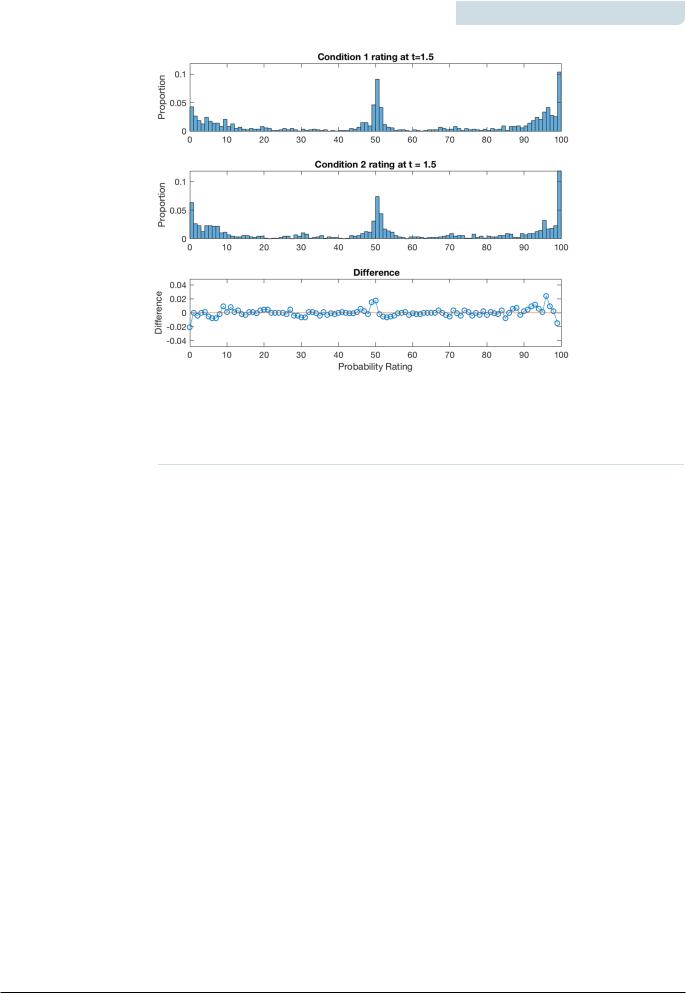
Figure 3.  Relative frequency distribution of ratings at 2% coherence level for conditions 1 at t2 = 1.5 and condition 2 at t1 = 1.5, and interference e ect between these conditions. e horizontal axis represents the probability ratings for the correct direction, and the vertical axis represents the proportion assigned to each rating value. Top panel shows results for condition 1, middle panel shows condition 2, and bottom panel shows the di erence (top minus middle).

beliefs, and another that we call the “di usion” rate that a ects the speed of change and dispersion of the distributions. Using maximum likelihood (see Methods for details), we estimated these two parameters from the joint distribution (pair of ratings at 0.5 s and 1.5 s) obtained from condition 1, and the joint distribution (pair of ratings at 1.5 s and 2.5 s) from condition 2, separately for each coherence level and each participant. en we used these same two parameters to predict the joint distribution (pair of ratings 0.5s and 2.5 s) obtained from condition 3 for each coherence level and participant.

Results

e probability ratings were made by moving a cursor (via joystick) across the edge of a semi-circular scale ranging from 0 (certain moving le ) to 100 (certain moving right). Ratings for right-moving dots were used directly; but ratings for le -moving dots were rescored as (100 - rating). In this way, a rating of zero represented certainty that dots were moving in the incorrect direction, a rating of 50 represented uncertainty about the direction, and a rating of 100 represented certainty that the dots were moving in the correct direction.

To examine the e ect of coherence, we computed the mean and standard deviation of the ratings at t1 pooled across trials and conditions separately for each participant and coherence level. Averaging these participant means and standard deviations across participants, produced average means (average standard deviations) equal to (53.84(4.07), 59.51(6.33), 66.60(11.08), 79.72(16.81)) for coherence levels 2%, 4%, 8%, 16%, respectively. e prediction of interference derived from the quantum model relies on the assumption that there is second stage processing of information; without second stage processing, the quantum model predicts no interference (cf.11). To check this assumption, we tested the e ect of the second stimulus interval on the change in probability ratings from time t1 to t2 by computing the mean change for each person and coherence level (averaged over conditions). e average mean (average standard deviation) change across participants equaled 1.28(1.87), 1.03(2.94), 2.75(2.42), 2.01(1.86) for coherence levels 2%, 4%, 8%, and 16% respectively. According to a Hotelling T test, this vector of change is sig-

nificantly different from zero (F(3, 8) = 4.5765, p = 0.039), indicating that participants’ judgments moved toward response values in favor of the correct dot motion direction over the second time interval, on average.

Figure 3 shows the relative frequency distribution of ratings for the lowest (2%) coherence level for conditions

1 at t2 = 1.5 s and condition 2 at t1 = 1.5 s, and the di erence between the two. First note that the ratings tended to cluster into three groups near the end points and middle point of the probability scale. is clustering also occurred with all of the other coherence levels and across participants. Based on the nding that the ratings tended to cluster into three groups, we categorized the data into three levels (L =low ratings from 0 to 33, M =medium ratings from 34 to 66, and H =high ratings from 67 to 100). is also had the bene t of increasing the frequencies within the cells, which was required for the chi - square statistical tests reported next.

Statistical tests of interval condition efects.  First we statistically tested for an interference e ect between conditions 1 and 2 using the categorized ratings. For this test, we compared the marginal distribution

across the three categories for condition 1 at time t2 = 1.5 s with the marginal distribution across the three cate-

Scientific Reports | (2019) 9:18025 | https://doi.org/10.1038/s41598-019-54383-9

4

www.nature.com/scientificreports/


www.nature.co /scientificr ports

suai.ru/our-contacts


quantum machine learning


Obs


Markov


Quantum


Markov-V


L2

M2

H2

L2


M2

H2

L2

M2

H2

L2

M2

H2


L1

0.20

0.02

0.07

0.09


0.06

0.03

0.14

0.05

0.04

0.24

0.02

0.01


M1

0.04

0.23

0.05

0.11


0.30

0.16

0.05

0.31

0.07

0.08

0.20

0.09


H1

0.05

0.02

0.32

0.02


0.07

0.15

0.03

0.05

0.25

0.01

0.03

0.32


Table 1.  Observed and predicted distributions for condition 3, averaged across participants, at coherence level 1.


Obs


Markov


Quantum


Markov-V


L2

M2

H2

L2


M2

H2

L2

M2

H2

L2

M2

H2


L1

0.17

0.02

0.07

0.06


0.05

0.03

0.14

0.05

0.04

0.18

0.03

0.01


M1

0.02

0.22

0.05

0.09


0.28

0.19

0.05

0.29

0.08

0.06

0.19

0.09


H1

0.05

0.02

0.38

0.02


0.07

0.20

0.03

0.05

0.27

0.01

0.03

0.39


Table 2.  Observed and predicted distributions for condition 3, averaged across participants, at coherence level 2.


Obs


Markov


Quantum


Markov-V


L2

M2

H2

L2


M2

H2

L2

M2

H2

L2

M2

H2


L1

0.12

0.02

0.04

0.04


0.04

0.03

0.10

0.04

0.03

0.12

0.02

0.01


M1

0.02

0.18

0.07

0.06


0.24

0.21

0.04

0.26

0.10

0.05

0.18

0.08


H1

0.03

0.02

0.50

0.01


0.07

0.30

0.02

0.04

0.36

0.01

0.03

0.49


Table 3.  Observed and predicted distributions for condition 3, averaged across participants, at coherence level 3.

gories for condition 2 at time t1 = 1.5 s. e chi square di erence between the marginals for the two conditions was rst computed separately for each participant and coherence level, and then summed across participants for each coherence level to produce a total chi square test at each coherence level. e results produced signi cant di erences only for the low coherence levels (the G2 (chi square statistics) are 38.0, 27.6, 25.4, 28.1, for coherence

levels 2%, 4%, 8%, and 16% respectively, and the critical value for α = 0.05 and df = 11 (3 1) = 22 equals 33.9). Only 3 out of the 11 participants produced signi cant e ects at the low (2%, 4%) coherence levels.

Second, we statistically tested the di erence between the joint probability distributions for conditions 1 versus 3 and again for conditions 2 versus 3. ese tests were simply manipulation checks. e purpose was to ensure that the generalization test condition was signi cantly di erent from each of the calibration conditions. For completeness, we also tested the di erence between conditions 1 and 2. In all three cases, there are only two responses, one at t1 and another at t2. Only the values of the time points (t2, t2) di ered across the comparisons. For the test between condition 1 versus 3, we compared the 3 ×3 joint distribution produced by category ratings at time t1 and t2 for condition 1 with the 3 ×3 joint distribution produced by category ratings at time t1 and t3 for condition 3; likewise for the tests comparing conditions 2 versus 3 and conditions 1 versus 2. e chi square di erence between two 3 ×3 joint distributions was rst computed for each person separately, and then summed across participants. The results produced significant differences for both the condition 1 versus 3 comparison

(G2 =116.9, df = (9 1) 11 = 88, p = 0.0215) and for the condition 2 versus 3 comparison (G2 =192.4, df = (9 1) 11 = 88, p < 0.0001). Five of the 11 participant produced signi cant di erences for these conditions. e di erence between conditions 1 versus 2 was also signi cant (G2 =125.8, df = (9 1) 11 = 88,

p = 0.005).

In summary, the results suggest that interference e ects do occur with sequences of judgments, but they are small and occur for only a subset of the participants and coherence conditions. e results also show di erences between the calibration conditions (1, 2) and the generalization condition 3, as well as a di erence between the two calibration conditions (1, 2). e latter tests simply con rm that our manipulations of time periods were e ective.

Model comparisons.  Both models have two parameters: a dri and a di usion parameter (see Methods).ese two parameters were estimated by maximizing the likelihoods of the data from the pair of 3×3 joint distributions produced by responses in conditions 1, 2. is was done separately for each participant and coherence

level. e discrepancy between data and model predictions was measured using G2 = −2 LL, where LL symbolizes log likelihood (see Methods), and we computed the difference between models defined as

Gdiff2 = GMarkov2 Gquantum2 . Positive values indicate lower discrepancy (favorable support) for the quantum model. For all four coherence levels, the quantum model produced lower discrepancies for both of the two calibration

conditions: the Gdiff2 , summed across the 11 participants, equaled 675, 703, 595, and 230 for coherence levels 1 through 4 respectively.

A more powerful test of parameterized versions of the Markov versus quantum models was performed for each participant using the generalization criterion method15. e parameters estimated from the two calibration

Scientific Reports | (2019) 9:18025 | https://doi.org/10.1038/s41598-019-54383-9

5

www.nature.com/scientificreports/


www.nature.co /scientificr ports

suai.ru/our-contacts


quantum machine learning


Obs


Markov


Quantum


Markov-V


L2

M2

H2

L2


M2

H2

L2

M2

H2

L2

M2

H2


L1

0.05

0.01

0.03

0.02


0.02

0.02

0.04

0.01

0.01

0.03

0.01

0.01


M1

0.01

0.14

0.05

0.03


0.16

0.14

0.02

0.18

0.04

0.03

0.15

0.07


H1

0.02

0.01

0.68

0.01


0.04

0.59

0.01

0.04

0.66

0.01

0.02

0.67


Table 4.  Observed and predicted distributions for condition 3, averaged across participants, at coherence level 4. Note: For example, L1 stands for Low rating a er rst interval and M2 stands for High rating a er second interval. Cells in the upper right o diagonal represent transitions from lower to higher probability ratings during the second interval.

conditions were used to compute the predictions for each participant and coherence level for the generalization

condition 3. e Gdiff2 statistics, summed across participants, were 350, 306, 260, 40 for coherence levels 2%, 4%, 8%, 16% respectively, favoring the quantum model over the Markov model. Eight of the 11 participants produced

Gdiff2 favoring the quantum model for coherence levels 2%, 4%, and 8%, but only 5 participants produced results favoring the quantum model for coherence level 16%. e results clearly favor the quantum model, but less so for high coherence.

To be complete, we also used parameter estimates from conditions 1 and 3 to predict condition 2; and we used parameter estimates from conditions 2 and 3 to predict condition 1. ese results were consistent with the originally planned generalization test using estimates from conditions 1 and 2 to predict to condition 3, and they are reported in the SI.

Tables 14 show the predicted and observed frequencies of responses (3 ×3 tables), averaged across participants, for each coherence level. e observed data reveals large frequencies at both Low and High ratings under low coherence conditions. e wave nature of the quantum model provides a way to spread the judgments across both Low and High levels. However, the sample path nature of the Markov model makes it difcult to simultaneously distribute frequencies to both Low and High ratings. To address this problem with the Markov model, a revised Markov model, shown as Markov-V in the tables, is discussed next.

One possible reason for the lower performance of the Markov is that it does not include any variability in the dri across trials. It has been argued that dri rate variability is required to produce accurate ts for the Markov model (see, e.g.2). To allow for this variability, we computed the predictions produced by averaging over a normal distribution of dri rates. For this model we estimated three parameters: a mean dri rate, a variance of the dri rate, and a di usion rate. ese three parameters were estimated for each participant and each coherence level (see Methods).

e Markov model with averaging has one more parameter than the quantum model. For this reason, we used

the di erence between Bayesian information criteria for the two models de ned as as BICdiff = Gdiff2 + p ln(N), where p = 11 for one extra parameter per participant, and N = 11 1735 (number of participants times number

of observations per participant). Positive BICdi favors the quantum model. e quantum model produced more favorable BICdi values at the two lower coherence levels, but the Markov model with averaging was favored at the two higher coherence levels. e BICdi values equaled 219, 36, 98, 67 for coherence levels 2%, 4%, 8%, 16% respectively.

For the generalization test condition 3, the Markov model with averaging model produced Gdiff2 statistics, summed across participants, equal to 74, 30, 160, 160 for coherence levels 2%, 4%, 8%, 16% respectively (once again, positive values indicate evidence for the quantum model and negative values indicate evidence for the Markov model). e quantum model is favored for the lower coherence levels, but the Markov-V model is favored for the higher coherence levels. For example, 5 participants were favored by the quantum model at the 4% coherence level, but only 2 were favored at the 8% level.

e prediction of the Markov model with dri rate variability are also shown on the right side of Tables 14.e predictions of the Markov-V model are much improved over the original Markov model, and the accuracy of the Markov-V model is now comparable to the quantum model.

Discussion

is article empirically evaluated two di erent types of dynamic models for belief change during evidence monitoring. According to a Markov process, the decision maker’s belief state acts like a particle that changes from one location to another producing a sample path across time. In contrast, according to the quantum model, the decision maker’s belief state is like a wave spread across the evidence scale that ows across time. ese two competing models can be compared using both qualitative tests of properties of each model as well as quantitative comparisons of predictive accuracy.

e Markov and quantum processes make di erent qualitative predictions regarding interference e ects that can occur when a sequence of responses is requested from the decision maker. e Markov process predicts no interference e ect, but the quantum process produces interference e ects. As mentioned earlier, Kvam et al.11 examined interference e ects under a “choice and then rating” condition. at earlier experiment produced signi cant interference e ects such that con dence was less extreme following a binary decision, and the size of the interference was directly related to the size of the e ect of second stage processing, as predicted by the quantum model. e present study examined interference e ects under a “ rating and then rating” condition.is new experiment indicated that an interference e ect did occur at the low levels of con dence, but the e ect was smaller. One way to interpret this di erence in empirical results is that using a binary decision for the rst

Scientific Reports | (2019) 9:18025 | https://doi.org/10.1038/s41598-019-54383-9

6

www.nature.com/scientificreports/

www.nature.co /scientificr ports

suai.ru/our-contacts

quantum machine learning

measurement may be more e ective for “collapsing” the wave function than using a probabilistic judgment for the rst measurement, resulting in greater interference between choice and rating responses than for sequential rating responses.

e occurrence of an interference e ect is considered as evidence against the basic Markov model. One could make ad hoc assumptions about how the choice at time t1 changes the dynamics a er that response. For example, one possibility is that a decision at time t1 produces a bolstering e ect that increases the con dence in favor of the decision. However, the interference e ect found by Kvam et al.11 went in the opposite direction, contrary to this ad hoc explanation for their experiment. Moreover, Kvam et al.11 examined a wide range of ad hoc assumptions which failed to account for their results.

e present experiment is unique in the way the two models were quantitatively compared. A generalization criterion method was used, which allowed us to examine not just how well the models t the data, but rather how well they could predict data obtained from a new and di erent condition. Using this method, the parameters of the models were estimated from conditions 1 and 2 and these same parameter estimates were then used to predict a new condition 3. e results of the present experiment indicated that the quantum model produced more accurate predictions for low levels of con dence, but the Markov model (with dri rate variability) produced more accurate predictions for high levels of con dence. Together these results suggest that neither process alone, quantum or Markov, is sufcient to account for all conditions and all participants.

Rather than treating Markov and quantum models as mutually exclusive, an alternative idea is that a more general hybrid approach is needed, one that integrates both quantum and Markov processes. e quantum model used in the present work is viewed as a “closed system” quantum process with no external environmental forces. Technically, only Schrödinger evolution is used (see Methods). However, it is possible to construct an “ open system” quantum process where a person’s belief state partially decoheres as a result of interaction with a noisy mental environment. Technically, Lindblad terms are added to the evolution equation, which forms a more general master equation, producing a combined quantum-Markov process10,16,17. Open system quantum models start out in a coherent quantum regime (represented by a density matrix with o diagonal terms, see Methods) and later decoheres into a classical Markov regime (represented by density matrix with no o diagonal terms, see Methods)16. In fact, previous work18 compared Markov and quantum models with respect to their predictions for both choice and decision time: When a closed system quantum model was compared to the Markov model, there was a slight advantage for the Markov model; however, when an open system quantum model was used, the quantum model produced a small advantage. For our application, we would need to speculate that the speed of decoherence (i.e., change from a quantum to Markov regime) depends on the experimental coherence level, but the development of a speci c open system quantum model for belief change is le for future research.

Methods

Participants.  A total of 11 Michigan State University (8 female, 3 male) students were recruited for the study

– 1 additional participant began the study but was dropped for failing to complete all sessions of the study. Each of the 11 remaining participants completed 3 sessions of the study and were paid $10 per session plus an additional bonus based on the accuracy of their con dence ratings – up to $5 based on how close they were to the “100% con dent in the correct direction” responses on each trial. Each participant competed approximately 1000 trials of the task across all sessions. e Michigan State University institutional review board approved the experiments; all experiments were performed in accordance with relevant named guidelines and regulations; informed consent was obtained from all participants.

Task.  In the task, participants viewed a random dot motion stimulus where a set of dots were presented on screen. Most of these dots moved in random directions, but a subset of these dots was moving coherently to either the le or the right side of the screen. e dots were white dots on a black background which composed a circular aperture of approximately 10 visual degrees in diameter. e display was refreshed at 60 Hz and dots were grouped into 3 dot groups that were presented in sequence (group 1, 2, 3, 1, 2, 3,) and displaced by a quarter of a degree every time they appeared on screen, for apparent motion at 5 degrees per second. When prompted, participants indicated their con dence that the dots were moving le or right on a scale from 0 (certain that they are moving le ) to 100 (certain that they are moving right). ey entered their responses by using a joystick to move the cursor across the edge of a semicircular con dence scale like the one shown in Fig. 2.

To begin each trial, participants pressed the trigger button on a joystick in front of them while the cursor – presented as a crosshair – was in the middle of the screen. e random dot stimulus then appeared on the screen, with 2%, 4%, 8%, or 16% of the dots moving coherently toward one (le vs. right) direction. A er 500 ms or 1500 ms, participants were prompted for their rst probability judgment response with a 400 Hz auditory beep.ey responded by moving the cursor across the semicircular con dence scale at the desired probability response. Since participants were using a joystick, the cursor naturally returned to the center of the screen a er this initial response. Once the rst response had been made, the stimulus remained for an additional 1000 or 2000 ms before a second auditory beep prompting the second probability response. Participants made their second response in the same way as the rst. is resulted in a possible on-screen stimulus time of 1500 or 2500 ms plus the time it took to respond.

The stimulus coherence was halted while participants entered their response, but the stimulus was still on-screen - so there were dots just randomly appearing and disappearing but there was no useful information until they entered their rating (which participants were told, so that they wouldn’t try to sample more information between the beep and their response).

A er each trial, participants received feedback on what the correct dot motion direction was and how many points they received for their con dence responses on that trial. We recorded the amount of time it took participants to respond a er each auditory beep, the con dence responses they entered, the number of points received

Scientific Reports |

(2019) 9:18025 | https://doi.org/10.1038/s41598-019-54383-9

7

www.nature.com/scientificreports/

www.nature.co /scientificr ports

suai.ru/our-contacts

quantum machine learning

for the trial, and the stimulus information (coherence, direction, beep times). Everything was presented and recorded in Matlab using Psychtoolbox and a joystick mouse emulator19.

Procedure.  Participants volunteered for the experiment by signing up through the laboratory on-line experiment recruitment system, which included mainly Michigan State students and the East Lansing community. Upon entering the lab, they completed informed consent and were briefed on the intent and procedures of the study. e rst experimental session included extensive training on using the scale and joystick, including approximately 60 practice trials on making accurate responses to speci c numbers, single responses to the stimulus, making two accurate responses to numbers in a row, and making two responses to the stimulus (as in the full trials).

Subsequent experimental sessions started with 30–40 “warm-up’ ‘ trials that were not recorded. A er training or warm-up, participants completed 22 ( rst session) or 28 (subsequent sessions) blocks of 12 trials, evenly split between con dence timings and stimulus coherence levels. e timing and coherence manipulations were random within-block, so each block of 12 trials included every combination of coherence (4 levels) and con dence timing. A er every block of trials, they completed 3 test trials where they were asked to hit a particular number on the con dence scale rather than respond based on the stimulus. is was included to get a handle on how accurate and precise the participants could be when using the joystick and understand how much motor error was likely factoring into their responses. Ultimately, motor error was controlled by grouping responses into the three main con dence levels - motor error was far less than the distance between con dence categories on the physical scale.

At the conclusion of the experiment, participants were debriefed on its intent and paid $10 plus up to $5 according to their performance. Performance was assessed using a strictly proper scoring rule20 so that the optimal response was to give a con dence response that re ected their expected accuracy. Participants received updates on the number of points they received at the end of each block of the experiment, including at the end of the study.

Mathematical Models.  ere are di erent types of Markov processes that have been used for evidence accumulation. One type is a discrete state and time Markov chain21, another type is a discrete state and continuous time random walk process22, another type is a continuous state and discrete time random walk1,23, and fourth type is a continuous state and continuous time di usion process24. However, the discrete state models converge to make the same predictions as the di usion process when there are a large number of states and the step size approaches zero25.

Like the Markov models, there are di erent types of quantum processes. One type is a discrete state continuous time version10,11 and another type is a continuous state and time version8.

To facilitate the model comparison, we tried to make parallel assumptions for the two models. e use of a discrete state and continuous time version for both the Markov and quantum models serves this purpose very well. Additionally, a large number of states were used to closely approximate the predictions of continuous state and time processes.

For both models, we used an approximately continuous set of mental belief states. e set consisted of N = 99

states j {1, , 99}, where 1 corresponds to a belief that the dots are certainly not moving to the right (i.e., a belief that they are certainly moving to the le ), 50 corresponds to completely uncertain belief state, and 99 corresponds to a belief that the dots are certainly moving to the right. We used 1–99 states instead of 0–100 states because we categorized the states into three categories and 99 can be equally divided into three sets. For a Markov

model, the use of N = 99 belief states produces a very closely approximation to a di usion process.

For the Markov model, we de ne ϕj(t) as the probability that an individual is located at a belief state j at time t for a single trial, which is a positive real number between 0 and 1, and ϕj(t) = 1. ese 99 state probabilities

form a N ×1 column matrix denoted as ϕ(t). For the quantum model, we de ne ψj as the amplitude that an individual assigns to the belief state located a evidence level j on a single trial (the probability of selecting that belief

state equals |ψj|2). e amplitudes are complex numbers with modulus less than or equal to one, and ∑|ψ|2 = 1.

e 99 amplitudes form a N ×1 column matrix denoted as ψ(t). Both models assumed a narrow, approximately normally distributed (mean zero, standard deviation =5 steps in the 99 states), initial probability distribution at the start (t =0) of each trial of the task.

e probability distribution for the Markov process evolves from to time τ + t according to the Kolmogorov transition law ϕ(t + τ) = T(t) ϕ(τ), where T(t) is a transition matrix de ned by the matrix exponential function T(t) = exp(t K). Transition matrix element Tij is the probability to transit from the state in column j to the state in row i. e intensity matrix K is a N ×N matrix de ned by matrix elements Kij = α > 0 for i = j 1, Kij = β > 0 for i = j + 1, Kii = −α β, and zero otherwise. e amplitude distribution for the quantum process evolves from to time τ + t according to the Schrödinger unitary law ψ(t + τ) = U(t) ψ(τ), where U(t) is

a unitary matrix de ned by the matrix exponential function U(t) = exp(i t H). Unitary matrix element Uij is the amplitude to transit from the state in column j to the state in row i. e Hamiltonian matrix H is a N ×N

Hermitian matrix de ned by matrix elements Hij = σ for i = j + 1, Hij = σ for i = j 1, Hii = μ Ni , and zero otherwise.

For both models, we mapped the 99 belief states to 3 categories using the following three orthogonal projection matrices ML, MM, and MH. Define 1 as a vector of 33 ones, and define 0 as a vector of 33 zeros. Then

ML = diag[1, 0, 0], MM = diag[0, 1, 0] MH = diag[0, 0, 1]. Finally, de ne X 1 as the sum of all the elements in

the vector X, and X 2 as the sum of the squared magnitude of the elements in the vector X. For the Markov model, the probabililty of reporting rating l at time t2 equals

Scientific Reports | (2019) 9:18025 | https://doi.org/10.1038/s41598-019-54383-9

8