Материал: искусственный интеллект

Внимание! Если размещение файла нарушает Ваши авторские права, то обязательно сообщите нам

suai.ru/our-contacts

quantum machine learning

J.B. Broekaert, et al.

Cognitive Psychology 117 (2020) 101262

parameter {s}, however this parameter is now monitoring a hyperbolic tangent version of the logistic function, Eqs. (41). A similar ‘coupled-switching’ dynamics, controlled by a mixing parameter , is implemented for the attention switching from Win to Lose correlated to switching between Gamble or Stop decision. The mixing Hamiltonian, Eq. (42), and the Markov intensity rate mixing, Eq. (24), are structured differently due to Hermeticity instead of probability conservation requirements. In the gamble block with Win and Lose outcome conditions the context effect is implemented by the weight parameters {, µ} for first period and second period respectively.

In the quantum-like model the carry-over effect from first to second period is implemented differently in the belief-action state for the Unknown condition; instead of weighting two components the parameter {} now causes an interference between the two components by implementing a relative complex phase.

The quantum model, just like the Markov model, relies on 9 parameters to cover the process dynamics and the initial belief-action states in both flow orders, both periods and all payoffs amounting to theoretical values for 30 data points. The Supplementary Materials section, (SM 2) provides more details on the temporal evolution in this model.

4.4. Logistic model

In order to compare the performance of the Markov and quantum-like process models, we devised a third model which aims to heuristically reproduce the observed gamble probabilities. Similarly to the Markov and quantum-like models, this baseline model is also made context and order sensitive but does not comprise a dynamic process for the belief-action state. Instead the baseline model implements for each gamble condition ad hoc weightings of the two utilities for Win outcome and Lose outcome, Eqs. (16). The gamble probability is then simply obtained from a logistic function of the heuristic utility

p (gamble|X, Cond) =

1


(50)

1 + e s·U (X,Cond)

,

where the parameter s functions as a sensitivity parameter. In the first period, the utility of taking the second-stage gamble in the Win and in the Lose condition will be set according to

UKU (W ) = KUK uW + (1

KUK )uL,

UKU (L) = (1

KUK )uW + KUK uL,

(51)

where KUK is a weight parameter, 0

KUK

1, expressing the participant’s inclination towards Win and Lose beliefs. Hence also in

the Logistic model we allow for partial adherence to the information in the outcome condition, but now this occurs on the level of utility instead of belief probability amplitude. It can be argued that each presented gamble is embedded between Win-outcome and Lose-outcome games, and this engenders residual utility-based support.

In the first period the utility of the Unknown outcome of a first-stage gamble is

UUK (U) = UKU UUK (W ) + (1 UKU )UUK (L)

(52)

which expresses the resulting utility is a weighting of Win and Lose conditioned utility assessments, by the parameter UKU .

In the second period the context effect is now modified by the carry-over effect, which changes the weighting in the utility of the Win and Lose outcome gambles

UUK (W ) = UKK uW + (1 UKK )uL, UUK (L) = (1 UKK )uW + UKK uL

(53)

in which the weight parameter now is UKK .

In the Unknown first-stage outcome gamble the utility weighting, KUU , is now changed because of the carry-over effect

UKU (U) =

KUU UKU (W ) + (1 KUU )UKU (L)

(54)

with 0 KUU

1.


Parametrization. In contrast to the Markov and quantum-like models, the Logistic model does not rely on belief-action states but

rather on heuristically adapted utility functions. For each condition of Known or Unknown outcome, gamble payoff and period a dedicated utility weighting drives a logistic function to render the probabilities for the second-stage gamble. The logistic model

requires the same four dynamical parameters for the driving utility difference as in the two dynamical models, namely {

0W , 1W } and

{ 0L, 1L}. The effect of the utility difference on the decision is controlled by a sensitivity parameter {s} on a logistic function, Eq. (50).

In the

logistic model the carry-over effect and the context effect are covered by four ad hoc weighting

parameters,

{ KUK ,

KUU , UKK , UKU}.


Like the Markov and the quantum-like model, the logistic model uses 9 parameters to produce the gamble probability for both flow orders, both periods and all payoffs amounting to theoretical values for 30 data points.

5. Theoretical model performance

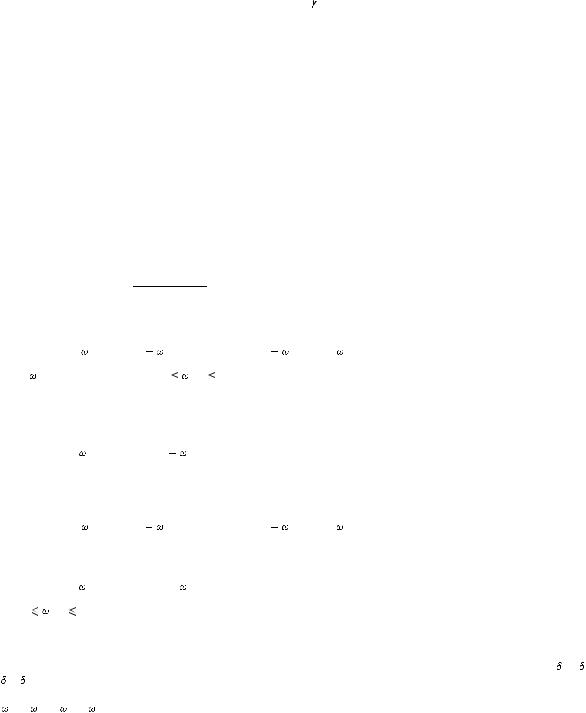
The three models have been parametrized for maximum likelihood statistical estimation on the data set. With three initial gamble outcome conditions and the five variable payoff amounts the survey produces fifteen observed proportions for each block ordering. For each model the objective function G for the parameter optimalisation is
20

suai.ru/our-contacts

quantum machine learning

J.B. Broekaert, et al.

Cognitive Psychology 117 (2020) 101262

Table 3

G-statistic for lack of fit test for the Markov, quantum-like and Logistic model fitted to the partitioning of less and more risk averse participants.


‘Less risk averse’


‘More risk averse’


group

Markov

quantum-like

Logistic

Markov

quantum-like

Logistic

all

70.96

18.96

62.15

52.77

23.23

61.00

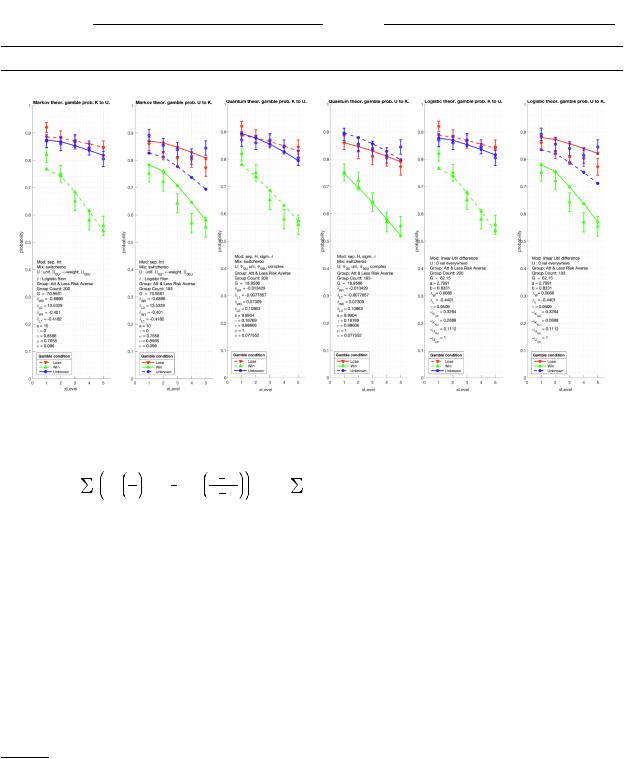
Fig. 6. Observed and theoretical gamble probabilities for Less risk averse participants, for each of the three models Markov, Quantum and Logistic

for K-to-U (left) and U-to-K (right) flow orders. The payoff parametrised by XLevel [1, 5] appears on the x-axis. Error bars represent the standard error of the mean.
G = 2NKU

15

oiln

oi

+ (1

oi)ln

1

oi

+ 2NUK

15

(idem)


i=1

i=1


ei

1

ei

(55)

where NKU and NUK are the number of participants for each flow order, the oi and ei are the observed and expected probabilities, and the sums cover the order condition ‘K-to-U’ and ‘U-to-K’ respectively. The G statistic expresses the lack of fit of the model predictions with the observed values. The numerical optimization was executed in Matlab using a 39 grid for the initial parameter vectors (Supplementary materials, SM 8).

The model performance is compared using the Bayesian Information Criterion. The BIC penalizes a model for complexity through the number of free parameters. With BIC = G + plnN , and the three models sharing the same number of parameters and data points the BIC comparison reduces to a G value comparison.

5.1. Model comparison for risk attitude partitioning.

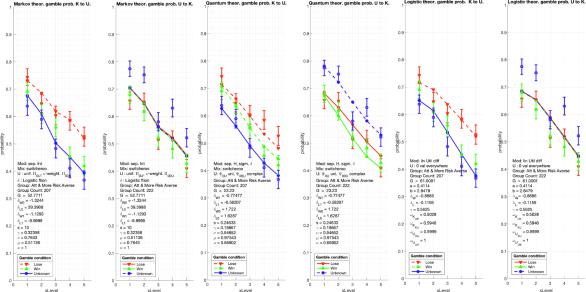
In the sample partitioning approach by risk attitude the observed gamble proportions are separated along ‘Less risk averse’ and ‘More risk averse’ attitude. The BIC comparison favours the quantum-like model as the best fit for the risk partitioned observations. For the Logistic model G = 123.15, for the Markov model G = 123.73 and for the quantum-like model G = 42.19 (Table 3). In this partitioning of participants both the Markov model and the Logistic model perform equally unsatisfactorily (Figs. 6 and 7).15 This is in the line with expectation since both the Logistic and the Markov models are abiding by classical logical constraints on the probabilities which prevent these models from providing inflative or deflative Disjunction Effects.

15 The more fine-grained partitioning using the played gamble patterns of each participant, Supplementary Materials Section SM 5, reveals the Markov model performs better than the Logistic model only in four out of eight subgroups, namely for ‘More risk averse’ attitude in the ID-ranges [-2,2], [0,0] and [-1,0] and ‘Less risk averse’ attitude in the ID-range [-2,2] (the ID-ranges are defined in Table S2). This analysis also shows that the two subgroups with pronounced contributions to the violation of the Law of Total Probability are the ones best modeled by the quantum model (namely for ‘More risk averse’ attitude in the ID-ranges ]-2,2] for UK and [-2,2[ for KU).

21

suai.ru/our-contacts

quantum machine learning

J.B. Broekaert, et al.

Cognitive Psychology 117 (2020) 101262

Fig. 7. Observed and theoretical gamble probabilities for More risk averse participants, for each of the three models Markov, Quantum and Logistic

for K-to-U (left) and U-to-K (right) flow orders. The payoff parametrised by XLevel [1, 5] appears on the x-axis. Error bars represent the standard error of the mean.
6. Discussion

We defined the Disjunction Effect as a deflative violation of the Law of Total Probability, an effect which appears at a level of aggregate probabilities. We pointed out that the Sure Thing Principle and its violation can contribute to the Disjunction Effect but it does not significantly do so in the data of our present study on the two-stage gamble.

Our study revealed some new empirical findings, set forward some theoretical issues and provided model solutions in the twostage gamble paradigm. The two main empirical contributions concern ‘more risk averse’ participants. For these participants, we found a reliable order effect in relation to the Disjunction Effect and the violation of the Law of Total Probability. Also a novel inflation effect on gambling in the Unknown outcome condition was observed, analogous but opposite to the Disjunction Effect when Unknown conditioned two-stage gambles precede the Known outcome conditioned ones. We found that ‘less risk averse’ participants did not produce either of these effects.

Specifically our replication of the two-stage gamble experiment, with variation of the payoff amount and the blocking and ordering of outcome conditions, showed a significant inflative violation of a prediction based on the Law of Total Probability for ‘More risk averse’ participants when the block of gambles with Unknown outcome conditions preceded the block of gambles with Known outcome conditions. The classical deflative Disjunction Effect was observed with only marginal statistical significance for this same group of ‘More risk averse’ participants when the grouped gambles with Known outcome conditions preceded the grouped gambles with Unknown outcome conditions. The factors of gamble outcome condition and condition-block ordering showed a strong cross-over interaction in the gamble probability for this ‘More risk averse’ group.

The group of ‘Less risk averse’ participants did not show any indication for the deflative Disjunction Effect in Known to Unknown outcome order, and only a very weak indication for an inflative Disjunction Effect in Unknown to Known order.

We mention that in the conclusion of their paper Tversky and Shafir (1992) comment on an additional test (N = 87) in which the Unknown outcome gamble case appears on the same page just after Win outcome and Lose outcome. This showed an ‘inflative’ violation of the Law of Total Probability (see also Kühberger et al. (2001), p. 256). Tversky and Shafir (1992) argued the concurrent presentation allows participants to realize that they accept the repeated gamble in both Known outcome cases compelling them to accept the repeated gamble in the Unknown outcome case. Their observation is at odds with our present results of a similar inflative effect occuring when participants have not previously made decisions on Known previous outcome gambles.

In sum, the factors of previous gamble outcome condition and condition-block ordering showed a strong cross-over interaction in the gamble probability of the ‘More risk averse’ group. In contrast to the Tversky and Shafir (1992) result our observation shows the Disjunction Effect –and its inflative variant– is fully dependent on the order in which the outcome conditions are cued to the participant and moreover only appears in ‘More risk averse’ participants. In none of the cases was Tversky and Shafir’s signature gamble pattern for the Disjunction Effect –to play the gamble on Win outcome and on Lose outcome but to stop the gamble on Unknown outcome– a significant contribution to the effect. Therefore the violation of the Sure Thing Principle –through the named signature gamble pattern– did not contribute to the Disjunction Effect in our observations.

Tversky and Shafir argued their participants were inclined to take the second-stage gamble under Win condition for one reason, e.g. ‘house money’, (Thaler & Johnson, 1992), and also under Lose condition for another reason, e.g. ‘make up for a loss ’, but would

22

suai.ru/our-contacts

quantum machine learning

J.B. Broekaert, et al.

Cognitive Psychology 117 (2020) 101262

not take the second-stage gamble under Unknown previous outcome condition because they lost their acuity to process the differing reasons. By contrast, in our study we clearly found that individual participant risk attitude and first-stage gamble outcome order condition play a crucial role in the occurrence of the deflative and inflative violation of the Law of Total Probability. This shows prior experience of Winning and Losing gambles can carry over into a Disjunction Effect, but lacking such prior experience on the contrary can still lead to a violation of the Law of Total Probability.

In relation to the general sample characteristics it may be important to note that our participants were recruited among MTurk workers, taking on this task in a short duration of time and for a small monetary compensation. The lowered probability to gamble on Win and the relatively increased probability to gamble on Lose indicates these participants are conservative with respect to risk; keeping for sure what was gained and risking to regain what was lost. The gamble strategies may thus well be influenced by sociocultural traits besides general risk attitude (Surov et al., 2019).

In Experiment 2 we observed the intriguing pattern of results that ‘more risk averse’ participants are less likely to accept the second-stage gambles under Unknown conditions in the K to U order, than ‘less risk averse’ participants. A plausible (but currently speculative) explanation is that in the U to K order, decisions about second-stage gambles are informed vaguely from first-stage gambles, since there was no experience of gain or loss; participants were just told that a gamble was played, but the outcome of the gamble was Unknown. By contrast, in the K to U order, participants would be offered a more direct experience of loss and gain. ‘More risk averse’ participants are likely to be disproportionately influenced by the experience of loss than the experience of gain, in the K to U order, compared to ‘less risk averse’ participants, depressing the relative tendency for accepting a second-stage gamble under Unknown conditions in the K to U order for such participants.

From a theoretical point of view we presented two dynamical models for the decision process and provided one static logistic utility model that mimicked relevant decision features in an ad hoc manner. More specifically, the underlying principles of the decision process are (i) a utility drive which is condition dependent both on a gamble outcome and payoff size, (ii) a context influence of the conditioned gamble block causing partial acceptance of the Win or Lose information, (iii) an assumption to regain an effective initial belief-action state prior to each second-stage gamble, and (iv) a carry-over influence on the belief-action state due to the ordered flow of condition blocks.

All these –cognitively very plausible– features can be incorporated in formally very similar ways in both the Markov and the quantumlike model, but the latter was shown clearly superior in most participant groups. The Markov and the quantum-like models were formally matched carefully, so that their difference essentially concerned the use of classical probability principles in the former and quantum ones –like superposition of states belief-action states– in the latter. Our results clearly show that, at least in some cases, the alternative probabilistic principles of quantum theory are required for a satisfactory explanation of decision behavior. The carry-over effect from first to second period in the Unknown condition was implemented by using quantum superposition. This principle causes a belief and action potential interference between the two Known outcome components, and reflects the ambiguous belief in the Unknown condition. It is this aspect of the quantumlike approach that makes it an appropriate and efficient formalism to capture aspects of ‘irrationality’ in human decision making.

7. Authors contributions

J.B.B. and E.M.P conceived the initial phase of the study and designed Experiment 1, J.R.B advised order conditioning in Experiment 2 and supervised the completion of the study. The construction of theoretical models and data analysis were done by J.B.B. and discussed with J.R.B and E.M.P.. J.B.B. wrote the paper with both J.R.B. and E.M.P. providing feedback.

8. Ethical clearance

The survey received ethical clearance in the framework of ‘Risky Decision Making’, PSYETH (S/L) 16/17 51, City, University of London.

9. Funding

This research was partly funded by AFOSR FA 9550-12-1-0397 to J.R.B and J.B.B., Leverhulme Trust grant RPG-2015–311 to E.M.P. and J.B.B. and ONRG grant N62909-19–1-2000 to E.M.P.. The opinions expressed in this publication are those of the authors and do not necessarily reflect the views of the funding agencies.

Acknowledgements

The authors thank the anonymous referees for discussing the possibility of a ‘lazy responding’ effect in less risk averse participants, and the observed differences between the unconditional first-stage gamble probability and the second-stage Unknown-con- ditioned gamble, as well as many other comments.

Appendix A. Introduction to quantum modeling

To implement a quantum-like process in cognitive modeling an adaptation and simplification of the quantum mechanical formalism is required (Busemeyer & Bruza, 2012; Khrennikov, 2010; Yearsley, 2017; Yearsley & Busemeyer, 2016). In practice the dimensions and features of the model are set by the measured properties, the operational order of the experimental paradigm and

23

suai.ru/our-contacts

quantum machine learning

J.B. Broekaert, et al.

Cognitive Psychology 117 (2020) 101262

theoretical presuppositions. A participant’s belief-action state is assumed to be probabilistic over its potential realisations - quite similar to a Markov approach. In the quantum-like approach a participant’s response is a realisation of one of its potentials, in a Markov approach there is no difference between the realised and inherent state. In a quantum-like model the belief-action state is represented by a vector in a Hilbert space, which is a regular vector space - of any dimension - with an inner product and a completeness property that assures limits will exist.

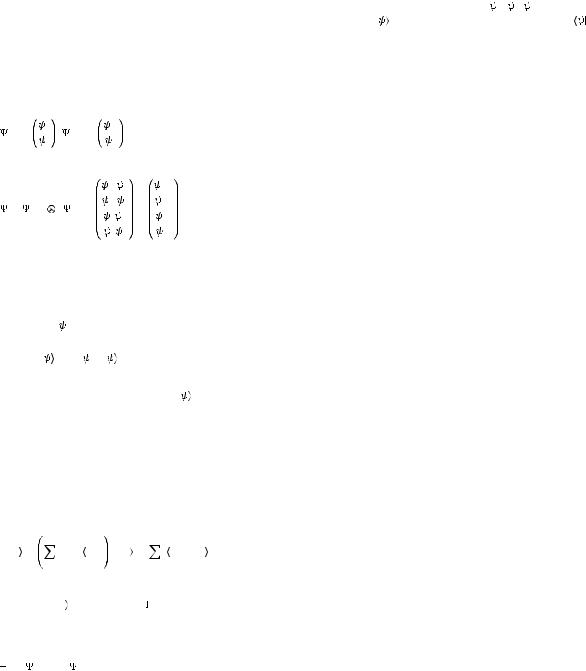
In most models this space will just be the finite dimensional complex valued space n, and its points = ( 1jn)represent a belief-action state for n properties. Typically this state will be written as a column vector , or complex-transposed as a row vector .

When different properties are combined in the belief-action state, it becomes more practical to describe each property by its own vector and then combine these vectors using the tensor product. This will result in an encompassing vector in which each entry is the joint probability amplitude of outcome values for the different features. In our model we have used this tensor decomposition to emphasize the dynamics that deploys in each feature, separately from the ‘mixing’ dynamics which engages between different features. For instance we take the action-potential for Gambling and Stopping as a vector for the decision, and the belief supporting a Win or Lose state as a vector for the category.

G,S =

G

, W ,L =

W

(A1)

S

L

The overall vector for this model becomes

= W ,L

G,S =

W

G

=

WG


W

S

WS


L G

LG

(A2)


L

S


LS

Notice that the tensor product is not commutative, and that the choice of order must be maintained for the propagators of this encompassing belief-action state.

The response of a participant is the realisation of a binary outcome –‘gamble’ or ‘stop’– for a given property, which occurs by a measurement enacted by a measurement operator, say M. The outcome state of the measurement by M –e.g. ‘Do you take the gamble?’– is one of the eigenvectors of the operator M. The probability pj of a given outcome value j is obtained by projecting the

belief-action state | on the corresponding eigenvector of M and taking the norm squared. With Mj being this projector on the eigenstate, the probability for outcome value j is thus given by:

pj = ||Mj | ||2 = |Mj |

(A3)

This is the conventional Born’s rule for outcome probabilities in quantum mechanics.

Most importantly the belief-action state | of a participant changes over time by cognitive input through the cues in the experimental paradigm. In our present work we use the Schrödinger equation to capture the temporal evolution of the dynamic process of cognition. This approach needs temporal constraining since by its nature a finite dimensional and energetically closed system will be periodical. Alternatively open system dynamics with Lindblad evolution have been used (Asano, Ohya, Tanaka, Khrennikov, & Basieva, 2011; Khrennikova, Haven, & Khrennikov, 2014; Martínez-Martínez, 2014; Martínez-Martínez & Sánchez-Burillo, 2016) but require additional parametrization to fit the experimental paradigm.

In other ‘time-less’ quantum-like models that emphasize complementarity of features this evolution is abstracted and ad hoc unitary matrices are used to propagate the belief-action state Aerts (2009). These models would render a change of belief-action state by changing the base of the Hilbert space. These changes of basis correspond to changes of ‘cognitive perspective’ on the decision. For example, to change the perspective from Win to Lose, a Win base {eWj} and Lose base {eLk} would be related according to:

|eW j =

k

|eLk

eLk |

|eW j =

k

eLk |eW j |eLk

(A4)

Then


UU =


Ujk = eLk |eW j ,

with


(A5)

In the Schrödinger approach a temporal parameter, ‘time’, orders the subsequent belief-action states, and evolves them according to the Hamiltonian operator:

d

(t) = H (t)

(A6)

i dt

where we have replaced the partial differential towards time with its the total derivative. Also Planck’s constant, which is the unit of action, was set equal to 1. This renders both the ‘energy’ and ‘time’ into dimensionless variables. This simplified Schrödinger equation is solved easily

(t) = Ut(0), with Ut = eiHt.

Central to developing a quantum-like model is the construction of the Hamiltonian operator. Only the Hamiltonian components that

24