Материал: искусственный интеллект

Внимание! Если размещение файла нарушает Ваши авторские права, то обязательно сообщите нам

suai.ru/our-contacts

quantum machine learning

Density Hypercubes, Higher Order Interference and Hyper-decoherence

151

idC2 =

+ + + + + + + + + + + + + + +

(22) The same notation can be used to graphically decompose projectors corresponding to various subspaces determined by the orthonormal basis (x )x X . For any non-empty subset U X, we define the following projector on DD(H):

PU := DD

x ψx|

(23)


x U


In particular, the P{} for X are the projectors corresponding to the indi-

vidual vectors of the basis, while PX is the identity idDD(H). No matter how large X is (with #X ≥ 2), the projectors P{,} corresponding to 2-element

subsets {, } X are always decomposed as follows:

P{,}

=

+ + + + + + + + + + + + + + +


(24) The presence of higher order interference in the theory of density hypercubes is really a matter of shapes: when the dimension of H is at least 3, the identity contains pieces of shapes which do not appear in projectors for 1-element and 2-element subsets. Because of this, in the theory of density hypercubes the probabilities obtained from 1-slit and 2-slit interference experiments will not be enough to explain the probabilities obtained from 3-slit and/or 4-slit experiments; however, the probabilities obtained from 1-slit, 2-slit, 3-slit and 4-slit experiments will always be enough to explain the probabilities obtained in experiments with 5 or more slits.

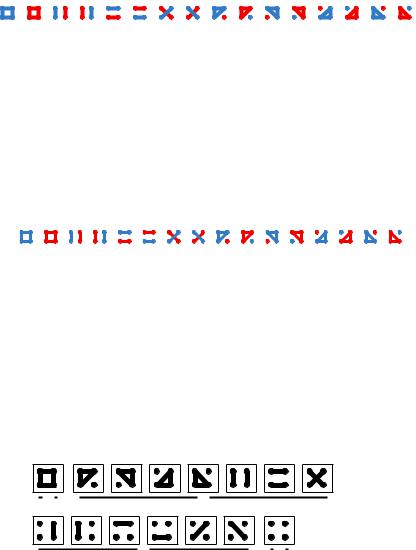
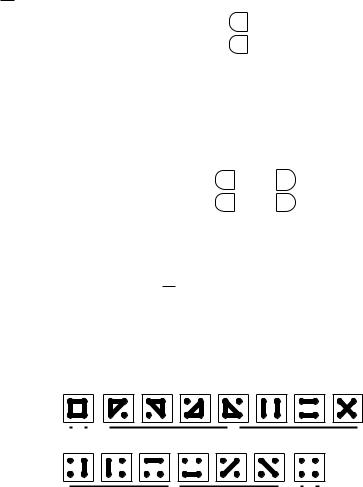
Below you can see an atlas of all possible shapes that pieces of the identity can take in our graphical notation, together with a note of the smallest dimension that a projector must have to contain pieces of that shape:

(25)

1-dim

2-dim


(26)

3-dim

4-dim

The shape labelled as 1-dimensional only requires a single index value, and hence pieces of that shape appear in all projectors. The shapes labelled as 2- dimensional all require exactly two distinct index values, and hence pieces of those shapes can only appear in projectors for subsets with at least 2 elements. The shapes labelled as 3-dimensional all require exactly three distinct index values, and hence pieces of those shapes can only appear in projectors for subsets with at least 3 elements. Finally, the shape labelled as 4-dimensional requires exactly four index values, and hence pieces of that shape can only appear in projectors for subsets with at least 4 elements.

suai.ru/our-contacts

quantum machine learning

152 S. Gogioso and C. M. Scandolo

Thanks to the graphical notation introduced above, we already have a first intuition of why density hypercubes display higher-order interference. However, a rigorous proof requires a complete set-up with states, projectors, measurements and probabilities for a d-slit interference experiment, so that is what we now endeavour to provide.

1. We choose a d-dimensional space H Cd, and we value our tensor indices in

=

the set X = {1, ..., d} (the same set that we use to label the d slits).

2.We fix an orthonormal basis (|x )x X , and we interpret |x to be the state in which the particle goes through slit x with certainty.

3.The initial state for the particle is the superposition state in which the particle

goes through each slit with the same amplitude. More precisely, it is the pure


1


|


1


d


normalised density hypercube state ρ+ corresponding to the vector


ψ+


:=


d

|

|


( 1

+ ... + d

):

1


H


ρ+ :=


Ψ+


(27)


d2


Ψ+


H


4.The particle goes through some non-empty subset U X of slits at random: afterwards, the experimenter knows which subset the particle passed through, but no more information than that is available in the universe.

5.The particle is measured at the screen, and the experimenter estimates the probability P[+|U ] that the particle is still in state ρ+ after having passed through the given subset U of the slits:


1


Ψ+


1


P[+|U ] :=


P

U


Ψ

(28)


+


d2 Ψ+


d2


PU


Ψ


+


It is immediate to see that the outcome probability P[+|U ] depends solely on the number of di erent pieces appearing in the decomposition of the projector

PU :

P[+|U ] =

1

· number of pieces in PU

(29)

d4

To count the number of pieces in PU , it is convenient to group them by shapes. If U is a subset of size k, standard combinatorial arguments can be used to obtain the number of pieces of each shape appearing in the decomposition (as a

convention, we set k = 0 for j > k):

j

(k1)·1!

7 shapes, (k2)·2! each


(30)


6 shapes, (k3)·3! each

(k4)·4!

suai.ru/our-contacts

quantum machine learning

Density Hypercubes, Higher Order Interference and Hyper-decoherence

153

By adding up the contributions from pieces of each shape, we get the following closed expression for the outcome probability P[+|U ]:

P[+|U ] =

1

(#U )4

(31)

d4

For d ≥ 3 we observe third-order interference, witnessed (by definition) by the following inequality:

P[+|{1, 2, 3}] =

P[+|V ]

P[+|V ]

(32)


V {1,2,3}

V {1,2,3}


s.t. #V =2

s.t. #V =1


Indeed, the left hand side evaluates to 81/d4, while the right hand side evaluates to the following expression (again by standard combinatorial arguments):

1

3

24

3

14

=

1

45

=


1

81

(33)

d4

2

1

d4

d4

The di erence between left and right hand sides is 36/d4, which is exactly the contribution d14 6 · 33 · 3! of the 6 shapes requiring 3 distinct values (appearing in P{1,2,3} but not in any of the sub-projectors). For d ≥ 4 we observe fourth-order interference, witnessed (by definition) by the following inequality:

P[+|{1, 2, 3, 4}] =

P[+|V ]

P[+|V ] +

P[+|V ] (34)


V {1,2,3,4}

V {1,2,3,4}

V {1,2,3,4}


s.t. #V =3

s.t. #V =2

s.t. #V =1

Indeed, the left hand side evaluates to 256/d4, while the right hand side evaluates to the following expression (again by standard combinatorial arguments):

1

4


4


4


1


1


3

34

2

24 +

1

14

=


232

=


256

(35)

d4

d4

d4

The di erence between left and right hand sides is 24/d4, which is exactly the

contribution

1

4

· 4! of the shape requiring 4 distinct values (appearing in


d4

4

P{1,2,3,4} but not in any of the sub-projectors).

For d ≥ 5, however, we observe absence of fifth-order (or higher-order) inter-

ference, witnessed (by definition) by the following equality:


P[+|{1, 2, 3, 4, 5}] =

P[+|V ]

P[+|V ]


V {1,2,3,4,5}

V {1,2,3,4,5}


s.t. #V =4

s.t. #V =3


+

P[+|V ]

P[+|V ]

(36)


V {1,2,3,4,5}

V {1,2,3,4,5}


s.t. #V =2

s.t. #V =1


Indeed, the left hand side evaluates to 625/d4, and the right hand side yields the same:

1

5

44

5

34 +

5

24

5

14

=

1

625

(37)

d4

4

3

2

1

d4

suai.ru/our-contacts

quantum machine learning

154 S. Gogioso and C. M. Scandolo

5 Conclusions

In this work, we used an iterated CPM construction known as double-dilation to construct a full-fledged probabilistic theory of density hypercubes, possessing hyper-decoherence maps and showing higher-order interference e ects. We have defined all the necessary categorical structures. We have gone over the mathematical detail of the (hyper-)decoherence–induced relationship between our new theory, quantum theory and classical theory. We have imported diagrammatic reasoning from the familiar setting of mixed-state quantum theory. We have developed a graphical formalism to study the internal component symmetries of states and processes. Finally, we have shown that the theory displays interference e ects of orders up to four, but not of orders five and above.

A number of questions are left open and will be answered as part of future work. Firstly, we endeavour to carry out a more physically-oriented analysis of the theory, including a study of the structure of normalised states and e ects and a characterisation of the normalised reversible transformations. Secondly, we need to investigate the physical significance and implications of subnormalisation of the hyper-decoherence maps, and construct a suitable extension of our theory where said maps become normalised. Finally, we intend to look at concrete implementations of certain protocols in our theory, such as those previously studied [16, 18] in the context of higher-order interference.

From a categorical standpoint, we also wish to further understand the specific roles played by double-mixing and double-dilation in our theory. At present, we know that the former is enough for density hypercubes to show higher-order interference and decohere to classical systems, but the latter seems to be necessary for quantum systems to arise by hyper-decoherence. Further investigation will hopefully shed more light on the individual contributions of the two constructions. Finally, we endeavour to investigate the generalisation of our results to higher iterated dilation, and more generally to higher-order CPM constructions [12] (with finite abelian symmetry groups other than the ZN2 groups arising from iterated dilation).

Acknowledgements. SG is supported by a grant on Quantum Causal Structures from the John Templeton Foundation. CMS was supported in the writing of this paper by the Engineering and Physical Sciences Research Council (EPSRC) through the doctoral training grant 1652538 and by the Oxford-Google DeepMind graduate scholarship. CMS is currently supported by the Pacific Institute for the Mathematical Sciences (PIMS) and from a Faculty of Science Grand Challenge award at the University of Calgary. This publication was made possible through the support of a grant from the John Templeton Foundation. The opinions expressed in this publication are those of the authors and do not necessarily reflect the views of the John Templeton Foundation.

A Proofs

Proposition 4. The process theory DD(fHilb) is causal, in the following sense: for every object DD(H), the only e ect DD(H) R+ in DD(fHilb) which yields

H

suai.ru/our-contacts

quantum machine learning

Density Hypercubes, Higher Order Interference and Hyper-decoherence

155

the scalar 1 on all normalised states of DD(H) is the “forest” discarding map of density hypercubes DD(H).

Proof. Seen as an e ect in CPM(fHilb), any such e ect must take the form of a sum x X px|ax ax|, where px R+ and (|ax )x X is an orthonormal basis for H H which satisfies an additional condition due to the symmetry requirement for e ects in DD(fHilb). If we write σH,H for the symmetry isomorphism H H → H H which swaps two copies of H in fHilb, the additional condition on the

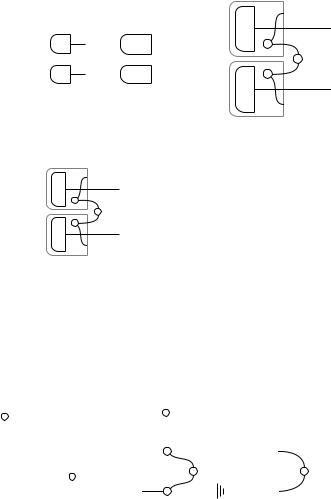
orthonormal basis implies that for each x X there is a unique y X such that σH,H |ax = ex |ay and px = py ; we define an involutive bijection s : X → X by setting s(x) to be that unique y. For each x X, consider the normalised state

ρx := 12 (|ax ax| + |as(x) as(x)|) in CPM(fHilb), which we can realise in the subcategory DD(fHilb) by considering the classical structure on C2 corresponding


| |


|

x


2

|


x | |


s(x) |

to orthonormal basis

0 , 1


and the vector

r


:=

1

( a

0 +


a

1 ):


4


H


Rx


1


Ax

H

As(


H


x)


ρx

=


+


=


(38)


2


Ax

H

As(


H


x)


Rx


H

Now observe that the requirement that our e ect yield 1 on all normalised states implies, in particular, that the following equation must hold:


H


1 =


Rx


=

1

(px + ps(x)) = px

(39)


A


2


Rx


H


As a consequence, our e ect is written

x X |ax ax|, which is exactly the “for-

est” discarding map


DD(H) of density hypercubes on DD(H).


Proposition 5. Let Split(DD(fHilb)) be the Karoubi envelope of DD(fHilb), and write Split(DD(fHilb))K for the full subcategory of Split(DD(fHilb)) spanned by objects in the form (DD(H), dec). There is an R+-linear monoidal equivalence of categories between Split(DD(fHilb))K and the probabilistic theory R+-Mat of classical systems. Furthermore, classical stochastic maps correspond

to the maps in Split(DD(fHilb))K normalised with respect to the discarding maps


(DD(H),dec ) defined as


DD(H) dec


and which we can write explicitly as


follows:


H


H


(DD(H),dec )

:=


=


(16)

H