Материал: искусственный интеллект

Внимание! Если размещение файла нарушает Ваши авторские права, то обязательно сообщите нам

suai.ru/our-contacts

quantum machine learning

156 S. Gogioso and C. M. Scandolo

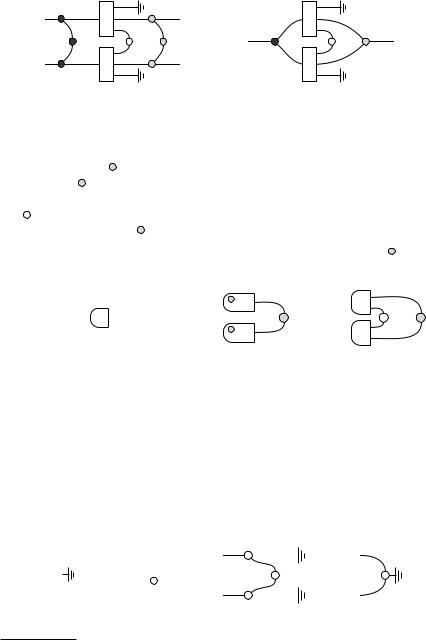
Proof. Consider two objects (DD(H), dec) and (DD(K), dec), where and are special commutative -Frobenius algebras associated with orthonormal bases (x )x X and (y )y Y of H and K respectively. The morphisms from (DD(H), dec) to (DD(K), dec) in Split(DD(fHilb)) are exactly the maps of density hypercubes DD(H) DD(K) in the following form:

¯

F

(40)

F

We can expand the definition of decoherence maps to see that these morphisms correspond to generic matrices Mxy of non-negative real numbers, with matrix composition as sequential composition, Kronecker product as tensor product, and the R+-linear structure of matrix addition.

¯


¯


Ψx

Ψ

x


Φy


F


F


Φy


=


F


x X y Y


Ψx

Ψ

x


F


Φ

Φy


y


(41) The discarding maps obtained by decoherence of the environment structure for DD(fHilb) yield the usual environment structure for classical systems:


H

=

H

=

H

Ψx

(H,dec )

:=


(42)


H

Ψ


x


H


H

x X


Hence CK is equivalent to the probabilistic theory R+-Mat of classical systems.

Proposition 6. Let Split(DD(fHilb)) be the Karoubi envelope of DD(fHilb), and write Split(DD(fHilb))Q for the full subcategory of Split(DD(fHilb)) spanned

by objects in the form (DD(H), hypdec). There is an R+-linear monoidal equivalence of categories between Split(DD(fHilb))Q and the probabilistic theory CPM(fHilb) of quantum systems and CP maps between them. Furthermore, trace-preserving CP maps correspond to the maps in Split(DD(fHilb))Q nor-

malised with respect to the discarding maps (DD(H),hypdec ) := DD(H) hypdec , which we can write explicitly as follows:

H


H

(DD(H),hypdec ) :=

=

(18)

H


H

Proof. We can define an essentially surjective, faithful monoidal functor from Split(DD(fHilb)) to the category CPM(fHilb) of quantum systems and CP maps

suai.ru/our-contacts

quantum machine learning

Density Hypercubes, Higher Order Interference and Hyper-decoherence

157

by setting (DD(H), hypdec) → H on objects and doing the following on morphisms:

H

¯

K


¯


F


F


H

K

(43)

H

F

K


F


In order to show monoidal equivalence we need to show that the functor is also full, i.e. that every CP map can be obtained from a map of Split(DD(fHilb)) in this way. Because of compact closure, it is actually enough to show that all states can be obtained this way. Consider a finite-dimensional Hilbert space H and a

classical structure


on it, and write (x )x X for the orthonormal basis of H

associated to

. The most generic mixed quantum state on

H

takes the form ρ =


+


y Y py y γy |, where (y )y Y

is some orthonormal basis of H and py R


.

Let

be the classical structure associated with the orthonormal basis (y )y Y ,

and define the states |


:=


x X |ψx

ψxy

, where


ψxy

C is

γy

such that


2 =


C. If we write φ

:=


,


ψx

γy


ψx γy


γy


yY


py

|

γy


|


|


|


|

then the desired state ρ can be obtained as follows:


Φ¯


=


=


py


Γy


=


ρ


py Γy


Y


y


Y


y


py


Γy


Φ


(44) Hence the monoidal functor defined above is full, faithful and essentially surjective, i.e. an equivalence of categories. Furthermore, it is R+-linear and it respects discarding maps.

BPossibility of Extension for the Theory of Density Hypercubes

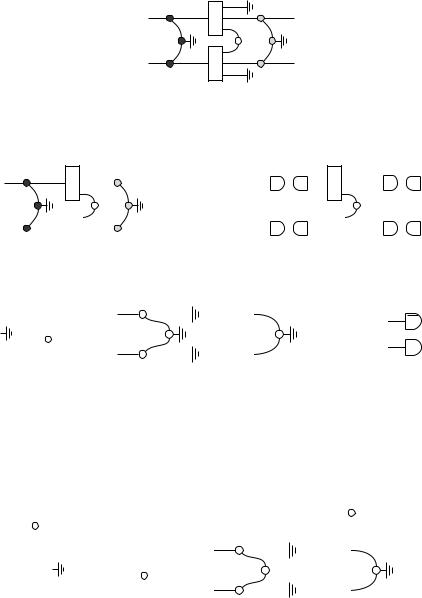
The theory of density hypercubes presented in this work is fully-fledged1 but incomplete: as shown by Eq. 18, the hyper-decoherence maps are not normalised (i.e. they are not “deterministic”, in the parlance of OPTs/GPTs)

H


H

(DD(H),hypdec ) :=

=

(18)

H


H

1In the sense that it contains all the features necessary to consistently talk about operational scenarios, such as preparations, measurements, controlled transformations, reversible transformation, test, non-locality scenarios, etc.

suai.ru/our-contacts

quantum machine learning

158 S. Gogioso and C. M. Scandolo

When it comes to this work, however, this is not much of a problem: all we need to show is that an extension of our theory can exists in which the “tree-on-a- bridge” e ect above can be completed to the discarding map, and our results— both hyper-decoherence to quantum theory and higher-order interference—will automatically apply to any such extension.

Let (x )x X be the orthonormal basis associated with the special commutative -Frobenius algebra . The e ect needed to complete (DD(H),hypdec ) to the discarding map DD(H) is itself an e ect in CPM(fHilb), which can be written explicitly as follows:

H


H


=

H


Ψx

(45)


Ψ


x,y X

H


H


H


y


s.t. x=y


Because it is an e ect in CPM(fHilb), which has R+ as its semiring of scalars, it is in particular non-negative on all states in DD(fHilb), showing that: (i) hyper-decoherence maps are sub-normalised; (ii) our theory does not satisfy the no-restriction condition; (iii) an extension to a theory with normalised hyperdecoherence is possible. This shows that our results on hyper-decoherence have physical significance. Furthermore, let |1 , ..., |d be an orthonormal basis of Cd, and let correspond to the Fourier basis for the finite abelian group Zd:

1

d

2π


ei

jk |j


(46)


d


d


k=1,...,d


j=1


Choosing k := d, in particular, shows that the orthonormal basis above contains

the state 1 used in Sect. 4. Then the e ect defined in Eq. 45 also shows that

d +

the computation of P[+|U ] in Sect. 4 can be done as part of a bonafide measurement in any such extended theory, and hence that our higher-order interference result has physical significance.

References

1.Barnum, H., Lee, C.M., Scandolo, C.M., Selby, J.H.: Ruling out higher-order interference from purity principles. Entropy 19(6), 253 (2017). https://doi.org/10.3390/ e19060253

2.Barnum, H., M¨uller, M.P., Ududec, C.: Higher-order interference and single-system postulates characterizing quantum theory. New J. Phys. 16(12), 123029 (2014). https://doi.org/10.1088/1367-2630/16/12/123029

3.Chiribella, G., D’Ariano, G.M., Perinotti, P.: Probabilistic theories with purification. Phys. Rev. A 81, 062348 (2010). https://doi.org/10.1103/PhysRevA.81. 062348

4.Chiribella, G., Scandolo, C.M.: Entanglement as an axiomatic foundation for statistical mechanics. arXiv:1608.04459 [quant-ph] (2016). http://arxiv.org/abs/1608. 04459

suai.ru/our-contacts

quantum machine learning

Density Hypercubes, Higher Order Interference and Hyper-decoherence

159

5.Chiribella, G., Scandolo, C.M.: Microcanonical thermodynamics in general physical theories. New J. Phys. 19(12), 123043 (2017). https://doi.org/10.1088/1367-2630/ aa91c7

6.Coecke, B.: Terminality implies no-signalling... and much more than that. New Gener. Comput. 34(1–2), 69–85 (2016). https://doi.org/10.1007/s00354-016- 0201-6

7.Coecke, B., Lal, R.: Causal categories: relativistically interacting processes. Found. Phys. 43(4), 458–501 (2013). https://doi.org/10.1007/s10701-012-9646-8

8.Coecke, B., Pavlovic, D., Vicary, J.: A new description of orthogonal bases. Math. Struct. Comput. Sci. 23(3), 555–567 (2013)

9.Coecke, B., Perdrix, S.: Environment and classical channels in categorical quantum mechanics. In: Dawar, A., Veith, H. (eds.) CSL 2010. LNCS, vol. 6247, pp. 230–244.

Springer, Heidelberg (2010). https://doi.org/10.1007/978-3-642-15205-4 20

ˇ

10. Daki´c, B., Paterek, T., Brukner, C.: Density cubes and higher-order interference theories. New J. Phys. 16(2), 023028 (2014). https://doi.org/10.1088/1367-2630/ 16/2/023028

11. Gogioso, S., Scandolo, C.M.: Categorical probabilistic theories. In: Coecke, B., Kissinger, A. (eds.) Proceedings 14th International Conference on Quantum Physics and Logic, Nijmegen, The Netherlands, 3–7 July 2017. Electronic Proceedings in Theoretical Computer Science, vol. 266, pp. 367–385. Open Publishing Association (2018). https://doi.org/10.4204/EPTCS.266.23

12. Gogioso, S.: Higher-order CPM constructions. Electron. Proc. Theor. Comput. Sci. 270, 145–162 (2019). https://doi.org/10.4204/EPTCS.287.8

13. Jin, F., et al.: Experimental test of born’s rule by inspecting third-order quantum interference on a single spin in solids. Phys. Rev. A 95, 012107 (2017). https:// doi.org/10.1103/PhysRevA.95.012107

ˇ

14. Kauten, T., Keil, R., Kaufmann, T., Pressl, B., Brukner, C., Weihs, G.: Obtaining tight bounds on higher-order interferences with a 5-path interferometer. New J. Phys. 19(3), 033017 (2017). https://doi.org/10.1088/1367-2630/aa5d98

15. Krumm, M., Barnum, H., Barrett, J., M¨uller, M.P.: Thermodynamics and the structure of quantum theory. New J. Phys. 19(4), 043025 (2017). https://doi.org/ 10.1088/1367-2630/aa68ef

16. Lee, C.M., Selby, J.H.: Deriving Grover’s lower bound from simple physical principles. New J. Phys. 18(9), 093047 (2016). https://doi.org/10.1088/1367-2630/18/ 9/093047

17. Lee, C.M., Selby, J.H.: Generalised phase kick-back: the structure of computational algorithms from physical principles. New J. Phys. 18(3), 033023 (2016). https:// doi.org/10.1088/1367-2630/18/3/033023

18. Lee, C.M., Selby, J.H.: Higher-order interference in extensions of quantum theory. Found. Phys. 47(1), 89–112 (2017). https://doi.org/10.1007/s10701-016-0045-4

19. Lee, C.M., Selby, J.H., Barnum, H.: Oracles and query lower bounds in generalised probabilistic theories. arXiv:1704.05043 [quant-ph] (2017). https://arxiv.org/abs/ 1704.05043

20. Lee, C.M., Selby, J.H.: A no-go theorem for theories that decohere to quantum mechanics. Proc. Roy. Soc. A: Math. Phys. Eng. Sci. 474(2214), 20170732 (2018). https://doi.org/10.1098/rspa.2017.0732

21. Niestegge, G.: Three-slit experiments and quantum nonlocality. Found. Phys. 43(6), 805–812 (2013). https://doi.org/10.1007/s10701-013-9719-3

22. Park, D.K., Moussa, O., Laflamme, R.: Three path interference using nuclear magnetic resonance: a test of the consistency of Born’s rule. New J. Phys. 14(11), 113025 (2012). https://doi.org/10.1088/1367-2630/14/11/113025
suai.ru/our-contacts

quantum machine learning

160 S. Gogioso and C. M. Scandolo

23.Sinha, A., Vijay, A.H., Sinha, U.: On the superposition principle in interference experiments. Sci. Rep. 5, 10304 (2015). https://doi.org/10.1038/srep10304

24.Sinha, U., Couteau, C., Jennewein, T., Laflamme, R., Weihs, G.: Ruling out multi-order interference in quantum mechanics. Science 329(5990), 418–421 (2010). https://doi.org/10.1126/science.1190545

25.Sorkin, R.D.: Quantum mechanics as quantum measure theory. Mod. Phys. Lett. A 9(33), 3119–3127 (1994). https://doi.org/10.1142/S021773239400294X

26.Sorkin, R.D.: Quantum Measure Theory and its Interpretation. In: Quantum Classical Correspondence: The 4th Drexel Symposium on Quantum Nonintegrability, pp. 229–251. International Press, Boston (1997)

27.Ududec, C.: Perspectives on the formalism of quantum theory. Ph.D. thesis, University of Waterloo (2012)

28.Ududec, C., Barnum, H., Emerson, J.: Three slit experiments and the structure of quantum theory. Found. Phys. 41(3), 396–405 (2011). https://doi.org/10.1007/ s10701-010-9429-z

29.Zwart, M., Coecke, B.: Double dilation = double mixing (extended abstract). In: Coecke, B., Kissinger, A. (eds.) Proceedings 14th International Conference on Quantum Physics and Logic, Nijmegen, The Netherlands, 3–7 July 2017. Electronic Proceedings in Theoretical Computer Science, vol. 266, pp. 133–146. Open

Publishing Association (2018). https://doi.org/10.4204/EPTCS.266.9

˙

30. Zyczkowski, K.: Quartic quantum theory: an extension of the standard quantum mechanics. J. Phys. A 41(35), 355302 (2008). https://doi.org/10.1088/1751-8113/ 41/35/355302