Материал: Донсков С.И., Мороков В.А. Группы крови человека. Руководство по иммуносерологии

Внимание! Если размещение файла нарушает Ваши авторские права, то обязательно сообщите нам

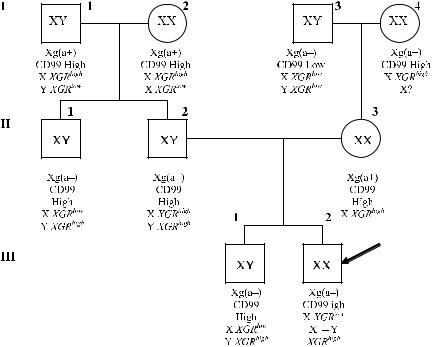
Рис. 14.4. Родословная мужчины с кариотипом ХХ, показывающая возможность рекомбинации X–Y (по De la Chapelle и соавт. [26]) с различными уровнями экспрессии антигена СD99. Пробанд (мужчина III-2) Xg(a−) унаследовал: от матери (II-3) Х-хромосому с геном XGR low, от отца (II-2) рекомбинантную Х–Y- хромосому, в которой локус XG замещен геном XGRhigh. У брата пробанда рекомбинация локуса XG не затронулаY-хромосому.

значительно длиннее, чем у Х-хромосом женщин. Соответственно рекомбинации Х–Y могут происходить с различным количеством генетического материала, и это объясняет, как одна и та же Х-хромосома может нести одновременно локусы XG и SRY.

Антиген Xg в биологии человека

Антиген CD99 выполняет функцию молекул клеточной адгезии. Реакция CD99 на клеточной мембране с антителами инициирует активацию Т-лимфоцитов, о чем свидетельствует появление антигена CD25 (рецептора к интерлейкину-2) и антигенов CD69 и CD40L(маркеров Т-клеточной активации) (Wingett и соавт. [98]).

По данным Bernard и соавт. [8], Pettersen и соавт. [70], связывание анти- CD99-антител с тимоцитами и зрелыми Т-клетками ускоряло их апоптоз.

Некоторые образцы анти-CD99-антител блокировали спонтанное розеткообразование Т-клеток человека с эритроцитами барана (Bernard и соавт. [7]). Стимуляция эпитопа CD99 антителами вызывала агрегацию тимоцитов,

711

несущих антигены CD4иCD8, а также агрегацию В-лимфобластов (Bernard и соавт. [9], Hahn и соавт. [50]). Укороченный изомер гликопротеина CD99, лишенный цитоплазматического домена, наоборот, ингибировал агрегацию В-клеток (Ambros и соавт. [2]).

Высокий уровень экспрессии антигена CD99 наблюдается у больных саркомой Эрвинга и другими опухолями нейроэктодермального происхождения (Ambros и соавт. [2]). Анти-CD99-антитела угнетали рост клеток саркомы Эрвинга in vitro и in vivo, в связи с чем предложено использовать эти антитела для терапии (Scotlandi и соавт. [83]).

Снижение экспрессии антигена CD99 наблюдалось у больных лимфогранулематозом (болезнь Ходжкина) (Kim и соавт. [57]). Одновременно у больных отмечалась слабая выраженность антигенов гистосовместимости I класса. Эти лиганды накапливаются внутри комплексов Гольджи. Не исключено, что эпитопы CD99 участвуют в транспорте HLA-антигенов из аппарата Гольджи, где они синтезируются, в мембрану клеток (Sohn и соавт. [87]). Уменьшение количества антигенов гистосовместимости в опухолевых клетках рассматривают как один из механизмов ускользания их от системы иммунологического надзора (Sohn и

соавт. [87]).

Функции антигена Xg a в клетке неизвестны. Его структурная гомология с антигеном CD99 позволяет полагать, что он определяет адгезивные свойства клеток, однако его распределение на клетках организма человека (не эритроцитах) мало изучено.

Антигены Xga и CD99 у животных

Антиген Xg a обнаружен на эритроцитах гиббонов Hylobates lar lar. Из 32 обезьян фенотип Xg(a + ) имели 30 % особей мужского пола и 53 % – женского. У других представителей человекообразных обезьян (67 шимпанзе, 2 гориллы, 20 орангутангов, 60 бабуинов и 5 гиббонов Hylobates pileatus) антиген Xg a не выявлен.

Антиген CD99 не обнаружен на лимфоцитах периферической крови гиббонов, но выявлен на фибробластах шимпанзе и горилл. Он отсутствовал у орангутангов и других исследованных млекопитающих (Gavin и соавт. [39], Shaw и

соавт. [84]).

Shaw и соавт. [93], анализируя геномную и кодирующую ДНК, установили наличие генов XG и MIC2 у низших приматов. Хромосомную организацию двух высокогомологичных генов – XG и MIC2 – авторы объясняют дупликацией одного из генов, полагая, что она произошла около 150 млн лет назад.

Список литературы

1.Adam A., Tippett P., Gavin J. et al. The linkage relation of Xg to g-6 pd in Israelis: the evidence of a second series of families //Ann. Hum. Genet. – 1967. – V. 30. – P. 211–218.

712

2.Ambros J.M., Ambros P.F., Strehl S. et al. MIC2 is specific marker for Ewing’s sarcoma and peripheral primitive neuroectodermal tumors: evidence for a common histogenesis of Ewing’s sarcoma and peripheral primitive neuroectodermal tumors from MIC2 expression and specific chromosome aberration // Cancer. – 1991. – V. 67. – P. 1886–1893.

3.Anstee D.J., Parsons S.F., Mallinson G. et al. Characterization of monoclonal antibodies against erythrocyte sialoglycoproteins by serological analysis, immunoblotting and flow cytometry // Rev. Franc. Transfus. Immunohemat. – 1988. – V. 31. – P. 317–332.

4.Azar P.M., Saji H., Yamanaka R., Hosoi T. Anti-Xga suspected of causing transfusion reaction // Transfusion. – 1982. – V. 22. – P. 340–341.

5.Banting G.S., Pym B., Darling S.M., Goodfellow P.N. The MIC2 gene product: epitope mapping and structural prediction analysis define an integral membrane protein // Mol. Immunol. – 1989. – V. 26. – P. 181–188.

6.Banting G.S., Pym B., Goodfellow P.N. Biochemical analysis of an antigen produced by both human sex chromosomes // EMBO J. – 1985. – V. 4. – P. 1967–1972.

7.Bernard A.F., Aubrit B., Raynal D. et al. A T cell surface molecule different from CD2 is involved in spontaneous rosette formation with erythrocytes // J. Immunol. – 1988. – V. 140. –

P.1802–1807.

8.Bernard G., Breitmayer J.-P., de Matteis M. et al. Apoptosis of immature thymocytes mediated by E2 / CD99 // J. Immunol. – 1997. – V. 158. – P. 2543–2550.

9.Bernard G., Zocolla D., Deckert M. et al. The F2 molecule (CD99) specifically triggers homotypic aggregation of CD4 + CD8 + thymocytes // J. Immunol. – 1995. – V. 154. – P. 26– 32.

10.Bhatia H.M. Frequency of sex-linked blood group Xga in Indians in Bombay: preliminary study // Indian J. Med. Sci. – 1963. – V. 17. – P. 491–492.

11.Boon W.H., Noades J., Gavin J., Race R.R. Xg blood groups of Chinese // Nature. – 1964. –

V.204. – P. 1002.

12.Buckle V., Mondello C., Darling S. et al. Homologous expressed genes in the human sex chromosome pairing region // Nature. – 1985. – V. 317. – P. 739–741.

13.Burgoyne P.S. Genetic homology and crossing over in the X and Y chromosomes of mammals // Hum. Genet. – 1982. – V. 61. – P. 85–90.

14.Burgoyne P.S. Mammalian X andYcrossingover // Nature. – 1986. – V. 319. – P. 258–259.

15.CampanaT.,SzaboP.,PiomelliS.,SiniscaloM.TheXgaantigenonredcellsandfibroblasts // Cytogenet. Cell Genet. – 1978. – V. 22. – P. 524–526.

16.Chown B., Lewis M., Kaita H. The Xg blood group system: data on 294 white families, mainly Canadian // Can. J. Genet. Cytol. – 1964. – V. 6. – P. 431–434.

17.Cook I.A., Polley M.J., Mollisson P.L. A second example of anti-Xga // Lancet. – 1961. – i. – P. 857–859.

18.Curry C.J.R., Magenis R.E., Brown M. et al. Inherited chondrodysplasia punctata due to deletion of the terminal short arm of an X chromosome // N. Engl. J. Med. – 1984. –

V.311. – P. 1010–1015.

19.DanielsG.L.HumanBloodGroups.–2-nded.–Oxford:BlackwellScience,2002.–560 p.

20.Daniels G.L., Green C. Expression of red cell surface antigens during erythropoiesis // Vox Sang. – 2000. – V. 78 (Suppl. 1). – P. 149–153.

21.Daniels G.L., Tippett P. MAb 161: a monoclonal antibody detecting the 12E7 glycoprotein [Abstract] // Proc. 2-nd. Int. Workshop MonoclonalAntibodiesAgainst Human Red Blood Cells RelatedAntigens. – 1990. – P. 127.

22.Darling S.M., Banting G.S., Pym B. et al. Cloning and expressed gene shared by the human sex chromosomes // Proc. Nat.Acad. Sci. USA. – 1986. – V. 83. – P. 135–139.

23.Davies K. The essence of inactivity // Nature. – 1991. – V. 349. – P. 15–16.

24.De la Chapelle A. The etiology of maleness in XX men // Hum. Genet. – 1981. – V. 58. –

P.105–116.

713

25.De la Chapelle A., Savikurki H., Herva R. et al. Aetiologial studies in males with the karyotype 46, XX //Aspects Of Human Genetics. – Basel, Karger. – 1984. – P. 25–42.

26.De la Chapelle A., Tippett P.A., Wetterstrand G., Page D. Genetic evidence of X-Y interchange in a human XX male // Nature. – 1984. – V. 307. – P. 170–171.

27.Devenish A., Burslem M.F., Morris R., Contreras M. Serologic characteristics of a further exampleofanti-Xga inNorthLondonblooddonors//Transfusion.–1986.–V.26.–P.426–427.

28.Dewey W.J., Mann J.D. Xg blood group frequencies in some further populations // J. Med. Genet. – 1967. – V. 4. – P. 12–15.

29.Ducos J., Marry Y., Sanger R., Race R.R. Xg and X chromosome inactivation // Lancet. – 1971. – ii. – P. 219–220.

30.Ellis N., Goodfellow P.N. The mammalian pseudoautosomal region // Trends. Genet. – 1989. – V. 5. – P. 406–410.

31.Ellis N.A., Tippett P., Petty A. et al. PBDX is the XG blood group gene // Nat. Genet. – 1994. – V. 8. – P. 285–289.

32.Ellis N.A., Ye T.-Z., Patton S. et al. Cloning of PDBX, an MIC2-related gene that spans the pseudoautosomal boundary on Xp // Nat. Genet. – 1994. – V. 6. – P. 394–399.

33.Evans H.J., Buckton K.E., Spowart G., GarothersA.D. Heteromorphic X chromosomes in 47, XX males: evidence for the involvement of XY interchange // Hum. Genet. – 1979. –

V.49. – P. 11–31.

34.Fellous M., Bengtsson B., Finnegan D., Bodmer W.F. Expression of the Xga antigen on red cells in the culture and its segregation in somatic cell hybrids // Amer. J. Hum. Genet. – 1974. – V. 37. – P. 421–430.

35.Fergusson-Smith M.A. X-Y chromosomal interchange in the aetiology of true hermaphroditism and of XX Klinefelter syndrome // Lancet. – 1966. – ii. – P. 475–476.

36.Fouchet C., Gane P., Cartron J.-P., Lopez C. Quantitative analysis of XG blood group and CD99 antigens on human red cells // Immunogenetics. – 2000. – V. 51. – P. 688–694.

37.Fouchet C., Gane P., Huet M. et al.Astudy of the coregulation and tissue specificity of XG and MIC2 gene expression in eucariotic cells // Blood. – 2000. – V. 95. – P. 1819–1826.

38.Fraser G.R., Steinberg A.G., Defaranas B. et al. Gene frequencies at loci determining blood-croup and serum-protein polymorphisms in two villages in Northwestern Greece // Amer. J. Hum. Genet. – 1969. – V. 21. – P. 46–60.

39.GavinJ.,NoadesJ.,TippettP.etal.BloodgroupantigenXga ingibbons//Nature.–1964.–

V.204. – P. 1322–1323.

40.Gavin J., Tippett P., Sanger R., Race R.R. The Xg blood groups in Negroes // Nature. – 1963. – V. 200. – P. 82–83.

41.Goodfellow P. Expression of the 12E7 antigen in controlled independently by genes on the human X andYchromosomes // Differentiation. – 1983. – V. 23. – P. 35–39.

42.GoodfellowP.,BantingG.,LevyR.etal.AhumanX-linkedantigendefinedbyamonoclonal antibody // Somat. Cell Genet. – 1980. – V. 6. – P. 777–787.

43.Goodfellow P., Banting G., Sheer D. et al. Genetic evidence that a Y-linked gene in man is homologous to a gene on X-chromosome // Nature. – 1983. – V. 302. – P. 346–349.

44.Goodfellow P.J., Darling S.M., Thomas N.S., Goodfellow P.N. A pseudoautosomal gene in man // Science. – 1986. – V. 234. – P. 740–743.

45.Goodfellow P.J., Pritchard C., Tippett P., Goodfellow P.N. Recombination between the X and Y chromosomes: implications for the relationship between MIC2, Xg and YG // Ann. Hum. Genet. – 1987. – V. 51. – P. 161–167.

46.GoodfellowP.N.,PymB.,MohandasT.,ShapiroL.J.Thecellsurfaceantigenlocus,MIC2X, escapes X-inactivation //Am. J. Hum. Genet. – 1984. – V. 36. – P. 777–782.

47.Goodfellow P.N., Pym B., Pritchard C. et al. MIC2: a human pseudoautosomal gene // Phil. Trans. R. Soc. Lond. B. – 1988. – V. 322. – P. 145–154.

48.Goodfellow P.N., Tippett P.A. A human quantitative polymorphism related to Xg blood groups // Nature. – 1981. – V. 289. – P. 404–405.
714

49.Habibi B., Tippett P., Lebesnerais M., Salmon C. Protease inactivation of the red blood cell antigen Xga // Vox Sang. – 1979. – V. 36. – P. 367–368.

50.HahnJ.-H.,KimM.K.,ChoiE.Y.etal.CD99(MIC2)regulatestheLFA-1 / ICAM-1-mediated adhesion of lymphocytes, and its gene encodes both positive and negative regulators of cellular adhesion // J. Immunol. – 1997. – V. 159. – P. 2250–2258.

51.Haldane J.B.S. Test for sex-linked inheritance on population samples // Amer. J. Hum Genet. – 1963. – V. 27. – P. 107–111.

52.Herbich J., Meinhart K., Szilvassy J. Verteilung 18 verschiedener Blutmerkmalsysteme bei 2440 Personen aus Wien und Umdebung //Arztl. Lab. – 1972. – V. 18. – P. 341–348.

53.Herron R., Smith G.A. Identification and immunochemical characterization of the human erythrocytemembraneglycoproteinsthatcarrytheXga antigen//Biochem.J.–1989.–V.262.–

P.369–371.

54.Hsu S.H., Migeon B.R., Bias W.B. Unreliability of the microcomplement fixation method for Xga typing of culture fibroblasts // Cytogenet. Cell Genet. – 1976. –V. 16. – P. 382–386.

55.Issitt P.D., Anstee D.J. Applied Blood Group Serology. – 4-th ed. – Durham, NC, USA: Montgomery Sc. Publ., 1998. – 1208 p.

56.Jacobs P.A., Hassold T.J. The origin of numerical chromosome abnormalities // Adv. Genet. – 1995. – V. 33. – P. 101–133.

57.Kim S.H., Choi E.Y., Shin Y.K. et al. Generation of cells with Hodgkin’s and Reed-Sternberg phenotypethroughdownregulationofCD99(Mic2)//Blood.–1998.–V.92.–P.4287–4295.

58.Klinger R., Miggiano V.C., Tippett P., Gavin J. Diabete mellito e nanismo ipofisario in chimera XX, XY//Ann.Acad. Med. Lomb. – 1968. – V. 23. – P. 1392–1396.

59.Latron R., Blanchard D., Cartron J.-P. Immunochemical characterization of the human bloodcellmembraneglycoproteinrecognizedbythemonoclonalantibody12E7//Biochem.

J.– 1987. – V. 247. – P. 757–764.

60.Levy R., Dilley J., Fox R.I., Warnke R. A human thymus-leukemia antigen defined by hybridoma monoclonal antibodies // Proc. Natl. Acad. Sci. USA. – 1979. – V. 76. –

P.6552–6556.

61.Lyon M.F. X-chromosome inactivation // Curr. Biol. – 1999. – V. 9. – P. 235–237.

62.Lyon M.F. X-chromosome inactivation and developmental patterns in mammals // Biol. Rev. – 1972. – V. 47. – P. 1–35.

63.Mak K.H., Chua K.M., Leong S., Devenish A. On the incidence of Xga and anti-Xga in Hong Kong Chinese // Transfusion. – 1993. – V. 33. – P. 443–444.

64.Mann J.D., Cahan A., Gelb A.G. et al. A sex-linked blood group // Lancet. – 1962. –

V.i. – P. 8–10.

65.Mayr W.R. Das Blutfactorensystem Xg // Schweiz. Med. Wochenschr. – 1969. – V. 99. –

P.1837–1844.

66.Metaxas M.N., Metaxas-Buhler M. An agglutinating example of anti-Xga and Xga frequencies in 558 Swiss blood donors // Vox Sang. – 1970. – V. 19. – P. 527–529.

67.Nakajima H., Murata S., Seno T. Three additional examples of anti-Xga and Xg blood groups among the Japanese // Transfusion. – 1979. – V. 19. – P. 480–481.

68.Novaretti M.C., Morganti L., Dorlhiac-Llacer P.E., Chamone D.A.F. Xga gene frequencies inCaucasian,MulattoesandBlackblooddonors[Abstract]//Blood.–1996.–V.88(Suppl. 1). – P. 95B.

69.Petit C., De la Chapelle A., Levelliers J. et al. An abnormal terminal X-Y interchange accounts for most but not all cases of human XX maleness // Cell. – 1987. – V. 49. –

P.595–602.

70.Pettersen R.D., Bernard G., Olafson M.K. et al. CD99 signals caspase-independent T cell death // J. Immunol. – 2001. – V. 166. – P. 4931–4942.

71.Petty A.C., Tippett P. Investigations of the biochemical relationship between the blood group antigen Xga and CD99 (12E7 antigen) on red cells // Vox Sang. – 1995. – V. 69. –

P.231–235.

715