Материал: Snote

Внимание! Если размещение файла нарушает Ваши авторские права, то обязательно сообщите нам

Taoist love-posture with woman in the active role. Such postures are particularly suited to love-making when a woman is menstruating. From a Chinese painting of the late eighteenth century.

menstruation: the red snow

A Chinese tradition speaks of menstruation as the Monthly Affair, the Monthly Guest,

Regular Fluid, the R e d Flood, Peachflower Flow, or the R e d Snow. As in most other ancient cultures, in China it was customary for a woman to separate herself from her normal wordly activities during this time. During menstruation, a woman was not supposed to cook or take part in any family duties or religious rites, and her forehead was generally marked with a red spot to indicate her condition.

The taboos associated with menstruation are practically universal. They exist in both primitive and sophisticated cultures, from India to China, Japan, the Pacific Islands, North and South America, Africa, the Middle East, and parts of Europe. In all these areas of the world special arrangements are usually made for women at the time of their monthly bleeding.

During her monthly period a woman is more open, receptive, and vulnerable than usual; she is often prey to moods and emotions that a man finds hard to understand. All the signs associated with the onset of menstruation, such as moodiness, sudden irritability, listlessness, fits of passion, swollen breasts and stomach, sudden weight gain, skin irritations, flushing, and so on, are caused by hormonal changes accompanied by the excretion of toxic elements from the body. It is a time of complete purification, when a woman prepares to become "new again," just as the moon does every month.

The association of menstruation with the moon and lunar cycles is culturally universal. There are even common taboos against "looking at the moon when menstruating." Ishtar, the M o o n goddess of the ancient Mediterranean cultures, was believed to menstruate during the time of the full moon. Hindus believe that a menstruating woman is under the moon's influence and should be treated with respect and care. Orthodox Hindus are very paranoid about the touch or even

the glance of a menstruating woman. Both are supposed capable of causing food to spoil or milk to curdle. Traditionally, a woman is not to bathe at all during the time of menstruation. However, once her period is completed, she is supposed to have a thorough wash, or even a full mud bath, letting the mud dry on her body and then washing it off afterward. Her hair is shampooed and, in Moslem cultures, treated with henna. She is then viewed as being totally renewed, a "virgin" once more.

In the Hindu tradition, menstrual blood is considered a form of Agni, the Fire god. It is the fiery and sulphurous aspect of menstrual blood that, according to Tantra, is both dangerous and potent. Tantric teachings state that during her monthly period woman is virtually the embodiment of the downwardmoving Vital Energy (the Apana), which governs the eliminative functions of the body.

Menstrual blood contains the remains of the uterine lining, together with amounts of discarded egg cells, estrogenic hormones, lecithins, arsenic compounds, and rich concentrations of essential minerals such as iron and phosphorus. It is these that Eastern mystical and alchemical teachings refer to under the single grouping "sulphurous." The

Golden Treatise of Hermes Trismegistus, the seminal work of Western alchemy, views menstrual blood similarly, referring to it as "brimstone," "unguent," or "hidden wisdom." Know that the fatness of our earth is sulphur," states the Golden Treatise. "Sulphur tinges and fixes and is the connection of all alchemic tinctures."

From a worldly standpoint, a woman is shedding waste material when she menstruates. Moslems greatly fear the power of menstrual blood, as do orthodox Brahmins. In many cultures a man will not even walk on ground that has been trod by a menstruating woman . In primitive societies menstrual blood is used in Black Magic rites and for empowering negative charms and amulets.

Tantric Yogis view a menstruating woman as the very embodiment of Mother Kali, the Transcendental Power, linking this world to the next. A mystic form of this female principle, known as the goddess Vajravarahi, is described in Tantric texts as "dripping with blood and passionately pressing the thighs of her partner with her legs and lower body."

According to Tantra, a woman is "very

282 Vishnu the Preserver

special" at the time of her menstrual period. She is a "doorway to the other worlds." Yogis understand the invigorating and rejuvenating powers of menstrual blood. In rituals designed to tap these powers a menstruating woman takes the active role and becomes Kali the Initiatress into transcendence.

Making love in the standard "missionary" or "woman supine" position with a menstruating woman is not considered beneficial, since the movements of love will push the woman's downward-moving energy and excretions back upward. The natural flow is thwarted, and at times menstruation may even stop as a result of such love-making, causing a reabsorption of bodily residues that can jeopardize a woman's health.

The Tantric form is for the man to lie down on the bed or carpet, while the woman sits above him. Taking the active role, without shame or sexual restraint, she makes love to him, pouring the downward-moving energy and the libation of the menstrual flow on his erect Lingam. From her he receives the invigorating essence of her ova-rich blood, which would have been the basis for supporting the life of a fetus, and she experiences a loss of menstrual pains and cramps. Many Tantric texts credit such love-making with the power of physical rejuvenation and initiation into the wisdom-teachings.

The menstrual cycle is mainly controlled by the female hormones estrogen and progesterone, though the male hormone testosterone is continuously secreted throughout the female cycle. Birth-control pills are made from synthesized female hormones, which regularize the period. However, such benefits may be offset by the fact that they alter a woman's natural cycle.

A scientific study of menstruation found that the monthly periods of women living together tend to synchronize. According to the paper published at the conclusion of the study, "the longer the women lived together, the more their periods tended to occur on the same days, even though most of the women claimed that they were not aware of when the others were menstruating." A secondary finding was that girls with regular boy friends tended to have shorter menstrual cycles and more regular periods.

There are many factors in modern life that adversely influence the natural cycle of woman. Emotional upset, tension, dieting,

and excessive travel can all make a woman miss her periods or upset their regularity.

The view that a woman is renewed after the cessation of her menstrual period is supported by many ancient traditions. In priestly cultures the tradition is that menstruation renews virginity. The cycle of woman is compared to that of the moon, which changes and creates different influences at the different periods, ultimately returning to its original status. In the Tantric tradition a woman is viewed as a virgin (Kumari) just after menstruation, as a young wife (Saraswati) during

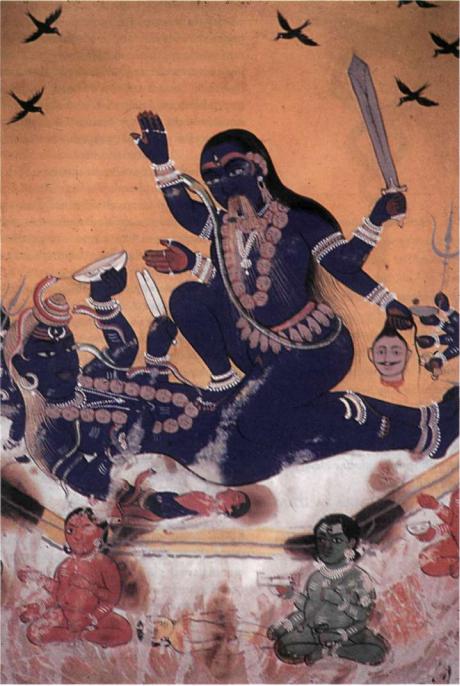
Kali making love to Shiva. She personifies the regenerative power of female sexuality. A Rajasthani miniature painting of the eighteenth century.

Vishnu the Preserver 283

The Tantric Adept should view a menstruating woman with reverence

and awe. She is the living embodi-

ment of Kali, the power of transcendence; her menstrual blood

[Khapushpa] is the flowery essence

of all womanhood, the

very blood

of life. Possessed of supernormal

qualities, it is a potent

rejuvenating

and transforming force, purifying all poisons through its alchemical fire. By performing sexual rites with a menstruating woman, the Adept can more quickly advance along the Path of Liberation.

KAULA TANTRA

the week following menstruation, as a worldly mistress of the house (Lakshmi) during the next week, and as a wise lady (Kali) during the approach to menstruation. During menstruation itself she is "beyond world-

liness," " d e a d to the w o r l d and its

responsibilities," and therefore freed from household duties. It is during this time that she serves as a link between this world and the next.

In her role as mother and sustainer of the family, a woman spends the majority of her time caught up in a web of worldly activities. By the time her period approaches, she has become more like a man through her contact with worldliness and her husband or

lover.

Many of the rules governing a menstruating woman, such as that she should not cook for others or take part in religious practices or wash in the common bathing place, are based on the knowledge that her psychic atmosphere at this time is quite different from that during the rest of the month. It is not that she is dirty, but that she is "different" and is exceedingly open to non-worldly forces. This is one of the main reasons why, in evolved ancient cultures, special places— parts of buildings or even a whole house—

were set aside for w o m e n to live while menstruating.

Traditionally, such a place was overseen by one or several elderly woman, already past their menopause. These "wise w o m e n " would have the job of looking after the needs of the younger menstruating women, using the time to instruct and initiate them into various arts, sciences, crafts, ritual songs, music, and spiritual traditions, all of which could later be applied to worldly life. In particular, this was a time to learn the legends of the tribe, the lineage of the family, and to become acquainted with the powers of transcendence. The Kailish tribe of Kafiristan, which resisted Moslem culture until recently, is one group that has preserved this tradition. Many so-called primitive tribes of In-

dia and Africa still have a common "menstruation house" for women.

Though it would indeed be difficult for a modern woman to apply this ancient tradition to her life (to do so completely would mean a rearranging of society), some aspects of the ancient wisdom on menstruation can be usefully adapted to suit our present culture.

A man should treat his woman in a more protective way during the time of her menstruation. She should make it a policy not to get involved in worldly activities, but rather to cultivate her "retreat from the world." In this way she will become more familiar with her own sexual identity and its cycles of change.

Voluntary self-seclusion may in fact be very rewarding for a menstruating woman. This retreat allows her to explore the terrain of her psyche, while at the same time permitting her to rest from her worldly duties. The time of menstruation is particularly suited to meditation and contemplation, and can be a great chance to experience transcendence from worldliness.

When a couple are closely knit, it is not unusual for the man to experience some of the menstrual pains of his partner. Even in the Moslem culture, this has been recorded. Abu Abbas Saffah had a single wife with whom he was deeply in love. It was said of him that "If she ails, he ails; and even if she menstruates, he also does the same in his own way." Woman is attuned to the lunar cycle, and man is keyed to the longer solar rhythm; nevertheless, the essential bisexuality of each relates him or her to both cosmic cycles.

Though the orthodox Hindu viewpoint is that the couple should refrain from lovemaking during the woman's menstrual period, the Tantric approach is that if passion calls, there should be no holding back. With the right mental attitude, a couple can safely and enjoyably use this time of enhanced potency to explore the mysteries of Kali and her renewing powers.

Menstruation is only for a matter of days, and God willed that it be used to totally purify and cleanse the womb. When it's all over, a woman is better than before.

SHAYKH NAFZAWI

284 Vishnu the Preserver

conception and contraception

In order to fully understand the Eastern teachings on both conception and contraception, we must examine the ancient, traditional view of how an individual "life" becomes embodied in a womb. All traditions declare that mental attitude is the prime factor in determining both conception and the gender of the child. The time of lovemaking, with respect to both the woman's menstrual cycle and the hour of the day or night, also plays a role. Finally, health and diet are important considerations.

In the East, there is a general agreement that the first few days immediately after the cessation of a woman's menstruation are conducive to conception. This belief is expressed in Indian, Tibetan, Chinese, Japanese, and Arabic sexological works. The Arab writer Abu Bakri, for example, says, "Sexual intercourse in the latter part of the night, shortly after menstruation, and at the beginning of the lunar month, never fails to produce noble children." He adds the interesting view that "Children conceived as a result of nocturnal intercourse are generally nobler than those conceived during the day."

A Chinese text, which quotes some of the

Sexual Secrets of the Plain Girl, states: "There is the following fixed method for obtaining children. First, one should purify one's heart and put aside all worldly sorrows, meditating and concentrating the mind with the help of a fast. Then, on the third day after the woman's menstruation has stopped, in the period after midnight and before the early morning, the man should excite her passion. There should be considerable foreplay. Then he should unite with her, ensuring that his innermost feelings are adjusted to hers, and carefully blending his own enjoyment with that of his partner."

According to Peng Tsu, the Chinese Taoist master, "In order to obtain children, a man should conserve his semen by not ejaculating too frequently; by this means he will become more potent. Then, if he makes love with his woman on the third or fifth day after her menstruation has finished, she will conceive."

The Hindu tradition is very similar. The

Charaka Samhita, an important early Indian medical work, declares: "If a woman wishes to conceive a child, she should wait until her menstruation has finished. She should then take a bath and be massaged and shampooed. Then both she and her husband should dress in white clothes and wear garlands of flowers; greatly longing for each other, they should make love passionately."

The same text adds that "During such love-making the woman should receive the seed of man while lying on her back, for in that posture all the elements in the body are balanced and retain their correct positions." Many ancient traditions point to the role of love postures in conception, and favor the woman-supine position as most effective for ensuring impregnation. Ancient Hebrew and Chinese texts support this view.

The whole process of conception is beautifully described in the Charaka Samhita:

The semen, having been set in motion by the ecstatic Self and informed by it, emerging from the man's body, mixes with the sexual secretions of the woman, having entered the inner parts of her Yoni. It reaches the womb, where the Conscious-element [the Spirit], which has the mind as its instrument, proceeds first of all to gravitate to itself all the needed ingredients. It gravitates all the Vital Elements to itself, drawing the subtle Space-element before the others [air, fire, and so forth].

All the ancient teachings on conception stress that mental attitude is paramount in guaranteeing success. As the great Hindu teacher Atreya so clearly states, "An infant is said to be born of the mother, the father, born of the Spirit, born of concordance and of nourishment. There is, however, always the connecting agent, the mind."

When a couple make love, a "vortex" of swirling ecstatic energy rises up through their Psychic Centers. Esoteric teachings declare that it is this energy vortex that attracts and "draws down" the Spirit of a being already existing in the intermediate state between death and birth and impelled by the right Karma. The parents do not "make" the child, but rather "attract" the Spirit into the womb . The physical body is then built up to house the Spirit, drawing from the genetic instructions contained in the sperm and

During passionate love-making an energy vortex is created that attracts beings from the Spirit-realm.

Vishnu the Preserver 285

ovum. Biologically, a number of factors are necessary before conception can take place. The woman must be healthy and fertile; the man must have potent semen. The coming together of sperm and ovum must take place during the woman's fertile period of ovulation. Along with the biological factors of conception, a bond of spirituality and love should permeate the union, as otherwise a Spirit will be attracted that will cause disruption in the home. The Karmic elements of conception cannot be overstated. W h e n conceived in love, there will be love generated. W h e n a child is conceived in fear or lust, these same sentiments will ultimately pervade the family. The energy vortex, in creating a condition ripe for conception, carries the dominant sentiments of the couple into the Spirit-realm and attracts a being that reflects these sentiments. Esoteric traditions declare that the energy vortex becomes "colored" by the sentiment of the lovers and it is this "coloring" that attracts the Spirit of the child to be.

The Charaka Samhita gives an intriguing view of conception. It states: "A woman gives birth to a child resembling that person of whom she thinks at the time of conception." Many children bear little resemblance to other family members. Both women and men commonly fantasize when making love, particularly if the relationship is casual. The fantasy of having sex with a person other than the love-partner creates the possibility that the woman will conceive a child resembling her fantasy-lover. In ancient India this principle was used to attract beautiful and abnormally intelligent children into a family. The woman would visualize herself making love to a divine being, such as Krishna, in the belief that some of the godly qualities would become part of the new child. Several Hindu texts refer to this technique and attest to its success. The Greeks taught that imagination plays an important role in the

type of child c o n c e i v e d .

H e s i o d

and

Empedocles (circa 440 B.C.)

both cite

the

significance of fantasy to physiognomy; later, Hippocrates and the celebrated physician Soranus supported this view, as did Aristotle and Pliny.

In most healthy relationships both partners are deeply in love with each other and look to exalted qualities in the partner; these qualities are manifest in their offspring. In the Tantric approach to love-making the vi-

sualization of the couple as god and goddess creates an ideal psychic atmosphere for the conception of beautiful, intelligent, and "godly" children.

In the ancient cultures of the East there is a consistent tradition that the sex of a future child can be controlled by careful attention to the diet of the would-be mother in the months before conception. Hindu texts declare that if a woman wants a boy child, then she should eat salty foods, whereas for a girl child, sweet foods should be chosen. Experiments in Canada and France (by Dr. Jacques Lorrain and Dr. Joseph Stolkowski) have shown an 80 percent success rate in predetermining sex of offspring by restricting the would-be mother's diet. Saltier foods increase the mother's potassium and sodium content, and indeed create a higher incidence of male births. Fine wine or beer, as well as most vegetables, provide high concentrations of potassium and sodium salts. Sweet foods, and dairy products in particular, have high calcium and magnesium contents, and if a woman restricts her diet to these items in the two months prior to conception, she is more likely to conceive a female child.

Eastern traditions view contraception primarily as a matter of personal choice. If a woman wishes to become pregnant while making love with a virile partner, then the Eastern view is that conception is likely; on the other hand, if she does not want to become pregnant, her psyche will inhibit and reject the sperm. The living sensitivity of sperm, which maintain a subtle or psychic contact with the man, is responsible for their receptivity to mental messages from the couple. The time in the woman's periodic cycle is also important since when a woman ovulates, her mental and physical conditions attract conception. The Yoni of an ovulating woman contains a mucus that reacts to the sperm and energizes it, thereby increasing the likelihood of conception. A sensitive woman can tell when she is ovulating by distinct changes in her emotions (she becomes more sensual and "motherly"), her body odor, her Yoni secretions, and her vision. Recent experiments have shown that during ovulation a woman's vision improves considerably.

The possibility of mental control in conception or contraception is supported by the findings of Verrier Elwin, a theologian and anthropologist who spent many years living with the Muria tribe of India. The Murias

286 Vishnu the Preserver