arabian nights
The very words "Arabian Nights" evoke sensuous and exotic imagery: a man in a harem reclining on cushions and carpets, water-pipe in hand, a beautiful woman on each arm, and attendants offering delicacies to the accompaniment of dance and music. Such are the popular ideas associated with Arabia. Shaykh Nafzawi in his classic The Perfumed
Garden gives a typical description:
He arrived then at the curtain hanging at the entrance; it was of red brocade. From there he examined the room, which was bathed in light, filled with many chandeliers and candles burning in golden sconces. In the middle of this saloon played a jet of musk-water. A tablecloth extended from end to end, stretched out over the floor and covered with sundry meats and fruits.
The saloon was provided with gilt furniture, the splendor of which dazzled the eye. In fact, everywhere there were ornaments of all kinds. On looking closer, the King ascertained that round the tablecloth there were twelve maidens and seven women, all like moons; he was astonished at their beauty and grace. His attention was above all attracted by a woman like the full moon, of perfect beauty, with black eyes, oval cheeks, and a lithe and graceful waist; she humbled the hearts of those who grew enamored of her. Stupefied with her beauty, the King was as if stunned. He then said to himself, "How is there any getting out of this place? O Spirit, do not give way to love!"
Continuing his inspection of the room, he perceived glasses filled with wine in the hands of those who were present; they were drinking and eating. He heard one of the women saying to one of her companions, "Oh, let's go to bed; sleep is overpowering us. Come, let us light a torch and retire to the other chamber." Later the King hid himself. The two women returned from their ablutions and shut the doors of the room. Obscured by wine, they passionately pulled off each other's clothes and began to caress each other.
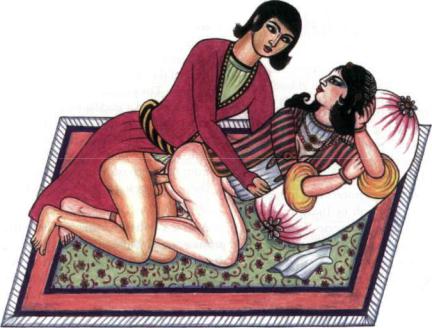
In the harem, Moslem women commonly entered into sisterly or even Sapphic relationships. The ritual of bathing, with mutual washing, shampooing, massage, and depilation, fostered an ambiance of sensuality, so often associated with polygamy and Oriental sexuality.
According to the Koran, a man is allowed up to four wives simultaneously, as well as any number of concubines. As J. G. Bennett, the interpreter of Gurdjieff's teachings, so clearly points out, " T h e rule made by Muhammad specified three conditions of polygamy. First, there must be the means to supply the needs of more than one family. Second, there must be sufficient virility to satisfy more than one woman. Third, there must be sufficient inner authority in the man for more than one woman to accept him. These conditions somewhat diminished the incidence of polygamy."
Richard Burton, translator of The Arabian Nights (first published in 1885 in a private edition), cites traditional sources for the following reasoning: "If a man has only one wife, she holds herself as an equal, answers back, and gives herself airs and graces. Two wives are always quarreling. Three wives are no real company, since two of them will invariably team up together against the nicest of the three and will cause havoc. Four wives are the best solution, since if they quarrel they can more easily make things up between themselves in equality. The husband thus enjoys comparative peace." Burton further states that the Moslem restriction of four wives to one husband is derived from an even older Jewish custom.
Though the popular view of Arabian Nights is linked to polygamy and overt sensuality, most modern Moslems do not have more than one wife and tend to be conservative in their sexual habits. Women are beginning to take an active role in Islamic society, and some of the restrictions on them are being lifted. Nevertheless, Arabic culture remains patriarchal and essentially chauvinistic. The traditional Hollywood version of "Arabian Nights" is hard to find in the real world.
Islam is riddled with superstitions about the sex act, which, when analyzed, can be reduced to a dread of women "gaining ascendancy" over men. Sexual postures with the woman on top and taking the active role are viewed with suspicion and said to be