Материал: Snote
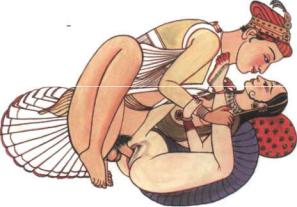
nine kinds of sexual union
The combinations of sizes of male and female sexual organs produce nine different possibilities or kinds of union. As the Kama Sutra declares, "There are three equal unions between persons of corresponding dimensions, and there are six unequal unions when the dimensions of the sex organs do not correspond. This makes nine in total."
As we shall see later, the number nine has a special esoteric significance. It occurs in the Nine Apertures of the Body and in several important metaphysical concepts. Though
the classification of sexual sizes is a diffi cult topic to generalize about, there seems to be a great deal of wis-
dom in the ancient Indian
system. The |
Kama |
Sutra |
|
|
states, "In Equal Unions, |
|
|||
t h e r e are |
n e v e r |
any |
|
|
problems. |
In Unequal |
|
||
Unions, positions should |
|
|||
be used |
w h i c h create |
|
||
balance." |
|
|
|
|
|
|
|
||
EQUAL |
|
UNEQUAL |
||
Men |
Women |
Men |
Women |
|
hare |
deer |
hare |
mare |
|
bull |
mare |
hare |
elephant |
|
horse |
elephant |
bull |
deer |
|
|
|
|
bull |
elephant |
|
|
|
horse |
deer |
|
|
|
horse |
mare |
|
|
|
|
|
When the proportions of both lovers are alike and equal, then satisfaction is
easy to achieve. The greatest happiness consists in the correspondence of dimensions. Discomfort increases with the ratio of difference.
ANANGA RANGA
Hindu love manuals explain how to use positions to adjust for genital size. Here, by leaning back and opening wide, the woman's Yoni more easily accommodates her lover's Lingam. From a miniature painting in the collection of the King of Nepal,
circa 1830.
hindu love postures
Many Hindu books on the Art of Love contain lists of love-making postures. These were added to and complemented in the Tantric tradition.
The Kama Sutra, the earliest of the surviving Hindu love manuals, was written around the second century A.D. by a sage called Vatsyayana. This book, which was translated into English by Sir Richard Burton in 1883, contains a wealth of information on sexual matters including lists of numerous love pos-
tures. Other later texts, such as the Ananga Ranga and Koka Shastra, drew their inspiration from the Kama Sutra. We have retranslated passages from the Kama Sutra and Ananga Ranga for this book, with an eye to restoring their original purity and presenting them as part of the Tantric tradition.
The Kama Sutra and Ananga Ranga were originally illustrated with the various postures. As examples of these early illustrated texts are no longer available, we have re-created the flavor of the originals by gathering together the finest examples of Hindu erotica and in many cases redrawing them in order to highlight the postures. In ancient India, it was customary to give a love manual such as the Kama Sutra to girls approaching puberty. This was done to help them understand their sexuality and prepare them for womanhood.
Vishnu the Preserver 157
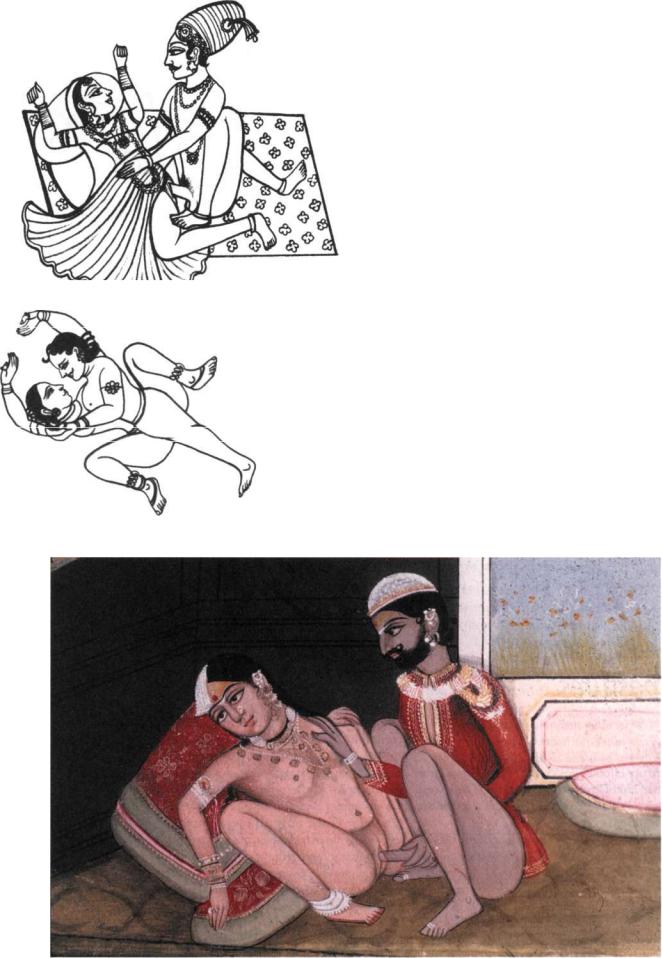
 Widely Open Position. From a Rajasthani miniature painting, circa eighteenth century.
Variation of Yawning Position. From an Orissan miniature painting, circa nineteenth century.
Indrani Position. A Rajasthani miniature painting, circa eighteenth century.
postures of the kama sutra
W I D E L Y O P E N P O S I T I O N
The woman lies back, lowers her head and raises up her middle parts. In this position, the man should take care to make his entrance easy.
Y A W N I N G P O S I T I O N
The woman lies back, raises her thighs and keeps them wide apart during lovemaking.
I N D R A N I P O S I T I O N
The woman lies back and draws up her thighs so that her knees are against each of her two sides. This position allows a woman to accommodate a man with an unusually large Lingam.
The three positions described above are particularly suitable when the man's Lingam exceeds the woman's Yoni in size. These positions are useful to a Deer Woman to help her widen her Yoni.
158 Vishnu the Preserver
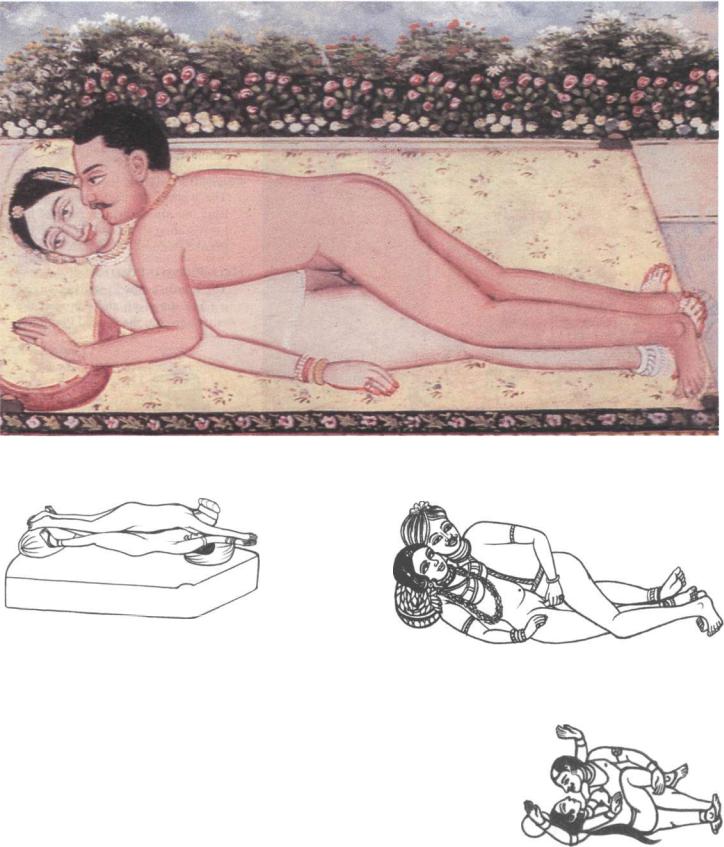
Variation of Clasping Position. An East Indian miniature painting, circa nineteenth century.
Clasping Position. From a Rajasthani miniature painting, circa seveneenth century.
Mare's Position. From an East Indian miniature painting, circa nineteenth century.
C L A S P I N G P O S I T I O N
This is when the legs of both the man and the woman are stretched straight out over each other. It takes two forms, the Side Position and the Supine Position, depending on the way in which the couple are lying. In the Side Position, the man should lie on his left side and the woman should lie on her right.
P R E S S I N G P O S I T I O N
After love-making has commenced in the Clasping Position, the w o m a n should press her lover by bringing together her thighs to hold his Lingam tightly. This is called the Pressing Position.
T W I N I N G P O S I T I O N
Continuing from the Pressing Position, the woman should place one of her thighs across the thigh of her lover. This is known as the Twining Position.
T H E M A R E ' S P O S I T I O N
This is when the woman brings her legs tightly together, in the Twining Position, and then forcibly holds the Lingam in her Yoni.
The preceding four positions are particularly suitable when the woman's Yoni exceeds the man's Lingam in size. They are useful to the Elephant Woman to help her constrict her Yoni.
Twining Position. From an Orissan miniature painting, circa nineteenth century.
Vishnu the Preserver 159
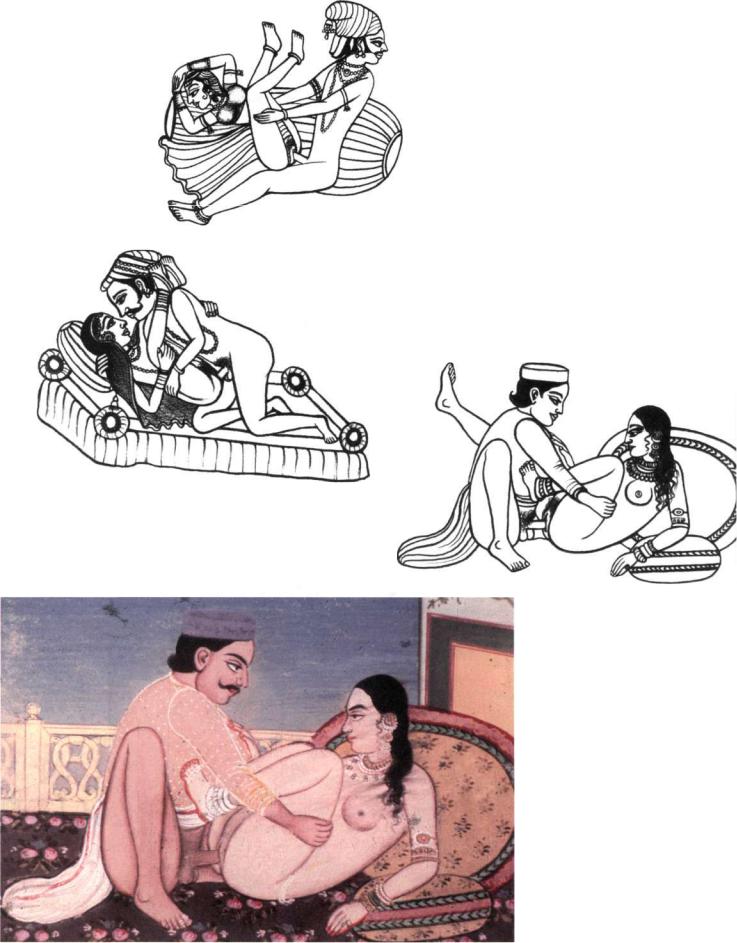
Rising Position. From a Rajasthani miniature painting, circa eighteenth century.
Alternate Yawning Position. From a Rajasthani miniature painting, circa nineteenth century.
R I S I N G P O S I T I O N
W h en the woman lies back and raises
her two thighs, it is known as the Ris-
ing Position.
A L T E R N A T E Y A W N I N G P O S I T I O N
This is when a woman lies back, raises both her legs and places them on the shoulders of her lover.
P R E S S E D P O S I T I O N
The woman lies back, draws up her legs, and places them in front of her lover's chest. This is known as the Pressed Position.
H A L F - P R E S S E D P O S I T I O N
The woman lies back, stretches out one leg and draws up and contracts the other one as in the Pressed Position.
Half-Pressed Position. From an East Indian miniature painting of the nineteenth century.
Pressed Position. An East Indian miniature painting of the nineteenth century.
160 Vishnu the Preserver
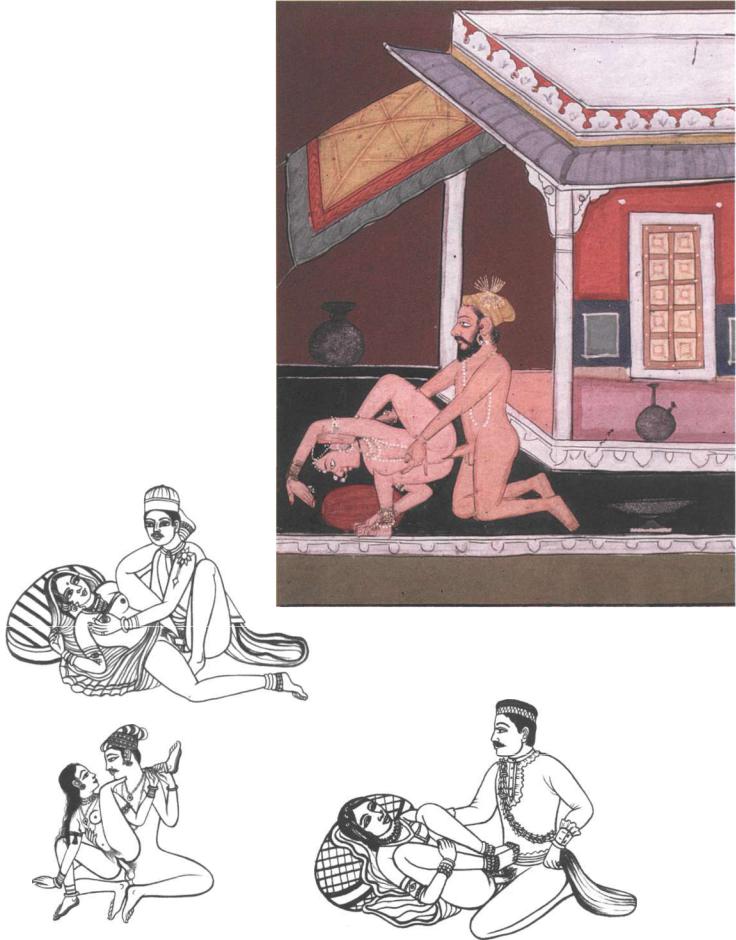
S P L I T T I NG A B A M B O O
This is when a woman lies back, places one of her legs on her lover's shoulder, and stretches the other leg out, and then reverses the procedure, placing the stretched-out leg on the other shoulder and bringing down the first leg, stretching it out, and so on alternately. This procedure is known as Splitting a Bamboo and requires great concentration to perfect.
F I X I N G A N A I L
This is when a woman lies back and places one of her legs behind her head and stretches out the other leg. This is known as Fixing a Nail and is a difficult posture. It should not be forced; it should be perfected by practice.
T H E C R A B
This is when a woman lies back, pulls up and contracts both legs, placing her feet on the region of her stomach.
Splitting a Bamboo Position. From an East Indian miniature painting of the nineteenth century.
Variation of Splitting a Bamboo Position. From a Rajasthani miniature painting of the eighteenth century.
Variation of Fixing a Nail Position. A Rajasthani miniature painting of the nineteenth century.
Crab Position. From an East Indian miniature painting of the nineteenth century.
Vishnu the Preserver 161