Материал: Snote
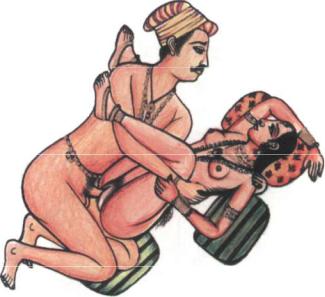
nine movements of the man
The Kama Sutra enumerates nine distinct categories of male sexual movements during love-making. This ninefold division, along with the tradition of Nine Kinds of Sexual Union (according to sexual sizes), is a constant feature of metaphysical systemization (see "The Yang Number" for a detailed description of the subtle meaning of the num - ber nine and its multiples). T h e N i n e Movements of the Man are:
M O V I N G F O R W A R D
The Lingam is moved forward, directly into the Yoni.
C H U R N I N G
The Lingam is held by the hand and turned and churned around in the Yoni.
PIERCING
The Yoni is lowered, and the upper part of it is then struck with the Lingam.
R U B B I N G
This is the same action as Piercing, done to the lower part of the Yoni.
G I V I N G A B L O W
The Lingam is removed some distance from the Yoni and then brought back to forcibly strike it. This is known as Giving a Blow.
B L O W OF A B O A R
This is when only one part of the Yoni is rubbed by the Lingam.
S P O R T I N G OF A S P A R R O W
This is when the Lingam is deep in the Yoni and is moved up and down repeatedly, without being taken out. This takes place at the approach to climax and should be a playful movement.
P R E S S I N G
This is when the Lingam is inside the Yoni and is pressed deep within.
T O G E T H E R P R E S S I N G
This is when the man and woman press the Lingam and Yoni alternately, with-
out any withdrawal. It creates a rapid climax.
W h e n a woman is acting the part |
||
of a man, she can enact his nine |
||
movements. The classical texts |
||
state that a man should al- |
||
ways make a point of |
||
pressing or focusing |
||
on those parts of her |
||
body on which she |
||
turns |
|
her eye. A |
man |
should learn |
|
from |
|
the actions |
and |
sounds of a |
|
w o m a n d u r i n g |
||
love - making so |
||
that |
he becomes |
|
aware |
of her dispo- |
|
sition |
and the way she |
|
best likes to be enjoyed. The Kama Sutra states that when a woman is enjoying lovemaking, she shows increased willingness to join the Lingam and Yoni as close together
as possible.
Taoist texts list ten different ways for a woman to act during love-making. We enumerate these in the section entitled "Secrets
of the Plain Girl," under the subhead "Ten Ways of Moving." This type of categoriza-
tion is helpful, since it indicates the order in which passion is physically manifested. Tantric texts attach great significance to stages of sexual excitement, seeing them as reflections of a greater cosmology, the order of the evolution of universes. T h e
Hevajra Tantra, for example, states, "From the union of Lingam and Yoni, the earth element arises out of contact with the quality of hardness. From the flow of secretions, the water element is evoked by the friction of love-making. The air element arises from the movements of lovers approaching ecstasy, and the space element corresponds to the all-pervading Bliss."
A couple should be aware of their movements during love-making and should try to manifest them as artistically as possible. This helps to focus the minds and emotions of the partners, enabling the channeling of energy and the transformation of ecstasy into the visions of unity. When lovers hold in mind and enact the multifarious sexual roles, they can build up to orgasm consciously. This is one of the secrets and goals of Tantric lovemaking.
A couple in the approach to Indrani Position. From a Deccani miniature painting, circa seventeenth century.
One of the man's chief duties is to learn to withhold himself as much
as possible and at the same time to hasten the enjoyment of his partner. The desires of the woman are cooler and slower to rouse than those of the man; she is not easily satisfied by a single act of lovemaking. Her slower excitement demands prolonged embraces, and if these are denied her, then she often feels irritated. By the second love-act the passions of a woman become thoroughly aroused and she has a full orgasm; then she can be said to be contented. This state of affairs is reversed in the case of a man, who approaches the first act burning with love-heat, which cools during the second, often leaving him languid and disinclined for a third.
ANANGA RANGA
Vishnu the Preserver 167
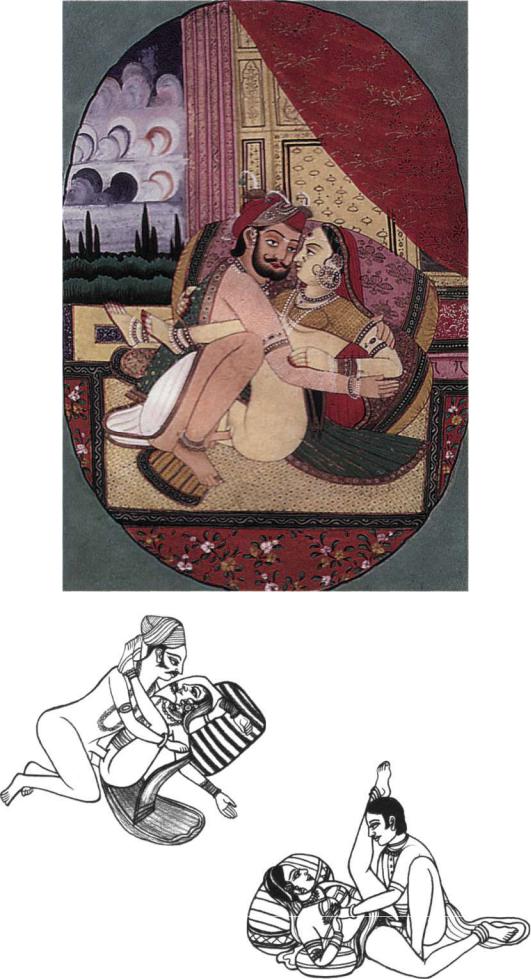
Equal-Legged Position. From a Rajasthani miniature painting of the nineteenth century.
A Hindu maharaja and his consort in the beginning stage of the Bird Position. A Rajasthani miniature painting, circa 1900.
postures of the ananga ranga
The Ananga Ranga is a relatively late Hindu work, probably of the sixteenth century. Known as the Stage of Love, it is an analysis and compilation of earlier love treatises such as the Kama Sutra. The text shows some Moslem influence, and has been translated into Arabic under the title Lizzat-al-Nisa
(Pleasures of Woman). The different lovemaking postures are systematized quite effectively into six categories. These are, first, with a woman on her back in a supine position; second, with the woman lying on her left or right side; third, the various sitting postures; fourth, the standing positions; fifth, with the woman prone, on her stomach; and sixth, with the woman on top, acting the part of the man.
Yogic, alchemical, and animal terminology are used to describe the positions in the
Ananga Ranga. Many can be related directly to Taoist equivalents. We will consider each of the categories individually.
Woman Lying Supine
ELEVEN VARIATIONS
E Q U A L - L E G G E D P O S I T I O N
The woman lies on her back, raises both legs, placing them on his two shoulders. Sitting close to her body, he inserts his Lingam into her Yoni. The couple then proceed with their lovemaking.
B I R D P O S I T I O N
The woman lies on her back and the man sits between her legs, raising them both and keeping them on either side of his waist. In this manner, they both enjoy their love-making.
T H E T H R E E S T E P S O R
S T E P P I N G B E Y O N D
One of the woman's legs is left lying on the bed while the other leg is placed on the man's head. He should support himself upon both hands.
Stepping Beyond Position (The Three Steps). From an East Indian miniature painting of the nineteenth century.
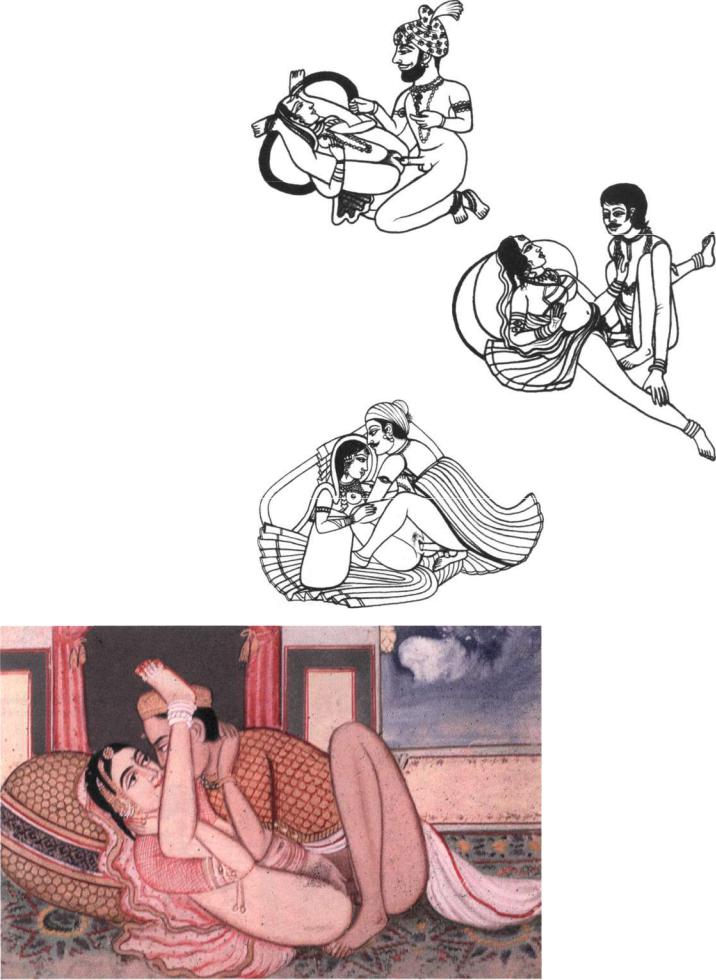
F E E T I N T H E A I R
The woman lies on her back and raises both legs, holding them with her hands, and drawing them back as far as her head. The man then sits as close to her as possible, places both of his hands on her breasts, and the couple make love joyfully.
R E M E M B R A N C E W H E E L
This is also known as the Wheel of Kama (the Love god) and is a method much enjoyed by voluptuous lovers. In this position, the man sits between the legs of the woman, who is on her back. He extends his arms as far as possible on both sides of her, holding her legs wide apart. He should move and turn the body with his arms.
T H E I N E X H A U S T I B L E K I N D N E S S O R FAVORITE SPLIT
The woman lies on her back and raises both her legs so that they touch the chest of her lover. He should sit between her thighs, embracing her closely and loving her passionately.
Full Feet in the Air Position. From a Rajasthani miniature painting of the late eighteenth century.
Remembrance Wheel Position. From an East Indian miniature painting of the nineteenth century.
Variation of Inexhaustible Kindness Position. From a provincial Mughal miniature painting, circa 1775.
Advanced stage of Feet in the Air Position. An East Indian miniature painting of the nineteenth century.
Vishnu the Preserver 169
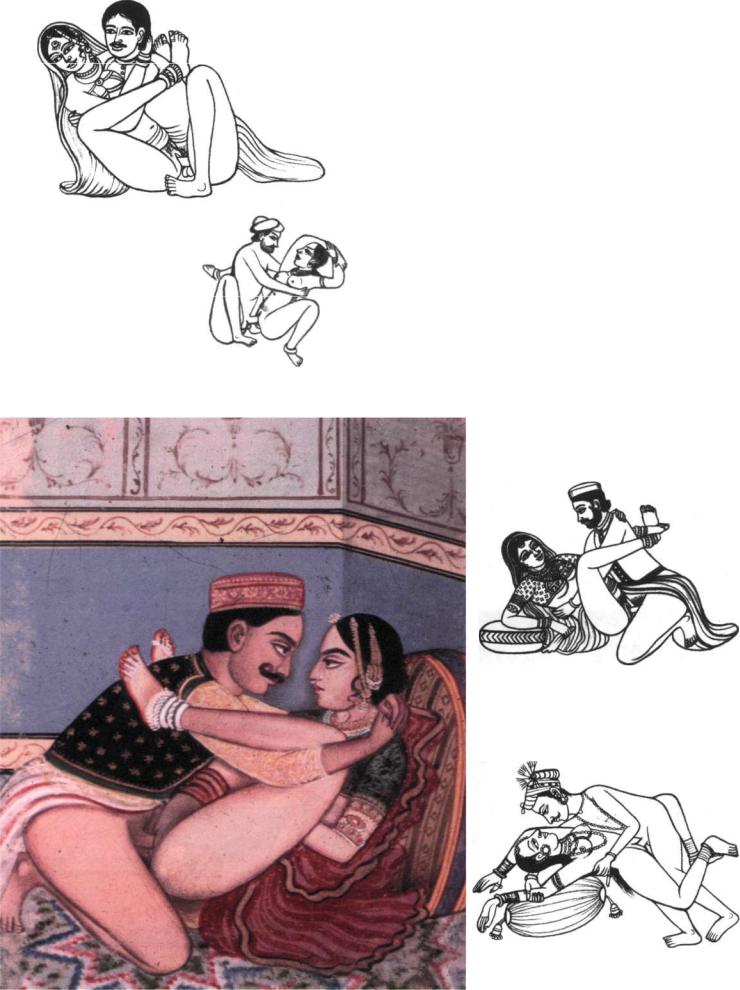
Elixir Position. From an East Indian miniature painting of the nineteenth century.
Variation of Elixir Position. From a Rajasthani miniature painting of the late eighteenth century.
The Bow Position. An East Indian miniature painting of the nineteenth century.
T H E E L I X I R P O S I T I O N
The woman lies on her back and the man squats on both feet. He places both hands under her lower back and draws her to him in close embrace. She returns his affection by tightly grasping his neck. In this position, they make love by gentle rocking backward and forward.
T H E B O W
The woman lies on her back. The man places pillows beneath her hips and head, raising her seat of pleasure and rising to it by kneeling on a cushion. With the woman's body now bent into the shape of a bow, he should aim his Arrow of Love. This is a particularly fine love-making position which is much enjoyed by both partners.
A L L - E N C O M P A S S I N G P O S I T I O N
The woman lies on her back with legs crossed and raised. The man carefully inserts his Lingam into her Yoni. This posture is very well suited to couples burning with desire.
All-Encompassing Position. From an East Indian miniature painting of the nineteenth century.
Variation of All-Encompassing Position. From a Rajasthani miniature painting of the late eighteenth century.
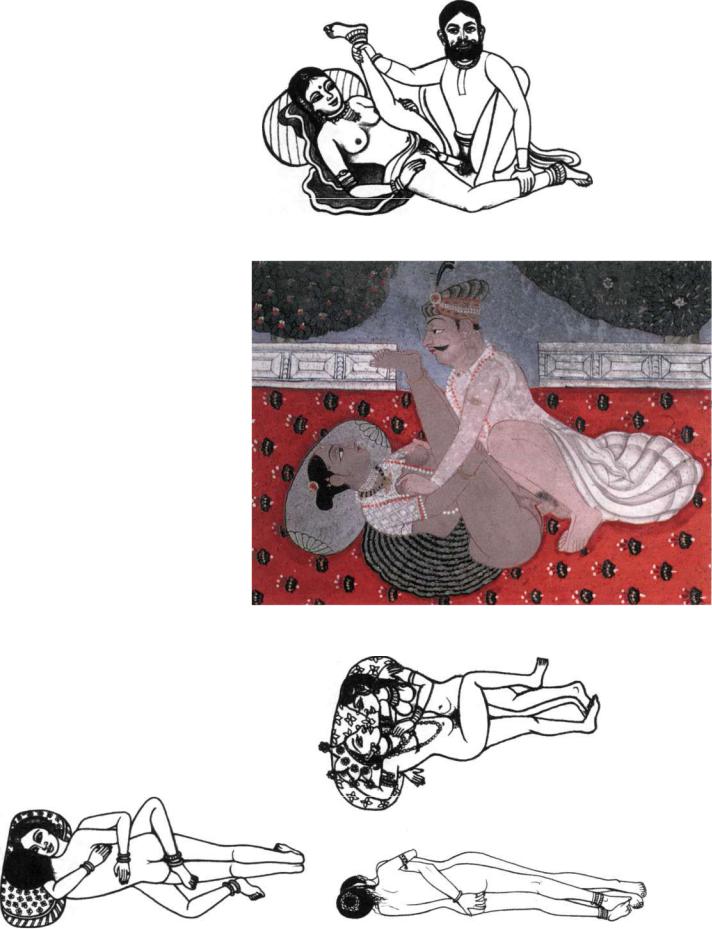
S P L I T T I NG A B A M B O O
This is a position with the woman lying on her back, with one leg upon her lover's shoulder and the other leg straight out on the bed. It is a very effective m e t h o d for bringing on a woman's sexual climax.
O P E N I N G A N D B L O S S O M I N G
P O S I T I O N
The woman lies on her back. The man inserts his Lingam into her Yoni and penetrates deeply. He then raises up her legs, joins her thighs closely together, and presses and releases them rhythmically.
Woman Lying on Her Side
THREE VARIATIONS
O B S T A C L E - R E M O V I N G P O S I T I O N
The man places himself alongside the woman, who is lying on her right or left side. He raises one of his legs over her hip, and leaves his other leg lying on the bed. This position is only suitable for love-making with a fully developed woman. With a young girl it is unsatisfactory.
T H E C R A B
The man and woman both lie on their sides. The man lies between her thighs, with one of her legs under him and the other thrown over him, just below his chest.
B A L A N C E P O S I T I O N
The man and woman lie straight on their sides, without any movement or change in the position of their limbs. Love-making is gentle and focuses on rhythm and breathing. This posture is also known as Double Hemisphere and echoes the process of alchemical distillation.
The Crab Position. From an East Indian miniature painting of the nineteenth century.
Splitting a Bamboo Position. From an East Indian miniature painting of the nineteenth century.
Variation of Opening and Blossoming Position. A large painting
on paper, formerly in the collection of the King of Nepal, circa 1830.
Variation of Obstacle-Removing Position. From a Rajasthani miniature painting of the nineteenth century.
Balance Position. Contemporary.
Vishnu the Preserver 171