Материал: Snote
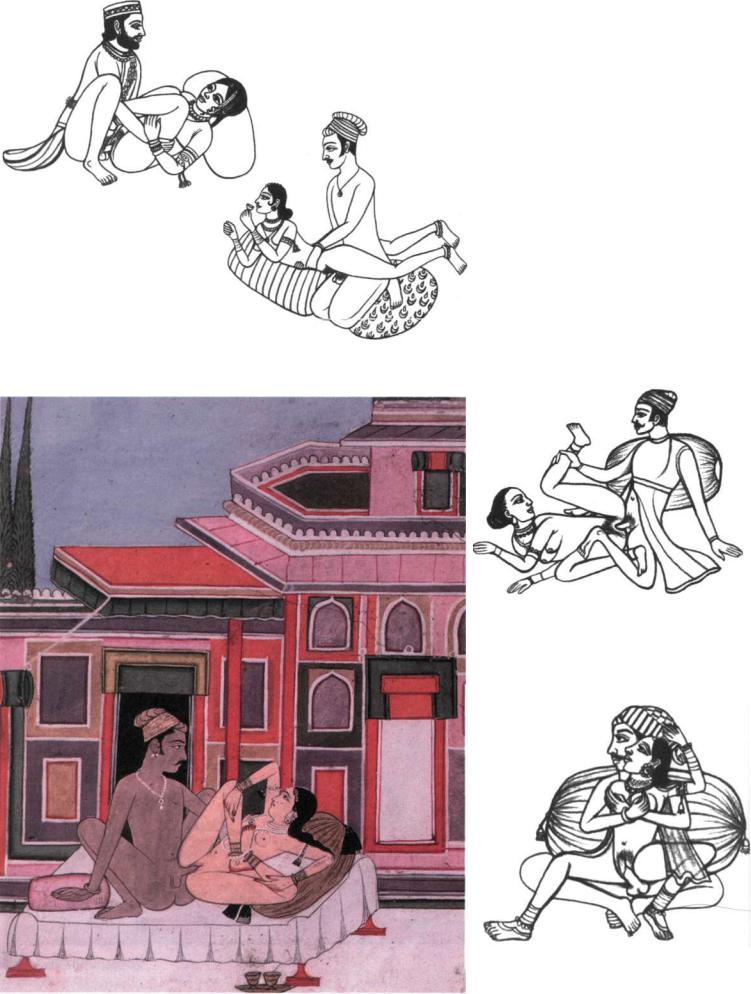
Packed Position. From an East Indian miniature painting of the nineteenth century.
Turning Position. From a Rajasthani miniature painting of the eighteenth century.
Lotus-like Position. A Rajasthani miniature painting of the eighteenth century.
P A C K E D P O S I T I O N
T he woman lies back, raises her thighs and crosses one leg over the other. This position creates a tight fit between the Lingam and Yoni.
T U R N I N G P O S I T I O N
When the man turns around and enjoys the woman from behind, without withdrawing from her Yoni, it is called the Turning Position. It can best be learned by practice.
L O T U S - L I K E P O S I T I O N
The woman lies back and crosses her legs in the lotus posture of a Yogi
(padmasana). She raises her thighs, bringing them up to her breasts. Entry is then effected, with the man kneeling or lying upon her.
Variation of Turning Position. From an East Indian miniature painting of the nineteenth century.
Variation of Turning Position. From a Rajasthani miniature painting of the nineteenth century.
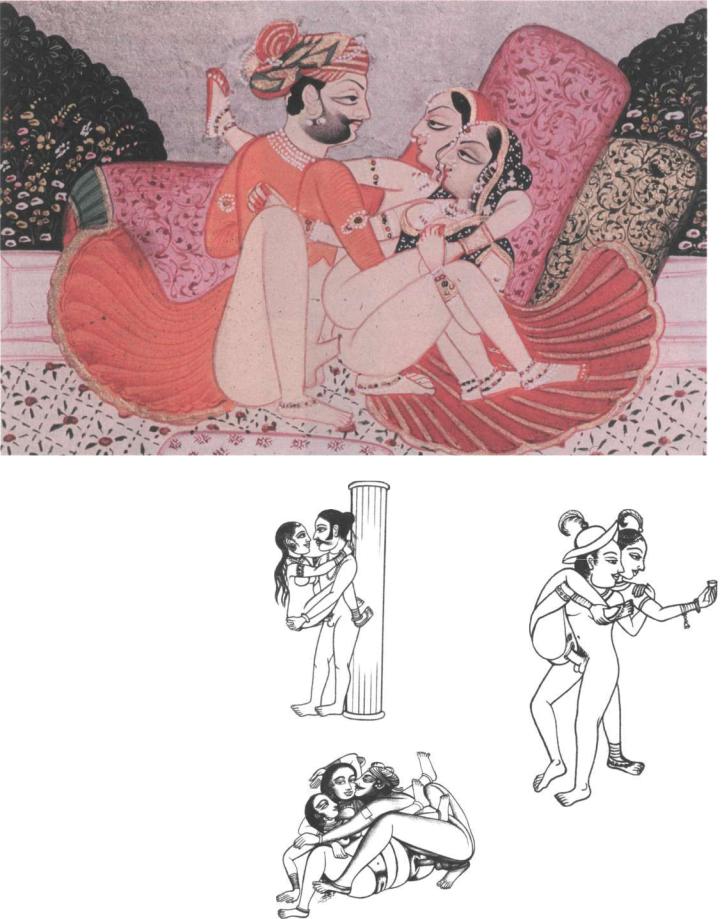
Variation of United Position. A Jodhpur miniature painting circa 1830.
U N I T E D P O S I T I O N
This is when a man makes love to two women at the same time, both of whom love him equally. It requires great self-control on the part of the man, w h o must ensure that each woman reaches her climax.
S U S P E N D E D P O S I T I O N
This is when the man supports himself against something and the woman, sitting on his joined - together hands, throws her arms around his neck, puts her thighs alongside his waist and moves herself up and down by pushing her feet against whatever the man is leaning on.
S U P P O R T E D P O S I T I O N
When a man and woman make love while standing, supporting themselves on each other's bodies or on a wall or pillar, it is known as the Supported Position.
Suspended Position. From a Rajasthani miniature painting of the early nineteenth century.
Supported Position. From a Rajasthani miniature painting of the eighteenth century.
United Position. From an Indian miniature painting of the mid-eighteenth century.
Vishnu the Preserver 163
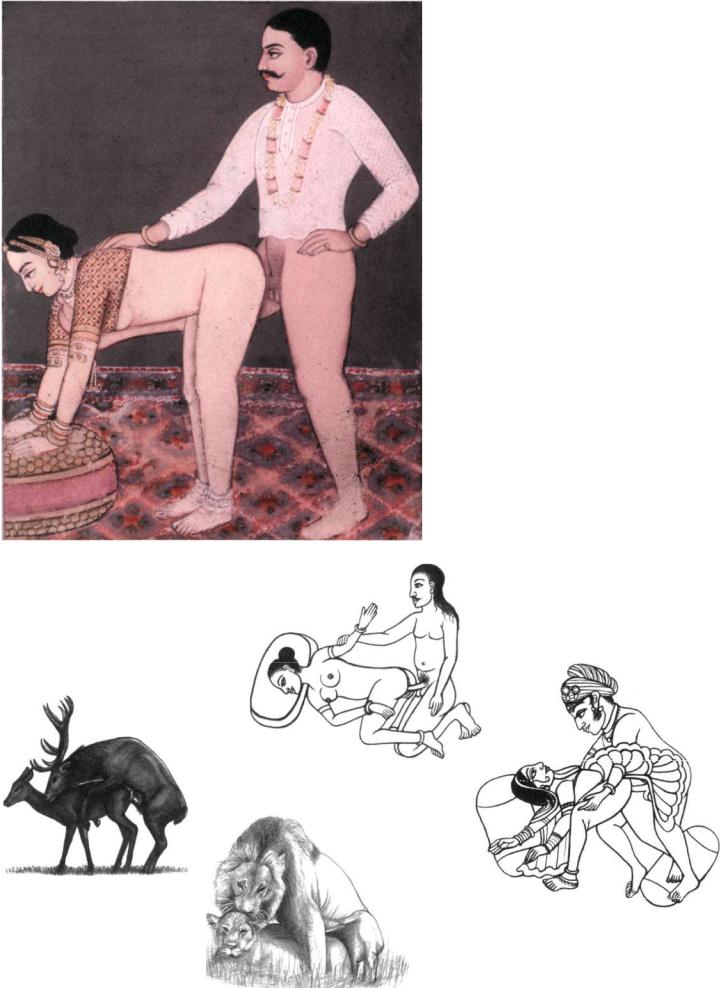
Position of a Cow. An East Indian miniature painting of the nineteenth century.
Love-posture from an erotic manual. Kashmir, nineteenth century.
Love-positions evolved from and were named after the different postures of animals.
P O S I T I O N OF A C O W
W h e n a woman stands on all fours, with her hands and feet on the ground like a quadruped, and her lover mounts her like a bull, from behind, it is known as the Position of a Cow. At this time, everything that is normally done on the breasts of woman should be done on her back.
O T H E R A N I M A L P O S I T I O N S
The characteristics of the different animals should be manifested by acting like them. The couple should produce sounds like the various animals. These auspicious positions are known as: Position of a Dog, Position of a Goat, Position of a Deer, the Forceful Mounting of an Ass, the Union of Cats, the Jump of a Tiger, the Pressing of an Elephant, the Rubbing of a Boar, and the Mounting of a Horse. Many lovemaking postures, like Yoga postures, evolved from the observation of animals. The indication is that the different natures of the animals should be emulated. Tantra teaches that this produces a sympathetic, magical bond with specific animals, whose particular powers and qualities (such as strength, quickness, sense of smell, or sight) can be assimilated by the couple. In this way, animals become allies or extensions of the human personality.
Variation of Position of a Cow. From a Rajasthani miniature painting of the late eighteenth century.
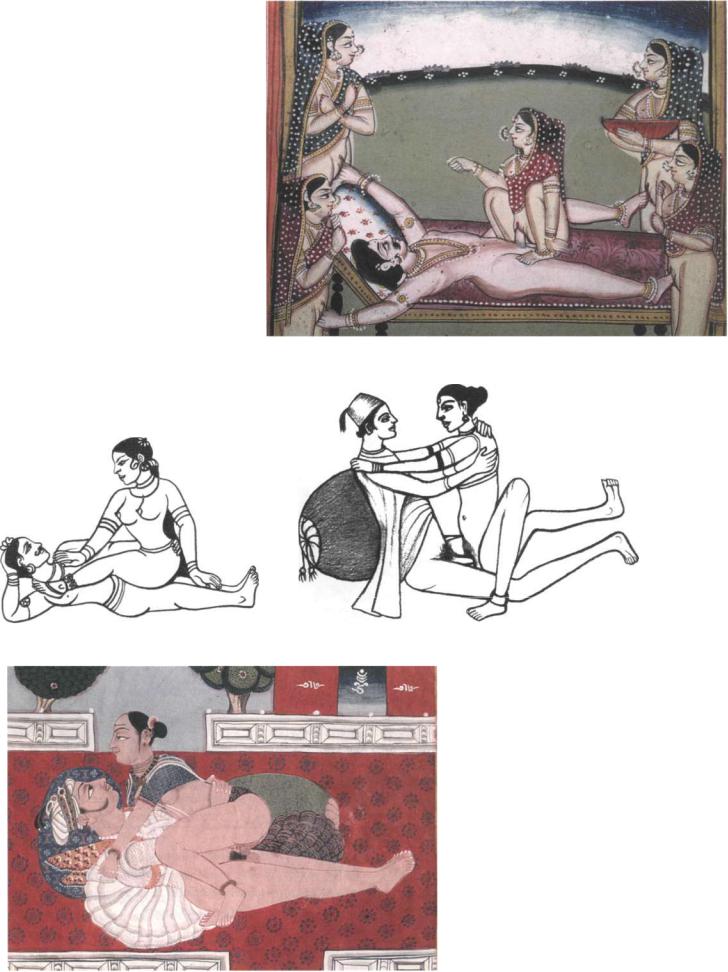
T H E H E R D O F C O W S
This is when a man makes love with a number of w o m e n simultaneously. There are other variations—the Union of Many Goats, the Union of a Herd of Deer, the Union of a Bull-Elephant with Many Females (which takes place in water)—all of which are imitations of these animals enacted by humans.
W O M A N A C T I N G T H E M A L E R O L E
During love-making, the woman turns around and gets on top of her lover and continues to make love to him. Or the woman can take up this position from the beginning. There are three variations of her movements in this position:
P A I R O F T O N G S
The woman sits on top of the man, draws his Lingam into her Yoni, holds it in by the action of her thighs, presses it, moves against him, and keeps the Lingam in her for a long time.
The Herd of Cows. A Rajasthani miniature painting of the late eighteenth century.
Woman Acting the Male Role. From an East Indian miniature painting of the nineteenth century.
Variation of Pair of Tongs Position. From an East Indian miniature painting of the nineteenth century.
A royal couple make love in the posture known as Pair of Tongs, in which the woman is on top of the man. A large painting on paper, formerly in the collection of the King of Nepal,
circa 1830.
Vishnu the Preserver 165
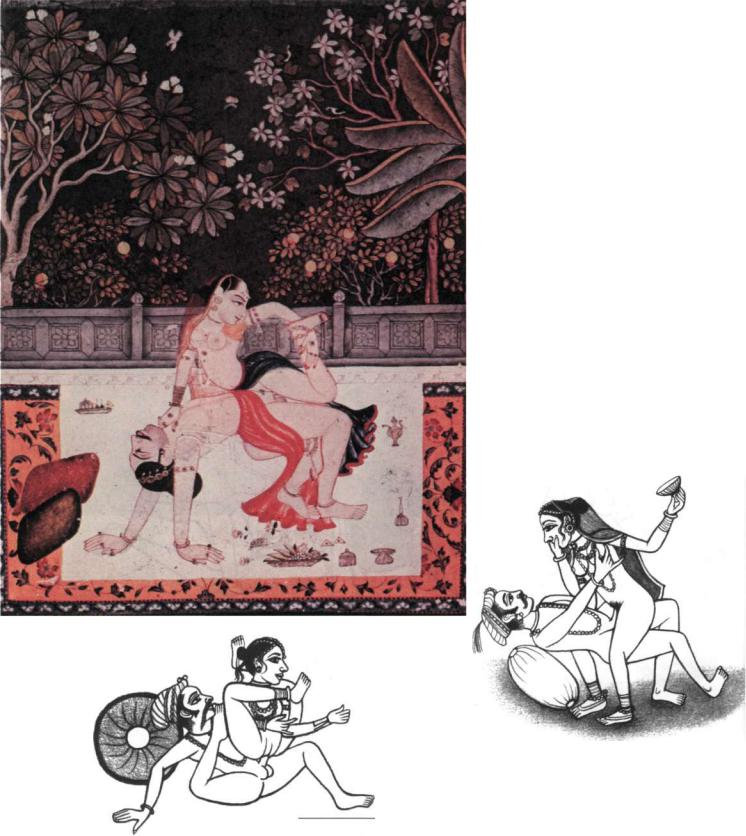
S P I N N I N G T O P
The woman sits on top of the man and takes care to maintain contact between the Lingam and Yoni. She turns around and around, like a wheel above him, swinging her body to create the mo - mentum. This is called the Spinning Top and can only be learned by practicing.
T H E S W I N G
The woman sits on top of the man, who lifts up the middle part of his body. She then turns around so her back is facing him and rocks backward and forward. This is called the Swing.
Many of the postures listed in the Kama Sutra can be practiced in sequence. Though some of the descriptions are abbreviated and by no means comprehensive, the Kama Sutra presents the entire range of love-making variations. The text suggests that lovers should practice love-making postures in water, since this makes bodies much lighter and more maneuverable.
Spinning Top Position. A Rajasthani miniature painting of the eighteenth century.
Variation of Spinning Top Position. From a Rajasthani miniature painting of the late eighteenth century.
Beginning stage of the Swing Position. From a Rajasthani miniature painting of the late eighteenth century.
An ingenious person |
should multiply |
the kinds |
of love-making after the |
|||
example of the many |
different |
kinds of birds and |
beasts. For these |
different ways |
||
of loving, performed according |
to |
the |
traditions of different countries |
and the |
||
preference of individuals, generate |
love, friendship, and respect. |
|
||||
|
|
|
|
|
KAMA SUTRA |
|
166 Vishnu the Preserver