Материал: Snote
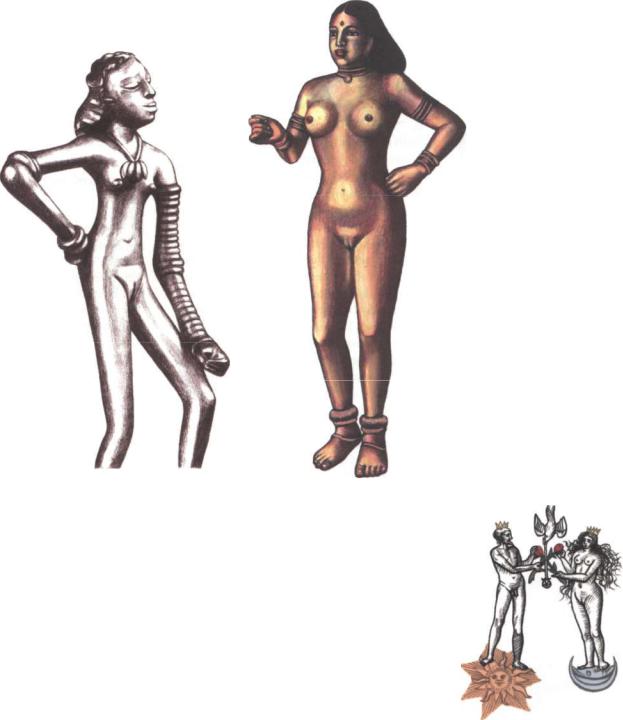
Dancing-girl in the pose of a sex initiatress. Bronze sculpture from the Indus-Valley civilization, Mohenjodaro, circa 3000 B.C. After the original in the National Museum, New Delhi.
Dancing-girl/Yogini in the posture of an initiatress (ahuyabarada mudra), inviting the exploration of her mysteries. From a wood
sculpture of the eighteenth century, Orissa, India.
to the exclusion of others. This leads to the repression of sexuality and its conversion into fantasy. People then become dishonest about their sexual feelings and instead cover up and create complex psychological problems. Fantasy takes over, feelings become atrophied, and separation inevitably results.
Though fantasy-inspired sexual role playing is in itself harmless, it rarely produces ecstatic experiences unless performed with a clear and shared commitment to a transcendental goal. Frequent concentration on fantasy scenarios d u r i n g sexual c o n t a c t commonly leads to boredom and frustration.
Sexual union can never be totally fulfilling and consequently unifying unless grounded in a real relationship. The qualities of Virgin and Whore should be incorporated into a relationship for their uplifting and transcendental value.
In much erotic literature, it is the "stolen joys" that taste sweetest; rarely are they shared by the committed couple. However, the bond of true intimacy should add to the capacity for sexual enjoyment rather than restrict it. The key to this seeming contradiction is to bring the unconventional into the shared experience of love.
Each sucks the nectar from the other's lips, breathing lightly, lightly. In those willowy hips the passion beats; the mocking eyes, bright like stars. The tiny drops of sweat are like a hundred fragrant pearls; the sweet full breasts tremble.
The dew, like a gentle stream, reaches the heart of the peony; and so they |
taste |
the joys of love in perfect harmony. For stolen joys, in truth, are ever the |
most |
sweet. |
|
CHIN-P'ING-MEI
Sol and Luna, the Sun and Moon, depicted crowned and holding plants, a dove bringing an offering. From a medieval alchemical woodcut.
Vishnu the Preserver 137
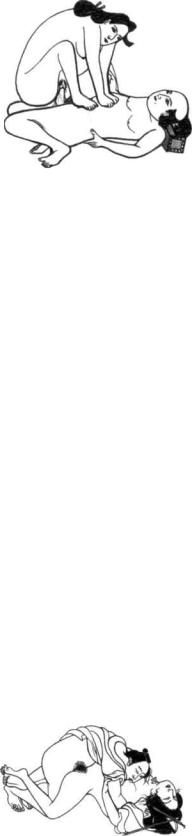
Woman in the active role of an initiatress. From a painted scroll by Yoshida Hamber, Kyoto ukiyo-e school, late seventeenth century, Japan.
Though a woman is naturally reserved and keeps her feeling concealed, yet when she gets on top of a man she should show all her love and desire. A man should gather from the actions of the woman above him of what type of disposition she is, and in what way she likes to be enjoyed.
KAMA SUTRA
Taoist love-posture depicting woman "raising up." From a painted scroll of the Japanese school of Hokusai, circa 1830.
active and passive
In "The Virgin and the Whore" we indicated the direct relationship between the submissive and aggressive roles. This flexibility in sexual roles should be fully exercised. Whether the man or woman takes the active role during love-making should depend on spontaneous feeling rather than design.
According to Hindu Tantra, woman by her very nature is the embodiment of Shakti, the active creative principle. It is also said that there is "an inner woman in every man," which refers to the raw energy of Kundalini. A popular Tantric expression states that "Shiva without Shakti is a corpse." It is the Shakti-power of woman that stimulates the erotic sentiment; woman arouses man by channeling this force, whereas man becomes aroused when this Shakti awakens within.
The consummation of love exists at both outer and inner levels. On the outside, in the realm of the sense organs, the play of love is brought about through the contact of the bodies and the senses. On the inside, erotic play takes place in the Subtle Body, the mind, and the spirit.
Both outer and inner loving require m o - ments of activity and passivity. The self or ego needs to become passive in relation to the Higher Self, one's "spirituality"; and the will needs activation and conscious control by the mind in order to awaken the Kundalini and direct it through the psychic centers (Chakras). The Kundalini energy, which is the active principle in sexual union, travels through the psychic centers and finds fulfillment in ecstatic union with the passive Shiva-principle in the Head Center. This is the consummation if inner living, the goal of Tantra.
Ecstatic sexual orgasm, the outer consummation of love, is a mixture of active and passive, the blending of "fire" and "water," the passions and secretions. Orgasm results from a mutual giving and taking, a balance of loss and gain. The inherent bisexuality of both man and woman seeks fulfillment in the exchange of active and passive roles. The mystical, alchemical, Tantric, and Taoist teachings express this concept in the symbol of the androgyne, the form that is at once both male and female.
The Chinese novel of the late Ming period called Jou Pu Tuan (The Way to Holiness through the Flesh) contains an illuminating account of how a woman can take the active part during love-making. A bordello madame, who had been taught the technique by a Taoist wizard when she was sixteen, offers the instruction, couching her description in diplomatic terminology:
F I R S T P R I N C I P L E
It is not the gentleman who should court the lady, but the reverse. If he lies down on his back, she mounts to the saddle and guides his Ambassador into the right channel. When the ambassador is flushed with enterprise, she holds him tight as a flute in a flute case. When he is listless, she rekindles the flame of his desire with deft finger-play. The wilder the fray, the more active and enterprising she should become; withstanding her adversary's attacks, she should joyously take the counter-offensive. Try as he may, he will be bound to miss certain spots, so the best thing to do is to help him find every sensitive place. Both will benefit. That is what is meant by the Taoist technical phrase "solicitously to lower the Pleasure House [Yoni] toward the Ambassador." That is the first artifice.
S E C O N D P R I N C I P L E
Ready for the fray, the lady takes her place beneath the gentleman. But she does not leave him to do all the work; full of sympathy and understanding, she assists him, taking up his movements and accompanying them. In this way, she turns the game of love into a delightful butterfly chase, giving herself and him a twofold pleasure and at the same time making it easier for the Assailant to arrive at his main goal, her Jewel Enclosure [the womb]. True pleasure must be had in common. The two participants should meet each other halfway. Then their encounter becomes a feast. If the lady does not respond to the gentleman's movements with really sympathetic counter-movements, but remains passive, he might just as well resort to a wooden or cardboard woman with an artificial Pleasure House. Why, then, bother with living woman of flesh and blood? Every first-class courtesan follows this principle, so gaining the favor of her guests and increasing her own pleasure at the same time. This then is the second artifice,
138 Vishnu the Preserver
which is designated by the Taoist technical phrase "obligingly to lift her Pleasure House to meet the Ambassador."
T H I R D P R I N C I P L E
This has to do with something quite extraordinary, something bordering on the magical arts. When there is mutual sympathy between players and they are intimately entangled, a woman should become animated by a desire not to waste the vital essence of her womanhood, not to secrete it for nothing, but to bestow it on her lover for his lasting pleasure. Otherwise she will regret the emission of secretions as a sheer loss, a "loss of capital," so to speak. And so she should resolve that her secretion of vital essence will not be in vain but will redound to her lover's advantage. But how does she go about it?
When she is on the verge of ecstasy, she commands her lover to bring his Tortoise Head close to her Flower Heart [the opening to the uterus], and then to cease all movement. Clasping him in her arms and legs and pressing him close, she gives her belly a very special twist [see "Nurturing Nature"], which causes her Jeweled Enclosure to open and the orifice of her Flower Heart to come to rest precisely on the orifice of his Ambassador. The Ambassador is thus enabled, when ecstasy sets in, to drink her vital essence. It pours directly from her Gateway into his Cinnabar Field [solar plexus] and produces its effect. The wonderful
thing about this kind of essence is that it possesses a vitalizing power that no ginseng preparation can approach; moreover, there is nothing like it for prolonging life and rejuvenating the body. This, then, is the third and highest artifice, which is designated by the Taoist technical phrase "sacrificing vital essence for the lover's benefit."
A good lover has no predetermined routine, but can adapt spontaneously to the m o - ment, becoming one with it. An ancient hermetic teaching declares, "As above, so below." As mentioned previously, the person on top echoes the role of Heaven, whereas the one underneath corresponds to Earth; either the male or the female can fulfill these roles to complete satisfaction. Heaven and Earth "mutually complete each other."
The Moslem teaching on sex, which sought at all costs to keep woman in a subservient position, declares that a woman should "not act the part of a man," adding that this might weaken the man both physically and psychologically.
However, the Indian and Chinese teachings on sexuality emphasize the benefits to be obtained from role switching. In the many postures of love outlined throughout this third part of the book, active and passive roles are meant to be freely experimented with. Once a natural versatility is gained, the pure joy of intimate love-making can be experienced in the exchange between active and passive.
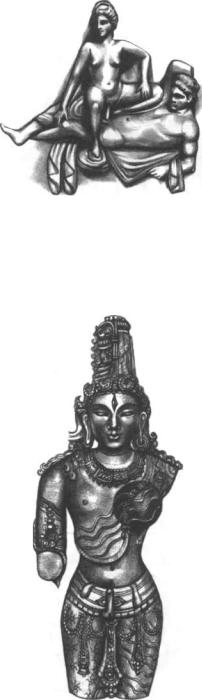
Woman in the active role. Ancient Greek and Roman love-postures show a wide range of variety. The initiatory power of woman playing the active role was well known. From a Roman marble carving, Naples Museum.
There is a particularly potent form of love-making that is known as the Method of the Large Bee. In this, the wife, having placed her husband full length upon the bed or carpet, sits
squatting upon his thighs and closes her legs firmly after she has inserted his Lingam into her
Yoni. Moving her waist in a circular way, churning as it were, she enjoys her husband and
thoroughly satisfies herself. |
While thus reversing |
the natural order, the woman should draw |
|||
in her breath, in the way |
known |
as Sitkara; she should smile gently and show a kind of |
|||
half-shame. |
Then she should say, |
"O husband! |
Today you have become subjected to me, |
||
being totally |
defeated in the Battle of Love." Moreover, she should remember that, without |
||||
a special exertion of will power on |
her part, the |
husband's pleasure will not be perfect. |
To |
||
this end she must ever strive to close and constrict the Yoni until it holds the Lingam, |
as a |
||||
finger, opening and shutting at her pleasure, and |
finally, acting as the hand of the Gopi |
||||
maiden who milks the cow. This can only be learned by practice and especially by throwing the power of the will into the part to be affected. While so doing, she should mentally repeat the name of the Love god, Kamadeva.
ANANGA RANGA
Ardhanarisvara, the androgynous Shiva, with left side female and right side male. The inherent bisexuality of all humans is suggested by this iconographic form.
From a stone sculpture of the twelfth century, Bengal.
Vishnu the Preserver 139
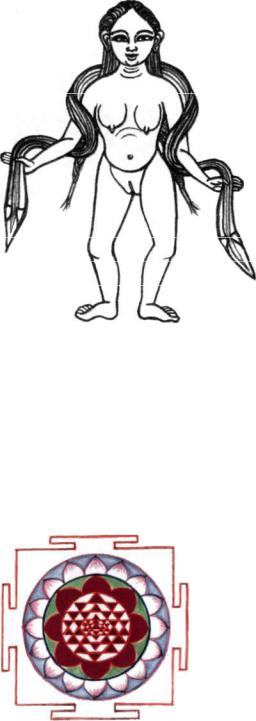
The White Dakini symbolizes the removal of ignorance and worldliness. Her form is visualized as an ideal Yogini, who has the power of initiation into the Wisdomteachings of Tantra. From a Tibetan painting of the late eighteenth century.
Sri Yantra, a mystic diagram comprised of nine interlaced triangles; the five upwardpointing ones symbolize Shiva-principles and the downward triangles symbolize Shakti-principles. Depicted as white and red, this Yantra evokes the unity of Shiva and Shakti. From a Rajasthani painting, circa 1800.
the red and the white
In Eastern cultures, the color red is associated with the female principle and the color white with the male. In ancient China, red always symbolized woman, creative power, sexual potency, and a happy, successful life. Brides usu-
ally wore red silk under trousers and marriage was referred to as the R e d Affair. R e d lanterns were suspended
outside wine-houses and brothels; even burial gifts were painted red in the belief that this would help preserve them from decay.
In India and Tibet, the color red has very similar connotations. It has always suggested dynamic femininity, creative power, passion, and sexual energy. R e d symbolized fire in the Tantric tradition, and red marks are applied to the forehead of both men and women as a ritual reminder of and a symbolic identification with Kundalini, the creative energy within. The central point of mystic diagrams, such as the Sri Yantra, is usually colored red and is known as the Shakti Bindu, the energy point. In Tantra, red is the color code of passion and transcendental delight. The R e d Dakini, an ecstatic redcolored goddess in the form of a young girl filled with passion, symbolizes in Tantra the refinement of emotion.
Islam attributes similar qualities to the color red. Moslems use the adjective red when describing a beautiful woman. There is a popular Arabic saying that "beauty is red" and red-colored veils are considered particularly seductive: "If ever you go out, my girl, put on a veil of red," declared a famous Arab poet. In the West, we too have sexual associations with the color red; for example, the red heart of Valentine's day, the "scarlet woman," and the "red-light district" all have sexual overtones. R e d light stimulates the sex hormones of the male, and has long been the color associated with sensuality and pleasure.
In ancient China, the color white symbolized man, the transcendence of all worldly things, death, and mourning. Burial ceremonies were always referred to as the White
Affair and white was worn at funerals; this custom is practiced throughout the East to this day.
In India, celibates traditionally wear white. White is associated with Yoga, meditation and Shiva, who is often described as being "white as camphor." In Tibet, the White Dakini is worshipped and identified with for the "removal of worldliness" and Avalokiteshwara, the Compassionate Savior, the symbol of transcendence through the removal of delusion, is depicted as white. Islam strongly identifies white with purity, masculinity, leadership, and mysticism.
The mystical significance of the Red and White can only be fathomed through a consideration of both the inner and outer aspects of man and woman. We will see that the red and white forces exist in both, but are related to different functions in man and woman . The natural bisexuality and the complementary attributes of male and female reveal themselves in the context of the Red and White.
Woman is traditionally viewed as receptive, intuitive, watery, and lunar. W h e n stimulated, woman emits profuse watery secretions from her mouth (saliva) and Yoni (sexual discharge). The texts of Taoism and Tantra declare that the Shakti or Yin-force of woman is inexhaustible, provided she lives a natural and harmonious life. A woman becomes "fiery" when her passions are stirred up; emotions cause this arousal, altering her rate of breathing, and stimulating her navel center. W h e n a woman has her monthly period, she emits red blood, and after giving birth, she produces white milk to feed her baby. Woman cries more readily than man when emotionally upset or stimulated.
Man embodies the qualities of aggression and logic. Traditionally associated with the sun and the element of fire, man has a tendency to become dry-mouthed and red-faced when angry. Man rarely cries when upset, but becomes more fiery. When the passions of man are stimulated, his rate of breathing increases; his inner fire at the navel center of psychic transformation flares up. In sexual excitement, this awakens the dormant Kundalini-energy, his inner woman, which surges up the spinal column in wave after wave and "melts the moon" in the head center. The physical correlate of the head center is the pineal gland, which regulates and controls sexual secretions. Man's sexual
140 Vishnu the Preserver
stimulation culminates in ejaculation of white-colored semen.
The Goraksapaddhati, an important Hindu Yogic text, declares, "The quintessence of the body is of two kinds. These are the white and red bindus [literally "seeds" or "points"],
the former of which is of the nature of semen and the latter of which is of the nature
of the ovum." The text goes on to say, "Semen is concentrated originally in the inner moon of the head center, and is the attribute of Lord Shiva, the Yogi par excellence. The ovum is concentrated originally at the inner sun of the navel center and is the attribute of Shakti, the goddess of all becoming." This text presents a clear outline of the twin aspects of lunar and solar forces in the two main bodily centers. It is interesting to note that in this description of the location of the original archetypal sexual forces, the normal "worldly" roles of Shiva as the sun and Shakti as the moon are reversed. Once again, this points to the original hermaphroditic nature of the human psycho-organism.
Every man and woman is the product of the synthesis of sperm and ovum, "seed" and "egg." A Tantric text declares, "Seed is generated inside the body of man and the egg is created in the body of woman. This takes place by virtue of the intake of food rightly digested, which becomes successively transformed into blood, flesh, fat, bones, marrow, and vital essence, the whole process requiring exactly twenty-eight days to complete." This one-month period is, of course, identical to the menstrual cycle of woman.
In man's body, the most refined sublimation of food is transformed into sperm, which, according to Tantra, contains the man's mental, emotional, and physical characteristics in living and transmittable form. Modern embryology confirms this concept.
Sperm is a very complex substance, with the capacity to live and retain "consciousness" for a long time after ejaculation. R e - cent tests by Cleve Backster suggest that sperm that has been released and contained "recognizes" and responds to the presence of the original donor. These tests have been conducted under laboratory conditions, using a technique known as polygraphy. It is logical to suppose that the same reaction occurs when the sperm is inside the body of a woman. The conscious resonance between sperm and donor long after ejaculation is the rationale for magical spells that specify the
use of human sperm for empowering amulets and talismans.
Though ejaculated sperm has been observed to remain alive for only a few days under normal conditions, fe-
male snakes (the symbol of the Kundalini-energy) have the ability to store sperm from a male snake and use it to impregnate
themselves more than six months later. Both Tantric and Taoist texts describe methods of storing and transforming sperm into an inner "lunar effulgence," the
Soma. A.text declares, "The Yogi can cause his seed to rise up to his head center, where it becomes transformed i n t o Soma, the Elixir of gods." In contrast to woman, who has
an unlimited supply of vital es-
sence and can therefore have repeated orgasms, man makes sperm from all parts of his body and is limited in how many times he can ejaculate in a single love-session. Sperm is produced from digested food over the period of a month. A man must eat invigorating food in order to replace the loss of vital body elements from repeated ejaculations of
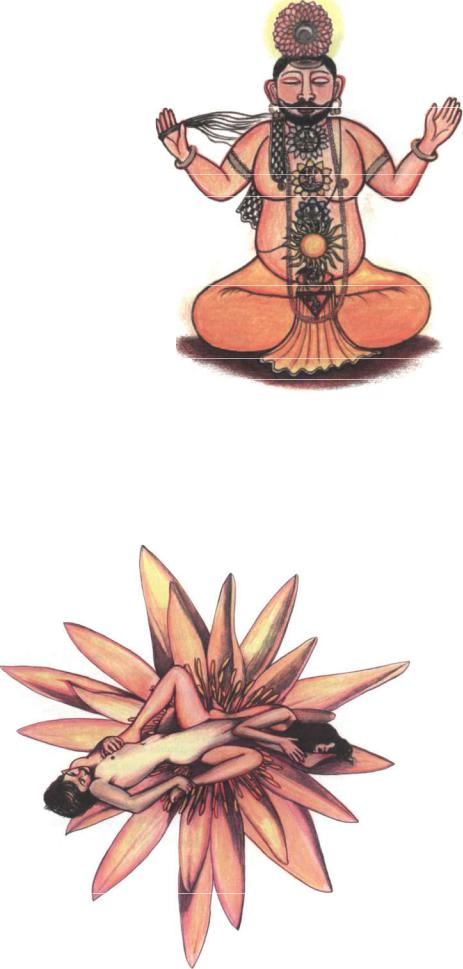
A Tantric Yogi displaying the centers of the Subtle Body. The cooling moon of the head center distills the psychic heat of the navel center. From a Rajasthani miniature painting of the late eighteenth century.
Tantric love-posture for channeling and circulating the energies of ecstasy.