Материал: Snote
erotic sentiment; whether literally or allegorically depends on the particular context, but always these two elements evoke the erotic. The Tantras declare that the "fires" and "waters" can be experienced through the bodies of both men and women; love-making is the most direct way of realizing their potencies. Solar and lunar breathing, as outlined in the first part of this book, is automatically brought about by the movement of postures during peaks of sexual activity. If consciously channeled, the forces of breath can evoke the solar and lunar energies within and rapidly bring about the prolonged experience of Tantric ecstasy.
In the East gaiety, joking, and laughter are encouraged at funerals, births, and marriages, for this spirit, rather than solemnity, fosters love. In the West the concepts of love, lust, and the erotic have been greatly confused. This has been due in large part to the influence of the church, which has chosen to ignore the spiritual dimension of physical love. An old Indian adage declares, "The
comic sentiment arises from and is next to the erotic." Another states that the comic is the "mimicry" of the erotic. The mass me - dia have exploited the closeness between the comic and the erotic sentiment. Titillating comedy often serves to relieve the tensions of unfulfilled sexuality. Though laughter is itself healing, it is no substitute for eroticism. Extreme outbursts of laughter can in fact block the flow of energy within the body or force it to flow along unnatural channels.
The enormous surge of sexual liberation movements makes this an apt moment to reevaluate the function of the erotic sentiment in the light of Tantric and Taoist traditions. These teachings repeatedly confirm the most revolutionary discoveries of new-age psychiatry, medicine, and cosmology. The remainder of this book outlines important points for consideration. It offers a detailed account of the role of eroticism, particularly as it pertains to the preservation and maintenance of the highest aspects of man and woman.
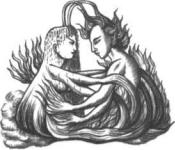
Food is called "Soma," the Waters, which represent the female of Mother-principle, whereas "Agni," the Fire, represents the male of Father-principle. When these two are satiated it is called real spiritual worship.
RATISARA
Cosmic fire and cosmic water in union. This alchemical concept is found in medieval treatises but originally was developed in the mystery schools of the East. Illustration from an Indian manuscript.
How delicious an instrument is woman, when artfully played upon; how capable is she of producing the most exquisite harmonies, of executing the most complicated variations of love, and of giving the most Divine of erotic pleasures.
ANANGA RANGA
Vishnu and
Lakshmi
In its role as Preserver, the Divine is called Vishnu. His is the force that maintains all existence. His symbols are the conch shell and discus. Lakshmi is his female counterpart. This archetypal couple, visualized in practice as god and goddess, are identified as higher aspects of the human psyche. To be-
come Vishnu or Lakshmi is to become the Lord or Lady of Preservation, the embodiment of spiritual wealth and material prosperity. In Tantra the couple strives to embody these two principles.
Vishnu "dreams" the play of the world and teaches various methods of preserving the higher self by extracting "Bliss-waves" from the great cosmic Ocean of Existence. Vishnu, the Lord of the Universe, is generally visualized as blue in color. In his original form, he reclines on a great, many-headed serpent, the embodiment of infinity, who supports him on the cosmic Ocean. It is said that nine different incarnations of Vishnu
Vishnu and Lakshmi are ever in love-dalliance together; for this purpose they assume various forms. Their changing outer manifestations tell of their inner communication with each other. They are the Eternal Lovers.
VISHNU PURANA
Vishnu the Preserver 127
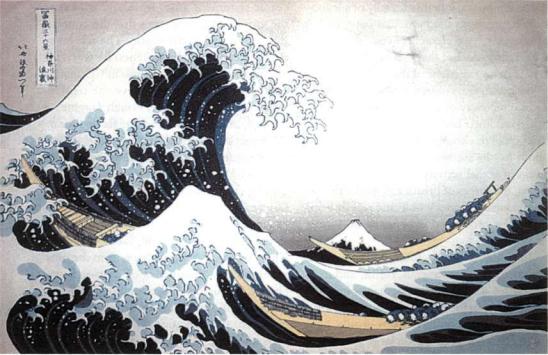
The Wave of Bliss. From the "36 Views of Fuji" by Hokusai, circa 1820, the "Great Wave of Kanagawa," Japan.
Unconventional love corresponds to the path of non-involvement in the world and contact with the cosmic principles; it is solely for erotic purposes. Conventional or "procreative" love produces immortality through the line of progeny and the accompanying obligations and ancestral rites.
Unconventional or "erotic" love offers immortality through the power of sudden release.
DURLABHASARA
have manifested in the world. This myth seems to be an ancient rendering of evolutionary theory; the first incarnation was a fish, then a tortoise, a boar, a man-lion, a dwarf, a warrior, a heroic killer of demons, the Eternal Youth (Krishna), and the Buddha (the intellectual aspect). A tenth incarnation, Kalki, has yet to appear; he is the cosmic horseman of the Apocalypse who will come to destroy all corruption of this Age.
Many other forms of Vishnu are described in the texts, some of them having four or six arms, which iconographically expresses his multiple roles in a single visualization. Lakshmi, the female counterpart of Vishnu, is conceived as white or red in color, depending on her sentiment, and holding a lotus flower as her special symbol. She too can take many different forms, even multiplying herself to become the different "wives" of her Divine Lover.
The Prapanchasara Tantra provides this richly detailed visualization of Vishnu and Lakshmi, which may be practiced by the couple in endeavoring to evoke the divinity within. It states,
Think of a beautiful garden filled with wish-granting trees, fragrant with the scent of flowers and harmonious with the rhythmical humming of large bees. Then meditate on Vishnu, seated upon the great Garuda-bird, who rests upon a red lotus. This form of Vishnu is of a
red color, expressive of the erotic sentiment, brilliant like the hibiscus flower and shining with the force of millions of rising suns. He manifests as a handsome youth, exuding sweet-scented nectar and loving kindness; he holds various weapons, including the conch shell, club, bow, and discus, and his eyes are gazing upon the face of his consort Lakshmi, who embraces him with the fullness of her love. Encircling this Divine Couple are many beautiful women, with heavy thighs, hips, and breasts, smiling erotically, moving voluptuously, and sensuously forming their hands into the shapes of lotuses. Their lips are parted, but they are silent in a tremulous kind of passion; with clothes and hair in disorder, their eroticism is openly expressed.
Such a visualization evokes the erotic sentiment, which in turn circulates vital energy. Erotic thought has an immediate effect on the rate of breathing, the heartbeat, and the flow of energy. Tantra teaches that the role of woman is multifarious; a woman can easily become a number of women. If a woman allows herself to become multiple in her manifestations as girl, wife, mistress, whore, virgin, and so on, there will be an immediate increase in the vital sexuality of her man. This happens on a basic energy level; it is biological and psychological at the same time. The expansion of consciousness in a woman natu-
128 Vishnu the Preserver
rally creates multiple anima-characters. A man exists primarily in multiple roles, such as hunter, hero, husband, lover, or businessman. Through the expansion of consciousness he naturally distills these into a single entity, which on the highest level of Tantra is the Yogi, or Guru archetype. The ability of a woman to become "all women" for her man is a great source of raw energy and a tremendous vitalizing contribution to a relationship.
Vishnu and Lakshmi together rule over the erotic sentiment, particularly in its function as the sustaining force of existence. Vishnu and Lakshmi also rule over the element of water, without which we cannot maintain our worldly existence. The erotic urge generates profuse and moist secretions; this is essential to our well-being, both in the realm of materiality and that of spirituality. The Skanda
Purana, a Hindu text, declares, "Everything proceeds by sexual intercourse. Without sexual love all creatures dry up."
The myths of Hinduism tell us that the son of Vishnu and Lakshmi is the Love god, Kama. A kind of Indian Cupid, he shoots arrows made of flowers on a bow made from flowers and bees. Symbolic of the senses and the erotic play, this account of the "birds and bees" is an interesting variation on the Western concept. Kama is extremely handsome, as Shiva granted him the gift of eternal youth and beauty. Kama embodies the love of Vishnu and Lakshmi; often pictured riding on a dove, he has the cuckoo and bee as his allies. He is especially remembered during Springtime and at the moment of ritual lovemaking. It is Kama who is evoked in the hearts of lovers; the Kama Sutra is his song, the "Melody of Love."
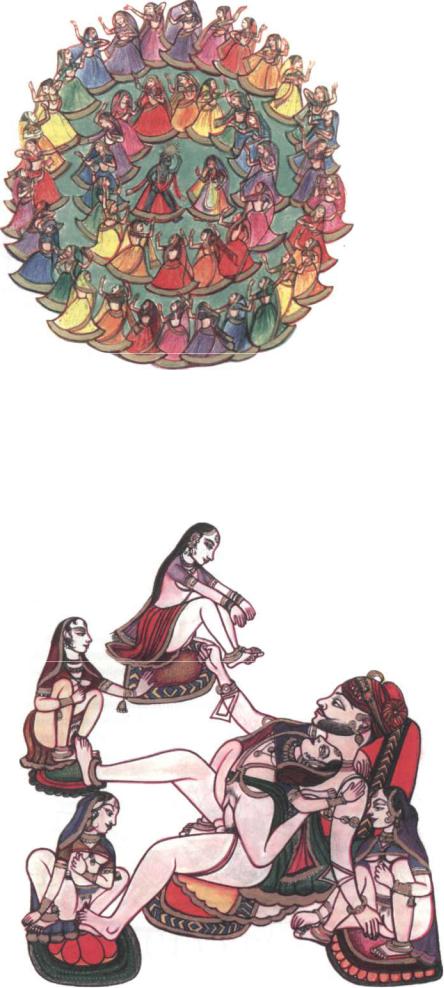
The eighth incarnation of Vishnu is known as Krishna, the playful child or "Eternal Youth," who is depicted in a bluish color and is the popular expression of the erotic sentiment in present-day India. Tantric sexual rites often recapitulate the legends of Krishna, who "sports erotically with the Gopis, the cow-herding women, encircling him, vying for his attention." The Gopis, who milk the cows and churn for butter, are symbolic of the erotic play in life. They also represent the inner swirling of emotion during the process of spiritualization.
The circular erotic dance of Krishna with the beautiful Gopis expresses both the inner swirling of sexual energies in the psychic centers of transformation and the swirling
of galaxies in the macrocosm. This "Krishna Lila" or "Krishna's Play" is a psycho - cosmic glyph of energy transformation in the Tantric tradition. It is an erotic dance that evolves from the multifarious nature of woman in her expansive capacity, circulating, and constantly changing around the
The Krishna Lila: The "Play of Krishna." This is a psychocosmic glyph of energy transformation. The beautiful Gopis encircle Krishna. Each one believes that her specific existence is dancing with him alone. From a painting in the collection of the Maharaja of Jaipur, circa 1800.
A maharaja in Tantric union with his consort and four other women
simultaneously. This form of eroticism should be understood on three levels: as an expression of the multifarious roles of woman within a monogamous relationship; then on the level of a polygamous sexual encounter with energy access and circulation as the criterion; finally and iconographically this
form of love-making is known in Tantra as the Union of the Five Senses. From a miniature painting, Kotah, India, late eighteenth century.
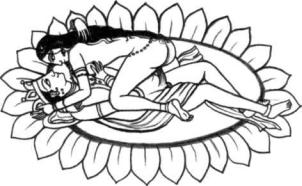
Kama and Rati in erotic union. Kama is the Love god, the mystic child of Vishnu and Lakshmi. Rati is his wife, the embodiment of sexuality. A
Hindu myth tells how, after Kama was slain by Shiva for using his powers to help Parvati seduce this supreme Yogi, Rati acquired a blessing that restored her husband to life in the form of an Eternal Youth. From an Indian painting of the eighteenth century.
single absolute archetype of God-man, the ever-playful Krishna.
The ideal of the Krishna Lila is very popular in contemporary India, despite the tendency to more puritanical religious modes of expression. Spiritual sensuality has, in general, been repressed in the East, largely because of the influence of Moslem and Christian invaders. Nevertheless, Indian wives still like to think of themselves as Gopis serving Krishna, and popular devotional songs express this longing for liberation through sensuality.
The Gopis are aspects of Lakshmi, just as Krishna is a manifestation of Vishnu. Each Gopi claims Krishna for her very own; any separation from him creates an intense longing. The Gopis represent refinements of the great emotional force of eroticism. Longing is an essential ingredient in all mystic transformation; it is the emotional surge that can break through all barriers of dualism or conventionality. Without longing and a sense of "specialness," woman ceases to express her multifarious roles. This is a sexual secret that Tantra has utilized as a potent method of increasing the ability for transcendence. Gopis are "Shaktis charged with longing," vying for the attention of a single focused "Lord." In the stories of Krishna he appears to multiply himself into identical aspects and therefore is able to make love simultaneously with all the Gopis. Each feels satisfied that Krishna is hers and hers alone. In this play, Krishna is not unfaithful; he is merely unconventional, projecting his single identity into exact illusory replicas of himself. Each of the Gopis is an aspect of the one Lakshmi. The Krishna Lila is the mythic expression of the Divine Love of Vishnu and Lakshmi, through which the Gopis (representing the emotions) are purified.
Conventional love conforms to predictable patterns; it is the love between husband and wife, believed to produce spiritual fruits through the establishment of the family. This
is the way of the world; of service between husband and wife, between parent and child, and of the whole family to the line of ancestors. This path was highly exalted in ancient civilizations such as China and Egypt, and in the West as well until recent times. Marriages were an endorsement to produce children; a man either divorced a woman who could not produce children or took another wife. An impotent man was considered the most unfortunate of all, since he could do nothing to ensure a blood relative acting on his behalf in the future. Conventional spirituality in all cultures meant blood ties, liberation in the long term through family success, and insisted on the duties of children to their parents even beyond their worldly existence.
The current rise of materialism has perverted the path of conventional love without offering a valid alternative. Conventional love, in the present time, frequently is viewed as limited and lacking novelty. The established conventions have lost their meaning. There is no spiritual activity in present-day Western culture designed to strengthen or add meaning to marriage. A once happily married couple now commonly find that, over the years, they are drifting apart; their marriage contract has become meaningless. Today this is more the rule than the exception, as the ever rising divorce rate testifies.
Unconventional love is unpredictable and spontaneous, based on pure feeling. It is usually deemed illicit, occurring outside the boundary of socially sanctioned love. Eastern mysticism credits unconventional love with enormous potential for transcendence. It is said to lead to Divine Love, if the energy can be correctly channeled.
In the present time unconventional love has almost become conventional, yet rarely is there any mystic fruit reaped from this type of relationship. There has been spontaneity, but without mystical direction. The Tantric teachings can give guidance in this matter.
The boundary between the two forms of erotic love is no longer clearly defined. The categories "unconventional" and "conventional" have lost their meaning. Actually it is a question of attitude rather than of categorization. The Tantras teach that it is possible to bring the unconventional into communion with the conventional; to "have the best of both worlds." This is certainly an attitude to be cultivated in the Art of Love. When love-making becomes predict-
130 Vishnu the Preserver
able and boring, communication breaks down. Self-doubt and lack of faith then dominate the relationship.
Try to introduce the Divine archetypes of Vishnu and Lakshmi into your life. Evoke and become them and try to evolve both conventional and unconventional modes of worship through your love-making. Step into the multiple roles of Krishna and the Gopis.
Draw upon the rich imagery of the myth of Krishna to explore your own erotic potential. Each woman is capable of becoming all the Gopis; each man has within him the Divine Lover, Krishna. The practical application of this ancient psychological truth provides a way of life that can fulfill and enhance all expectation. Become Vishnu and Lakshmi, and delight in their Eternal Play.
Desire, which is known as Kama or "love," is dangerous only when it is considered as the end. In truth Kama is only the beginning. When the mind is satisfied with the culture of Kama, then only can the right knowledge of love arise.
RASAKADAMVAKALIKA
woman, the initiatress of love
Woman is the Initiatress, the birth-giver, the evoker of pleasure to the Three Worlds, the kind and compassionate one. As the object of the five senses, woman is endowed with Divine Form.
CHANDAMAHAROSANA TANTRA
All ancient cultures with a strong esoteric foundation have traditions extolling the initiatory power of woman. Egypt, Greece, Arabia, India, Tibet, and China all shared this belief. Woman was considered the embodiment of sensuality and guardian of the creative potential. Every human being is born through the Yoni of a woman; every man strives to reenter this realm of womanhood through sexual contact.
Socrates sought instruction in the Art of Love from Diotima. In initiating him, she stressed the importance of beauty in a companion, for its capacity to first stimulate and then elevate passion from the sensual to the spiritual plane. The Tantric teachings make the same point. Though physical beauty is highly valued, it is not enough in itself. The power and significance of beauty of soul surpass superficial beauty, as the example of Socrates himself testifies.
The ideals of beauty are delineated in such Indian texts as the Kama Sutra and Ananga
Ranga. The different types of women and men
are categorized according to physical, emo - tional and mental characteristics. The Nayika Sadhana Tika declares that the woman with whom one wishes to practice the Art of Love should "be of exquisite beauty and have an equal share of excellence of body and mind. Her sudden appearance will open the door of emotion and captivate the mind." Another text poetically declares that the w o m a n should be "in the fullness of youth, with eyes which glance arrows of love, features expressive of all good things, lips stored with nectar, a body resembling a delicate and curvaceous creeper, and dressed in rich-colored silks."
In the Chinese tradition, w o m e n also guarded and transmitted the sexual secrets. Taoism refers to three different archetypal initiatory women: the Plain Girl, the Dark Girl, and the Elected Girl. The most comprehensive erotic handbooks of China, such as the Classic of the Secret Methods of the Plain Girl, the Sexual Handbook of the Dark Girl,
The Secret Dakini-queen absorbed all the peaceful and wrathful deities into her body.
She transformed the Yogi Padma into a seed-sound which rested on her lips, where she conferred the
Long-life Blessing. Then she swallowed this seed-sound and inside her stomach Padma received the secret initiation of
Boundless Compassion. At the region of the Kundalini, in the sex center, she conferred initiation of body, speech, and mind.
PADMA THANG YIG
Vishnu the Preserver 131