Материал: Snote
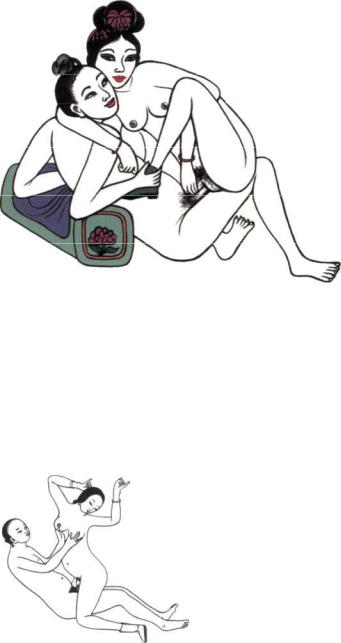
Woman the Initiatress of Love. Taking the active role, she confers her intuitive awareness and Wisdom-energy on her partner. From a Chinese hand-colored wood print of the Ming period.
The sex-initiatress. Taking the active role during love-making, she is here depicted making mystic gestures with her hands.
Energy is being recirculated by the positioning of her fingers. From a Chinese painting of the Ming period.
and the Sexual Recipes of the Plain Girl, take
the form of an intimate dialogue, where the woman initiates the man into the arcana of
sex.
Concerning the choice of a woman
suitable as a magical and potent sexual partner, the Plain Girl declares, "Such women are naturally tender and gentle. Their hairs are silky, their skin soft, and their bones fine; being neither too short nor too tall, neither too thin nor too fat, the lips of their sex organ should be full and their Pleasure Grotto
naturally moist. During the sexual act, they should exude copious fluid and move their body in such a way that the man is continually excited. Their ideal age is between twenty-five and thirty."
The Hevajra Tantra, an important Indian text, states, "He who is well versed in Yoga should give honor to the mother and sister, likewise to the dancer, the washerwoman, the outcaste woman and the noblewoman equally. He should combine the Scepter of his Means with the Lotus of her Wisdom. From this rite, liberation is obtained." This
seemingly enigmatic declaration actually
points to the initiatory power of womanhood. Further on occurs the following clarification: "Gnosis is called the 'mother' because she gives birth to the world; likewise she is known as 'sister' because her af-
fection is constant, 'dancer' because of her tremulous nature, 'washerwoman' because her inner essence is untouchable."
Even in Christianity, a religion notably hostile to sexuality and "the flesh," the tra-
dition of |
courtly love arose, in which |
ideal |
|
love of a |
mistress converges |
with and |
leads |
to the beatific love of God. |
To be sure, this |
||
tradition relied on the repression and sublimation of sexual energy, but this sublimated energy was put in the service of a transcendental end. It is curious that Muhammad the Prophet of Islam, who himself kept nine wives (his special privilege), never referred to the initiatory power of woman. A credible tradition states that he himself once declared, "I have been granted four favors which others have not; these are the qualities of generosity and courage, the capacity for frequent sexual union, and the ability to very rapidly regenerate my strength." There is even a recorded instance when he had sexual union with each of his nine wives separately in a single night, performing an act of ritual washing after successive sexual encounters. Unfortunately, he never credited his extraordinary capacity for regeneration to the multiple and initiatory power of his wives. This feminine power is very strongly confirmed in many archaic magical traditions. Chinese Emperors, for example, were supposed to have nine ordinary consorts every night and the Empress for two nights over the full moon.
The initiatory power of woman is tremendous, resting primarily in the mental attitude to sensual mysticism. By taking an active role and exploring the whole range of sexual secrets during love-making, a woman can endow transcendental power on her lover. This power, the highest form of Shakti, is a direct expression of the opened-up intuition, a "Wisdom-energy," spontaneous and joyful, which can break down all barriers. A woman should confidently initiate her man into mystical experience. Success rests on pure spontaneity, the ability to trust in and surrender to higher ideals, and the earnest desire to give "something special" to her lover. Selfconfidence is the essential ingredient in all rites of initiation, and it is the goddess within each woman who initiates.
A woman initiates through that same Yoni from which, in a previous life, the man was born before. A woman initiates through those same breasts which, in a previous life, suckled the man before. A woman initiates with that same mouth which once gently calmed the man before. A woman is the supreme initiatress of Tantra.
KAULARAHASYA
132 Vishnu the Preserver
the dancer
The dancer is a figure closely associated with sexual energy and the female power of initiation. A mystic song of the Tantric tradition declares that "The dancing-girl has the power to initiate the process of sexual rejuvenation." Many temples of the ancient world housed dancers, whose dancing conveyed the very essence of eroticism. Their presence in the temples of India shocked and offended the puritanical morality of the British, who passed laws forbidding such activities. It is unfortunate that the sexual prowess of the temple dancers caused the British to mistake them for prostitutes.
The temple dancers or "Devadasis" (literally "servants of God") of India were divided into various categories. The highest were experts at the different kinds of Yoga and through years of training developed control over their body functions. As initiatresses of Tantric Yoga, they served an important role. They were considered to be the mistresses of the temple gods, the embodiments of the Gopis, and emanations of Lakshmi. The prosperity of the country was believed to be related to the rites and activities of the temple dancers.
The courts of Kings and Emperors were filled with dancing-girls, whose function was to evoke the erotic sentiment and to engender a mood of spirituality and love. In ancient Egypt, the dancing-girls of the court or temple were believed to have power over life and death; many became influential as priestesses, for dance lends itself to expressing esoteric concepts that cannot be described by words or static pictures. Dance embodies the full range of emotions; thus it can reveal the Subtle Body of Tantra in all its glory.
The following contemporary account by Allen V. Ross stunningly illustrates the sexual role of the Indian temple dancer:
The girl entered softly on bare feet. She knelt before me and kissed my feet. She was good-looking, about thirty, with a face that was at once worldly and childlike. Her body was completely sheathed in a transparent gold silk sari. Her hands, feet and head were bare, except for some gold jew-
elry that jangled as she moved. She began to dance without any accompaniment at all. This Devadasi conveyed sexuality with every little twitch of her rouged lips, the gestures of her hands, the movements of her head, the stamping of her feet, the roll of her eyes. The opening and shutting of her nostrils, the sinuous twisting of her firm but pliable body, was an amazing performance. I could feel the electrical charges of the girl's erotic magic and it seemed to me that she was using only a fraction of her skills. Her dance, slow and ecstatic, was highly symbolic, displaying various sexual moods, from enticement and arousal to seduction and final rapture. It must have lasted hours and I was completely taken with her. Then she possessed me. There was no vulgar striptease. She daintily slipped out of her clothes, displaying a supple body the color of wild cinnamon. She told me to lie on the mat. After that it was just my Lingam and her Yoni in cosmic union. Her intimacies possessed me. I was devoured. She was what the Hindus call the "saraotastryan" or "nutcracker
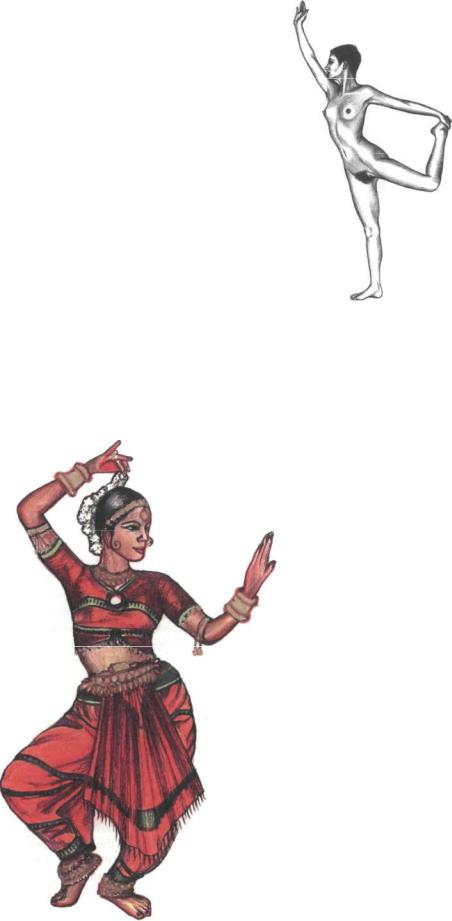
The dancer: a Yoga posture derived from dance. It is particularly suitable for toning up vitality and circulating energy.
There are many delights of visiting dancing-girls. When the dancing is finished he retires to a spacious tower, cooled by the breeze, and there practices the important methods of the Yellow Emperor. He takes the tender hand of a girl as beautiful as Hsishih, and the white arm of another one like Mao-shih. Their bodies are beautiful, supple like grass moving in the wind; they put forth all their charms so that one forgets about life and death.
PIEN JANG
An Indian temple dancer. This dance form makes use of erotic body movements and tells a story through gesture and mime.
Whole epics were expressed in dance, serving to initiate people into a non-verbal level of understanding. The dance form known as Orissi or "Odissi" is currently closest to the ancient style of Tantric mystic dance.
Vishnu the Preserver 133
Some Indian temples had more than five hundred resident dancers in attendance. They were trained by Yoginis, who had mastered the sexual secrets.
woman," because of the amazing power of her sphincter muscles. I was almost out of my mind. All the while she made murmuring, humming, drone sounds that put me into a trance. Suddenly there was an explosion in my brain and I felt myself in another dimension. There were amazing lights and fantastic colors. The walls seemed to be melting and I felt ecstasy in every cell.
This description is an accurate account of the potency inherent in the dancer archetype. A dancer needs to gain considerable control over normally automatic responses such as breathing, balance, and emotion. This control is similar to the control needed to master the teachings of Tantra. Emotion is the ultimate key; by consciously evoking and channeling the emotions, transcendence can both be achieved personally and transmitted to another person. The emotion of sex is easily evoked through dance. When the body is in a healthy condition and finely tuned, then dance really can become initiation.
The multifarious forms of dance can explicitly or unconsciously convey meaning. All dance forms involving couples present a ritualized, social reflection of the sexual act. The art of spiritual dance has almost become a thing of the past.
A display of dancing brings out the spectator in everyone. Public dancing and private dancing have distinctly different potentialities. This art form can be performed in solo, for your partner, or improvised together. Let your inhibitions go and indulge your creativity and spontaneity to the limit.
Dance can be many things: an individualistic search for ecstasy, a means of communication, a social activity, a healthful exercise, or a courtship ritual. Of the Sixty-four Arts, dance is one of the most closely related to the Art of Love. The dance of a woman has a unique potential for firing the vitality of man and reviving depleted energies. The tones and rhythms of music incorporated into the erotic dance can enhance and sustain the consummation of love.
If in joy, songs are sung, let |
them be the most excellent Eternal songs. If one |
dances when joy has arisen, |
let it be done with release as its object. |
|
HEVAJRA TANTRA |
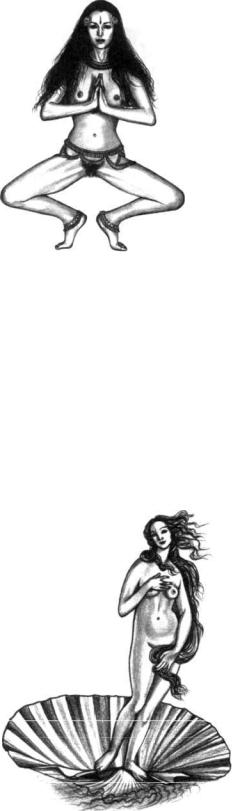
Aphrodite as the goddess of Love (Venus), riding on a scallop shell. From a fifteenthcentury painting by Botticelli.
the virgin
and the whore
One of the earliest Greek myths on the origins of the gods recounts how the god of Time, Cronus, who was the youngest son of Heaven and Earth, became jealous of his father. Lying in wait, he cut off the erect Lingam of Heaven with a sickle while his father was making love to his mother.
The Lingam of Heaven fell down to the
world and a few remaining drops of semen from it impregnated the ocean. Out of the foam of the sea, which broke frothily on the shores of land, the beautiful Love goddess Aphrodite was born.
Aphrodite, who emerged from the water, became the wife of the Fire god, Hephaestus. Though he was the son of Zeus, the Supreme Ruler of the whole world, he was born lame and decidedly ugly. Most of his time he spent forging precious metals, making weapons, and ornaments. Aphrodite quickly became bored and dissatisfied with her husband and took Aries, the handsome but foolish War god, as a lover.
When Aphrodite's husband learned of her
134 Vishnu the Preserver
infidelity, he set a trap; with a golden net, forged in his own smithy, he caught her naked in the arms of her lover and called upon the other gods as witnesses. Fleeing in shame, Aphrodite sought refuge on the island of Cyprus, where she gave birth to Eros, the Love god.
The Greek Love goddess Aphrodite is linked directly to Inanna the Fertility goddess of the Sumerians, Astarte the Phoenician Love goddess, Ishtar the Babylonian Love goddess, and Isis the High Priestess and Egyptian Mother goddess. The cult of Aphrodite became famous in Cyprus and influenced Western mysticism considerably. Worshippers came to her island by the thousands from all over the ancient world.
Women were required to prostitute themselves within the precincts of Aphrodite's temple at Paphos in Cyprus, to any stranger, once, on demand, before becoming eligible for marriage. The money received in this transaction was cherished as a talisman, and no amount was considered too small. Any children born of such unions were brought up in the sanctuary of Aphrodite. Significantly, a woman was still considered a virgin after such ritual prostitution, and children born of this ritual act were said to be "born of a virgin."
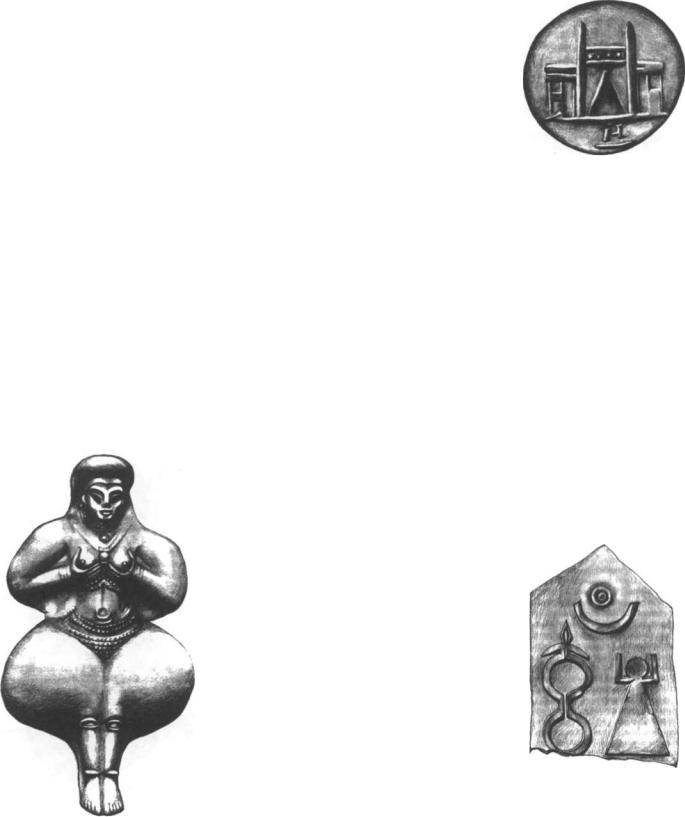
Inanna, the Sumerian Mother-goddess and initiatress into the mysteries. From a terracotta sculpture in the Louvre.
We can see that the concept of virgin birth, a central tenet of Christianity, did not originate with it but was present in Greece, Egypt, India, and other ancient civilizations. The twin roles of virgin and whore exerted influence on the sexual expressions of women in the ancient world, and make their mark on the female unconscious mind.
Few modern women have not, at some time or other, had fantasies of themselves as prostitutes; others have remained infatuated with virginity. The split in the Western psyche b e t w e e n the archetypes of the "chaste" and "loose" woman is a frequent cause of sexual neurosis in both sexes. The virgin is "pure, unattainable, untouchable outside of conventional marriage, and pristinely spiritual," whereas the whore is "crude, degrading, dissolute, and unworthy of respect." Such simplistic ideas still pervade our culture, despite the moves toward sexual liberation.
From earliest times, woman has been associated with the moon, because of her monthly cycle, and with the element of water. Man has been associated with the sun and the element of fire. Aphrodite, embodiment of erotic beauty, born out of the water and married to the Fire god, exemplifies the universality of this psycho-cosmic symbolism. The lunar-solar relationship is fully elaborated and refined in the practical sexual Yoga of the Tantric and Taoist traditions.
The art of the Western medieval period often represents the Virgin Mary enthroned on the moon. The Greeks had a trinity of virgin goddesses known as Artemis, Hestia, and Athena; the first had the moon as her special symbol and was directly associated with Selene, the Moon goddess. The virgin goddesses or Vestal Virgins of the Roman tradition were invoked at the beginning and end of all ritual sacrifices. They were believed to be the incarnations of Wisdom (Gnosis) and were assigned the task of tending the sacred fire. One of the three, Hestia, was always depicted wearing a veil, with her right hand resting on her hip. This is, traditionally, the characteristic gesture of the sacred prostitute and even today is regarded as an erotic gesture.
Ishtar, the Babylonian Love goddess or High Priestess, is generally depicted wearing a veil said to "conceal her secrets from the eyes of the uninitiated." The veil was, in ancient times, the traditional mark of both vir-
Aphrodite's Phoenician temple at Paphos, Cyprus, showing the sacred black meteorite cone worshipped as the Yoni of the goddess. From a Cypriote coin of the Imperial Roman period, Cyprus Museum, Nicosia.
Passion resides in the woman's right side during the bright fortnight of the lunar month, from new moon to full. The reverse is the case during the dark fortnight. The shifting of passion is believed to take place by the action of light and darkness.
ANANGA RANGA
Stele from Carthage, depicting the goddess Tanit of pyramidic shape and with arms stretched upward toward the crescent moon. To the left is a glyph of an alchemical retort, reminding us that, like the moon, she acts in a renewing and rejuvenant manner.
Vishnu the Preserver 135
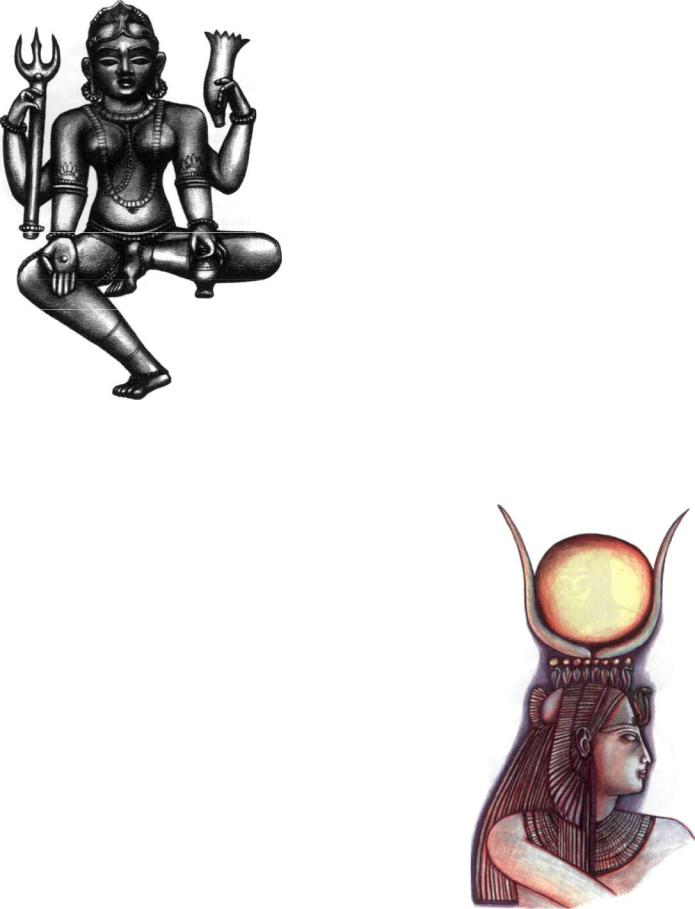
Parvati, favorite of Shiva the Supreme Yogi. As the daughter of the Himalaya Mountains, she personifies abundance and transcendental attainment. She is beautiful like the full moon and holds a trident, datura flower, and ritual consecration vase; she makes the gesture of bestowing blessings. From a stone sculpture of the eleventh century, Lakshmana temple, Khajuraho.
The extent of a woman's love potential is rarely known, even to those who are objects of her affection. This is because of the subtlety of a woman's love. Women are hardly ever known by men in their true light, though they may love them or become indifferent toward them, may give delight or abandon them, or even extract from them everything that they possess.
KAMA SUTRA
gins and prostitutes. Ishtar, though also a Mother goddess with children, was addressed ritually and liturgically as "The Prostitute." Similar concepts are found in India, China, and other parts of the world, always associated with the Moon mother, who, though a virgin, bore children. This paradox brings us to the mystery of the Virgin and the Whore as exemplified in the Tantric tradition. The initiatory power of woman, dealt with earlier, provides a foundation for understand-
ing these twin sexual roles. The key to this dichotomy lies in the light and dark aspects of the lunar phases that
govern the monthly cycle of woman. In Hinduism, the goddess Parvati embodies the moon's bright phases, and the goddess Kali, the dark. In the Greek tradition, Aphrodite and Hecate parallel Parvati and Kali but without so clear a distinction in their mystic attributes.
Parvati and Aphrodite symbolize the white full moon and the principles of preservation and abundance; Kali and Hecate are mystic forms of the dark crescent moon and the principles of dissolution and transcendence. Aphrodite/Parvati represents raw sexual energy in its worldly and productive role, while Hecate/Kali signifies that same sexual energy in its otherwordly and transformative role. The roles of Virgin and Whore may be better understood in the context of the goddesses Aphrodite/Parvati and Hecate/Kali.
As the Virgin, woman takes the surrendering role and man acts as the initiator. She is the "clean slate" on which he writes a Karmic message, while she confers and shares her untouchable "pure essence" with him alone. In this role, she embodies conventional love at its most potent level. She is the "pure flower" whose fragrance is his alone to smell.
As the Whore, a woman is in the active role; it is she who acts as the initiatress into the mysteries of love. Without any shame or restraint, she is free to give all of herself to him without any restrictions. In this role, woman embodies unconventional love. Sure of her sexuality, she offers herself in service without reservation, guilt, or insecurity. She must draw on her own special qualities and confer them on her lover. She is pure Shakti,
the power principle of initiation, the High Priestess.
The women who prostituted themselves in the temple of Aphrodite were ritually acting out what is a fundamental truth to Tantra: the great potency inherent in the spontaneous sexual act. They received their first initiation into eros through contact with a man in this way, and thus became equipped to play the role of Whore for their eventual husbands. Yet they were still considered Virgin. There is certainly an important psychological truth to be learned from this ancient custom. Un - conventionality has the ability to renew conventionality. When viewed in relation to the light and dark lunar cycle of woman and in relation to the qualities and aspects of Parvati and Kali, the roles of Virgin and Whore take on a deep and mystical significance.
The ancient rites of love were not designed to further promiscuity, but to give meaning to female sexuality. The virgin, muse, whore, and goddess can all be embodied in a single woman, just as the boy, hero, lover, and god can be found in an individual man. There is today a tendency to separate sexual roles and identify with one
Isis, the Egyptian goddess of the Earth and the Moon, symbolizes the productive and preserving principles of Nature. From an ancient Egyptian stone relief.
136 Vishnu the Preserver