Материал: Internal_diseases_propedeutics._Part_II._Diagnostics_of_cardiovascular_diseases
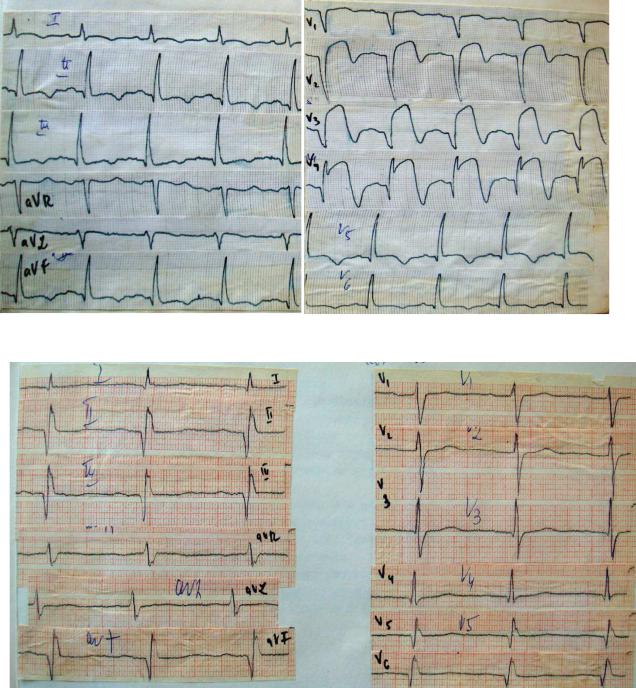
LOCALIZATION OF IM (Fig. 28-29):
1.The FRONT wall of the left ventricle: I, aVL, V1-4; discordant displacement to ST III, aVF;
2.The SIDE wall of the left ventricle: V5-6;
3THE LOWER wall LV: III, aVF; the discordance of the offset ST in I, aVL
Fig.28. MI of the front wall of the left ventricle.
Fig.29. MI of the lower wall of the left ventricle.
81
TEST CONTROL:
1.THE PATIENT COMPLAINS OF PROLONGED (MORE THAN 10 MIN.) CHEST PAIN OF INCREASING CHARACTER, RADIATING TO THE BACK, ARM AND NECK, RESULTING IN A STATE OF REST AND NOT STOPED AFTER TAKING 3 TABLETS OF NITROGLYCERIN. WHAT KIND OF PATHOLOGY YOU CAN THINK OF (GIVE ONE ANSWER)?
a) cardialgia; b) angina;
c) angina at rest;
d) myocardial infarction; e) pericarditis;
f) dissecting aneurysm of the aorta.
2.INDICATE THE 5 CHARACTERISTIC SYMPTOMS OF RIGHT HEART FAILURE:
a) enlargement of the liver;
b) shortness of breath during physical exertion and/or at rest;
c) attacks of breathlessness with difficulty in inhalation and exhalation, forcing to take a half upright position;
d) attacks of breathlessness with difficulty exhaling, forcing to take a sitting position with fixation of the shoulder girdle;
e) presence of free fluid in the abdomen (ascites);
f) the presence of free fluid in the pleural cavity (hydrothorax);
g) the presence of free fluid in the pericardial cavity (hydroperiod); h) swelling of the feet.
3.PERCUSSION BORDERS OF RELATIVE CARDIAC DULLNESS OF THE PATIENT REVEALED THE FOLLOWING DATA:
- right margin – 1 cm outwards from the right edge of the sternum, - left – 4 cm laterally from the left midclavicular line,
- upper – in intercostal space III,
- the width of the vascular bundle – 5 cm.
For what configuration of the heart is typical?
a)for normal;
b)for the mitral;
c)for aortic.
82
4.WHAT ARE 2 FACTORS MOST DETERMINE THE LEVEL OF DIASTOLIC BLOOD PRESSURE (BP)?
a) the tone of resistive vessels (arterioles) – tot al peripheral vascular resistance; b) the volume of the vascular of ejection (stroke volume of the heart);
c) the elasticity of the walls of the aorta;
d) the completeness of closure of the valves of the aorta.
5.DURING THE INSPECTION AND PALPATION OF THE HEART REGION OF THE PATIENT REVEALED AMPLIFIED AND DIFFUSE APEX BEAT. WHAT STATE OF HEART IS THE EVIDENCE?
a) only hypertrophy of the left ventricle; b) only dilatation of the left ventricle; c) only dilatation of the right ventricle
d) hypertrophy of the left ventricle and dilatation of the left ventricle
6.LIST THE FEATURES CHARACTERIZING HEART DISEASES EDEMA:
a)a high density edema ("solid" edema);
b)low density edema (soft swelling);
c)pallor of the skin in the area of edema;
d)cyanotic skin in the area of edema;
e)the presence of trophic skin changes in the area of edema;
f)lack of trophic skin changes in the area of edema.
7.EXPLAIN THE MECHANISM OF OCCURRENCE OF COUGH WITH CLEAR SPUTUM AND HEMOPTYSIS IN PATIENTS WITH LEFT VENTRICULAR HEART FAILURE (GIVE ONE ANSWER):
a) inflammatory process in the alveoli – the exudat ion of blood plasma and red blood cells;
b) high pressure in the blood vessels of the pulmonary circulation – the leakage of blood plasma and erythrocytes in the alveoli;
c) high pressure in the blood vessels of the big circle of blood circulation – the leakage of blood plasma and erythrocytes in the alveoli;
d) high pressure in the blood vessels of the pulmonary circulation – bronchial vessels microreserve – penetration of blood plasma into the lumen of the bronchi.
8.WHAT ARE 3 METHODS OF PHYSICAL AND INSTRUMENTAL EXAMINATION CAN REVEAL DILATATION OF THE LEFT VENTRICLE? a) palpation of the heart;
83
b)percussion of the heart;
c)electrocardiography (ECG);
d)roentgenography of chest organs;
e)echocardiography (EchoCG).
9.HOW TO CHANGE THE LOCALIZATION OF THE APEX BEAT OF THE WOMAN IN THE LAST 2-3 MONTHS OF PREGNANCY?
a) will not change;
b) shift up and to the left; c) will shift to the right.
10.PALPATION OF THE PATIENT IN THE APEX OF THE HEART REVEALED A THRILL THAT DOES NOT COINCIDE WITH THE PULSATION OF THE APEX BEAT. FOR WHAT CONDITION IS THIS TYPICAL?
a) obstruction of blood flow through the mitral valve hole;
b) obstruction of blood flow through the opening of the tricuspid valve; c) obstruction of blood flow through the opening of the aortic valve.
11.SPECIFY 3 MAIN COMPONENTS INVOLVED IN THE FORMATION OF I TONE OF THE HEART:
a) fluctuations of the valves of the atrioventricular valves in the phase of isometric reduction;
b) fluctuations of the valves of the valves of the aorta and pulmonary artery protodiastolic period;
c) fluctuations in the muscular wall of the ventricles in the phase of isometric contraction; d) fluctuations in the muscular wall of the ventricle at protodiastolic period;
e) oscillations of initial segments of the aorta and pulmonary artery in the early phase of exile.
12.SPECIFY THE MAIN 4 MECHANISM OF WEAKENING OF THE II TONE IN THE SECOND INTERCOSTAL SPACE RIGHT OF STERNUM:
a) increase the mobility of the semilunar valves of the aorta; b) reducing the mobility of the semilunar valves of the aorta;
c) non-tight closing of the valves of the aorta in the protodiastolic period; d) lowering the pressure in the aorta;
e) the increase in the rate of relaxation of ventricular myocardium; f) decrease in the rate of relaxation of the ventricular myocardium.
84
13.WHAT ARE 3 OF THE LISTED SIGNS CAN BE USED TO IDENTIFY THE I HEART TONE?
a) the tone coincides with the apex beat and carotid pulsation;
b) a tone does not coincide with the apex beat and carotid pulsation; c) the tone is listened after a long pause;
d) the tone is listened after a short pause; e) a low frequency tone and long lasting.
14.HOW TO CHANGE THE VOLUME OF I TONE AT THE APEX IN MITRAL VALVE INSUFFICIENCE?
a) increase; b) decrease;
in) will not change.
15.WHAT 2 CHANGES II TONE OF THE HEART CAN REVEAL IN THE 2ND INTERCOSTAL SPACE LEFT OF STERNUM IN PATIENTS PRESENTING COMPLAINTS OF SIGNIFICANT DYSPNEA AND A COUGH WITH STREAKS OF BLOOD, INCREASING IN A HORIZONTAL POSITION AND DECREASING IN ORTHOPNEA POSITION?
a) gain (emphasis) II tone; b) weakining II tone;
c) no change II tone.
16.SPECIFY THE 2 CHARACTERISTIC AUSCULTATION SIGNS OF ATRIAL FIBRILLATION:
a) correct (regular) rhythm of the heart;
b) isolated premature occurring I and II heart tones followed by a pause on the background of the right rhythm;
c) completely irregular (chaotic) rhythm of the heart; d) the same volume I of tones in each cardiac cycle;
e) the constant change of volume I of the tone ( from one cardiac cycle to another).
17.WHEN REGISTERING PHONOCARDIOGRAM (FKG) AT THE APEX OF THE HEART, THE PATIENT RECORDED HIGH-FREQUENCY DIASTOLIC EXTRATONE ARISING FROM CLOSE II TONE (EVERY 0.1 S). NAME IT:
a) III the tone of the heart; b) IV is the heart;
c) the tone of the opening of the mitral valve.
85