Материал: Internal_diseases_propedeutics._Part_II._Diagnostics_of_cardiovascular_diseases
-Reduced |
HDL |
|
-symptomatic arterial disease |
|
cholesterol |
|
|
Advanced |
hypertensive |
-Raised LDL cholesterol |
|
retinopathy |
|
|
-Microalbuminuria |
in |
|
-haemorrhages or exudates |
|
diabetes |
|
|
-papilloedema |
|
-Impaired |
glucose |
|
|
|
tolerance |
|
|
|
|
-Obesity |
|
|
|
|
-Sedentary lifestyle |
|
|
|
|
-Raised fibrinogen |
|
|
|
|
-High risk socioeconomic |
|
|
|
|
group |
|
|
|
|
-High risk ethnic group |
|
|
|
|
-High risk geographic |
|
|
|
|
region |
|
|
|
|
|
|
|
|
|
1 - "Target Organ Damage" corresponds to previous WHO Stage 2 hypertension
2 "Associated Clinical Conditions" corresponds to previous WHO Stage 3 hypertension.
Table 9.
Stratification of Risk to Quantify Prognosis
Other |
Risk |
Grade 1 |
Grade 2 |
Grade 3 |
|
Factors |
& |
SBP 140-159 or |
SBP 160-179 or |
SBP і 180 or |
|
Disease History |
DBP 90-99 |
DBP 100-109 |
DBP і 110 |
|
|
|
|
|
|
|
|
I. no other |
risk |
LOW RISK |
MED RISK |
HIGH RISK |
|
factors |
|
|
|
|
|
|
|
|
|
|
|
II. 1-2 risk |
MED RISK |
MED RISK |
V HIGH RISK |
|
|
factors |
|
|
|
|
|
|
|
|
|
|
|
III. 3 or more risk |
HIGH RISK |
HIGH RISK |
V HIGH RISK |
|
|
|
|
|
|
|
|
|
|
|
71 |
|
|
factors or |
TOD1 |
|
|
|
|
|
or diabetes |
|
|
|
|
|
|
|
|
|
|
|
|
|
IV. ACC2 |
|
V |
HIGH |
V |
HIGH |
V HIGH RISK |
|
|
RISK |
|
RISK |
|
|
|
|
|
|
|
|
|
Risk strata (typical 10 year risk of stroke or myocardial infarction): Low risk = less than 15%; medium risk = about 15-20% risk; high risk = about 20-30%; very high risk = 30% or more
1.TOD – Target Organ Damage (Table 2)
2.ACC – Associated Clinical Conditions, including clinical cardiovascular disease or renal disease (Table 8)
Classification of essential hypertension (hypertensive disease)
According to great attention to cardiovascular risk evaluation in hypertensive patients there is designed transition to classifications with distinction of BP elevation grades with simultaneous risk assessment (low, medium, high, very high). This approach was stipulated in WHO and ISAH experts recommendations (1999) and was supported in Russian national recommendations on AH (2000). Recently used in Russia classifications are presented below. Until now classification of essential hypertension (hypertensive disease) by WHO (1962) is widespread in Russia.
Classification of essential hypertension (hypertensive disease) by WHO (1962).
I stage — BP elevation >160/95 mmHg without organic changes of cardiovascular system;
II stage — BP elevation > 160/95 mmHg in combinatio n with changes of target organs (heart, kidneys, brain, fundal vessels), caused by hypertension, but without their functional alterations;
III stage — hypertension, combined with target orga ns damage (heart, kidneys, brain, fundal vessels) with their functional alterations.
72
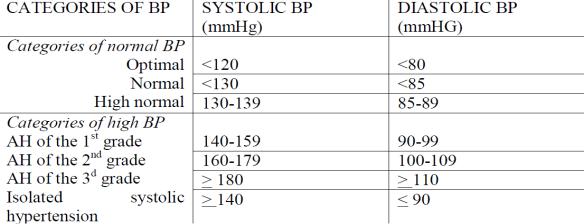
Table 10
Definitions and Classification of Blood Pressure Levels
Recently both classifications are recommended in Russia; it is necessary to indicate stage of disease as well as BP grade.
Clinical manifestations depend on damage of target organs.
Many of patients are asymptomatic, and frequently hypertension is detected occasionally. There may be neurosis signs, headaches, particularly in the mornings; nausea, flashing of ―midges in front of eyes; pain in precordium, palpitation, rapid fatigability, epistaxis (nasal bleedings), hyperexcitability, irritability, sleep disturbance. In later stages coronary events may appear. Severity of these symptoms, in particular, headaches, not always corresponds to BP elevation grade.
On medical history analysis it is necessary to obtain information about family history of hypertension as well as other conditions, worsening prognosis in their presence – diabetes mellitus, coronary heart disease, stroke, dyslipidemia. Information about duration and level of BP arising, previous drug and non-pharmaceutical therapy effectiveness are important. It is necessary to elicit patient's lifestyle peculiarities, including diet (fats, excessive salt and alcohol consumption), smoking, physical activity level, excessive body mass or obesity.
On examination one attracts attention on excessive body mass. A face hyperemia as well as pallor due to peripheral arteriolar spasm are noticed.
On heart examination sign of left ventricular hypertrophy (apical impulse shift to the left) - key syndrome in hypertension - is detected, that confirmed by ECG, X-ray and,
73
especially, ECO examinations. On elevated BP there is typical pulse strain increase, due to grade of which may be approximately assessed level of BP. Moreover, elevated BP is characterized by accent of S2 at the aorta appearance.
ECG changes are initially characterized by decrease of T-wave amplitude in the left chest leads. Left ventricular hypertrophy is revealed by high-amplitude R-wave with oblique depression of ST segment in V4-6. Left bundle-branch block may develop.
On ECO hypertrophy of interventricular septum and left ventricular posterior wall is verified. Sometimes these changes are accompanied by dilatation, increase of end-systolic and end-diastolic left ventricular dimensions. Appearance of hypokinetic and even dyskinetic zones in the myocardium is the sign of left ventricular contractile capacity decline.
Different metabolic disorders: hyperinsulinemia, impaired glucose tolerance (in some cases – diabetes mellitus, type II), dyslipide mia (reduced HDL cholesterol, raised LDL cholesterol), obesity were frequently marked during last years.
Hypertensive crisis. Clinical course of hypertension may be complicated by hypertensive crisis. It is fast, additional, significant BP rise. It may be provoked by different physical and mental loading, excessive dietary sodium, water, alcohol intake; cessation of drug therapy. Very high BP is detected in patient (diastolic BP may exceed 130—140 mmHg). In the majority of cases on the back ground of such BP elevation cerebral signs (nausea, vomiting, vision reduction) appear.
Simultaneously or later other signs and complications of hypertension may increase: coronary heart disease (CHD) exacerbation, acute left-sided heart failure occurrence and stroke. On severe crisis fundal hemorrhages, papilledema may appear.
Kidneys damage. During the late stage of hypertension due to arteriolosclerosis development the signs of kidneys damage appear: impaired concentrative capacity, decrease of urine relative density, proteinuria, hematuria, and in the terminal stage – azotic wastes retention. Parallel signs of eyes fundum damage develop: increasing retinal arteries narrowing and tortuosity, especially in comparison with veins; veins dilation, may be fundal hemorrhages, and later degenerate foci in retina.
74
Central nervous system damage determines various signs, concerned with intensity and location of vascular disorders. Vascular narrowing (due to their spasm) leads to focal brain ischemia with partial fall-out of its functions and in more severe cases is accompanied by brain hemorrhages. In sharp BP elevation there may be arterial wall ruptures with massive hemorrhage.
Primary hypertension is asymptomatic until complications in target organs develop (eg, left ventricular failure, atherosclerotic heart disease, cerebrovascular insufficiency with or without stroke, renal failure). Dizziness, flushed facies, headache, fatigue, epistaxis, and nervousness are not caused by uncomplicated hypertension.
A fourth heart sound and broad, notched P-wave abnormalities on the ECG are among the earliest signs of hypertensive heart disease. Echocardiographic evidence of left ventricular hypertrophy may appear later. Chest x-ray is often normal until the late dilated phase of hypertensive heart disease. Aortic dissection or leaking aneurysm of the aorta may be the first sign of hypertension or may complicate untreated hypertension. Polyuria, nocturia, diminished renal concentrating ability, proteinuria, microhematuria, cylindruria, and nitrogen retention are late manifestations of arteriolar nephrosclerosis.
Retinal changes may include retinal hemorrhages, exudates, papilledema, and vascular accidents. On the basis of retinal changes, Keith, Wagener, and Barker classified hypertension into groups that have important prognostic implications: group 1-- constriction of retinal arterioles only; group 2--constriction and sclerosis of retinal arterioles; group 3--hemorrhages and exudates in addition to vascular changes; group 4 (malignant hypertension)--papilledema.
Diagnosis
Diagnosis of primary hypertension depends on repeatedly demonstrating higher- than-normal systolic and/or diastolic BP and excluding secondary causes
ATHEROSCLEROSIS. ISCHEMIC HEART DISEASE
Atherosclerosis is a form of arteriosclerosis characterized by patchy subintimal thickening (atheromas) of medium and large arteries, which can reduce or obstruct blood flow. Atherosclerotic plaque consists of accumulated intracellular and extracellular lipids,
75