Материал: Business Communication and Correspondence Деловая коммуникация и коммерческая корреспонденция. Меркулова Н.В

The notes will give you confidence, but because you will have prepared your presentation fully, you may not even need them!
9) Rehearsal
Rehearsal is a vital part of preparation. You should leave time to practise your presentation two or three times. This will have the following benefits:
you will become more familiar with what you want to say
you will identify weaknesses in your presentation
you will be able to practise difficult pronunciations
 you will be able to check the time that your presentation takes and make any necessary modifications
So prepare, prepare, prepare! Prepare everything: words, visual aids, timing, equipment. Rehearse your presentation several times and time it. Is it the right length? Are you completely familiar with all your illustrations? Are they in the right order? Do you know who the audience is? How many people? How will you answer difficult questions? Do you know the room? Are you confident about the equipment? When you have answered all these questions, you will be a confident, enthusiastic presenter ready to communicate the subject of your presentation to an eager audience.
QUESTIONS:
1.Give the definition of the term “a presentation”.
2.What are the common objectives of a presentation?
3.Speak about the main points of preparation for a presentation.
4.What is the structure of a presentation?
5.How to prepare a presentation?
LECTURE 2: Equipment for Presentations
Easily your most important piece of equipment is...YOU! Make sure you're in full working order, and check your personal presentation carefully - if you don't, your audience will!
Dressing for a job, an interview, a networking event, etc. is a source of anxiety for everyone at some point in their career. You want to make the best impression, of course, and your clothes say a lot about you & who you are.
The three types of dress codes are: Professional Dress, Business Casual and Campus Casual.
1. Professional Dress is the most conservative type of business wear. For women, this means a business suit or pants suit, or dress and jacket. For men, professional dress means a business suit or a blazer, dress pants and a tie.
2. Business Casual is a more relaxed version of «Professional Dress». Basically, business casual is a shirt with a collar and/or a sweater, khakis or dress pants and nice shoes for women. Women can also sometimes wear a moderate length dress or skirt (read: knee-length or longer!). For men, business casual is a polo shirt or shirt with a collar and/or sweater, khakis or dress pants and dress shoes. No tie is required.
6
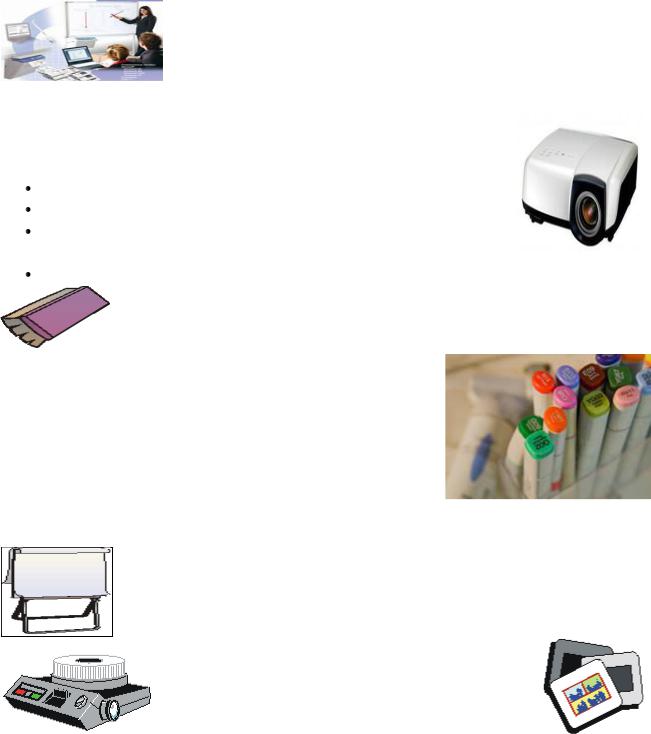
3. Campus Casual is what you probably won‟t be wearing to work. This is the technical term for what you‟re probably wearing every day – jeans, tee shirts, flip flops, sneakers. You may be asked to wear campus casual to some very informal oncampus interviews and career days, and some casual networking events. In general, you probably want to stay away from this in the workplace and err towards more conservative stuff.
The whiteboard (more rarely blackboard or greenboard) is a useful device for spontaneous writing - as in brainstorming, for example. For prepared material, the OHP might be more suitable.
The overhead projector (OHP) displays overhead transparencies
(OHTs or OHPTs). It has several advantages over the 35mm slide projector:
it can be used in daylight
the user can face the audience
the user can write or draw directly on the transparency while in use.
The duster is used for cleaning the whiteboard. It is essential that the duster be clean to start with. You may consider carrying your own duster just in case.
Markers are used for writing on the whiteboard (delible - you can remove the ink) or flipchart (indelible - you cannot remove the ink). They are usually available in blue, red, black and green. Again, it's a good idea to carry a spare set of markers in case you are given some used ones which do not write well.
The flipchart concists of several leaves of paper that you 'flip' or turn over. Some people prefer the flipchart to the whiteboard, but its use is limited to smaller presentations.
The Slide projector - which must be used in a darkened room - adds a certain drama. Some slide projectors can be synchronised with audio for audio-visual (AV) presentations. These projectors are typically used for larger presentations. The
majority take 35mm slides or transparencies (as seen here), but projectors for 6x6cm slides are also available.
7
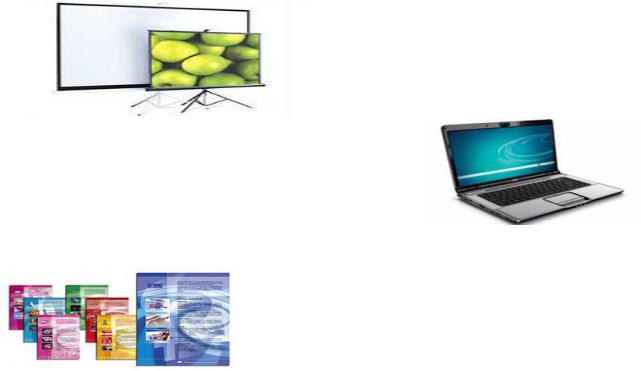
Transparencies are overhead projector onto a screen - in screen which can transported.
The notebook computer is increasingly being used to display graphics during presentations. It is often used in conjunction with an overhead projector, which actually projects the image from the computer screen onto the wall screen.
projected by an or a slide projector this case a folding be packed up and
Handouts are any documents or samples that you 'hand out' or distribute to your audience. Note that it is not usually a good idea to distribute handouts before your presentation. The audience will read the handouts instead of listening to you.
QUESTIONS:
1.Speak about different dress codes.
2.What is the most common equipment for presentations?
3.Characterise the modern presentation equipment.
4.What is the most important equipment for presentations?
LECTURE 3: Delivery of a Presentation
'Delivery' refers to the way in which you actually deliver or perform or give your presentation. Delivery is a vital aspect of all presentations. Delivery is at least as important as content, especially in a multi-cultural context.
- Nerves
Most speakers are a little nervous at the beginning of a presentation. So it is normal if you are nervous. The answer is to pay special attention to the beginning of your presentation.
First impressions count. This is the time when you establish a rapport with your audience. During this time, try to speak slowly and calmly. You should perhaps learn your introduction by heart. After a few moments, you will relax and gain confidence.
- Audience Rapport
You need to build a warm and friendly relationship with your audience. Enthusiasm is contagious. If you are enthusiastic your audience will be enthusiastic, too.
And be careful to establish eye contact with each member of your audience. Each person should feel that you are speaking directly to him or her. This means that you must look at each person in turn - in as a natural way as possible. This will also give you the opportunity to detect signs of boredom, disinterest or even disagreement, allowing you to modify your presentation as appropriate.
8
- Body Language
What you do not say is at least as important as what you do say. Your body is speaking to your audience even before you open your mouth. Your clothes, your walk, your glasses, your haircut, your expression - it is from these that your audience forms its first impression as you enter the room.
Generally speaking, it is better to stand rather than sit when making a presentation. Be aware of and avoid any repetitive and irritating gestures.
Be aware, too, that the movement of your body is one of your methods of control. When you move to or from the whiteboard, for example, you can move fast or slowly, raising or reducing the dynamism within the audience. You can stand very still while talking or you can stroll from side to side. What effect do you think these two different approaches would have on an audience?
- Cultural Considerations
Because English is so widely used around the world, it is quite possible that many members of your audience will not be native English-speakers. In other words, they will not have an Anglo-Saxon culture. Even within the Anglo-Saxon world, there are many differences in culture. If we hypothetically imagine a German working for an Israeli company making a presentation in English to a Japanese audience in Korea, we can see that there are even more possibilities for cultural misunderstanding.
You should try to learn about any particular cultural matters that may affect your audience. This is one reason why preparation for your presentation is so important.
Cultural differences can also be seen in body language, which we have just discussed. To a Latin from Southern France or Italy, a presenter who uses his hands and arms when speaking may seem dynamic and friendly. To an Englishman, the same presenter may seem unsure of his words and lacking in self-confidence.
- Voice quality
It is, of course, important that your audience be able to hear you clearly throughout your presentation. Remember that if you turn away from your audience, for example towards the whiteboard, you need to speak a little more loudly. In general, you should try to vary your voice. Your voice will then be more interesting for your audience. You can vary your voice in at least three ways:
 speed: you can speak at normal speed, you can speak faster, you can speak more slowly - and you can stop completely! You can pause. This is a very good technique for gaining your audience's attention.
 intonation: you can change the pitch of your voice. You can speak in a high tone. You can speak in a low tone.
 volume: you can speak at normal volume, you can speak loudly and you can speak quietly. Lowering your voice and speaking quietly can again attract your audience's interest.
The important point is not to speak in the same, flat, monotonous voice throughout your presentation - this is the voice that hypnotists use to put their patients' into trance!
9

- Visual aids
Of all the information that enters our brains, the vast majority of it enters through the eyes. 80% of what your audience learn during your presentation is learned visually (what they see) and only 20% is learned aurally (what they hear). The significance of this is obvious:
visual aids are an extremely effective means of communication;
 non-native English speakers need not worry so much about spoken English - they can rely more heavily on visual aids.
It is well worth spending time in the creation of good visual aids. But it is equally important not to overload your audience's brains. Keep the information on each visual aid to a minimum - and give your audience time to look at and absorb this information. Remember, your audience have never seen these visual aids before. They need time to study and to understand them. Without understanding there is no communication.
Apart from photographs and drawings, some of the most useful visual aids are charts and graphs, like the 3-dimensional ones shown here:
Piecharts are circular in shape (like a pie).
Barcharts can be vertical (as here) or horizontal.
Graphs can rise and fall.
- Audience Reaction
Remain calm and polite if you receive difficult or even hostile questions during your presentation. If you receive particularly awkward questions, you might suggest that the questioners ask their questions after your presentation.
QUESTIONS:
1.What is the “delivery” of a presentation?
2.What are the main points you should consider for a good presentation?
3.What are the most useful visual aids?
4.Speak about the body language and the voice quality as important factors of a good presentation.
5.What is the role of the cultural considerations for the presentation?
LECTURE 4: Language for Presentations
If you want your audience to understand your message, your language must be simple and clear.
10