Материал: 4555
Ex. 3. Mind the meaning of the suffixes - ful, - less and the prefixes un -, im -, ir, - dis -, il - and translate the following pairs of words.
thoughtful – thoughtless careful – careless hopeful – hopeless tactful – tactless
kind – unkind patient – impatient
responsible – irresponsible sincere – insincere tolerant – intolerant logical – illogical
truthful – untruthful practical – unpractical decisive – indecisive selfish – unselfish honest – dishonest polite – impolite
Ex. 4. Form nouns from adjectives.
polite - politeness |
modest - modesty |
weak ............ |
honest .......... |
shy ............ |
generous ......... |
stupid ............ |
active ......... |
frank ............ |
cruel ......... |
rude ............ |
sociable ......... |
tolerant - tolerance |
courageous - courage |
intelligent ............. |
friendly ............ |
violent ............. |
famous ............ |
elegant ............ |
gifted ........... |
extravagant .......... |
snobbish ........... |
Ex. 5. Combine the words to form compound adjectives. Translate them into Russian and use in your own sentences.
open |
|
good |
|
kind |
hearted |
ill |
mannered |
frank |
|
bad |
|
|
|
|
|

|
|
broad |
|
|
hot |
tempered |
minded |
||
narrow |
||||
quick |
||||
|
progressive |
|
||
bad |
|
|
||
|
|
|
||
|
|
|
|
strong
willed
weak
Ex. 6. Show the difference in meaning between these sets of adjectives by placing them in the correct position on the scale.
|
1 |
2 |
3 |
4 |
Example: |
wise, |
clever, |
silly, |
crazy |
1.violent, quiet, shy, irritated
2.hard-working, lazy, passive, studious
3.polite, rude, impolite, good-mannered
4.active, passive, energetic, indifferent
5.cold, angry, friendly, open-hearted
6.arrogant, modest, shy, snobbish
7.talkative, boastful, sullen, reserved
Ex. 7. Put correct forms of the words in the spaces. Use a dictionary to help you if necessary. Mind word-formation.
Noun (person) |
Noun |
Verb |
1. achiever |
............... |
............... |
2. ............... |
challenge |
............... |
3. negotiator |
............... |
............... |
4. ............... |
............... |
enthuse |
5. aspirer |
............... |
............... |
6. ............... |
............... |
enquire |
7. ............... |
analysis |
............... |
8. ............... |
............... |
communicate |
9. contributor |
............... |
............... |
10. ............... |
admiration |
............... |
11. ............... |
............... |
inspire |
12. stabilizer |
............... |
............... |
A. Try to explain the nouns (personality types) according to the model.
A stabilizer |
is a person who is not dependent on others. He or she is |
|
always reliable. They accept responsibility easily. |
A challenger |
is a person who is always ready to meet difficulties (or |
|
challenges). |
|
He or she tends to move from idea to idea. |
B. Now think of the best translation of the words explained.
Ex. 8. Look at the two groups of adjectives below. Those in group A are supposed to be favourable, in group B - unfavourable. Pair the adjectives in A with their opposites in B.
A |
B |
1) amusing |
a) stupid |
2) calm |
b) disagreeable |
3) cheerful |
с) boring |
4) clever |
d) humorless |
5) even-tempered |
e) hypocritical |
6) generous |
f) lazy |
7) good-looking |
g) mean |
8) hard-working |
h) miserable |
9) pleasant |
I) moody |
10) polite |
j) narrow-minded |
11) self-confident |
k) plain |
12) sensitive |
l) quick-tempered |
13) sincere |
m) rude |
14) tolerant |
n) shy |
15) witty |
o) unfeeling |
Which five adjectives in group A do you think are the most important in a friend? Which five adjectives in group B describe people you dislike most?
Ex. 9. Sometimes we can't but notice some unfavorable features in a man's character or behavior. But we should pay more attention to positive or favorable features. Complete the following according to the model.
St A: John is a bit impatient. St B: But I like his optimism. or He always has different ideas. or People enjoy his company, because he is kind and possesses a good sense of humor.
1.St A: Susan seems to be narrow-minded. St B: ... .
2.St A: I don't like Steve. He is easily-influenced. St B: ... .
3.St A: She is lazy sometimes.
St B: ... .
4.St A: I can't stand her at all. She is so tactless. St B: ... .
5.St A: I should say Jackson is a very jealous guy. St B: ... .
6.St A: Sue is not practical at all. St B: ... .
7.St A: I don't want a husband like Tom. He's so sentimental. St B: ... .
Ex. 10. Check your vocabulary.
A. Find an adjective in the box for each of these descriptions.
hard-working cruel vain mean boring shy funny jealous lazy crazy
1. Someone who never says anything interesting is boring .
2.Someone who always tells jokes which make people laugh is ______.
3.Someone who works a lot of hours every day is ______.
4.Someone who wants things other people have got is _______.
5.Someone who never does any work and always gets up late is ______.
6.Someone who never gives anything to anyone is _______.
7.Someone who says and does strange things is _______.
8.Someone who enjoys hurting people is _______.
9.Someone who finds meeting new people difficult is _______.
10.Someone who likes looking in the mirror is _______.
B. How do you qualify a person who is.
1. independent |
a) enjoys meeting people and making new friends; |
2. sociable |
b) decides things for himself, doesn't ask people for help or |
|
advise; |
3. emotional |
c) often gives friends gifts and enjoys spending money on |
|
other people; |
4. generous |
d) whether he is excited or sad, he shows his feelings very |
|
easily; |
5. impatient |
e) has a very high opinion of himself; |
6. arrogant |
f) doesn't like to wait for anything; |
7. unbalanced |
g) loses his / her temper quickly; |
8. knowledgeable |
h) reads a lot and knows much about the world; |
9. touchy |
i) can't keep a secret; |
10. boastful |
j) is easily hurt |
Ex. 11. Read the text, then put one of the following words into each of the gaps.
talents independent teaching sticky various skilled must alone proudly opinions squabbling tolerant embark boisterous
My grandfather was a man who held strong 1) ... . He was an 2) ... sort, and loved to spend his free time 3) ... working in his garden, or sometimes with us grandchildren. Looking back, he 4) ... have been remarkably 5) ... not to get frustrated by having three 6) ... toddlers running riot round his garden, often 7) ... with each other. He was also a 8) ... carpenter and made 9) ... items of furniture such as desks and chairs. His 10) ... did not stop there either, because every summer he would throw my grandmother our of the kitchen and 11) ... on a jam-making session. I remember him 12) ... me how to make lemon curd, a kind of jam made from lemons, and I would 13) ... return home bearing a 14) ...
pot or two for my mother.
Now retell the story. Think of your grandparents. Write a story of your own. Use the underlined expressions.
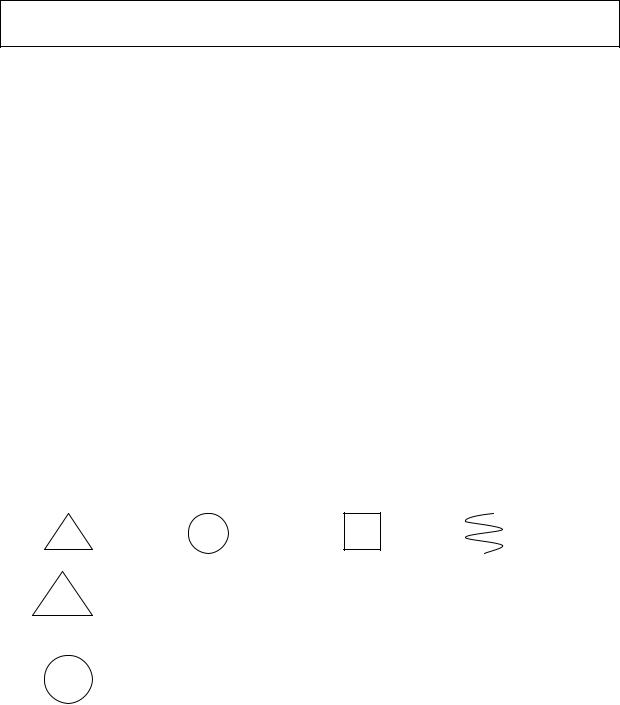
Ex. 12. These four shapes below represent different personality types.
A. Work in pairs, match these phrases with what you think is the appropriate shape.
nigh achiever |
enjoys a challenge |
logical |
methodical |
a warm personality |
clear goals skilled negotiation |
enthusiastic |
|
B. Now check if you matched the expressions to the shapes correctly
|
|
|
This is the only symbol with a clear sense of direction and it is |
|
|
|
the first choice of high achievers. These people set themselves |
The aspirer |
clear goals in life and work single-mindedly towards them. |
||
|
|||
|
|
|
|
|
|
|
The circle's perfect harmony attracts those with a warm |
|
|
|
personality whose skill lies in dealing with people. An |
|
|
|
intuitive understanding of others makes these people skilled |
The admirer |
negotiators. They are also good listeners. |
||
|
|
|
The logic of this symbol appeals to objective thinkers who |
|
|
|
|
|
|
|
analyze problems carefully and methodically before reaching |
The enquirer |
any conclusions. You base your decisions on fact and figures. |
||
|
|||