Материал: 2096
С |
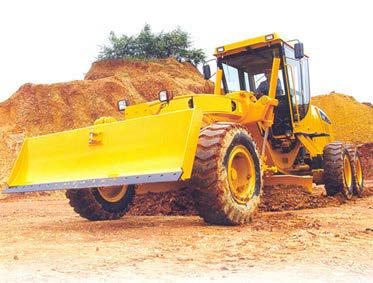
Motor Grader |
б |
|
A grader, also commonly referred to as a road grader, a blade, a maintainer |
|
or a motor grader, is an engineering vehicle with a large blade used to create a flat |
|
иsurface. Typical models have three axles, with the engine and cab situated above |
|
the rear axles at one end of the vehicle and a third axle at the front end of the vehicle, with the blade in between.
drawn equipment thatАfirst appeared in the 1870s. Then there is a class of motor graders significantly with smaller size are be used for specialty work in confined work spaces, often as multi–purpose tool carrier with a variety of attachments and often using hydrostatic drives geared drive trains. More even that motor graders are used extensively for snow removal,Дespecially in northern rural areas.
Motor graders history is fairly well documented, beginning with horse–
In civil engineering, the grader s purpose is to «finish grade» (refine, set precisely) the «rough grading» performed by heavy equipment or engineering vehicles such as scrapers and bulldozers.
Graders can produce inclined surfaces and surfaces with cambered cross– sections for roads. In some countries they are usedИto produce drainage ditches with shallow V–shaped cross–sections on either side of highways.
Graders are commonly used in the construction and maintenance of dirt roads and gravel roads. In the construction of paved roads, they are used to prepare the base course to create a wide flat surface for the asphalt to be placed on. Graders are also used to set native soil foundation pads to finish grade prior to the construction of large buildings. And our GR series of grader are mainly used in large area ground leveling such as road, airport and farmland and the operation of ditching, slope scraping, bulldozing, scarifying and snow–removing.
In some locales such as Northern Europe, Canada and places in the United States, graders are often used in municipal and residential snow removal. In scrubland and grassland areas of Australia and Africa, graders are often an essential piece of equipment on ranches, large farms and plantations to make dirt tracks where the absence of rocks and trees means bulldozers are not required.
121
XCMG GR series Motor Grader operating weight range from 11T~17T, with imported Cummins, Shangchai D6114ZGB engine, power from 100–225 kW (133–300 hp.). ZF or hangchi transmission, Mertor axle, imported hydraulic parts, import differential. And there are front dozer and rear ripper for option.
Си
бАRotary Drilling Rig
A drilling rig is a machine, which creates holes (usually called boreholes) and/or shafts in the ground. Drilling rigs can be massive structures housing equipment used to drill water wells, oil wells, or natural gas extraction wells or they can be small enough to be movedДmanually by one person. They sample sub– surface mineral deposits, test rock, soil and groundwater physical properties, and to install sub–surface fabrications, such as underground utilities, instrumentation, tunnels or wells. Drilling rigs can be mobile equipment mounted on trucks, tracks
or trailers, or more permanent land or marine–basedИstructures (such as oil
platforms,
refers the
• Small and portable, such as those used in mineral exploration drilling, water wells and environmental investigations.
• Huge capable of drilling through thousands of meters of the Earth s crust. Large «mud pumps» circulate drilling mud (slurry) through the drill bit and the casing, for cooling and removing the « cuttings» while a well is drilled. Hoists in the rig can lift hundreds of tons of pipe. Other equipment can force acid or sand into reservoirs to facilitate extraction of the oil or mineral sample; and permanent living accommodation and catering for crews, which may be more than a hundred. Marine rigs may operate many hundreds of miles or kilometers offshore with infrequent crew rotation.
122

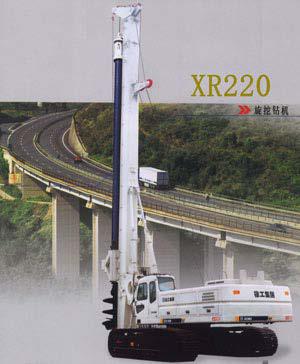
Our XCMG XR series Rotary drilling rigs are mainly used for road or building base construction. Drilling depth from 40m to 88m, rated power from 138kw to 298kw. Model is XR120, XR160, XR200, XR220, XR250, XR280. XR120 rotary drilling rig main configure: Max drilling dia.1500mm, Max drilling depth 51m, Max torque 120KN.M, Import Cummins engine with turbo(138KW), Import hydraulic, electric parts, telescopic crawler chassis, 51m (5 parts) friction drilling pipe, φ800 mm Auger.
Technical Features:
• load sensing hydraulic system;
• color LCD makes the operation flexible and convenient, automatic measuring and control of the boring depth and vertical rake, and automatic failure control and alarming system;
• utmost power control system and automatic slewing positioning function; |
|
С |
|
• |
telescopic crawler chassis, H–shape frame structure; |
• the whole machine (without removing the drill pipe) can be transported in |
|
и |
|
|
long distance. |
2. |
Discuss the properties of each type of the equipment. |
||||||
3. |
What is common and distinguishing between them? |
||||||
4. |
Discuss the possible target audience of these reports. |
||||||
Languageбpractice |
|
|
|||||
1. |
Match English words with their Russian definitions. |
||||||
|
|
|
|
|
|
|
|
|
1 |
Qualities |
|
A |
Оценивать |
||
|
|
А |
|
||||
|
2 |
Conductor |
|
B |
Извлекать |
|
|
|
3 |
Purpose |
|
C |
Проводник |
|
|
|
4 |
To extract |
|
D |
|
|
|
|
5 |
Ductile |
|
E |
Эластичный |
|
|
|
6 |
Domestic |
|
F |
Нержавеющий |
|
|
|
|
|
Домашний |
|
|||
|
7 |
To estimate |
|
G |
Качества |
|
|
2. |
8 |
Corrosion resistant |
|
H |
Цель |
|
|
|
|
|
|
|
|
|
|
3. |
Match English words with their opposite meaning. |
||||||
|
|
|
|
|
|
И |
|
|
1 |
Varied |
|
A |
Useful |
|
|
|
2 |
Decorative |
|
B |
Ability |
|
|
|
3 |
Tremendous |
|
C |
Functional |
|
|
|
4 |
Unnecessary |
|
D |
Magnetic |
|
|
|
5 |
Useless |
|
E |
Present |
|
|
|
6 |
Inability |
|
F |
Small |
|
|
|
7 |
Ancient |
|
G |
Necessary |
|
|
|
8 |
Nonmagnetic |
|
H |
Uniform |
|
|
123
4. Make all possible word combinations.
Materials |
technology |
Sports |
materials |
Glass–fiber |
composites |
Water |
absorption |
Plastics |
industry |
С |
ceramics |
High–performance |
Writing
1. |
Using phrases and word structures from section «Language practice» |
и6. |
|
|
write your own report about «Trucks» (types, structure, sphere of use, |
|
functions). |
2. |
Look through the text. |
3. |
Divide it into passages. |
4. |
б |
Give a headline to the text |
|
5. |
Give a headline to each passage. |
FORKLIFT
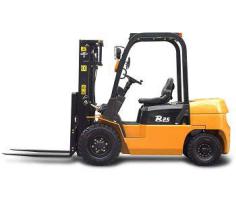
A forklift (also called a lift truck, a high/low, a stacker–truck, or a side
Counterweight – is a Аheavy cast iron mass attached to the rear of the forklift truck frame. The purpose of the counterweightДis to counterbalance the load being lifted. In an electric forklift the large lead–acid battery itself may serve as part of the
loader) is a powered industrial truck used to lift and transport materials. Truck
Frame – is the base of the machine to which the mast, axles, wheels,
counterweight, overhead guard and power source are attached. The frames usually
have fuel and hydraulic fluid tanks constructed as part of the frame assembly.
counterweight. Cab – is the area that contains a seat for the operator along with the control pedals, steering wheel, levers, switches and a dashboard containing operator readouts. The cab area may be open air or enclosed, but it is covered by the cage–like overhead guard assembly. Overhead Guard – is a metal roof supported by posts at each corner of the cab that helps protect the operator from any falling objects. On some forklifts, the overhead guard is part of the frame assembly. Power Source – may consist of an internal combustion engine that can be powered by LP gas, gasoline or diesel fuel. Electric forklifts are powered by
either a battery or fuel cells that provide power to electric motors. The motors may |
|
be either DC or AC types. |
И |
Tilt Cylinders – are hydraulic cylinders that are mounted to the truck frame and the mast. The tilt cylinders pivot the mast to assist in engaging a load. Mast – is the vertical assembly that does the work of raising and lowering the load. It is made up of interlocking rails that also provide lateral stability. The interlocking rails may either have rollers or bushings as guides. The mast is either hydraulically operated by one or more hydraulic cylinders or it may be chain operated with a hydraulic motor providing motive power. It may be mounted to the front axle or the frame of the forklift.
124
Carriage – is the component to which the forks or other attachments mount. It is mounted into and moves up and down the mast rails by means of chains or by being directly attached to the hydraulic cylinder. Like the mast, the carriage may have either rollers or bushings to guide it in the interlocking mast rails. Load Back Rest – is a rack–like extension that is either bolted or welded to the carriage in order to prevent the load from shifting backward when the carriage is lifted to full height. Attachments – may consist of forks or tines that are the L–shaped members
Сthat engage the load. A variety of other types of material handling attachments are available. These include side shifters, rotator, carton clamps, multipurpose clamps, fork positioners, carpet poles, pole handlers, container handlers, roll clamps and many others. Below is a list of common forklift attachments.
иSide shifter – is a hydraulic attachment that allows the operator to move the tines (forks) and backrest laterally. This allows easier placement of a load without having to reposition the truck. Rotator – To aid the handling of skids that may have become excessively tilted and other specialty material handling needs some forklifts areбfitted with an attachment that allows the tines to be rotated. This type of attachment may also be used for dumping containers for quick unloading. Fork Positioner – is a hydraulic attachment that moves the tines (forks) together or apart. This removes the need for the operator to manually adjust the tines for different sized loads. Roll and barrel clamp – a mechanical or hydraulic attachment used to squeeze the item to beАmoved. It is used for handling barrels, kegs, or paper rolls. This type of attachment may also have a rotate function. The rotate function would help an operator to insert a vertically stored paper into the horizontal intake of a printing press for example.
Pole Attachments – In some locations, such as carpet warehouses, a long metal pole is used instead of forks toДlift carpet rolls. Similar devices, though much larger, are used to pick up metal coils. Carton and Multipurpose Clamp Attachments – are hydraulic attachments that allow the operator to open and close around a load, squeezing it to pick it up. Products like cartons, boxes and bales can be moved with this type attachment. With these attachments in use, the forklift truck is sometimes referred to as a clamp truck. И
Slip Sheet Attachment (Push – Pull)
Slip Sheet Attachment – is a hydraulic attachment that reaches forward, clamps onto a slip sheet and draws the slip sheet onto wide and thin metal forks for
125