Материал: Учебное пособие по английскому языку для студентов технических вузов. Кочнева М.Г., Панкина М.Ф
B. Oh, I see! And the ditcher moves continuously.
A. Right you are! It should be said that these machines are widely used in all branches of construction.
B. Is it really so?
A. Yes, they are employed to drain and irrigate land, extract mineral resources, in mining for baring operations.
B .Oh, they are really most widely used in construction.
УРОК 11 LESSON ELEVEN
Фонетика: Чтение буквы «U» в закрытом слоге, буквосочетания «SION»
перед гласной, окончания «ED» в глаголах.
Грамматика: Причастие настоящего времени в функции обстоятельства.
Complex Subject.Сложное подлежащее.
Complex Object. Сложное дополнение (Повторение)
Тема: Многоковшовые экскаваторы. Multi-bucket Excavators.
E X E R C I S E S
I. Read the following words and translate them.
Excavators, types, operations, normally, classified, design, rotary, mechanical, lifted, system, cables, opposite, vertical.
II. Read the following words paying attention to the endings.
[d] [t] [id]
employed dumped differentiated
used forced lifted
raised reached under-loaded
lowered equipped mounted
powered attached operated
revolved stopped overloaded
handled pumped connected
called placed fitted
released pushed supported
III. Learn the information about Participle I.
When moving over freshly dug soil the scraper also partially compacts it.
When moving – Participle I в функции обстоятельства. На русский язык переводится деепричастием или существительным с предлогом «при». Союзы «when» и «while» не переводятся.
При движении по свежеотсыпанному слою грунта скрепер частично уплотняет его. (или: Двигаясь по свежеотсыпанному слою грунта, скрепер частично уплотняет его.
IV. Translate the following sentences paying attention to Participle I.
1.When digging soil with stony inclusions scrapers will operate normally if the size of these inclusions does not exceed 0.25 of the bucket width.
2. While operating on heavy soil the scraper must be used together with a crawler or a four wheel air-tyred tractor used as a pusher.
3. When laying a roadbed bulldozers remove bushes, stumps and small trees.
4. When going up the buckets discharge the material onto a receiving belt conveyor.
5. Compactors (грунтоуплотняющие машины) are employed when building roads.
V. Learn the following words.
1. Shape [Seip],v придавать форму, профилировать
2. Slope [slqup], n откос, уклон
3. Capping [`kxpiN], n пустая порода
4. Baring operations [`bEqriN Opq`reiSnz] работы по вскрытию пласта
5. Dump [dAmp], v сваливать, разгружать
6. Reduction gear [ri`dAkSn`giq] редукционная передача
7. Strip [strip], v снимать, вскрывать
8. Inclusion [in`klHZn], n включение посторонних тел
9. Exceed [ik`sJd], v превышать
10. Differentiate [,difq`renSieit], v дифференцировать, различать
11. Hourly output [`auli`autput] производительность в час
12. Gas and oil line [`gxs qnd `Oil`lain] газо- и нефтепровод
13. Sewerage pipe [`sHqriG`paip] канализационная труба
14. Pulley [puli], n шкив, блок
15. Underloaded [,Andq`lqudId], p.p. недогруженный
16. Spill [spil], v сыпать, просыпать (материал)
17. Wear-resistant [`wEq ri`zistqnt] устойчивый к износу
18. Gradually [`grxGuqli], adv постепенно
19. Inside [in`said], prep внутри, в
20. Rail track [`reil`trxk] рельсовый ход
VI. Find the equivalents to the following word combinations.
1. Dig longitudinal cuts a) передвигаться слишком быстро
2. To shape slopes b) многоковшовый экскаватор
3. Longitudinal multi-bucket excavator продольного копания
4. Cross cutting multi-bucket excavator c) гусеничный, пневмоколесный
или рельсовый ход
5. Travel too fast d) профилировать откосы
6. Crawler, air-tired or rail track e) копать продольные выемки
f) многоковшовый экскаватор
поперечного копания
VII. Read and translate the following text.
MULTI-BUCKET EXCAVATORS
Multi-bucket excavators (Fig.7) are employed to dig longitudinal cuts (trenches, ditches) and to shape their slopes. It should be noted that some types of multi-bucket excavators can be used to excavate mineral resources or strip capping in baring operations. When digging soil with stony inclusions, the excavator will operate normally if the size of these inclusions does not exceed 0.25 of the bucket width.
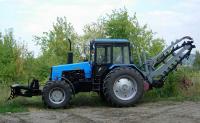
a) Excavator mounted on a wheel tractor
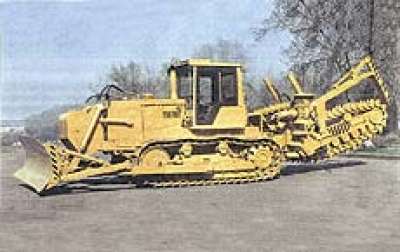
b) Chain excavator with an inclined frame
Fig. 7. Multi-bucket excavators
Multi-bucket excavators can be classified by:
the design of the operating equipment: chain-type and wheel- or rotary-type;
the method of excavation: longitudinal cutting multi-bucket excavators and cross cutting multi-bucket excavators;
the type of drive: with internal combustion engine and mechanical power train, with mains-powered electric motors, with diesel-electric power plant;
the size: trench excavators are differentiated by the cutting depth, chain quarry excavators by the capacity of the buckets, and wheel excavators by the hourly output.
Chain excavators make trenches for cables, sewerage pipes, etc., to a depth of 6 meters and a width of 2 meters.
Wheel excavators are widely used to excavate trenches up to 2.5 meters deep and 2.6 meters wide for gas and oil lines.
Chain excavators may have an inclined or vertical bucket frame. The bucket frame is lifted and lowered by a winch and a system of cables and pulleys. When a chain excavator begins to operate, its inclined frame is lowered onto the ground and its buckets gradually bite into the soil.
It should be pointed out that if the excavator travels too fast or the bucket chain moves too slowly the buckets will be under-loaded or, in the opposite case, spill some of the material.
The vertical frame of the trencher is raised and lowered by a chain and a hoist. A small conveyer is mounted inside the bucket frame. The buckets are dumped forward in the direction of motion onto the conveyer. The bucket chain is driven by the engine through the reduction gear.
Wheel excavators are more wear-resistant than chain-type excavators. They also have a greater capacity, although they can dig trenches no deeper than 2.5 meters. Wheel excavators are generally mounted on air-tired 35 hp tractors or on crawler tractors with engines rated at 55 and 100 hp.
VIII. Connect sentences according to the contents:
1. There are trench excavators a) although they can dig trenches no deeper
than 2.5 metres.
2. The buckets will be underloaded b)which are differentiated by the cutting depth
3. Wheel excavators are more
wear-resistant c) than chain-type excavators.
4. Wheel excavators have greater
capacity d) if the excavator travels too fast.
IX. Complete the sentences using variants (a) or (b).
1. Trench excavators are differentiated by …
… the hourly output;
… the cutting depth.
2. Chain quarry excavators are differentiated by …
… the capacity of the buckets;
… the hourly output.
3. Wheel excavator are differentiated by …
… the cutting depth;
… the hourly output output.
4. Chain excavators make trenches for …
… gas and oil lines;
… cables and sewerage pipes, etc.
5. Wheel excavators are widely used for …
… excavating trenches for gas and oil lines;
… cables and sewerage pipes.
X. Fill the gaps with prepositions.
1. Some types … excavators can strip capping … baring operations.
2. Trench excavators are differentiated … the cutting depth.
3. Wheel excavators dig trenches … 2.5 meters deep.
4. The inclined frame … the excavator is lowered … the ground.
5. The vertical frame … the trencher is raised and lowered … a chain and a hoist.
6. The buckets are dumped forward … the direction … motion … the conveyer.
7. The bucket chain is driven … the engine … the reduction gear.
XI. Insert the verbs in the proper form. Translate the sentences.
1. Multi-bucket excavators … into different types.
2. If the excavator … too fast, the buckets will be under-loaded.
3. If the excavators … too slowly the buckets … some of the material.
4. The vertical frame of the trencher … and … by a chain and a hoist.
5. The bucket chain … by the engine through the reduction gear.
6. Wheel excavator can … trenches no deeper than 2.5 meters.
XII. Use Complex Subject and Complex Object instead of complex sentences.
Example: We know that quarry shovels are used for digging very heavy soils.
Мы знаем, что карьерные экскаваторы используются для копания
очень тяжелых грунтов.
Quarry excavators are known to be used for digging very heavy soils.
Известно, что карьерные экскаваторы используются для копания
очень тяжелых грунтов.
We know quarry excavators to be used for digging very heavy soils.
1. We know that the repair of damaged cars begins in the sheet metal shops.
2. We know that multi-bucket excavators are employed to dig longitudinal cuts and to shape their slopes.
3. We consider that multi-bucket excavators are classified by the method of excavation.
4. It is proved that trench excavators are differentiated by the cutting depth.
5. We know that the bucket chain is driven by the engine through the reduction gear.
XIII. Answer the following questions.
1. What is this text about ?
2. What are multi-bucket excavators used for ?
3. How can multi-bucket excavators be classified ?
4. What are chain excavators used for ?
5. What are wheel excavators used for ?
6. How are trench excavators differentiated ?
7. What excavators are more wear-resistant ?
XIV. Translate into English.
1. По способу разработки грунта многоковшовые экскаваторы подразделяются на экскаваторы продольного и поперечного копания.
2. Мы знаем, что карьерные цепные экскаваторы различают по емкости ковшей.
3. Известно, что колесные экскаваторы различают по эксплуатационной производительности.
4. Известно, что цепные траншейные экскаваторы бывают с наклонной или вертикальной ковшовой рамой.
5. Ковши разгружаются по ходу цепи на транспортер.
XV. Read, translate and retell the following text using the introductory phrases.
Quarry Wheel Excavators
A quarry wheel excavator is used to excavate raw materials. The main mechanisms of quarry wheel excavators are the wheel with buckets, a belt conveyer, swing and travel mechanisms. They are actuated by a-c (alternative current – переменный ток) electric motors powered from the mains. The machine consumes an average (в среднем) 500 kilowatts. The wheel which is six meters in diameter carries eight buckets with a capacity of 350 liters each. The output of the machine is 500 cub.m. per hour. It weighs 400 tons. The digging radius is 24 meters, the digging height – 20 meters and the digging depth – 3 meters. The machine has an automatic swing control and can operate together with a mouldboard (отвалообразователь).
XVI. Learn the following dialogue and make up your own dialogue about wheel excavators. Use the scheme of this dialogue.
A. What do you know about chain excavators ?
B. I know that they are used for making trenches for cables and sewerage pipes.
And do you know anything about them ?
A. As far as I know they have smaller capacity than wheel excavators.
B . Is it really so ?
A. Certainly.
УРОК 12 LESSON TWELVE
Фонетика: Повторение чтения буквосочетания «SION» перед гласной и
согласной.
Грамматика: Повторение сложных инфинитивных конструкций, причастия,
абсолютного причастного оборота и герундия.
Тема: Грунтоуплотняющие машины. Compactors.
E X E R C I S E S
1. Read the following words.
[Zn] – explosion, cohesion, adhesion, inclusion, conclusion.
[Sn] - percussion, extension, succession, tension, suspension.
II. Read and translate the following words with the suffix “less” and preffix “un”.
Помните, что суффикс «less” и префикс «un» придают слову отрицательное значение.
Cohesionless, airless, useless, waterless, pumpless, unusual, uncompacted, undisturbed, unequal, undesirable, unmeasured, unloaded.
III. Form adverbs from the adjectives, translate them.
Example: independent – independently; независимый – независимо.
Equal, consequent, deep, slow, gradual, wide, normal, horizontal, vertical, smooth.