Материал: Учебное пособие по английскому языку для студентов технических вузов. Кочнева М.Г., Панкина М.Ф
VI. Translate the following sentences paying attention to the word “most”.
1. Most engines operate on the four-stroke cycle.
2. Most commonly in construction electric friction-type winches are used.
3. Pyramidal and conical hoppers are the most common.
4. Forced-discharge is the most reliable although it involves a greater consumption of power.
5. Power graders are most widely used in road construction.
VII. Read and translate the following text.
REVOLVING SHOVELS
The principle of operation subdivides all shovels into revolving shovels and ditchers.
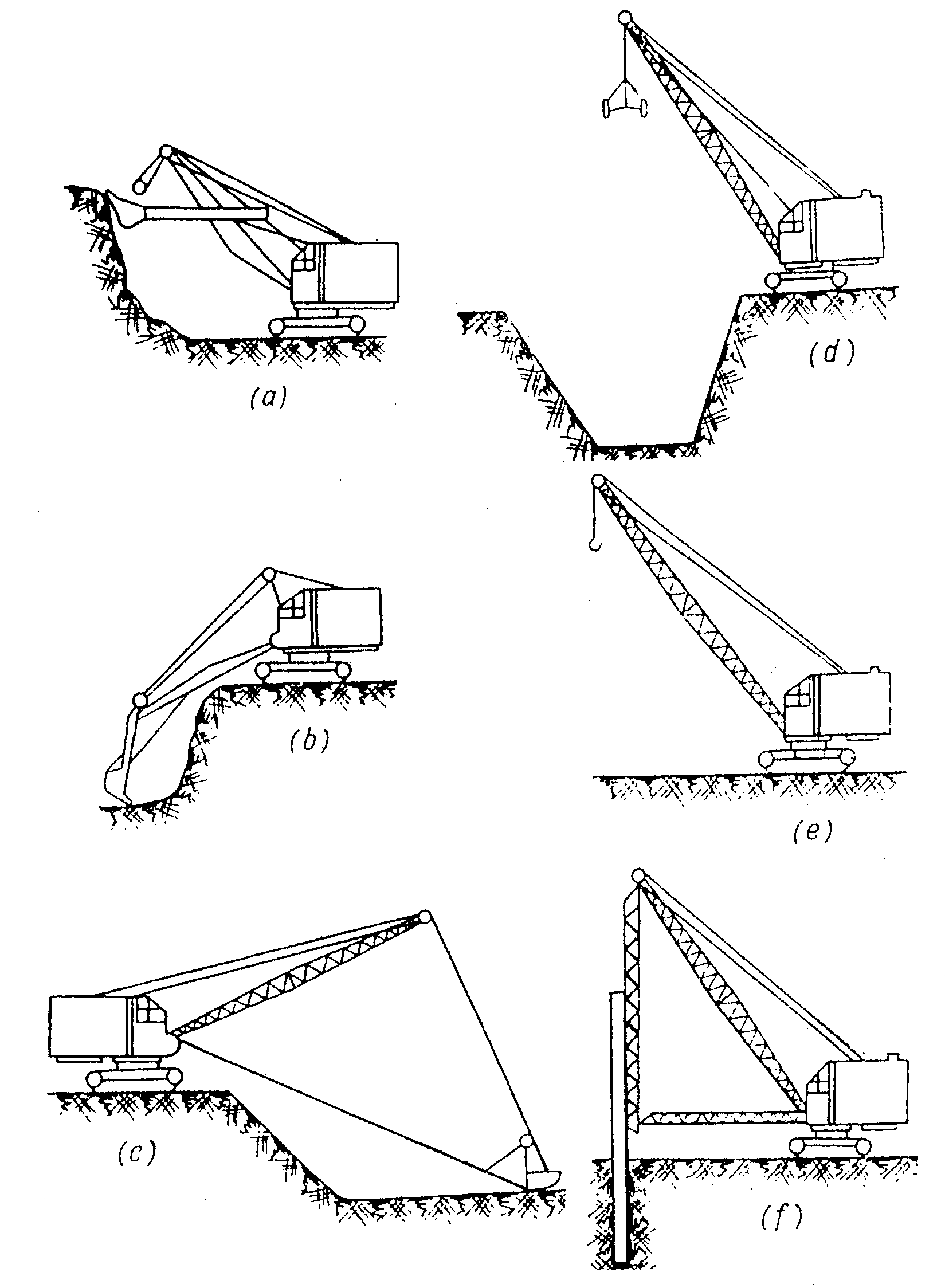
Fig. 6. Front attachments of revolving shovels
A revolving shovel digs soil while standing at one place where as a ditcher moves continuously. Revolving shovels are most widely used in all branches of construction: to drain and irrigate land, extract mineral resources, in mining for baring operations, etc. Revolving shovels can be classified by their purpose, bucket capacity, degree of universality, type of power plant, running gear, and controls. Depending on the bucket capacity and purpose revolving shovels can be divided into the following groups:
Building shovels with bucket capacities of 1.5- 4 cubic meters, used together with various alternative attachments for construction and auxiliary jobs and in small quarries for excavating building materials.
Quarry shovels with bucket capacities of 4-8 cubic meters, intended for extracting raw materials in quarries, for digging very heavy soils.
Stripping shovels with bucket capacities of 4-10 cubic meters, employed for removing the capping and dumping it in piles in open-cast mining,
Walking draglines with bucket capacities from 4 to 50 meters for digging deep cuts in soft soil in hydro-technical construction.
Revolving shovels are also subdivided into universal, semi-universal and special types.
Universal shovels are designed for operating with various alternative attachments: face shovel (Fig.6a), drag shovel (Fig.6b), dragline (Fig.6c), crane (Fig.6e), clamshell (Fig.6d), tower crane, pile driver (Fig.6f) and a frozen soil ripper.
Face shovels, drag shovels and draglines are the principal and most widespread kinds of replaceable attachments.
In addition to the principal attachments, semi-universal shovels have one or two auxiliary rigs. Most commonly such shovels carry a face shovel, a dragline or a crane. Special heavy type shovels are designed with only one type of attachment – a dragline or a face bucket.
The power plant of a shovel may be a diesel engine, an electric drive powered from an external supply or a diesel-electric drive. Most building shovels are powered by a diesel engine which can sometimes be replaced by an electric motor powered from the mains.
VIII. Define the functions of the shovels.
1. Building shovels a) are intended for digging deep cuts in soft soil
in hydro-technical construction.
2. Quarry shovels b) are used in construction and in small quarries
for excavating building materials.
3. Stripping shovels c) are employed for removing the capping and
dumping it in piles in open-cast mining.
4. Walking draglines d) are intended for extracting raw materials in
quarries and for digging very heavy soil.
IX. Complete the following sentences using variants (a) or (b).
1. A revolving shovel digs soil
while standing at one place
while moving continuously
2. Ditchers dig soil
while moving continuously
while standing at one place
3. Quarry shovels have bucket capacities of
0.15 – 4 cubic meters
4 – 8 cubic meters
4. Walking draglines are used for
a) digging deep cuts in soft soil
b) digging very heavy soils
5. Special heavy type shovels are designed with
different changeable attachments
only one type of attachments
X. Use the Gerund instead of the Infinitive.
Example : Jacks are used for raising a load to a small height.
Jacks are used to raise a load to a small height.
1. Hoists are used for assembling machines.
2. Building shovels are employed for excavating building materials.
3. Quarry shovels are intended for digging very heavy soils.
4. Stripping shovels are used for removing the capping.
5. Walking draglines are employed for digging deep cuts in soft soil.
6. Loaders are used for handling piece or loose loads.
XI. Insert the verbs in the proper form. Translate the sentences.
1. Revolving shovels … into different types.
2. Building shovels … for excavating building materials.
3. A revolving shovel … soil while standing at one place.
4. A ditcher … continuously.
5. Revolving shovels … into universal, semi-universal and special types.
6. Most building shovels … by a diesel engine.
7. Most commonly semi-universal shovels … a face shovel, a dragline and a crane.
XII. Fill in the necessary prepositions. Translate the sentences.
1. Revolving shovels are most widely used … all branches … construction.
2. Building shovels are used … various alternative attachments.
3. Stripping shovels are employed … removing the capping and dumping it … piles … open-cast mining.
4. A diesel engine can be replaced … an electric motor powered … the mains.
5. Walking draglines are used … digging deep cuts … soft soil … hydro-technical construction.
6. Quarry shovels are intended … extracting raw materials.
7.Universal shovels are designed … operating … various alternative attachment.
8. Most building shovels are powered … a diesel engine.
9. Revolving shovels may be classified … their purpose, running gear, etc.
XIII. Make up questions according to the models using the words given below.
Models: 1. What do you know about revolving shovels ?
building shovels
quarry shovels
stripping shovels
walking draglines
2. What can you say about ditchers ?
universal shovels
special heavy-type shovels
draglines
the power plant of a shovel
XIV. Ask questions on the underlined words.
1. Revolving shovels can be classified by their purpose.
2. Building shovels have bucket capacities of 0.15 – 4 cubic meters.
3. Universal shovels are designed to operate with various alternative attachments.
4. Stripping shovels remove the capping.
5. Quarry shovels dig very heavy soils.
XV. Express your doubt and put general questions to the statements.
Example: Revolving shovels can be classified by bucket capacities.
Is it really so? Can they be classified by bucket capacity?
1. Revolving shovels can be subdivided into universal, semi-universal and special types.
2. Revolving shovels can be classified by the type of power plant.
3. Stripping shovels have bucket capacities of 4 – 10 cubic meters.
4. Semi-universal shovels have one or two auxiliary rigs.
5. Quarry shovels are intended for digging very heavy soils.
6. Stripping shovels are used for removing the capping.
XVI. Answer the following questions using the introductory phrases.
1. What is this text about ?
2. How can revolving shovels be classified ?
3. What types of shovels are there ?
4. What are building (quarry, stripping) shovels used for ?
5. What are walking draglines used for ?
6. What do you know about universal shovels ?
7. What is the power plant of a shovel ?
8. What are the most widespread kinds of replaceable equipment?
9. What are most building shovels powered by?
10. How are revolving shovels subdivided?
XVII. Translate the following sentences into English.
1. Одноковшовые экскаваторы копают грунт, стоя на одном месте.
2. Карьерные экскаваторы используются для выкапывания минерального сырья из карьеров.
3. Универсальные экскаваторы предназначаются для работы с различными видами сменного рабочего оборудования.
4. Полууниверсальные экскаваторы оборудуют прямой лопатой, драглайном или краном.
5. Наиболее широко используемые виды сменного рабочего оборудования – это прямая и обратная лопаты и драглайн.
6. В зависимости от емкости ковша и назначения вращающиеся одноковшовые экскаваторы подразделяются на различные группы.
7. Вращающиеся одноковшовые экскаваторы очень широко используются во всех отраслях строительства.
XVIII. Read and retell the following texts using the introductory phrases.
A Hydraulic Crawler Shovels
There are hydraulic crawler shovels which have a telescopic boom. These hydraulic crawler shovels are designed for small-scale stripping jobs in pits, for leveling out small slopes, etc. Such shovels are powered by a 16 horse-power diesel engine. They have the 0.15 cubic meters bucket. The machine weighs 4.5 tons. The bucket can turn together with the table, change its position in a vertical plane together with the boom.
Cutter Excavator.
A cutter excavator (землеройно-фрезерная машина) is a highly efficient, self-propelled, track-laying machine of continuous action designed for large-scale excavation on irrigation and hydraulic works, where no heavy rock inclusions occur in soils. The machine employs a diesel-electric drive. The operating principle of the machine is based on soil falling, which is the most economical method of excavation.
The working attachment is represented by a cutter (фреза) mounted in front. The cutting blades and transporting threads (витки) of the screw conveyer are fastened on a horizontal shaft, driven from two electric motors through the medium of side reduction gears (через боковые редукторы). Soil falling due to the action of the blades is fed by the screw conveyors to the belt of the receiving conveyor and is further carried via a hopper on dumping fan conveyor which dumps the soil to a spoil bank. The main mechanisms of the machine are driven by individual electric motors supplied from a diesel-generator set.
Control of the main mechanisms of the cutter excavator is effected from the operator`s cabin.
XIX. Learn the following dialogue.
Situation: You have just looked through a technical journal in English and came across an interesting article about revolving shovels. You are going to discuss it with your friend.
A. Hello! Haven`t seen you for ages! You see, I have just read an information about revolving shovels.
B. Oh, it`s interesting. What have you learned about them ?
A. There are revolving shovels and ditchers.
B. And what is the difference between them, I wonder?
A. Can`t you guess? A revolving shovel digs soil while standing at one place …