Материал: Учебное пособие по английскому языку для студентов технических вузов. Кочнева М.Г., Панкина М.Ф
XVI. Answer the following questions using the introductory phrases.
1. What is a bulldozer?
2. Where are bulldozers employed?
3. What are bulldozers used for in winter time?
4. What are bulldozers used for at storage depot and at construction sites?
5. How are bulldozers classified?
6. What control may bulldozers have?
7. What can you say about cable bulldozers?
8. What do you know about hydraulic bulldozers?
9. What bulldozers are becoming more popular?
10. Why are bulldozers mounted on low-pressure air-tyred tractors becoming more popular?
XVII. Translate the following sentences into English.
1. Следует отметить, что при сооружении земляного полотна бульдозеры могут перемещать грунт из выемок в отвал.
2. Считают, что бульдозеры могут возводить насыпи высотой до 3 метров.
3. Известно, что отвал у бульдозеров с канатным управлением поднимается и опускается канатно-блочной системой.
4. Универсальный отвал может перемещать грунт перед собой и в сторону.
5. По типу базовой машины бульдозеры могут быть смонтированы на гусеничных и колесных тракторах или на специальных колесных тягачах.
6. Мы знаем, что бульдозеры, смонтированные на колесных тягачах с шинами низкого давления, становятся более популярными.
XVIII. Read and retell the following text using introductory phrases.
Tractor Dozers
Construction equipment Division of Clark Equipment Co. has the new “Michigan” Model 280 Series III tractor dozer on rubber tyres. Featuring (характеризуясь) 8 forward and 4 reverse speeds, the dozer weighs 60,800 lb. (pounds - фунтов). It has a solid plate frame and it is 23 ft (feet) in overall length and 11 ft. wide. Featuring easy accessibility (доступность), clutches can be changed in 30 min. and most parts are reached from outside. Tyres are 29.5x29, 16 ply and the top speed is 24.8 mph (miles per hour).
Articulated Pusher-Dozer
Articulated pusher-dozer (толкач с шарнирным управлением) has hydraulic articulated steering with exceptional (исключительный) manoeuvrability and a turning radius less than overall length: results are 80 deg. total and 40 deg. to right and left. The operator is positioned “up-front” on forward section providing max. visibility as working area is directly in front. Push arms are positioned to outside of front wheels. Blade is 163 in. wide by 48 in. high with max. lift of 59 in. and digging depth to 14 in. below ground level.
XIX. Learn the following dialogue.
Situation: You are preparing for the examination on earth-moving machines in English. You don`t know the theme “Bulldozers”. You ask your friend to explain it to you.
A. Can you tell me anything about bulldozers?
B. Yes, I can. A bulldozer is a pendant attachment mounted on crawler or wheel tractors.
A. I see. And how can they be classified?
B. As far as I know they are classified by the mounting of the blade, by the control system and by the type of carrying vehicle.
A. What bulldozers are popular now?
B. I think that bulldozers mounted on low-pressure air-tyred tractors are more popular at present.
A. But why?
B. Because their efficiency on a number of jobs is higher than that of crawler bulldozers.
A. I see, thank you.
B. Oh, you are welcome.
УРОК 8 LESSON EIGHT
Фонетика: Повторение чтения буквосочетания «TH».
Грамматика: Перевод глагола «SHOULD».
Тема: Скреперы. Scrapers.
I. Read the following words.
[T] –earth, earthen, method, three, through, width, length, strength, smooth.
[D] – the, this, that, than, they, there, with, without, either, although.
II. Form adverbs from adjectives.
Example: Smooth – smoothly - ровный – ровно.
Separate, mechanical, general, wide, common, partial, fresh, sufficient, insufficient
III. Pronounce and translate the following word combinations with the negative suffixes “un”, “in”.
Example: undesirable result – нежелательный результат.
Uncomfortable machine, unsuitable material, unusual design, unloaded truck, insufficient pull, undesirable solution, invariable shape, unchangeable equipment, invisible object, irregular form, uncomfortable cabin.
IV. Learn he following words.
1.Scraper [skreipq] n - скрепер
2. Level [levl] v - выравнивать
3.Compact [kqm`pxkt] v - уплотнять
4. Variety [vq`raiqti] n - разнообразие
5. Stick [stik] v –прилипать
6. Loam [lPum] n – суглинок
7. Clog [klOg] v -засорять
8. Mud [mAd] n -грязь, ил
9. Moderately [`mOdqritli] adv – умеренно
10. Semi-trailer [`semitreilq] – полуприцеп
11. Forced-discharge [`fLst dis`CRGd] – принудительная разгрузка
12. Free-discharge [`frJ dis`CRGd] – свободная разгрузка
13. Reliable –[ri`labl] a – надежный
14. Pull [pHl] n – тяга
15. In succession [in sqk`seSn] – последовательно
16. Locomotion [,lPukq`mPuSn] – передвижение
17. Sufficiently [sq`fiSqntli] adv – достаточно
18. Powerful –[`pauqful] a – мощный
19. Consumption [kqn`sAmpSn] n- потребление
20. Insufficient [insq`fiSqnt] a – недостаточный
21. Recently [`rJsqntli] adv – недавно
22. Lack [lxk] n – недостаток, отсутствие
23. Moist [`moist] – влажный
24. Fill [fil] n - насыпь
v – наполнять
25. Empty [`empti] v – опустошать
V. Find the equivalents to the following terms.
1. Low-capacity machines a) ил
2. Forced discharge b) централизованное управление
3. Semi-trailer c) машины малой емкости
4. Centralized control d) болотистый
5. Mud e) принудительная разгрузка
6. Boggy f) полуприцеп
VI. Find the equivalents to the following Russian terms.
1. Земляное полотно a) moist clay
2. Отвал b) boggy soil
3. Чернозем с) blade
4. Влажная глина d) earthen structure
5. Заболоченные земли e) black earth
VII. Make up sentences according to the scheme.
A … should be used …B
Помните, что глагол «should» с инфинитивом переводится как «следует».
A B
1. Jacks a) for assembling machines.
2. Tower cranes b) for raising a load to a small height.
3. Hoists c) for lifting materials to be used at construction.
4. Counterweight d) for digging irrigation ditches.
5. Elevating graders e) for removing snow from motor-roads.
6. Bulldozers f) for compensating for the weight of the boom
and part of the weight of the load.
VIII. Translate the following sentences paying attention to the verb “should”.
1. Scrapers should be used on moderately wet sandy soils and loams.
2. Scrapers should not be employed on soils containing large stones.
3. Mechanical feeding devices (питатели) should be used to deliver loose materials smoothly from hoppers to the receiver.
4. Screw conveyors should be used to handle cement, gravel, slag, concrete, wet clay and other loose or viscous materials.
5. Air-tyred and truck-mounted cranes should be provided with outriggers.
6. A semi-trailer elevating grader should be used together with a 100-horse power tractor.
IX. Read and translate the following text.
SCRAPERS
A scraper removes soil slice by slice, transports and places it in an earthen structure, or pushes it to a dump and then levels it. When moving over freshly dug soil the scraper also partially compacts it.
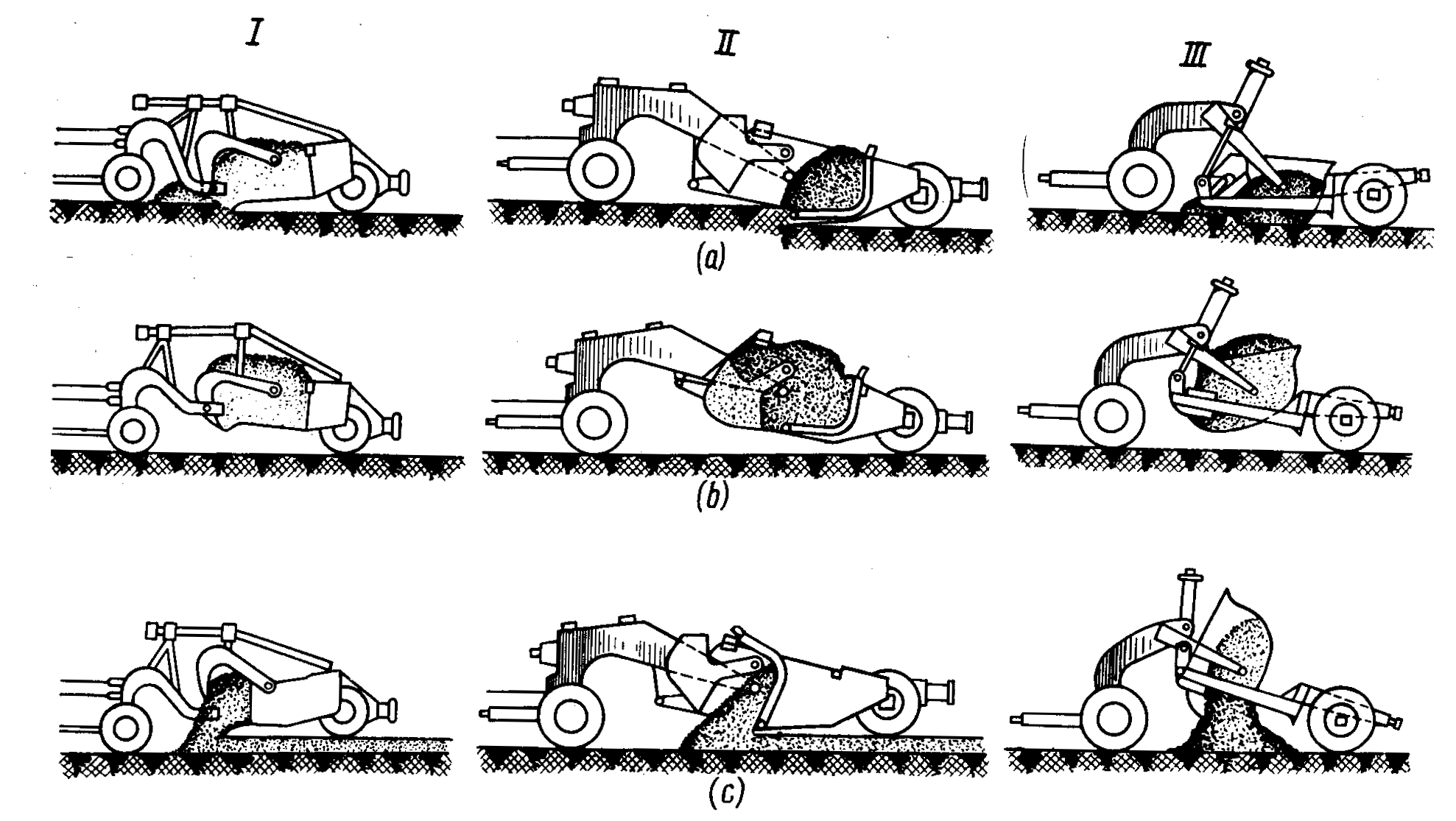
Fig. 5. Design and operation of scrapers:
I – scraper with forced discharge; II – scraper with half-forced discharge;
III – scraper with free discharge; ( a) loading, ( b) transportation, (c) discharge
Scrapers (Fig. 5) are extensively used in road-making, industrial and hydro-technical construction, etc. Scrapers can operate on a wide variety of soils, including black earth, sand and clay. On moist clay and black earth scrapers are not very efficient as the soil sticks to the walls of the bowl and clogs it. They are quite useless on boggy soils as the wheels sink into the mud. Scrapers should be used on moderately wet sandy soils and loams. They should not be used on soils containing large stones.
Scrapers can be classified as follows:
a) by the geometrical capacity of the bowl: 1.5, 3.0, 6.0, 10.0, 15.0, 25 cubic meters;
b) by the mode of locomotion: trailer, semi-trailer and self-propelled;
c) by the method of discharge: with free, half-forced and forced discharge.
Free discharge does not empty the bowl completely of sticky and moist soils. It is employed only in low-capacity machines.
Forced discharge proved to be the most reliable, although it involves a greater consumption of power.
d) by the system of control: scrapers with hydraulic or cable control.
Scrapers with bowls of 6 to 10 cubic meters in capacity were until recently designed in our country mainly with cable control due to the lack of sufficiently powerful hydraulic drives.
Scrapers are used together with tractors. When a scraper has to operate on heavy soil, the pull of one tractor or a two-wheel air-tyred tractor may be insufficient to cut a slice and fill the bowl. In such cases a crawler or a four-wheel air-tyred tractor is used as a pusher. The pulling force of a tractor can be used much better by making two or three scrapers into a train with a centralized control. The scraper controlled from the driver`s cab handles the soil in succession.
X. Make up sentences according to the scheme using the columns a and b.
Translate the sentences into Russian.
A …is/are proved …B
A B
1. Forced discharge a) to employed in low-capacity machines
2. Scrapers b) to used for continuous service
3. Multi-bucket loaders c) to the most reliable
4. Free discharge d) to highly manoeuvrable
5. Bulldozers mounted on low- e) to not very efficient on moist clay
pressure air-tyred tractors
XI. Complete the sentences using variant (a) or (b).
1. Scrapers are used for
removing bushes, stumps and small trees
removing soil slice by slice and for transporting it.
2. Scrapers should be used on
moderately wet sandy soils and loams
soils containing large stones.
3. Free discharge is employed only in
high-capacity machines
low-capacity machines
4. Scrapers are used together with
grab buckets
tractors
5. Scrapers are being designed mainly with
cable control
hydraulic control
XII. Insert the verbs in the proper form. Translate the sentences.
1. Scrapers partially … the soil.
2. Scrapers … by the mode of locomotion.
3. Scrapers … until recently with cable control.
4. A crawler or a four-wheel air-tyred tractor … as a pusher.
5. The scraper controlled from the driver`s cab … soil in succession.
6. Scrapers … together with tractors.
XIII. Fill in the prepositions. Translate the sentences.
1. Scrapers can operate … a wide variety … soil.
2. Scrapers are quite useless … boggy soil as the wheel sinks … the mud.
3. A scraper removes soil slice… slice.
4. Scrapers should not be used … soils containing large stones.
5. Scrapers are classified … the method … discharge.
6. Free discharge is used only … low-capacity machines.
XIV. Make up questions according to the models using the words given below.
Models: 1. Under what condition can scrapers operate ?
bulldozers
tower cranes
self-powered jib cranes
2. How can scrapers be classified ?
bulldozers
loaders
graders
single-bucket loaders
jacks
XV. Ask questions on the underlined words.
1. Scrapers are quite useless on boggy soils.
2. Scrapers should be used on sandy soils and loams.